Foreign Affairs Select Committee report on ‘political Islam’

The report recommends that the FCO should publish a clear set of standards for the political philosophies that the UK is committed to engaging with, and suggests three criteria:

i) Participation in, and preservation of, democracy. Support for democratic culture, including a commitment to give up power after an election defeat.

ii) An interpretation of faith that protects the rights, freedoms, and social policies that are broadly congruent with UK values.

iii) Non-violence, as a fundamental and unambiguous commitment.

The inquiry that has led to this report was announced in March 2016, and described as being “into ‘political Islam’, its characteristics, and how well the Foreign and Commonwealth Office (FCO) has understood and engaged with ‘political-Islamist’ groups.”

The All-Party Parliamentary Group for International Freedom of Religion or Belief submitted written evidence to the inquiry in April 2016.

It indicated that “Promoting and emphasising ‘human rights’ and ‘democracy’ as ‘British’ and thus ‘Western’ values, as opposed to universal values, when engaging in bilateral relationships with States or movements espousing ‘political Islam’ will not necessarily help such relationships… such values as human rights, equality before the law, democracy, freedom of expression and freedom of religion are principles that, regardless of culture or geography, should be universal.”

“Perceiving all those who espouse what might be defined as a ‘political Islamic’ view as having views inherently stemming from a ‘draconian tradition exhibiting little compassion for humans’ which presents a threat to ‘modern’, ‘liberal’ values, will not aid engagement either.”

“As there is no monolithic ‘political Islamic’ entity, there is also no single set of principles that should guide the FCO in its policy response to the future development of ‘political Islam’. A wide set of policies and tools should be utilised, including private and/or public diplomacy. This can politically incentivise individuals representing States and movements to abstain from violating international systems and universal norms such as international human rights law (including Freedom of Religion or Belief) and the rule of law.”

Read full APPG submission

The select committee report recommendations include “The FCO should encourage political-Islamist groups to accept an interpretation of faith that protects the rights, freedoms, and social policies that are congruent with UK values, with the EnNahda party in Tunisia being a prime example of one that has moved in this direction. The FCO is also right to look for indications that political Islamists may act to undermine these values. But it should also hold all governments—in the Middle East and North Africa, and around the world—to the same standards, regardless of their ideology.”

“We assess that exposure to free and fair elections, the need to appeal to a broad range of the electorate in order to win elections, and the need to work with other political perspectives in order to govern effectively, will serve to encourage political-Islamist groups to adopt a more pragmatic ideology, and an increasingly flexible interpretation of their Islamic references. Moves by them towards embracing certain universal human rights may be slower, and more tentative. The FCO should do all it can to hasten this process, in keeping with its global commitment to defending human rights.”

Read select committee report in full

Concern about increasing religious hate crime in the UK

As a Christian convert and his family are compelled to move, the APPG for International Freedom of Religion or Belief has expressed its deep concern over the increase in incidents of crime in the UK on grounds of individuals’ perceived or actual beliefs.

On 9 November 2016, after years of targeting and even physical attack since appearing on a 2008 Dispatches documentary to talk about his conversion from Islam to Christianity, Nissar Hussein and his family moved, escorted by armed police, from their Bradford home after fears of further imminent attacks. The Husseins stated that the West Yorkshire Police had confirmed a credible threat to their being targeted and attacked again on the basis of Mr Hussein’s beliefs.

This incident, the APPG believes, typifies a trend of individuals targeted and, on rare occasions, killed for their beliefs in the UK and highlights a wider problem of integration of different individuals with different beliefs in UK communities. In March 2016, Asad Shah, an Ahmadi Muslim shopkeeper in Glasgow, was murdered by Tanveer Ahmed, who was allegedly motivated by hatred of Shah’s religious views. In London, attacks against Muslims have more than tripled since the Paris atrocities of November 2015.

According to Home Office statistics, during the 2015/2016 reporting period there have been 4,400 religious hate crimes, an increase of 34% from the previous year. The number of racially or religiously aggravated offences recorded by the police in July 2016 was 41% higher than in July 2015.

The APPG has urgently called upon Sarah Newton MP, Parliamentary Under-Secretary of State for issues including hate crime, and her team to address the root causes of such attacks in the UK and also address societal tension; in particular, to meet with colleagues in the Department of Education to review how and if freedom of religion or belief and the freedom to convert are taught to young people in the UK.

The APPG has also urged the Home Secretary and her team to redouble its efforts to ensure that international human rights standards of freedom of religion or belief codified in Article 18 of the Universal Declaration of Human Rights are fully implemented and respected within the UK. It argues that this is of utmost importance, now more than ever, to prevent further escalation of religious and racially motivated targeting.

New UN Special Rapporteur on FoRB begins work

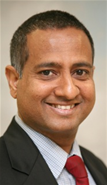
ahmed-shaheedOn 1 November Dr Ahmed Shaheed tweeted “Today I assume the duties of UN SR on freedom of religion or belief. I look forward to working with all to advance this foundational right.”

Up to that date Dr Shaheed had been Special Rapporteur on the situation of human rights in the Islamic Republic of Iran. He is also Lecturer in Human Rights in the School of Law and Human Rights Centre, University of Essex.

Dr Shaheed is an internationally recognised expert on foreign policy, international diplomacy, democratisation and human rights reform especially in Muslim States. He has twice held the Office of Minister of Foreign Affairs of the Republic of the Maldives, a position he used to promote human rights standards and norms. During his time in government, he played a leading role in the Maldives democratic transition and in its human rights reform process over a period of transition from a thirty-year-old autocracy with widespread human rights abuses, to a Muslim democracy which, in 2010, became a Member of the United Nations Human Rights Council with a record number of votes. In April 2009, the Center for the Study of Islam and Democracy in Washington presented him with the “Muslim Democrat of the Year Award,” and in 2010, the President of Albania awarded him the “Medal of Gratitude” for his contribution to peace and human rights in the Balkans.

The UN Human Rights Council appointed Dr Shaheed to the office of Special Rapporteur on the situation of human rights in the Islamic Republic of Iran in June 2011. He produced eight reports, submitted to the UN General Assembly (September 2011, 2012, 2013 and 2014) and to the UN Human Rights Council (March 2012, 2013, 2014 and 2015).

Dr Shaheed is also a member of the Advisory Committee on Interfaith Dialogue established by the United Nations Office on Genocide Prevention and Responsibility to Protect. He is the founding Chair of the Geneva-based human rights think-tank, Universal Rights Group.

A UN Special Rapporteur is a title given to individuals working on behalf of the UN within the scope of its “Special Procedures” mechanisms.

The Special Rapporteur has been mandated through Human Rights Council resolution 6/37

– to promote the adoption of measures at the national, regional and international levels to ensure the promotion and protection of the right to freedom of religion or belief;

– to identify existing and emerging obstacles to the enjoyment of the right to freedom of religion or belief and present recommendations on ways and means to overcome such obstacles;

– to continue her/his efforts to examine incidents and governmental actions that are incompatible with the provisions of the Declaration on the Elimination of All Forms of Intolerance and of Discrimination Based on Religion or Belief and to recommend remedial measures as appropriate;

– to continue to apply a gender perspective, inter alia, through the identification of gender-specific abuses, in the reporting process, including in information collection and in recommendations.

Working methods
In the discharge of the mandate, the Special Rapporteur:

a) transmits urgent appeals and letters of allegation to States with regard to cases that represent infringements of or impediments to the exercise of the right to freedom of religion and belief.

b) undertakes fact-finding country visits.

c) submits annual reports to the Human Rights Council, and General Assembly, on the activities, trends and methods of work.

Dr Shaheed replaced Professor Heiner Bielefeldt, who was Special Rapporteur for six years (the maximum time one individual can carry out the mandate).

Speaking about the challenges he faces, Dr Shaheed said: “I am keen to address emerging and existing concerns that fall within the scope of the mandate, and to focus on the implementation of international norms and standards, engaging with a wide variety of stakeholders in an open and inclusive manner.”

He praised previous mandate holders for “setting out the normative content of the right to freedom of religion or belief, and in identifying and exploring a number of key concerns and challenges.”

India: Muslims and Christians facing challenges to religious freedom

Fifty religious leaders from the Christian and Muslim minorities in India met together in September to discuss the religious freedom challenges facing both groups under Prime Minister Narendra Modi’s government.

Christians are “facing physical, symbolic and structural violence” from Hindu extremists across the country, said Father Z. Devasagaya Raj at the conference in New Delhi.

A recent article in The Economist on Muslims in India was headed An Uncertain Community: India’s biggest minority grows anxious about its future. It stated that “since India’s independence in 1947, the estrangement of Muslims has slowly grown.”

“India’s Muslims have not, it is true, been officially persecuted, hounded into exile or systematically targeted by terrorists, as have minorities in other parts of the subcontinent, such as the Ahmadi sect in Pakistan. But although violence against them has been only sporadic, they have struggled in other ways. In 2006 a hefty report detailed Muslims’ growing disadvantages. It found that very few army officers were Muslim; their share in the higher ranks of the police was “minuscule”. Muslims were in general poorer, more prone to sex discrimination and less literate than the general population (see chart). At postgraduate level in elite universities, Muslims were a scant 2% of students.

“A decade later, with most of the committee’s recommendations quietly shelved, those numbers are unlikely to have improved. Indeed, since the landslide election win by the Hindu-nationalist Bharatiya Janata Party (BJP) in 2014, some gaps have widened. There are fewer Muslim ministers now in the national government—just two out of 75—than at any time since independence, even though the Muslim share of the population has grown.

“India remains a secular country, yet some laws proposed by the BJP bear a disturbingly sectarian tint. One bill would allow immigrants from nearby countries who happen to be Hindu, Sikh, Christian or Buddhist to apply for citizenship, while specifically barring Muslims. Another would retroactively block any legal challenge to past seizures of property from people deemed Pakistani “enemies”, even if their descendants have nothing to do with Pakistan and are Indian citizens. Courts have repeatedly ruled in favour of such claimants—all of them Muslim—but their families could now be stripped of any rights in perpetuity.

“Far more than such legislative slights, what frightens ordinary Muslims is the government’s silence in the face of starker assaults. A year ago many were shocked when a mob in a village near Delhi, the capital, beat to death a Muslim father of three on mere suspicion that he had eaten beef. Earlier this month, after one of his alleged killers died of disease while in police custody, a BJP minister attended the suspect’s funeral, at which the casket was draped, like a hero’s, with the Indian flag.

“Earlier this month, too, newspapers reported a disturbing discrepancy between the fates of two men arrested for allegedly spreading religiously insulting material via social media. One of the men, a member of a right-wing Hindu group in the BJP-run state of Madhya Pradesh, was quickly released from custody after the customary beating. The arresting officers have been charged with assault; their superiors up to the district level transferred. In the other case, in the state of Jharkhand, a Muslim villager was arrested for posting pictures implying he had slaughtered a cow. Police claimed he died of encephalitis following his arrest. A court-ordered autopsy revealed he had been beaten to death. To date, no police officers have been charged.”


“The fact is that India’s Muslims are divided, not only between dominant Sunnis and a large Shia minority but also between starkly different social classes and regions: a Muslim in Bengal is likely to share no language and few traditions with a co-religionist far to the south in steamy Kerala. The divisions may soon get deeper. Both India’s supreme court and the national law commission, a state body charged with legal reform, are deliberating whether laws governing such things as divorce and inheritance should remain different for different religious groups, or should be harmonised in a uniform national code, as the constitution urges. Spotting another “Muslim issue”, past governments have let conservative clerics control family law. As a result India, unlike most Muslim-majority countries, still allows men to divorce simply by pronouncing the word three times.

“The BJP, however, is calling for sweeping reform, with Narendra Modi, the prime minister, painting the issue as a straightforward question of women’s rights. Much as many Muslims heartily agree that change is long overdue, suspicions linger that the BJP’s aim is less to generate reform than to spark inevitable protests by Muslim conservatives, so uniting Hindus in opposition to Muslim “backwardness”.

“This question may play out in elections this winter in Uttar Pradesh, India’s most populous state, nearly 40m of whose 200m people are Muslim. The state has witnessed repeated communal clashes since the destruction by Hindu activists, in 1992, of a medieval mosque said to have been built over an ancient temple marking the birthplace of Rama, a Hindu deity. Many expect the BJP to play the “Muslim card” in an effort to rally Hindu votes.”

‘A worrying trend’

A recent report from the Evangelical Fellowship of India’s Religious Liberty Commission recorded 134 attacks on Christians or their churches in the first half of 2016 – already almost as many as the annual totals for both 2014 and 2015.

Pointing out that the cases chronicled from 1 January to 30 June were just a “fraction of the violence on the ground” (only “carefully corroborated” incidents were included), the EFI report made several recommendations to Mr. Modi’s government, including the repeal of the controversial “anti-conversion laws”.

These laws – named “Freedom of Religion Acts” – are officially there to prevent religious conversions being made by “force”, “fraud” or “allurement”. But Christians and rights groups say that in reality the laws obstruct conversions generally, as Hindu nationalists invoke them to harass Christians with spurious arrests and incarcerations. Such laws are currently in force in five states – Madhya Pradesh, Chhattisgarh, Odisha, Gujarat and Himachal Pradesh – although they have been discussed in several others, such as in Maharashtra last year.

Nearly one fifth of the reported incidents of anti-Christian violence (25) occurred in the northern state of Uttar Pradesh (India’s most populous, with over 200 million people). The second and third highest frequency of attacks took place in states with anti-conversion laws: Madhya Pradesh (17 incidents) and Chhattisgarh (15).

Tamil Nadu was the other high scorer (14). In 2002, this state passed its own “Prohibition of Forcible Conversion of Religion Bill”, but it was repealed in 2004 after the defeat of the BJP-led coalition. The BJP (Bharatiya Janata Party, Prime Minister Modi’s party) is known for espousing a Hindu nationalist agenda and currently rules several states in central and western India, as well as controlling the federal government. The EFI report notes that Tamil Nadu is now governed by a Modi “ally”.

Last year, two BJP members – one in the Lower and one in the Upper House of the national Parliament – planned to introduce a Private Members’ Bill, each in their respective House, to introduce a national law against conversion from Hinduism, which would then force a debate in the Parliament.

The MP in the Upper House, Tarun Vijay, said the recently released census had indicated that, “For the first time, the population of Hindus has been reported to be less than 80 per cent. We have to take measures to arrest the decline. It is very important to keep the Hindus in majority in the country.

“My argument is that religion must remain a matter of personal choice. But in India, it has become a political tool in the hands of foreign powers, who are targeting Hindus to fragment our nation again on communal lines. This has to be resisted in national interest and in the interest of all minorities in India,” he added.

The MP in the Lower House, Yogi Adityanath, a senior BJP legislator, Hindu head priest and founder of Hindu Yuva Vahini, a social, cultural and nationalist group of youths who seek to provide a right-wing Hindu platform.

In June 2015, Adityanath declared that those opposing yoga and Surya Namaskar, a Hindu salutation to the sun god within yoga, “should leave India or drown themselves in the ocean”.

Christians account for around 5% of India’s population, according to the World Christian Database, though the official 2011 census figure was just 2.3% (with Muslims at 14.2% and Hindus 79.8%).

Last month, Tomson Thomas of Persecution Relief told World Watch Monitor attacks on Christians were at an “alarming level”, with more than 30 incidents a month being reported.

Meanwhile, the Mumbai-based Catholic Secular Forum said that in 2015 attacks on Christians had been reported on an almost daily basis.

Recent figures from Christian charity Open Doors, which works on such issues, suggest an even greater number of incidents (closer to 250) occurred in the first six months of this year. But whatever the precise figure, Rolf Zeegers from Open Doors’ World Watch Research says “a worrying trend is emerging”.

“It is very alarming,” he said. “Violence against Christians in India seems to be increasing and becoming more frequent. And yet President Modi’s administration does nothing. Isn’t it about time that Western countries offer the Christian community help by using diplomatic channels to directly put pressure on the Indian government to stop these violent radicals?”

The furore surrounding Mother Theresa’s canonisation on 4 Sep. was another reminder of the difficulties faced by India’s Christian minority. A roadside crucifix in Mumbai was reportedly desecrated on the same day, while Hindu nationalists continued to accuse the Catholic nun of having forcibly converted others. MP Yogi Adityanath said in June she had been on a mission to “Christianise India”. Meanwhile, an online petition was circulated in which she was labelled a “soul harvester” who proselytised the poor.

But perhaps there is a glimmer of hope in the conciliatory language used during the recent Supreme Court ruling, in which it was concluded that Christians had received “inadequate” compensation for the worst case of anti-Christian violence in India’s history – the 2008 Kandhamal rampage, during which around 100 Christians were killed, 300 churches and 6,000 Christian homes damaged and 56,000 people displaced after the killing of a Hindu leader.

The EFI report begins with a statement made by Chief Justice T.S. Thakur during that judgment: “The minorities are as much children of the soil as the majority and the approach has been to ensure that nothing should be done, as might deprive the minorities of a sense of belonging, of a feeling of security, of a consciousness of equality and of the awareness that the conservation of their religion, culture, language and script as also the protection of their educational institutions is a fundamental right enshrined in the Constitution…

“It can, indeed, be said to be an index of the level of civilization and catholicity of a nation as to how far their minorities feel secure and are not subject to any discrimination or suppression.”

Yet conciliation will mean little if what the report refers to as the “ominous and all-permeating impunity and occasional complicity of the administrative and police personnel” is not addressed.

The All India People’s Forum is quoted in the report as saying: “It is evident from the testimonies that the role of the police and administration is extremely lax. On some occasions the police have openly sided with the Bajrang Dal [a militant Hindu group], refusing to protect the Christians.

“On one occasion the police and administration even failed to turn up, having convened a gathering of Hindus and Christians, and possibly informed the Bajrang Dal that they would not turn up, thus setting the scene for organized mob violence against the Christians. On the occasions where the district administration and police have intervened, it has not been to enforce the rule of law and uphold the Constitution and arrest the Bajrang Dal mischief-makers; rather the ineffectual mode of ‘dispute resolution’ has been adopted.”

Sources: World Watch Monitor, The Economist

BBC Radio 4 Sunday Service to highlight FoRB

Under the heading A DECLARATION OF FREEDOM, Sunday Worship on BBC Radio 4, 8.10am Sunday 30 October, will come live from The Well, Retford, Notts, marking the work of Thomas Helwys, one of the earliest campaigners for freedom of religious conscience.

The programme will also explore the work of those who advocate for freedom of religion or belief across the world today and highlight the role of the All-Party Parliamentary Group for International Freedom of Religion or Belief.

Baroness Berridge will be one of the leaders of the service, and the preacher is The Revd Anthony Peck, General Secretary of the European Baptist Federation.

Benedict Rogers will highlight the case of Alexander Aan, an Indonesian atheist jailed for his beliefs. Baroness Brinton will draw attention to the persecution of Shia Muslims in Pakistan.

Andy Flannagan will sing ‘Seven Storeys’, written after a visit to Egypt where he was told of a young woman thrown to her death after she changed her religion.

Stephen Timms MP will be one of the lesson readers.

Further information

APPG marks International FoRB Day

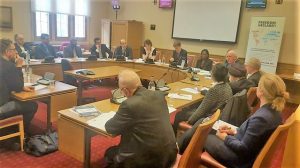
20161027_132416To celebrate International Freedom of Religion or Belief Day the All Party Parliamentary Group for International Freedom of Religion or Belief & the Commonwealth Initiative for Freedom of Religion or Belief held a roundtable event to assess the present state of Freedom of Religion or Belief (FoRB) around the world and the current work at the UN, EU, Commonwealth Initiative for FoRB, UK APPG, International Parliamentarian, civil society and academic level. The aim was to explore common concrete actions that could be taken together in the name of FoRB.
The APPG and CIFoRB team were joined by Baroness Berridge to hear how to support IPPFoRB post-Berlin; and Dr Fabio Petito (Senior Lecturer in International Relations at the University of Sussex).
The event was chaired by Stephen Timms MP and was also joined by Chian Yiew Lim (Human Rights Officer for the UN Special Rapporteur for FoRB), Dr Josephine Ojiambo (Deputy-Secretary General (political), Commonwealth Secretariat) and Jim Shannon MP (Chair, APPG).

There was a video interview with Jan Figel, the EU’s first Special Envoy for the promotion of freedom of religion or belief outside the European Union  View now  

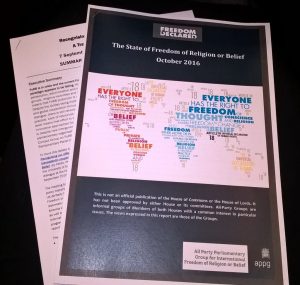
forb-day-report-2016The APPG published a report to mark the Day and the event, entitled The State of Freedom of Religion or Belief. In celebration of International Freedom of Religion or Belief (FoRB) Day – 27 October – the APPG team wanted to bring together assessments of where advancing the right to FoRB stands at different international and national levels. The team hopes that this document – which the APPG will seek to produce annually – will help all advocates and practitioners of FoRB read the perspectives and ideas of those working on FoRB at different levels. While a section on advancing FoRB at the civil society level has not been included, the team has done so intentionally as the experience amongst actors in this sphere will be as diverse as the number of organisations and individuals advancing FoRB. Through the event on International FoRB day in UK Parliament and after the APPG hopes that civil society organisations will critically engage with this document and the work programmes of those outlined in this report.
 

Foreign Office issues updated FoRB Toolkit

fco-2016-toolkit-cover

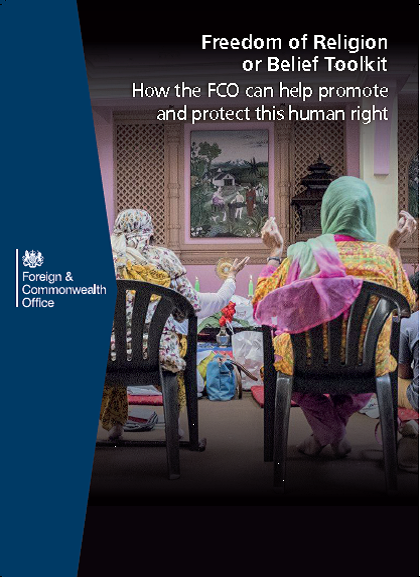
Last week the Foreign Office issued an updated version of its Toolkit, first produced in 2009.

It begins: Freedom of religion or belief is a key human right. The right to adopt a religion, to practice it without hindrance, to share your faith and to change your religion are all key freedoms that everyone should be able to enjoy. Promoting and protecting the right to freedom of religion or belief is an integral part of our human rights work, making a particular contribution to strengthening the rules-based international order, projecting our democratic values and supporting universal human rights, good governance and contributing to conflict prevention. Moreover, its enjoyment plays an important part in achieving the UK’s vision of a more secure and prosperous United Kingdom. It plays a significant role in building societies which are resilient against extremism. It is a sensitive issue in many countries.

These guidelines, elaborated in 2009 and updated in 2016 with the help of specialist stakeholders, aim to provide a simple introduction to the issues for FCO posts and desks, an analytical matrix to identify problems, some general responses to frequently raised issues, and other resources for those who wish to go deeper into the subject.

Under the heading Why is freedom of religion or belief important to the UK? the toolkit states:

The UK Government is firmly committed to promoting and protecting the right to freedom of religion or belief around the world, and to being a strong voice internationally in defence of this fundamental right. Freedom of Religion or Belief (FoRB) is a bellwether human right. It is a fundamental freedom which underpins many other human rights and where FoRB is under attack, often other basic rights are threatened too. In societies where freedom of religion or belief is respected, it is much harder for extremist views to take root. The government has made action to promote and protect FoRB one of the key pledges for our campaign for election to the Human Rights Council in both 2014 and 2016…

It is in the interests of the UK to help people to enjoy freedom of religion or belief and to end discrimination on the grounds of religion or belief. It is also a value that is a key part of the UK’s own heritage and its success as a multi-racial and multi-faith democracy, and a human right that the UK is committed to uphold.

Read the full toolkit

Foreign Office summit on FoRB and Countering Extreme Violence

Last week the Foreign Office hosted a 2-day summit to bring together experts to explore how freedom of religion or belief can help prevent violent extremism.

In her opening speech Baroness Anelay said “Freedom of Religion or Belief is fundamental to a successful society.”

The conference explored how building inclusive societies, in which people have freedom to practice their own religion and belief, can help prevent extremism.

It brought together more than 50 expert speakers and over 170 participants from 38 countries who shared ideas to extend and defend the right to freedom of religion or belief, discussed ways to build resilience against extremism and identified opportunities to work together.

The FCO stated that “Extremism is the biggest security challenge of our age and is a significant barrier to global prosperity, development, peace and stability.”

The conference was designed to explore the degree to which freedom of religion or belief can serve as part of the answer to this challenge because freedom and respect for human rights help to create the conditions under which societies can grow more stable and prosperous.

FCO Minister for Human Rights, Baroness Anelay said:

Freedom of religion or belief is one of our most powerful tools in the fight against extremism.

We need to value others, no matter what religion they follow. And if we teach our children to do the same we are equipping them to reject the hatred peddled by extremists.

All parts of society must join us in this effort and I’m delighted that so many are attending the conference, showing the level of commitment and ambition for this cause.

If we lay the foundations for open, equal and plural societies, then we are building communities that are more likely to reject extremism… 

I believe that if we tolerate a culture where people think that their fellow citizens are inferior because of their religion or belief, then we create fertile ground in which extremist ideologies can take root.

That is why freedom of religion is so important, and directly relevant to the fight against extremism. If we value others, regardless of what – if any – religion they follow, and if we teach our children to do the same, we also give them the tools to reject intolerance. If we lay the foundations for open, equal and plural societies, then we also build communities resilient to extremism; communities where everyone has the intellectual independence to resist hateful ideologies, religious or otherwise.

We need a global response to this global problem. We need to work together – as individual countries, and through institutions like the UN and the Commonwealth. We need all sectors of society to be involved – governments, civil society, faith leaders, academics and so on…

Speech in full


Lord Alton spoke to the heading Why Freedom of Religion and Belief Is Relevant and Urgent

In 1947, Muhammad Ali Jinnah, Pakistan’s great founding statesman, crafted a constitution which promised to uphold plurality and diversity:

Jinnah said: “You may belong to any religion, caste or creed—that has nothing to do with the business of the State…Minorities, to whichever community they may belong, will be safeguarded…. They will be, in all respects, the citizens of Pakistan without any distinction of caste and creed”

Jinnah’s values were also the values of the United Nations Charter, promulgated in 1945, and which committed all States to “promote universal respect” for “fundamental freedoms” “without distinction to race, sex, language or religion”…

It is a moral outrage that whole swathes of humanity are being murdered, terrorised, victimised, intimidated, deprived of their belongings and driven from their homes, simply because of the way they worship God or practise their faith. Infringement of freedom of religion and belief morphs into persecution and, as we have seen, can morph into crimes against humanity and genocide.

Article 18 is a foundational human right—many would say the foundational right. While there should be no hierarchy of rights, and all rights are interdependent, without the freedom to choose, practise, share without coercion and change your beliefs, what freedom is there?

At every opportunity, we must promulgate freedom of religion or belief. When we in the UK say we don’t need a special envoy to promote this because “every ambassador will do so” we need some way of benchmarking the effectiveness of their efforts.

And when the Government say this is “one of the Government’s key human rights priorities”, we need to provide resources which are commensurate with the scale of the challenge – certainly more than one full time FCO desk officer. Compare the £34 billion spent on military operations since the Cold War with the paltry resources deployed in promoting Article 18.

We also need a consistent, coherent international strategy. It is inconsistent to denounce some countries while appeasing others, complicit in jihadism, through financial support or the sale of arms.

Speech in full


“The co-operation of religious leaders is vital to the building of inclusive, plural — and peaceful — societies,” said the Archbishop of Canterbury’s Adviser for Reconciliation, Dr Sarah Snyder. “While religion is rarely the foundational cause of violence, our sacred texts and traditions can be, and are, hijacked to promote extremist agendas. Religion — all religions — must be recognised overwhelmingly as a source of peace, not violence. And religious leaders play a critical role in drawing their communities back to these foundational principles.”

Speech in full


The Foreign Office also announced the updated Freedom of Religion or Belief Toolkit

Hope for the Middle East report launched

Last week many MPs and peers attended the launch of the Hope for the Middle East report, highlighting the desire of Christians in Syria and Iraq to be able to stay in their countries with equality, dignity and responsibility.

The launch was hosted by Kate Green MP, former Shadow Minister for Women and Equalities, and those in attendance also heard from Rami*, a Syrian Christian and Open Doors field worker, and Baroness Anelay, Minister of State at the Foreign and Commonwealth Office. More

Ruth Gledhill reported in Christian Today that Rami, a Christian from Syria who escaped to Britain from Aleppo said many Christians would rather stay in the Middle East because they want to be part of the future of their countries. “Many of my friends in Syria are still in Damascus as well as Aleppo,” he said. Some even had the necessary paperwork to leave but were choosing to stay.

And they are living in a climate of fear and hopelessness.

“Beyond the physical and sexual violence we hear about, lies fear,” he said. This was partly fear of the unknown. “Christians don’t know what’s going to happen in the future.” There is a “thirst for a better form of government”, he added, and Christians need to be treated equally.

The other thing plaguing believers in Syria is hopelessness. “There has been one broken ceasefire after another. Is there ever going to be hope for Christians in Syria and Iraq?” He pleaded desperately for help. “Together we can contribute to influencing this change that Christians and others in Syria are asking for. It is their cry to you, not just to listen but also do all you can to support their right for a future.”

Christians do not see themselves as a minority but indigenous as much as any other community, he said. “Neither do Christians see themselves as a little group struggling to survive or maintain a presence in the Middle East.”

Lisa Pearce, chief executive officer of Open Doors, told the MPs at the meeting: “There are things you can do. There is influence you can exert. Many things have looked hopeless but have changed or been changed in history.”

Baroness Anelay said many of the issues brought up by Open Doors will be discussed at an international conference in Britain this week, where the Archbishop of Canterbury Justin Welby is among those who who will be looking at how violent extremism can be combated through building inclusive societies.

Among the recommendations to the Prime Minister, the FCO, DfID, Parliamentarians and Select Committees, there was this directed at APPGs: We welcome the continued commitment of the APPG for International FORB in promoting the importance of FORB in Parliament and beyond. We encourage its members to raise FORB in the Middle East as a priority, and ask all other APPGs to actively investigate the intersection between this important and all-pervasive right and your country or issue of concern, be that trade and investment, human trafficking and modern slavery, education etc.

Executive summary and recommendations

The full report

*name changed for security reasons


Reports of the UN Special Rapporteur on Freedom of Religion or Belief

The broad range of violations of freedom of religion or belief, their root causes and variables published August 2016

Two closely interrelated rights: freedom of religion or belief and freedom of opinion and expression published December 2015

The rights of the child and his or her parents in the area of freedom of religion or belief published August 2015

Preventing violence committed in the name of religion published December 2014

Tackling religious intolerance and discrimination in the workplace published August 2014

Tackling manifestations of collective religious hatred published December 2013

Freedom of religion or belief and equality between men and women published August 2013

Freedom of religion or belief of persons belonging to religious minorities published December 2012

Right of conversion published August 2012

Recognition published December 2011

Rapporteur’s Digest on Freedom of Religion or Belief
Excerpts of the Reports from 1986 to 2011 by the Special Rapporteur on Freedom of Religion or Belief Arranged by Topics of the Framework for Communications
The Special Rapporteur on freedom of religion or belief is an independent expert appointed by the United Nations Human Rights Council. The mandate holder has been invited to identify existing and emerging obstacles to the enjoyment of the right to freedom of religion or belief and present recommendations on ways and means to overcome such obstacles. This digest is a key resource to understanding the issues brought to the attention of the UN over 25 years.

For more links to important documents on these topics, go to Article 18 and click on Further Reading