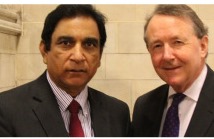
This House has Considered the Protection and Promotion of Human Rights Across the World on International Human Rights Day
Thursday 10 December 2015 House of Commons Backbench debate
Media release below, followed by full text of the debate:
On Human Rights Day, Thursday 10th December, members of the All Party Parliamentary Group for International Freedom of Religion or Belief (FoRB), secured a debate in the Main Chamber of the House of Commons. The debate considered Human Rights across the World with APPG members and others raising the relationship between FoRB and thematic Government priorities including, security, countering extremism, economic prosperity, overseas development aid and stabilisation of Syria.
In an unprecedented event, the House of Commons held a debate on International Human Rights Day which considered human rights across the world. The Backbench debate was secured by Jim Shannon MP (Co-Chair of the APPG for International Freedom of Religion or Belief), Fiona Bruce MP and Stephen Timms MP. It received considerable cross-party support, with members of all parties raising a broad range of human rights concerns: from executions in Saudi Arabia, political prisoners in Burma to persecution of Ahmadis in Pakistan as well as many more individual and country-based cases.
While debates around specific countries with human rights concerns and human rights themes have occurred in the last parliament, there has not been a wide-ranging debate on human rights, analysing the UK’s current policy on human rights, within the last government or even the current government so far. Securing this debate was truly an historic moment.
Jim Shannon MP stressed the importance of holding the debate to coincide with Human Rights Day, which commemorates the day that, in 1948, the United Nations General Assembly adopted the Universal Declaration of Human Rights. This year’s Human Rights Day is particularly poignant with the launch of the 50thanniversary of the two International Covenants on Human Rights – the International Covenant on Economic, Social and Cultural Rights and the International Covenant on Civil and Political Rights – that will occur next year.
Considering the unique nature of the debate, Mr Shannon proposed that the House should have an annual debate in the Chamber regarding International Human Rights to coincide with the Foreign and Commonwealth Office’s publication of their Annual Report on Human Rights.
During the debate, members of the APPG took a revolutionary approach in linking the freedom of religion or belief with Government priorities to highlight the importance and benefits of promoting human rights and, in particular, FoRB. This linkage unravelled the misguided notion that the promotion of human rights is a hindrance to our national interests. Members emphasised that promoting rights, including FoRB, is beneficial to our national interests. Members spoke about how FoRB assists in creating conditions conducive for security, economic prosperity, countering extremism and fostering peaceful and stable societies.
Mr Shannon spoke about how greater religious freedom leads to better security, stability and economic growth and that it reduces extremism, societal tensions, violence and even poverty. These points were elaborated by other members including Rt. Hon Stephen Timms MP who, using Dr Brian Grim of the Berkley Center’s extensive research, made particular mention of the “positive correlation of religious freedom and economic prosperity”, while Tom Tugendhat MP spoke of religious freedom and extremism and Alan Brown MP outlined the need for religious freedom in any new constitutional or legal orders in conflict states such as Syria for transition into a stable and peaceful society to occur. Fiona Bruce MP and Jeremy Lefroy argued that we cannot have long term development without freedom and that DfID must begin playing a more active role in the promotion of freedoms and rights. Mr Lefroy explicitly linked freedom of religion or belief to the four objectives of DfID’s November 2015 New Aid Strategy.
Members from across the House shared sentiments of urging the Government to speak out about religious freedom and other human rights abuses, calling the Government to pro-actively ensure that its current policies do not directly or indirectly support human rights violations.
The debate saw the freedom of religion or belief mainstreamed as a human right, with the Undersecretary of State, James Duddridge MP, explicitly mentioning the crucial role that freedom of religion or belief plays in countering extremism. Mr Duddridge also spoke of the profound concern that the Government has for FoRB and their commitment to uphold the rights of all religions and minorities.
ENDS
DEBATE IN FULL:
Jim Shannon (Strangford) (DUP):
I beg to move,
That this House has considered International Human Rights Day.
As we celebrate the 800th anniversary of Magna Carta this year, it seems particularly appropriate to debate international human rights to highlight the fact that in many parts of the world the values of Magna Carta, the rule of law and basic rights are routinely, systematically and severely violated; and to ask Her Majesty’s Government whether human rights remain at the very heart of our foreign policy, and, if so, how we protect and promote them in practice. That is the thrust of this debate.
I am aware of the recent reconfiguration of human rights priorities within the Foreign and Commonwealth Office to address human rights within the broad contexts of democratic values, the rules-based international system, and human rights for a stable world. I look forward to hearing from the Minister what that will mean in practice and how human rights will be more effectively delivered under the new framework.
Carol Monaghan (Glasgow North West) (SNP):
Having written to the Prime Minister and the Foreign Office a fortnight ago regarding proposed mass executions in Saudi Arabia, I am dismayed that the Government evidently do not share my alarm, as I am yet to receive replies. Does the hon. Gentleman agree that if the UK Government wish to be taken seriously about human rights, they need to show more leadership globally?
Jim Shannon:
Yes, I do, and I have already put that on the record in debates in Westminster Hall.
I am particularly pleased to have secured this debate alongside the hon. Member for Congleton (Fiona Bruce), who is sitting across the way; she is a dear friend who is well respected in this House. There have been many debates in this House on human rights themes in relation to specific countries, but we have not, to my knowledge, in the time of this Government or the previous one, had a wide-ranging debate with an opportunity to review the human rights situation around the world and the different ways in which Britain—this great nation—has responded to the challenges so far. The House of Lords has had several such debates, and I welcome this opportunity to do likewise.
The Foreign and Commonwealth Office publishes an annual report on human rights, as well as quarterly updates. May I suggest that we consider having an annual debate in Government time in the main Chamber of this House to coincide with the release of the annual report, giving the House as a whole an opportunity to respond to it?
It is vital that we discuss human rights today, on international human rights day, when we commemorate the adoption 67 years ago of the universal declaration of human rights by the UN General Assembly. The declaration was written to provide a common standard for all peoples and nations of which individuals and societies should strive to secure effective recognition and observance. It has helped to shape policy around the world and paved the way for nine legally binding human rights treaties, including the international covenants on civil and political rights and on economic, social and cultural rights, which were both adopted in 1966 and which more than 160 states have ratified.
Despite these treaties, the human rights and basic freedoms we enjoy in this country are under sustained and severe attack in many other parts of the world. Some 67 years on from the declaration’s adoption, the preamble is worth recording in Hansard, because it is very relevant today:
“disregard and contempt for human rights have resulted in barbarous acts which have outraged the conscience of mankind, and the advent of a world in which human beings shall enjoy freedom of speech and belief and freedom from fear and want has been proclaimed as the highest aspiration of the common people”.
That is what we should focus our attention on.
The first three articles of the declaration make it clear that human rights are not confined by geography, territoriality, culture or religion. As its name suggests, they are universal—for everyone—and as the UN Secretary-General, Ban Ki-moon, has underlined, it is not called the partial declaration of human rights or the sometimes declaration of human rights. Article 1 unequivocally states:
“All human beings are born free and equal in dignity and rights. They are endowed with reason and conscience and should act towards one another in a spirit of brotherhood.”
Article 2 states:
“Everyone is entitled to all the rights and freedoms set forth in this Declaration, without distinction…or under any other limitation of sovereignty.”
Article 3 insists:
“Everyone has the right to life, liberty and security of person.”
These and the following 27 articles should provide the framework for this debate and our foreign policy.
Liz McInnes (Heywood and Middleton) (Lab):
When I was a trade union representative, I went on a training course about the Human Rights Act 1998, and one thing that has always stayed with me is that the Act was introduced to prevent another holocaust from happening. Does the hon. Gentleman agree that, were this country to scrap the Act, it would send a terrible message to the rest of the world?
Jim Shannon:
Yes, I do agree. The Human Rights Act is an integral part of this debate, as I think contributions from across the Chamber today will confirm.
Despite everything I have said, freedom of expression, including freedom of the press, is denied in many countries. Journalists, dissidents and bloggers have been arrested, imprisoned or murdered in countries such as China, Bangladesh, Vietnam, Russia, Cuba, Egypt and Iran. Women’s rights are abused in many places through rape and sexual violence in conflict. Can we begin to understand the violence, barbarity and horror of what that means? Such things have occurred in parts of Burma and the Democratic Republic of Congo; such acts have been carried out by religious extremists in India and Pakistan; in countries such as Saudi Arabia women are denied basic freedoms. In addition, the rights of children are under attack through the forcible conscription of child soldiers in many countries and the use of child labour. Refugee rights are a particularly topical concern, given the unprecedented movement of people escaping desperate situations in the middle east and north Africa and the situation of the Rohingya people from Burma on boats in the Andaman sea.
Freedom of thought, conscience or religion is set out in article 18 of the declaration, and is the most basic right of all, yet the right to choose what to believe, to practise one’s beliefs, to share them with others in a non-coercive way and to change them is increasingly under threat throughout the world, and it affects everyone, of all religions and no religion. The Conservative party manifesto and the Government have recognised freedom of religion or belief as a fundamental British value, and the Government have pledged to stand up for this right at the UN Human Rights Council in 2017-19.
I am proud to chair the all-party parliamentary group on international freedom of religion or belief, which boasts 55 Members and 22 expert stakeholders dedicated to advancing this fundamental right. Freedom of religion or belief is a litmus test of the state of human rights in any society and is inseparably linked with other freedoms, such as the right to life, freedom from torture and inhuman or degrading treatment, the freedoms of expression and of association, as well as rights such as those concerning unjust detention, the right to a fair trial and the rule of law.
It is vital to recognise that such violations affect everyone, not just particular religious or belief communities. Minority belief women and children are particularly vulnerable, and are often doubly discriminated against for their identity. As Andrew Copson, chief executive of the British Humanist Association, and Benedict Rogers of the Christian Solidarity Worldwide highlight, where Christians are persecuted, minorities from within Islam—Shi’a or Ahmadiyya, for example—also suffer, as do the Baha’i. Where Muslims are the prime victims as in Burma, and the Uighurs as in China, Christians and other minorities suffer alongside them.
In many parts of the world, those who choose to exercise their right not to believe, to reject religion and to become agnostics, atheists or humanists, face discrimination, arrest, imprisonment, torture or even death. That is the reality of today’s world. Religious freedom involves far more than merely freedom to worship, and is not just a concern for some minorities that hold strong religious convictions. Religious freedom is not just a right to be tackled in moments of crisis.
My first suggestion for policymakers and diplomats therefore is directly to address freedom of religion or belief as a mainstream human right inseparably linked with other fundamental freedoms, and proactively to address religious freedom abuses before they escalate and result in devastating violence—the like of which we have seen at the hands of Daesh in Syria and Iraq. Ensuring that individuals have freedom of religion or belief is in the interests of all nations, including our own.
This year, 100,000 Christians will be murdered because of their faith, while 2 million will be persecuted for it and 2 billion will live in what is called an endangered neighbourhood. That is just one section of religion—Christians—and shows what can happen to them and to all the other religions as well. Extensive research carried out by Georgetown University’s Berkley centre demonstrates that greater religious freedom leads to better security, stability and even economic growth, and that it reduces extremism, societal tensions, violence and even poverty.
Promoting and securing the right of individuals to have the freedom to practise their beliefs in peace and safety is a fundamental British value that we all uphold. It should therefore be treated seriously as a framework on the basis of which many of the UK’s foreign policy aims can be achieved. Perhaps the Minister will respond to that point in his reply.
My colleagues will be able to expand on why a strategy including the advancement of freedom of religion or belief should inform how the 2015 national security strategy and the strategic defence and security review should be implemented. In its bid for re-election to the UN Human Rights Council, the UK pledges to advocate
“in favour of equality and non-discrimination, including on the grounds that freedom of religion or belief can help to counter violent extremism”.
I strongly believe that it can, so it is a pledge that I welcome and sincerely hope will be carried through.
It is important that the Government not only speak out about religious freedom and other human rights abuses, but proactively ensure that their current policy is not directly or indirectly supporting violations of human rights and particularly of religious freedom. Steps should be taken, for example, by the Department for International Development—it is important for this debate to encompass defence and DFID issues—in line with sustainable development goal 16 to ensure that aid is not given to schools that preach intolerance, as happens in Pakistan, and to encourage trading partners to ensure that religious minorities and those who have non-religious world-views are given equal rights in the workplace. Aid must be channelled, I believe, to organisations and programmes that can demonstrate a sophisticated understanding of freedom of religion or belief and can show how their work will have a positive rather than a negative impact.
Given that the Government have recognised in their various guises the importance of freedom of religion or belief as a fundamental stability and security-generating human right, and given that human rights are to remain at the centre of UK policy abroad, how will the Government ensure that its staff are “religious-freedom literate” and that this right will be taken seriously across all Government Departments? How will the Government ensure that all Departments work in conjunction with each other effectively to secure this right?
While the visits over the last few weeks of the Indian and Kazakhstani Prime Ministers and Chinese and Egyptian Presidents are important for building economic and trade ties, we sincerely and honestly hope that the human rights, and indeed human rights clauses in trade agreements, are kept integrated into the discussions during such visits. It is great to have economic ties, and we should have them, but let us have human rights enshrined and protected as well. Foreign policy cannot be based on fiction and we cannot allow immediate political and economic interests consistently to take precedence over more long-term security objectives, even if seen as controversial.
The spirit of the universal declaration of human rights, adopted 67 years ago today, must be respected and upheld. We must strive to secure effective recognition and observance of human rights that will in turn provide all victims of rights violations around the world with the hope that we take their situation personally and we take it seriously. We have an opportunity in this House today to be the voice of those who do not have a voice.
Tom Tugendhat (Tonbridge and Malling) (Con):
I am delighted to be under your chairmanship again, Madam Deputy Speaker.
I thank the hon. Member for Strangford (Jim Shannon) for his inspirational introduction to the debate, and for organising it. It is essential for international human rights day to be remembered in the House of Commons, which is, in many ways, the foundation of many of the rights of which we speak. It is from this Parliament, and from this voice of free-born sons of the country—originally English, but now including representatives of Scotland, Wales and Ireland—that many of the rights that we now see around the world have sprung. The traditions of democracy that were brought together here 750 years ago led to the rights in the declaration of New York, of which the hon. Gentleman rightly spoke, and which echoed around the world to fight the fascism and hatred that resulted in the holocaust. The hon. Member for Heywood and Middleton (Liz McInnes) spoke of that earlier.
Angela Rayner (Ashton-under-Lyne) (Lab):
On this international human rights day, does the hon. Gentleman agree that the issue of violation of the Igbo tribe’s human rights needs to be resolved, and that the Biafran leader should be released, as has been suggested in representations by my right hon. and learned Friend the Member for Camberwell and Peckham (Ms Harman)?
Tom Tugendhat:
The hon. Lady clearly speaks with great knowledge of those issues. I am sure that she will raise them with the Foreign Secretary and the Secretary of State for International Development on the appropriate occasions.
If the House will forgive me, I shall now focus on a specific aspect of human rights, namely the right to freedom of religion. This may surprise some Members, but I am going to begin with a quotation from the Koran. It is from the second Surah, Surah al-Baqarah, which states “la ikra fï al-din”: “There is no compulsion in religion.” One of the seminal tenets of Islam is that it is a religion freely entered into by free people, and one of the reasons why many of us recognise it as one of the great religions of the world is that very principle of freedom—that very underscoring of rights.
Those of us who may not share the same belief system as the Islamic faith, because we are from a Christian tradition, may not follow all its tenets. However, that freedom of association, that freedom of religion and expression, that freedom to choose whose God, which God, or indeed no God, is a fundamental human right. I am very pleased that we are beginning to have this conversation in the House of Commons, which, as we know, recognises all religions and none. As the west becomes more secular—and, indeed, as the “none” gains more power over the plurality—it is worth remembering that those freedoms do not always apply, and that some religions turn the minds of young men and women towards the extremism that this House would fight. However, I am pleased that we are at last talking not only about extremism as something that we might fight—as we did only a week or so ago, in the debate that was summed up so eloquently by the right hon. Member for Leeds Central (Hilary Benn)—but about a right: a very fundamental right that all people in our country and, we hope, around the world will share.
As we emerge from talk of extremism in the global area, I hope that Members will forgive me for speaking about extremism at home. In view of Operation Trojan Horse and Peter Clarke’s impressive report on Birmingham schools, it is worth remembering that even in our own society—even in our most multicultural and free towns, such as Birmingham and London—it is possible to find havens of hatred and islands of ideology that are absolutely inimical to the freedoms that we expect of all people, not just all British people but people around the world. I am delighted that the Government are fighting that extremism, and I urge them to stand even more strongly against it. When we see young people being brought to the school of hatred rather than the school of understanding, we must fight that with every fibre of our being. It is not those young people who are born to hate, but the so-called leaders, the so-called community elders who teach them hatred, and we must fight that too.
Extremism is of course not just a threat to the souls of humans all around the world; it is a threat to our security and it is therefore absolutely right that when we consider how we shape and defend ourselves, we form one simple principle into which we must all fit. That principle was underlined in this country with the signing of the Great Charter at Runnymede; that single understanding that we all stand equal before the law, from King to pauper, is a fundamental principle. It has applied for 800 years because the common law is indeed that: it is common to all of us and it works for all of us.
When I hear people talk, as some have over the past number of years, that we should have different legal structures for different religious communities, I say that as a man who follows the Church of Rome—I know not all Members of the DUP would agree that that is a great thing to say in this House—and who stays loyal to the Holy Father, I recognise very strongly that we here follow the common law. We follow the Queen’s law and it is right that we do so.
My own private confession is precisely that; it is a confession of private faith. It is not an act of public statement, and I would urge those of other religious communities that when they seek to structure the way they operate within our great United Kingdom to also see it as that. There is of course a place for conscience in our country—and there is a place for tradition and there is a place for culture—but it is not the same as the place for common law. That is why I am absolutely vehement and will bow to no one in my defence of that common law.
It is not just articles of the common law that some people speak of, and it is not simply Acts that may have been passed in the last 15 or 20 years, that guarantee those rights; it is the sum total of law that has been built up over nearly 1,000 years that guarantees those rights. Yes, there are other Acts that bring in elements of continental jurisdiction. Yes, there are Acts that bring in elements of other foreign concepts of jurisdiction as well. But personally, when people speak of the right of men, I prefer the rights of British men and women, because those are the fundamental rights that have kept us safe, free from fascism and communism and free to live our own lives in dignity and to practise our own faiths.
That leads me to think about some of the times when we have not been free. There have, even in this great kingdom of ours, been moments when our forebears were not free to practise their faiths, and when they were victims of hatred and religious wars. I am thinking, of course, of the reigns of the great Queens Mary and Elizabeth, when people under their authority executed and tortured people of opposing faiths. There were great saints on both sides of that national moment and there were great heroes on both sides of the debate, but for me what sums up that debate is something we should remember as having the heart of Englishness in it—it was, as we know, a very English moment. What summed it up for me was Queen Elizabeth’s great line; “I will not put windows into men’s souls.” That illustrates the understanding she had that freedom of expression under loyalty to the Crown was an essential part of being part of our kingdom.
That is the central aspect we must remember on international human rights day, because that understanding that freedom of faith and expression is something the state must guarantee for us—that, in our case, the Crown must guarantee—is essential but it works only if the relationship is two-way. Yes, the state must guarantee the freedom of expression, but the freely expressed religious faith must not be of a kind, an ideology or an extremism that seeks to undermine the liberties of others, which in our case means the application of common law.
I am deeply honoured to be following the hon. Member for Strangford (Jim Shannon), and I am deeply proud to be standing here on international human rights day in this Court of Parliament, which I see very much as the heart of the court of human rights in this world, because this Court of Parliament has been a light, a beacon, a city on a hill. It has been that ideal, and we can see, my own family included, how many migrants, activists and others have shaped their concepts of democracy and freedom on the basis of the words that have been spoken on these Floors and from these Benches. So I am honoured to be here speaking on behalf of this motion, and I urge the House to consider it well.
Valerie Vaz (Walsall South) (Lab):
It is a pleasure to follow the hon. Member for Tonbridge and Malling (Tom Tugendhat), whose family has a long tradition of public service. I also thank the hon. Members for Strangford (Jim Shannon) and for Congleton (Fiona Bruce), my right hon. Friend the Member for East Ham (Stephen Timms) and the hon. Member for Ochil and South Perthshire (Ms Ahmed-Sheikh) for securing this debate, because we are here to celebrate human rights today, not to bury them. I do not know whether hon. Members have seen the website of the Canadian astronaut Chris Hadfield, but he sent down images of Earth from space and showed us the beauty of where we live. He showed us Earth as one world, where we live together and the only boundaries are those of land and sea. Injustice and discrimination know no boundaries, which is why international human rights are necessary.
The universal declaration of human rights set out articles and protocols. They are the guide, the code, the commandments of how we should live together in a common humanity. The UK was one of the first countries to sign it and was the first to ratify it, in March 1951. What are they? The hon. Member for Strangford alluded to a few of them, but I want to put them on the record: the right to life; the prohibition of torture; the prohibition of slavery and forced labour; the right to liberty and security; the right to a fair trial; no punishment without law; the right to respect for private life; freedom of thought, conscience and religion; freedom of expression; freedom of assembly and association; the prohibition of discrimination; and, under the first protocol, the protection of property, the right to education and the right to free elections. Every single one of those we hold dear in our country, and they are embedded in the declaration’s words.
The universal declaration of human rights was drafted after the ending of the second world war, as a response to the oppression and tyranny that came out of the two world wars. Every one of the rights I listed had been systematically violated, which is why we need the declaration, and why we incorporated it into the European convention on human rights and subsequently into the Human Rights Act 1998. This was not to take anything away or add anything and make things difficult for judges; it was so that judges could read into our legislation whether it is compatible with our fundamental rights. Ministers do not have to do anything apart from declare that human rights and their legislation are compatible.
There is a myth that the European Court of Human Rights is taking some sovereignty away, as it applies the doctrine of the margin of appreciation. The margin of appreciation gives flexibility and enables the Court to balance the sovereignty of member states with their obligations under the convention and now the 1998 Act. It takes into account the sovereignty of member states and their laws.
Breaches of human rights still occur around the world. In Burma, despite the election win by the National League for Democracy, there are political prisoners who still need to be released—Pyone Pyone Aung took part in a peaceful protest; and the army can still overthrow a democratically elected Government in cases of national security. That must change. In Australia, Human Rights Watch found that the Government had done too little to address indigenous rights and disability rights—indigenous Australians are disproportionately represented in the criminal justice system. In the USA, the criminal justice system, from policing to prosecution and punishment, is plagued with injustices, such as racial disparities and excessively harsh sentencing. In Yemen, with which a number of Members have links, including my right hon. Friend the Member for Leicester East (Keith Vaz) and the hon. Member for Beckenham (Bob Stewart), who spent his childhood there, Amnesty International has reported 21 air strikes which killed at least 241 civilians and injured 157 people, most of them women and children. The strikes were found to be indiscriminate or disproportionate, and arms are still supplied by the UK.
We then come to the lawyers who have died defending human rights. The Law Society said it was shocked and saddened by the murder on 28 November of the Kurdish human rights lawyer Tahir Elçi. Karim Hamdy, 27, died in February 2015, after two days’ detention in Cairo, with broken ribs and bleeding in the brain. Salwa Bugaighis was shot dead in her home in Libya in June 2014 after voting. She was a prominent human rights lawyer who opposed moves to make the hijab compulsory.
Finally, human rights—both the Human Rights Act and human rights generally—are the David to the Goliath of the powerful. They provide help to the helpless and a voice to the voiceless, which is why we must protect them and celebrate them today.
Fiona Bruce (Congleton) (Con):
I congratulate the hon. Member for Strangford (Jim Shannon) on opening the debate on international human rights day so comprehensively, and on all that he does in this regard. It is a pleasure to follow the hon. Member for Walsall South (Valerie Vaz), and I commend her on her speech and all that she has done, particularly with regard to the people of Burma, over very many years.
This House is debating the most crucial of issues. A former Foreign Secretary was clear that human rights are at the very heart of foreign policy. I thank the Foreign Office Ministers for attending this debate, and for regularly raising human rights issues around the world, as I know they do. It is important that Ministers from the Department for International Development do so, too.
As a member of the International Development Committee and the Joint Committee on Human Rights, I was concerned to see a lack of any focused reference to human rights in the recently published Department for International Development strategy, “UK aid: tackling global challenges in the national interest”. Yes, there was reference to supporting women and girls, and yes there was reference to the disabled, but it is my contention that if there is not a core focus on human rights in our strategy for international development, we will miss out on addressing the cause of so many humanitarian problems around the world, which, ultimately, DFID and our aid funds have to address.
There must be much more focus on human rights in our international aid work. For example, not addressing article 18 disproportionately affects women and girls in any society. Not addressing inequality disproportionately affects the disabled. Twenty one of the 28 countries in which UK aid is spent are either fragile or conflict-affected, and for many of them, that fragility is at least in part—if not in large part—a result of their Governments’ lack of respect for human rights.
The hon. Member for Strangford mentioned Pakistan, which is a recipient of substantial UK aid, but many other countries that receive UK aid should be challenged on their human rights abuses. In Bangladesh, for example, freedom of expression is denied to journalists, dissidents and bloggers, who are arrested and detained. In Uganda and Sudan—also recipients of UK aid—the rights of the child are under attack. There is forcible conscription of child soldiers, and child labour. In Ethiopia, where we support women and girls, there is a closing down of the political and media space. In Nepal, where we have done so much to help with the recent disaster relief outcomes, there have been recent endeavours to restrict the constitution. In every country where UK aid is spent, DFID Ministers and in-country officials should challenge it when they see that human rights are not being respected.
Bob Stewart (Beckenham) (Con):
I thank my hon. Friend for giving way. I have a huge respect for what she does. Is it her belief that we should not give aid unless human rights are maintained in a country, or do we have to compromise in giving aid? I think we do. What does she think?
Fiona Bruce:
It would be a tragedy for the people of those countries to suffer even further and not receive our aid, simply because their Governments were abusing their human rights.
The UN Secretary-General Ban Ki-moon recently said that the freedom for civil society to operate is diminishing around the world, and there is real concern that the space for human rights has been closed down in many countries. Increasing restrictions in some countries are limiting the ability of non-governmental organisations to work or receive funding. If civil society is to play its full role, the international community, with the UK in the lead, needs to act to protect its operating environment, particularly as implementing the sustainable development goals—the new global goals recently signed up to by 93 countries—is a huge challenge. In those countries, the contribution of a healthy civil society, which very much needs those goals to succeed, will be essential. We cannot afford to see civil society space closed down.
Let me give examples of how even in the past few years, new laws and policies in countries that we support have restricted NGOs’ ability to operate. In Kenya, legislative restrictions on freedom of information are inhibiting the fight against corruption, and hundreds of NGOs have been shut down or had their bank accounts frozen. Amendments have been sought to legislation with the aim of capping foreign funding for NGOs at 15%, basically making it impossible for many to operate. Ethiopia, too, had similar restrictions on organisations receiving more than 15% of their money from abroad, and on working on issues such as women’s rights, child rights or peace building. What are the Government doing to help protect civil society space, particularly in countries with which the UK has a relationship?
Let me turn to concerns about sovereignty. If human rights are to be universal, the sovereignty of a country cannot be used as an excuse for ignoring them. We need to resist the growing argument that sovereignty is somehow paramount, and that that therefore allows countries to interpret human rights subjectively. If human rights are universal, they are universal. China cannot say that it is justified in incarcerating its human rights lawyers without due trial process, as it has recently, simply because it is a sovereign country and they have broken its laws. Nor can North Korean officials say, as they did to me only this morning, that they have their “own way” of interpreting human rights. They certainly do. When their view of human rights is state-sanctioned prohibition of freedom of expression, the imprisonment of anyone who utters even the slightest contradiction to the Government’s views and a host of atrocities, including against children, we need to stand up and speak out about them. Particularly when countries have recently signed up to the global goals, with their integral commitment to good governance and strong and stable institutions, we should speak out and challenge them on human rights.
It is a long time since 1948, and somebody asked me recently whether we would be able today to get the same broad sweep of clear human rights expressed in a document as we did then. We at least have the SDGs, or global goals, which were signed only in September; many of the statements in them re-express a clear commitment to human rights. Human rights should be not only universal but transparent. We should be transparent in how we challenge countries such as Saudi Arabia. We are challenging and should challenge it, as a country with which we trade, though it does not receive aid from us. It might be uncomfortable for those countries, and they might not like it, but the public require it, and it is right that we do it.
There are a number of other countries that I would have liked to have spoken about in more detail. The Conservative party human rights commission, which I chair, has done a lot of work to highlight the need to raise human rights and concerns about them across the world. Will Ministers reconsider some of the recommendations that our commission has made over time? For example, we recommended that there be a Minister responsible for international human rights in the Foreign and Commonwealth Office, who could focus on this issue, and that he be supported by an ambassador at large for international human rights; perhaps there could also be a number of special representatives on issues such as genocide, war crimes, crimes against humanity and women’s rights—a model employed effectively in other countries.
Will Ministers consider a high-level international conference, in which the UK takes the lead, perhaps similar to the summit held last year on preventing sexual violence, to raise international attention of increasing concerns about human rights abuses? It could co-ordinate international strategies, and ensure that media institutions and Governments around the world both speak out for oppressed individuals and help to ensure that, in their lifetime, we can truly say:
“All human beings are born free and equal in dignity and rights.”
Stephen Timms (East Ham) (Lab):
I am pleased to follow the very thoughtful speech from the hon. Member for Congleton (Fiona Bruce), and I welcome the way in which the hon. Member for Strangford (Jim Shannon) opened the debate.
There is no doubt that the publication of the universal declaration of human rights on 10 December 1948, 67 years ago, was a profoundly important moment in establishing the freedoms that men and women should expect to enjoy across the planet in the modern era. Eleanor Roosevelt, who chaired the drafting committee, made the comparison—the hon. Member for Strangford touched on this—with the Magna Carta. She referred at the time to the universal declaration as the
“international Magna Carta for all”,
and in this 700th anniversary year of the Magna Carta, it is right for us in this Chamber to underline that comparison. The universal declaration is a vitally important document around the planet.
One of the submissions sent to us ahead of this debate came from the British Institute of Human Rights, which published an advertisement today. I think a meeting is being held at this moment in the other place under its auspices, chaired by Sir Nicolas Bratza, who was the president of the European Court of Human Rights. It is drawing attention to the importance of our own Human Rights Act 1998. In its advertisement, the institute describes the legislation as
“the promise of the Universal Declaration of Human Rights made law here”
in the UK. I hope it will remain part of our law.
The Conservative manifesto pledged to scrap the Act. As others have suggested, that would be a terrible mistake, sending very bad signals around the world. I note that the Justice Secretary has delayed his consultation on this until the new year, no doubt reflecting serious, very proper concerns among Conservative Members about that course of action. I hope that the Human Rights Act will remain on our statute book.
Like the hon. Member for Strangford, I want to say something about article 18 of the universal declaration, which states:
“Everyone has the right to freedom of thought, conscience and religion; this right includes freedom to change his religion or belief, and freedom, either alone or in community with others and in public or private, to manifest his religion or belief in teaching, practice, worship and observance.”
There is growing concern that that article, as well as others, is being breached with increasing frequency around the world.
In September, along with the hon. Member for Strangford, I attended a conference in New York of the International Panel of Parliamentarians for Freedom of Religion or Belief, focused on that article. There was a big attendance of parliamentarians from a large group of countries, including European countries and Tunisia, Pakistan, Egypt, Iraq, Senegal, Malaysia and Turkey. It was good to hear a speaker from Iran addressing that conference on the subject of religious freedom. A strong case was made that more needs to be done to strengthen observation of adherence to that article around the world. It is increasingly clear that there is a link between religious freedom and prosperity. There is no doubt that over our history, economic growth has been bolstered by the ideas and inventiveness of people inspired by deep religious commitment. Prosperity has been increased by the contributions and brilliance of many people—including Protestants from France and Jews from central and eastern Europe—who fled to Britain to escape from religious persecution elsewhere, because they knew they would find freedom here to practise their beliefs.
Recent research has suggested that religious freedom more broadly can enable economic growth more directly. It can help create an environment in which wealth creation can flourish. Researchers in the US—the hon. Member for Strangford referred to research at Georgetown University—looked at GDP growth in 173 countries in 2011, controlling for a range of factors, and found a positive correlation between religious freedom and prosperity. That is another ground for us to support and promote article 18 of the universal declaration.
When the conference in New York concluded, the Members who attended sent out three letters. The first was sent to Vietnam, where there are proposals to restrict religious freedom in new legislation. The second was sent to Burma—my hon. Friend the Member for Walsall South (Valerie Vaz) mentioned Burma—and concerned a member of the Myanmar Parliament who was being prevented from standing in the forthcoming election, which took place in November, because he is a Muslim from the Rohingya minority. We wrote to the President of Myanmar to complain about that, and to urge that people not be barred from standing for election on religious grounds. The third letter was sent to the Speaker of the Iranian Parliament, expressing grave concerns about restrictions on religious freedom in that country. In 2010, for example, seven Baha’i leaders were sentenced to 20 years in prison simply for exercising their faith.
We also wrote about a number of Christian figures imprisoned in Iran. I particularly want to mention Maryam Nagash Zargaran, who is serving a four-year prison sentence in the notorious Evin prison. Her sentence began in 2013. She suffers from a serious heart condition, which has significantly worsened in the two years she has served so far. I understand that she was recently allowed a short period in hospital for treatment, but she needs more. I would like the Minister to ask his right hon. and hon. Friends in the Foreign Office to raise her case with the Iranian authorities, because her only crime has been to practise her faith.
One of the submissions that I and, no doubt, others received ahead of this debate asked us to draw attention to human rights violations being suffered by the people of Palestine. It listed articles that are being breached there, such as article 9, which states:
“No one shall be subjected to arbitrary arrest, detention or exile.”
I hope that we will see progress in that country as well.
Jeremy Lefroy (Stafford) (Con):
It is a great honour to speak in this debate, and I very much welcome the speeches of all Members who have contributed to the debate so far. Indeed, I do not have an awful lot more to add, but I want to make some points about the relationship between freedom and development and, in particular, as my hon. Friend the Member for Congleton (Fiona Bruce) said, the importance of respecting, and taking great note of, freedom in international development. I do not see enough of that in the aims of the Department for International Development, much as I respect its work.
The right hon. Member for East Ham (Stephen Timms) mentioned the huge contribution that people of religious faith have made to the development of this country, particularly those who fled persecution. He mentioned the Huguenots—I declare an interest, as I come from a Huguenot family—who were followed by the Jews and many others, including Asians from Uganda and, most recently, people from Somalia and Syria. They have all had a tremendous impact on the economic, cultural and social life of this country.
Freedom, in my view, is absolutely bound up with development. We cannot have long-term development without freedom. If we look at the four main aims of the Department for International Development’s strategy, as set out recently, we see how vital freedom is to them all. If we take the first two—strengthening global peace, security and governance, and strengthening resilience and response to crises—we see that it is often violations of freedom, whether religious or political, that lead to tensions and insecurity. Conversely, countries in which freedom is respected, despite—or perhaps because of—diversity, are often those that are most at peace. I had the honour of living in Tanzania for many years and I chair the all-party group on Tanzania, a country that has lived at peace since independence, even though it has a very wide variety of peoples, including very strong representations of both Christians and Muslims and, indeed, those of neither faith. They have lived at peace because they have respected the freedom of those people to practise their religion and faith. Indeed, more recently they have also respected political freedom since the mid-1990s.
The third and fourth aims of DFID are promoting global prosperity and tackling extreme poverty, and helping the world’s most vulnerable. The right hon. Member for East Ham has already referred to the work of Georgetown University. Amartya Sen’s book “Development as Freedom” was published in the late 1990s. He rightly points out that economic development entails a series of linked freedoms, including not only freedom of opportunity and economic freedom but political freedom and, by extension, religious freedom and freedom of thought.
If DFID is to achieve those four goals over the next five years, as I very much hope it will—it has some excellent Ministers and staff, both here and in the countries in which it operates, to do so—it needs to place the upholding of freedom and human rights at its core. I very much support the suggestions of my hon. Friend the Member for Congleton for human rights ambassadors and, indeed, a Minister with that specific responsibility.
In closing, I would like us to pay a little attention to our own record. We sometimes come here and talk about human rights and freedoms around the world, and that is absolutely vital, but we must make sure that we do not let those human rights and freedoms slip in our own country. I believe that sometimes it is necessary to take risks in order to maintain human rights. It is all too easy to think that, by clamping down a little here and with a bit more surveillance there, we are giving ourselves the security that we all desire for ourselves and our families, and yet, little by little, we are eroding those human rights that have taken so much pain and so much struggle over the centuries to realise in this country.
We also have to make sure that we do not consider security and economic progress to be the only goods—the only things—that we should strive for. There are many other things that are very important in life—friendship, family, the arts, laughter, the company of friends. Of course, those things do depend on and flourish with security and economic progress, but security and economic progress are not absolutely necessary to have them. It is vital that we ensure that freedoms and rights are placed above security and economic progress. We can run the risk of saying that unless we keep ourselves secure and unless we make ourselves more and more prosperous, we cannot be free. In fact, it is the other way around.
Siobhain McDonagh (Mitcham and Morden) (Lab):
Today is international human rights day and I want to focus my attention on two communities that are at the heart of my constituency, namely the Ahmadiyya Muslim community and the Sri Lankan Tamils.
Britain’s Ahmadiyya Muslims contribute greatly to this country, and their belief in peace and religious tolerance is an example to us all, as we would expect from a community whose motto is “Love for all, hatred for none”. However, in Pakistan the very same peaceful community continues to be persecuted on a daily basis. It is the only religious community to be targeted by the state on the grounds of faith. In Pakistan, Ahmadis cannot call themselves Muslims and are forbidden by law to vote as Muslims. This state-sponsored persecution has been enshrined in the country’s constitution since 1974. On top of that, they are openly declared as “deserving to be killed”, with neither state nor civic society willing to stand up for them against extremists. Perpetrators are given free rein to attack Ahmadis, safe in the knowledge that they will not be prosecuted for their actions, and in the past few years alone, hundreds of Ahmadis have been murdered.
It is quite shocking to think that the persecution this community faces is enshrined in Pakistani law. It is a criminal offence, punishable by imprisonment, a fine or even death, for Ahmadis to call themselves Muslim, to refer to their faith as Islam, to call their place of worship a mosque or to say the Islamic greeting, “Peace be upon you”. The laws specifically against the Ahmadi Muslims also conflict with the constitutional right of Pakistani citizens to freedom of religion.
State laws have emboldened other state actors and extremists to harass, attack and kill Ahmadis. They are denied the right to life. Hundreds have been murdered on the grounds of their faith. The deadliest attack on the community occurred in 2010, when the Pakistani Taliban attacked worshippers during Friday prayers at two Ahmadi mosques in Lahore. In 2014 alone, 11 Ahmadis were killed solely because of their faith. This year, a vigilante mob targeted an Ahmadi family in Gujranwala, setting their home alight and killing three family members—a grandmother and her two little grandchildren. No arrests have been made, and Pakistani news channels refused to air bulletins about the incident.
Ahmadis are denied the right to vote—they are disfranchised unless they declare themselves as non-Muslims—and are the only disfranchised group in Pakistan. It is crucial to note that no prosecutions have been brought in relation to any of these murders, or indeed in respect of any killings of Ahmadi Muslims. Civic society fares little better. The Pakistani Urdu press continues to publish fabricated stories inciting violence against Ahmadis, who are often presented as the root cause of the problems in Pakistan. In 2014, at least 2,000 such reports were published. Article 20 of Pakistan’s constitution guarantees freedom of religion. The country is also a signatory to the UN universal declaration of human rights, which makes it obligatory for the Government to safeguard the fundamental rights of all, without any discrimination based on religion, faith or belief.
It is clear that Pakistan is systematically failing to uphold the human rights of all its citizens. The ongoing persecution of Ahmadi citizens undermines Pakistan’s progress and development, and stores up huge problems for the future stability of the country. Furthermore, state policies allow extremism to flourish, which threatens the security of Pakistan and the rest of the world. It is also clear that the international community has a moral responsibility to act and to apply pressure on Pakistan to abide by international conventions and treaties to uphold the human rights of all.
The UK Government should consider what further steps to take to ensure Ahmadis have the right to vote in Pakistan. They should think about how to guarantee that UK taxpayers’ money will not be used to promote intolerance and extremism in Pakistan. They should decide how to raise the specific issue of anti-Ahmadi laws and corruption that allow extremists to target and murder Ahmadis.
Very sadly, Pakistan is not the only country where we have to be watchful of violated human rights and reflect on the UK’s moral responsibility. I am in the process of writing to the Foreign and Commonwealth Office about my concerns regarding the release of UK Government funds to Sri Lanka. I have previously raised the ongoing inadequacy of justice mechanisms.
In Sri Lanka, the Tamil community has suffered greatly. This group continues to be the victim of ongoing security sector human rights abuses. Despite the recent change of Government in Sri Lanka, which may offer some hope, the charity Freedom from Torture has received seven referrals in relation to people tortured in the country since the January elections, including as recently as July 2015. Let us consider the significance of that evidence by comparison with the UK’s seemingly unwavering confidence in the new Sri Lankan Administration. This confidence has been expressed in terms of financial support, with our Government providing funds from UK taxpayers partly to fund military reform in Sri Lanka, without any proper safeguards as to how the money will be spent.
Six years after the end of the brutal civil war, not one person has been prosecuted for war crimes, despite the fact that 40,000 Tamils died in the final stages of war alone. Furthermore, contemporary evidence of secret torture camps, sexual violence against Tamil war widows and the militarisation of Tamil lands demonstrate that the UK Government’s optimism is unfounded, and their financial support questionable without explicit safeguards.
This example demonstrates that the UK has an incredibly important role to play in encouraging countries to do the right thing when it comes to human rights. Where it can choose between calling for justice against human rights abuses and turning a blind eye, I hope the content of this debate will make it clear what its moral responsibilities should be.
Suella Fernandes (Fareham) (Con):
In today’s world, most of the major human rights treaties have been ratified by the vast majority of countries, yet I believe that the human rights mission is struggling. Although I admire and am grateful for the aims, the means have faltered.
In much of the Islamic world, women lack equality, religious dissenters are persecuted and political freedoms are curtailed. Political authoritarianism has gained ground in Russia, Turkey, Hungary and Venezuela. Lesbian, gay, bisexual and transgender communities are treated inhumanely in countries as diverse as Russia and Nigeria. The United States, which denied a fair trial to detainees in Guantanamo Bay, has lost credibility on civil liberties. Even slavery, which was supposedly abolished, continues to exist, with nearly 30 million people being forced to work against their will. Why do more than 150 countries of the 193 that belong to the UN still engage in torture? Why do women remain subjugated in many parts of the world? Why do children continue to work in mines and factories in so many countries? It was not supposed to be like this.
Based on the plight of millions of people, I say that, sadly, human rights law has failed to accomplish its objectives. I have the sense from my experience as a barrister that human rights were never as universal as people had hoped. The belief that they could be forced on countries as a matter of international law was shot through with misguided assumptions from the very beginning. Part of the problem is the imposition of top-down solutions on developing countries. I believe that it is time for a new approach.
I applaud and respect the aspirations of the universal declaration of human rights by the UN General Assembly in 1948, which arose from the ashes of the second world war and heralded a new, brighter era of international relations. It provided a long list of rights, most of which are the familiar political rights that are set down in many conventions or that have been constructed by courts over the years.
The weaknesses that would go on to undermine human rights law were there from the start. The universal declaration was not a treaty in the formal sense. No one believed at the time that it created legally binding obligations. It was not ratified by nations, but approved by the General Assembly, and the UN charter did not give the General Assembly the power to make international law. Moreover, the rights were described in vague, aspirational terms that could be interpreted in multiple ways by national Governments, who were wary of enshrining duties. At that time, the US did not commit itself to eliminating racial segregation. Several countries, such as the Soviet Union, Yugoslavia and Saudi Arabia, refused to vote in favour of the universal declaration and instead abstained.
The words in the universal declaration may have been stirring, but I question how much they have influenced the behaviour of Governments. Yes, countries have changed, but in Saudi Arabia, which ratified a treaty banning discrimination against women in 2007, women are still treated unequally in all areas of life, and child labour exists in countries that have ratified the convention on the rights of the child, such as Uzbekistan, Tanzania and India. In a very rough sense, the world is a freer place than it was 50 years ago, but is that because of the human rights treaties or because of other events, such as economic growth and the collapse of communism?
There are three key problems. The first problem with human rights law is ambiguity. A lack of precision allows Governments to rationalise almost anything that they do, as a result not of sloppy draughtsmanship but of the choice to overload the treaties with hundreds of poorly defined obligations. The sheer quantity and variety of rights, which protect virtually all human interests, can provide no guidance to Governments. Given that all Governments have limited budgets, protecting one human right might prevent a Government from protecting another.
Let us take as an example the right not to be tortured. Brazil is one of the largest democracies, and it is rarely considered a human rights violator, but unfortunately the local police often use torture because they believe that it is an effective way to maintain order and solve crimes. If Brazil’s national Government decided to wipe out torture, they would need to create honest, well-paid investigatory units to monitor the police. They would also need to fire their police forces and increase the salaries of the replacements. They would probably need to overhaul the judiciary, and possibly the entire political system, as well. Such a Government might reasonably argue that their resources should be put to other uses, such as building schools and hospitals. Such value judgments compromise the universality of human rights and undermine the status that it supposedly possesses. Problems such as those arise because the task of interpreting human rights has been left to trusted institutions such as the United Nations. Sadly, the UN is weakened by a lack of consensus between the nations and the lack of an accountable structure and hierarchy.
The second problem is that there is a misassumption running through our rights culture relating to the predominance of the individual over the communal interest. The importance of the individual is seen as the defining axiom upon which we should base our policy and gauge its success. This assertion of individual instincts is frequently transposed into rights and is becoming paramount. It now prevails over consideration of how our choices might affect others and have consequences for those born later, and of how they might be measured by past experience. The third problem goes to the core of our social values. Where is the reverence and respect for the habits, cultures and customs of our country? Tradition has deteriorated, and British values have declined at the expense of permissiveness. I hope for a fairer society in which value is stored in the commonality of our men and women.
Alan Brown (Kilmarnock and Loudoun) (SNP):
It is a pleasure to speak in this debate and I congratulate those hon. Members who secured it. It is also a pleasure to follow the hon. Member for Fareham (Suella Fernandes). I actually thought that, for once, I was going to agree with everything she said, but as it turned out, that was not the case, even today.
It would be great if the whole world could celebrate international human rights day, but unfortunately too many countries are still blighted by regimes that ignore the human rights of their citizens and persecute ethnic and religious minorities. Last week, we had a debate on Syria. Despite all the human rights abuses in that country, we on these Benches opposed the bombing of Daesh in Syria. We did so for a variety of reasons, but mainly because there appears to be no co-ordinated political strategy, no exit strategy, no plans for rebuilding and no proper commitments from the coalition on any of those elements.
It is clear that any plans for Syria must be based on lessons learned from Iraq. The de-Ba’athification of Iraq helped to create the power vacuum that led to religious persecution and the rise of al-Qaeda. Now we have come full circle with the creation of al-Qaeda’s offshoot, Daesh. We must ensure that those mistakes are not repeated in Syria. A future Syria must enshrine religious freedom and human rights in its constitution and legal system and ensure that no minorities are excluded or persecuted in revenge.
We have already heard about Saudi Arabia today. I felt that Saudi Arabia was the elephant in the room when we were discussing Syria last week. Not only does it have appalling human rights abuses, but it is clearly a state sponsor of terrorism, given its involvement in Yemen and, of course, in Syria. And yet Britain continues to sell arms to the country. The use of the death penalty is still extensive there, political opposition is closed down, and women are not even allowed to drive cars and are still subordinate to men. We need to send a much stronger message to Saudi Arabia.
Neighbouring Iran also has serious human right breaches, including extensive use of the death penalty. In 2014, Iran had the second-highest number of executions after China, and it is one of the biggest jailers of journalists and bloggers. Over the years, there have been an estimated 120,000 political executions in Iran, and the UK must speak with a strong voice in negotiations with that country. In many of those countries, it is illegal to participate in homosexual sex and there is a risk of the death penalty if men are caught engaging in homosexual activity. When using examples of such abuses as an excuse to bomb Daesh, we should remember that some other countries still incorporate such things in their legal systems.
I do not have time to mention all the human rights abuses in different countries, but we have already heard about Burma, Sri Lanka, Chad and the Congo. Palestine has not yet been mentioned, although that issue is worthy of a debate in itself. As hon. Members have said, Amnesty International does a great job of publishing human rights assessments for 160 countries.
When talking about human rights we are talking about the great traditions of the UK, but it is worth also reflecting on some of the human rights abuses that have taken place under UK Governments and Administrations since world war two. In the Malayan emergency of 1948, 500,000 ethnic Chinese were forcibly removed from their homes and rehoused in new villages. Between 1952 and 1963, concentration camps in Kenya imprisoned up to 1.5 million people. When Cyprus was agitating for its independence, the story was the same. Suspected rebels or insurgents were rounded up and tortured, and it turned out that a lot of innocent people were wrongly tortured. The Aden emergency in Yemen also led to torture chambers. We must always be careful and never become complacent.
In modern times, we have the scandal of the Chagos islanders, who were forcibly evicted from their homeland so that Britain could allow the US to set up an air base at Diego Garcia. The Government told lies over the years, and there was obfuscation about what had happened. I call on the UK Government to start making proper plans to allow the Chagossians to return home if they wish to, to allocate funding from the aid budget towards that, and to discuss further funding arrangements with the US and the European Union. Diego Garcia reminds us of the UK Government’s compliance in US rendition flights, which included the use of Scottish airports such as Prestwick. By turning a blind eye, the UK was party to the US moving prisoners to places where their human rights would be breached.
Domestically, we have a UN investigation into the imposition of the bedroom tax, an ongoing UN investigation into whether welfare cuts impact on the rights of people with disabilities, and the Government’s out-and-out attack on the trade unions. Those matters are a wake-up call for those who say that we do not need a Human Rights Act. That Act must remain for there to be any chance of retaining social justice in this country.
Yesterday, the First Minister of Scotland gave a speech on international human rights, and I commend her comment that the protections offered under human rights should be a “floor not a ceiling”. If the UK is to be, and to remain, the beacon that we have heard it can be on these matters, it must lead by example both domestically and in its overseas territories, and it must talk much tougher on the international stage. Recent events in Paris have shown that there are many who want to take away our freedoms. We must do all we can to protect and enshrine our human rights, and the Government must play a part in that as well.
Mr George Howarth (Knowsley) (Lab):
It is a pleasure to follow the hon. Member for Kilmarnock and Loudoun (Alan Brown), and I congratulate the hon. Members for Strangford (Jim Shannon) and for Congleton (Fiona Bruce), and my right hon. Friend the Member for East Ham (Stephen Timms) on securing this debate.
The burden of the argument put forward by the hon. Member for Fareham (Suella Fernandes) seems to be that universal declarations and standards are of no use without the means of enforcing them—I think that was her argument, broadly speaking. We could turn that on its head and argue that without those principles there is no basis by which to bring about improvement around the world.
I decided to take part in the debate because a constituent contacted me earlier this week and I wanted to read out what he had written. I will not name him, because I have not asked his permission. He wrote:
“In 2015, thousands of Christians around the world have been victims of unspeakable violence. Over 200 Christians were abducted by self-proclaimed Islamic State (IS) in Syria. Some were released, others remained captive, and still others were brutally executed. Iraqi Christian and Yazidi women and girls have been traumatised and brutalised as sex slaves by IS.
Elsewhere, Christians were attacked, jailed, tortured and executed because of their faith. The global persecution of Christians has continued relentlessly and, without a sustained response, it will only get worse.”
That is absolutely true about the persecution of Christians.
Groups such as ISIL in the so-called caliphate, Boko Haram and al-Shabaab carry out atrocities, falsely in the name of Islam, that all too often involve brutality and the appalling treatment of women. In a very un-Islamic way, they invoke the great religion of Islam to justify their existence. We have to speak out about that and we have to be prepared to take action. I think in a way that that was what the hon. Lady was saying.
Suella Fernandes:
Does the right hon. Gentleman agree that the aims are laudable but the means by which they have been implemented fall short, thereby undermining the method and the initial aspiration? We should be trusting in our traditional belief in our communal values.
Mr Howarth:
I think I did summarise that point of view. That was the argument I understood the hon. Lady was making.
Gavin Robinson (Belfast East) (DUP):
Does the right hon. Gentleman agree that in relying on faith to commit human rights abuses, many faith groups and individuals are turning the fundamental tenets of their beliefs on their head?
Mr Howarth:
I think I did make that point. If I did not, let me say that I agree with the hon. Gentleman.
Part of my argument, and why I feel strongly about these issues, is that I spent two years as a Minister in the Northern Ireland Office. It is fitting that the hon. Member for Strangford opened the debate. It is also fitting that the hon. Member for Foyle (Mark Durkan) has been here for most of it. The lesson I took from that period in Northern Ireland is that where there has been division in the past and each community sees a radically different future for the communities they represent, focusing on what can unite people for the future instead of what divided them in the past is probably the best way forward. I do not take any great personal credit for it, but the people of Northern Ireland, having made that decision, were able to move forward. I think that lesson can be applied around the world.
I want to conclude by saying a few words about the Human Rights Act 1998. There are a lot of myths about the Act, as though it came out of the ether and was imposed on the British people. It did not. I was a Minister in the Home Office at the time. The Human Rights Act is modelled very closely on the European convention on human rights, which we have already talked about. It was brought into our domestic law so that it would be more convenient for people to access justice through human rights law in domestic courts, rather having to take their cases off to Europe at great expense. Courts sometimes do misinterpret it, and I understand why the Government get concerned about that, but the way to address it is by dealing with the way the courts operate, not by scrapping the Human Rights Act. I hope that whatever concerns the Government have, some of which may be legitimate, about the Human Rights Act in practice, they do not throw away the principles by scrapping it, or even by the wholesale amendment of it. It is an important statement about the way in which we see ourselves in the world. I really do hope that it remains on the statute book as a strong statement about Britain and where we stand in the world.
Kate Osamor (Edmonton) (Lab/Co-op):
I thank the hon. Members for Strangford (Jim Shannon), for Congleton (Fiona Bruce) and for Ochil and South Perthshire (Ms Ahmed-Sheikh), and my right hon. Friend the Member for East Ham (Stephen Timms), for leading this debate.
We as a nation take pride in our historical championing of liberal democracy and human rights. The two are placed side by side as though living in a democracy means automatically that we should have a strong human rights record, but that is not always the case. Simply celebrating the UK’s efforts is one sided and slightly misleading. We must recognise the contradictions at the heart of our human rights policy and beliefs.
Why do the Government continue to hold Saudi Arabia—a country that routinely commits the gravest violations of human rights—as one of their closest allies in the middle east? Why did we back its bid for the Human Rights Council, despite its systematic discrimination against women and religious minorities, and its awful track record of executions, including of those on peaceful protests?
Our human rights failings occur not only in terms of international complicity but here at home. Our immigration detention system is inhumane and a violation of detainees’ human rights. We are unique in the EU in our policy of detaining people without a time limit—a policy the Government voted to uphold on Third Reading of the Immigration Bill. A recent parliamentary question I asked revealed that the longest a woman without outstanding criminal offences has been held in detention since 2010 is 588 days. This should never happen. The rights and dignity of people in this country should not depend on a piece of paper.
Why are the Government trying—although I would say unsuccessfully—to attack the Human Rights Act? We should be proud of what the Human Rights Act has achieved. It has upheld the right to peaceful protest, it has helped to defend journalistic freedom, and it has revealed the extent of racism in prisons. If we want to stand up today for human rights, we need to acknowledge the contradictions separating the Government’s rhetoric from their policy.
Human rights means human rights for everyone. It means standing up for ordinary people subjected to human rights abuses by our diplomatic allies. It means reforming our detention system. Fundamentally, it means saving our Human Rights Act.
Anne McLaughlin (Glasgow North East) (SNP):
I congratulate the hon. Members for Strangford (Jim Shannon) and for Congleton (Fiona Bruce), the right hon. Member for East Ham (Stephen Timms), and my hon. Friend the Member for Ochil and South Perthshire (Ms Ahmed-Sheikh)—I am going to train everyone to say the “ch” in “Ochil” at some stage—on securing this important debate.
It is remarkable that out of the bloodshed and destruction of the second world war was forged perhaps the defining guarantee of all that allows democracy and liberty to be defended—the universal declaration of human rights, which we commemorate and reflect on today. What may prove even more remarkable in the long term is that this declaration was endorsed by member states reflecting all of humanity’s philosophies, religions and political systems. That in itself should be a positive and timely reminder of the values that we share right across the globe in the face of those who seek to spread division and discord from behind the barrel of a gun or from the top of a soap box. At its heart, the declaration is a recognition and codification of the inherent dignity and rights of all members of the human family. It is not a bestowal of rights by a generous overlord, state or international organisation.
We might wish to reflect on that as we consider the human rights situation in our own jurisdiction. The different parts of the UK have made their own contributions to the recognition of human rights: for English Members, there is the Magna Carta, to which the right hon. Member for East Ham referred, and for Scottish Members, there is the Declaration of Arbroath, which provided a fundamental recognition of the freedom from tyranny, usurpation and subjugation by foreign powers. However, just because these rights are timeless and universal, it does not mean they are always recognised in practice, as many have said today.
My party, my constituents and I are gravely concerned by the direction of travel, rhetoric and philosophy of the Government when it comes to human rights. Two of our finest organisations in this field, Amnesty International and Liberty, share those concerns and are already campaigning stridently to defend our Human Rights Act. While the British Government are moving in the wrong direction, however, let nobody think they are supported by the people of the countries of the UK or civic society at large. We are blessed on these islands to have produced some incredible charities, non-governmental organisations and community groups that provide lifelines for their fellow human beings with very little funding.
I cannot name them all today, but I want to pay tribute to one, because today is the 30th anniversary of the Scottish Refugee Council, one of Scotland’s leading human rights agencies. I am proud to say it is recognised as an example of best practice in the UK, Europe and across the world. The SRC is known for its pioneering, holistic and asset-based approach to integration that recognises the dignity and resilience of refugees and works with them as actors in this through its holistic integration service. I am sure it would appreciate it if hon. Members could sign my early-day motion marking its achievements.
I turn to the international context in which we operate and, in particular, the Saudi Arabians, who, as the hon. Member for Edmonton (Kate Osamor) said—I congratulate her on standing up again for people stuck in indefinite detention in the UK—are busy killing their own civilians and foreign nationals in the name of justice in the most barbaric ways possible: stoning, beheading and beheading followed by crucifixion. The Government argue that engagement with tyrannical regimes might help bring them back into the fold and towards a recognition of universal rights, and I have some sympathy with that view in principle, but in practice this strategy of engagement with Saudi Arabia is clearly not working. No matter how close our Governments and royals, the butchering of civilians in the name of justice increases.
Amnesty tells us that at least 151 people have been executed this year, with scores more due to be executed in the coming weeks. This is the worst rate of execution for 20 years and it includes many so-called crimes that are in fact the exercising of one’s right to free speech and protest. A Sri Lankan housemaid is about to be stoned to death in Saudi Arabia, and I thank the hon. Member for Mitcham and Morden (Siobhain McDonagh) for raising the rights of Tamils and pointing out that we cannot yet be confident that a change of regime in Sri Lanka will help the Tamils in that country. We need to keep a watching eye on that.
I had never really thought through what stoning entailed until I read about it recently. This woman will be buried up to her neck in sand, and a bunch of men will hurl bricks at her head. She, of course, will be unable to lift a hand to protect herself. There will be nothing to prevent those bricks from smashing into her eyeballs, bursting her nose open and caving in her skull. It was due to happen towards the end of this week. For all we know, she might be buried up to her neck in sand right now, waiting. It is the very Saudi Arabian regime that the Government have befriended that is doing it to this poor woman.
Trying to bring such as wolf in sheep’s clothing back into the fold is not working. It is not pragmatism; it is veiled indifference. As my hon. Friend the Member for Kilmarnock and Loudoun (Alan Brown) said, if the Government continue to choose receipts for arms sales over the defence of the declaration, any words they offer today will be empty and meaningless.
Jim Shannon:
What comes to mind straight away when we are talking about Saudi Arabia are the 28 Christians—mostly women and children, but a few men—who were having a prayer meeting, but were arrested and then disappeared into the ether of Saudi Arabia. They have not been heard of since. That is another example of why Saudi Arabia needs to be taken to task.
Anne McLaughlin:
I thank the hon. Gentleman for that. People have disappeared in Saudi Arabia and indeed across the world and nobody seems to know where they are. It seems that we will never find them, yet all they have done is to practise their own religion and their own faith.
The Government were quick to condemn any opposition over the Syria vote last week, but if there is one example of appeasement in the face of tyranny, it is the UK’s relationship with Saudi Arabia. I—and, I am sure, Members of other parties—would welcome a statement from the Government on the role of British-made weapons in the deaths of innocent civilians at the hands of Saudi forces in Yemen. I have received many e-mails from constituents about that very point. Our constituents hear about people, regardless of where they are in the world.
What of human rights here in Britain? Thanks to groups such as Liberty, we have some examples of how human rights, and particularly the Human Rights Act, have made a real-life impact on our constituents. That is important because, as the right hon. Member for Knowsley (Mr Howarth) said, there is a lot of confusion about what the Human Rights Act actually means.
Diana Bryant’s daughter Naomi was cruelly murdered by a convicted sex offender. Her daughter’s death was not going to be subject to an inquest because the murderer had already been identified. However, by using the Human Rights Act and article 2 on the right to life, Naomi Bryant’s mother, working with Liberty, managed to secure an inquest. That inquest identified a catalogue of failures by public agencies and other partners that allowed a known convicted sex offender to murder Naomi. Without the Human Rights Act, that inquest would not have happened and the victim’s family would have been denied the truth. All our constituents would still have been at risk from the same institutional malpractice that failed Naomi Bryant.
Who would not have supported that mother’s right? Who would not support the human rights of the families of our armed forces killed in action? Who would not support the right of Mr V, who successfully used the Human Rights Act to ensure that when his wife, living with Alzheimer’s, had to go into a nursing home, it was not one so far away as to make it impossible for him to visit her? Anyone who supports the repeal of the Human Rights Act, that is who.
Let me close with the words of Thomas Muir of Hunters Hill, educated at Glasgow University, which were subsequently cited on the high street of Glasgow at my constituency’s boundary. Muir was sentenced to transportation to Botany Bay for sedition, simply for exercising his right to free expression as it is now generally known—outside regimes such as Saudi Arabia, of course. Speaking from the dock, Muir said:
“I have devoted myself to the cause of The People. It is a good cause—it shall ultimately prevail—it shall finally triumph.”
Human rights and their international recognition, protection and fulfilment are the modern successor to that fight, protecting the voiceless, defending the vulnerable. Advocates such as the imprisoned Saudi human rights lawyer, Waleed Abu al-Khair, are the modern successors to Thomas Muir. My party will continue to fight with all its power to defend them, whether it be through the universal declaration, the European convention or our own Human Rights Act. To do otherwise would be an abdication of our responsibilities and would render pointless our time in this place.
Andy Slaughter (Hammersmith) (Lab):
This has been a thoughtful and measured debated—something that this Chamber does very well. I begin by thanking the Backbench Business Committee for sponsoring the debate and the right hon. and hon. Members who have spoken in it: the hon. Members for Strangford (Jim Shannon) and for Tonbridge and Malling (Tom Tugendhat), my hon. Friend the Member for Walsall South (Valerie Vaz), the hon. Member for Congleton (Fiona Bruce), my right hon. Friend the Member for East Ham (Stephen Timms), the hon. Member for Stafford (Jeremy Lefroy), my hon. Friend the Member for Mitcham and Morden (Siobhain McDonagh), the hon. Members for Fareham (Suella Fernandes) and for Kilmarnock and Loudoun (Alan Brown), my right hon. Friend the Member for Knowsley (Mr Howarth), my hon. Friend the Member for Edmonton (Kate Osamor) and, last but not least, the hon. Member for Glasgow North East (Anne McLaughlin). I am sure that they will forgive me, given the time constraints, if I do not draw more on their excellent contributions.
We are here because this is international human rights day. As has been said, we commemorate the day in 1948 when the UN General Assembly adopted the universal declaration of human rights. The UN wishes us to mark the 50th anniversary of two other international covenants on human rights: the covenant on economic, social and cultural rights and the covenant on civil and political rights. That is important, because together, the two covenants and the declaration form the international bill of human rights, which sets out the civil, political, cultural, economic and social rights that are the birthright of all human beings. I do not share the pessimism of the hon. Member for Fareham (Suella Fernandes): I do not think that those international treaties and statements of rights are in any sense a waste of breath or paper. They are the bedrock on which we build, and if we fail to achieve those ambitions, it simply means that we should strive harder to do so.
My right hon. Friend the Member for East Ham (Stephen Timms) mentioned the full-page letter in The Times today, sponsored by the British Institute of Human Rights. It is a very short letter, so I shall read it out, because I think that it makes my central point. It states
“Today is Human Rights Day. Across the globe, people are celebrating the Universal Declaration of Human Rights. This international Magna Carta for all humanity has inspired so much, including our own Human Rights Act.
Today we celebrate the often overlooked everyday differences our Human Rights Act makes for people across the UK. Our examples are many, whether this is supporting children to access education, stopping inhuman treatment of older people, providing refugees with safety, preventing discrimination, or offering justice for victims and families failed by the system, and many more.
Today we celebrate how our Human Rights Act strengthens our democracy, giving everyone a voice, and ensuring the powerful do not go unchecked.
Today we celebrate how our Human Rights Act does more than defend our traditional liberties. It makes the universal human rights we share with people across the world part of our law here at home.
Today the future of human rights in the UK is uncertain. Today we stand with the Human Rights Act recognising it is the promise of the Universal Declaration of Human Rights made law here at home. We urge our political leaders to stand with us.”
We should not talk only about international obligations. We should celebrate the effect of those measures domestically, and understand why the Government’s decision to attempt to repeal the Human Rights Act is, at best, misguided. However, as international human rights have featured in the debate, I shall say a little about them.
Yesterday I had the privilege of attending a reception given by Amnesty International and hosted by Mr Speaker, who has a long-standing interest in human rights and has campaigned on them in Burma, Sudan, Zimbabwe and elsewhere. The reception was also attended by the right hon. and learned Member for Beaconsfield (Mr Grieve)—it was a very ecumenical occasion—and we heard a speech from the Leader of the Opposition, who has a history of upholding human rights around the world for more than 30 years. He mentioned in particular the recent release of Shaker Aamer, who had been detained at Guantanamo Bay for 14 years without charge or trial. It is shocking that one of our allies, and one of the great democracies of this world, should have treated a British resident in that way.
Many countries around the world have been mentioned, and, sadly, many of them have very poor human rights records. A third of countries still maintain the death penalty, and 141 still practise torture in one way or another. Many eyes are now on the middle east, because human rights abuses are occurring in a number of middle eastern countries. We think, obviously, of Syria, where 250,000 people have been killed, a million injured, 4 million made refugees, and 7 million displaced. Today we may think particularly of the family—a mother and seven young children—who drowned while trying to travel the short distance between Turkey and Greece. I ask the Minister to consider whether we are doing all that that we can to ensure that there is an effective search and rescue programme in that area, because the human rights of those people are as important as the human rights of anyone in this country or anywhere else in the world.
Syria is not alone, however. In Egypt, 40,000 political prisoners are detained, 2,500 political opponents have been killed, and 18 journalists are in jail. Palestine, which has been mentioned today, has undergone nearly 50 years of occupation, and there are more than 500,000 settlers, although that is illegal under international law. In Gaza, 1.8 million people have been blockaded, victims of collective punishment. We think, also, of the Gulf. Last night I had the privilege of chairing a meeting in the House on human rights in the United Arab Emirates. There was a live video link—because he is forbidden to leave the country—with Ahmed Mansoor, a very brave man who speaks out despite the risk of imprisonment, which he has already suffered, and indeed torture. I think also of Bahrain, which continues to practise torture, despite it being, the Government tell us, a firm ally, and a place where we are building a naval base.
I should also mention Saudi Arabia; it has been referred to several times, but I mention it particularly because on 27 November, the Leader of the Opposition wrote to the Prime Minister about the cases of Ali Mohammed al-Nimr, Dawoud Hussain al-Marhoon, and other young men who have been sentenced to some of the cruellest forms of punishment—death by crucifixion or beheading. I am afraid to say that the Leader of the Opposition has not yet received a response to that letter, but we know from the comments made by the hon. Member for Glasgow North East that over 50 Saudis are awaiting execution in Saudi, including people who were juveniles at the time of their detention, people detained for taking part in peaceful protests, people who have signed blank sheets of paper which were then rendered as confessions, and people who have been tortured and kept in solitary confinement. I ask the Minister and Government urgently to turn their attention towards that country.
I read the article by the Foreign Secretary in The Independent today, and I have to say that it filled me with dismay. The Foreign Secretary talks about
“Quiet and continued engagement behind the scenes”,
and says:
“Just because the British Government isn’t shouting about an issue from the rooftops, doesn’t mean we aren’t assiduously pursuing a case in private.”
Of course one uses all means to attempt to engage with human rights in countries abroad. He rightly mentioned that Karl Andree, a British citizen, has been released from the threat of being lashed many times in Saudi Arabia, but what about the cases the Leader of the Opposition raises? What about Raif Badawi and the others? We cannot rest on our laurels, we cannot be complacent about these matters, and we do have to speak up. I am afraid that the Foreign Secretary going to Saudi Arabia to apologise, as it were, for the Government not going ahead with the disgraceful prison contract, and saying that it was business as usual, does not set the right tone on human rights.
Let me return to domestic matters. It is right to say that this country, since Magna Carta, has a proud tradition of human rights under English common law, but the incorporation of the European convention through the Human Rights Act since 2000 has indeed been a sea change and a step forward, and it is shameful that repeal is being suggested. Who benefits from the Human Rights Act? Our armed forces, victims of crime, journalists, those engaged in peaceful protest, victims of homophobia and racism, those with mental health problems, those with disabilities, and those subject to unlawful or intrusive surveillance by the state. Those are the people who have been able to bring rights home, as the Government would put it—who are able to uphold their rights in UK law.
I wonder whether the Government even know what they are doing on this. In Justice questions earlier this week, several Members raised questions that the Government are frankly unable to answer at the moment. The hon. and learned Member for Edinburgh South West (Joanna Cherry) asked about the Sewel convention, and pointed out that the answers given by the Secretary of State for Justice to the House of Lords Constitution Committee show that he does not know whether this is a matter for the devolved Administrations or not. That is a key point that has to be answered.
Another key point is what rights will be excluded. I took part in a small act of civil disobedience earlier today, when, with Liberty, we unveiled a banner in Westminster Hall pointing out what rights were protected by the Human Rights Act, which the Government wished to repeal. I am glad to say that the House authorities treated us with their usual tolerance and politeness. This is a serious matter, however. Earlier this week, I raised with the Secretary of State the case of Andrew Waters, a person with Down’s syndrome who had a “Do not resuscitate” notice placed on his bed without the consent of his family, or indeed himself. That is the third of three cases, the others being those of Carl Winspear and Janet Tracey, involving unlawful acts under the Human Rights Act, as has now been determined by the courts.
Those article 8 rights are exactly the rights that the Government have complained about. The Secretary of State was perfectly right in saying that he would not expect such behaviour to be countenanced in law, whatever is in the Government’s proposals, but how do they square the circle? How can they say that article 8 rights—the ones particularly attacked by Conservative Back Benchers and Front Benchers—will be preserved if the rights of people such as Andrew Waters are not respected?
What is the answer? The Government have no answer on how to deal with the issue of supremacy—they do not seem to understand it. They have no answer to questions on devolution, and they do not have an answer on whether they will pick and choose which rights to implement. This week, the Duma—the Russian Parliament—decided to introduce a law allowing Russia to pick and choose which of the convention rights it implemented. I would not want to be part of a Parliament that endorsed that approach; I do not want to follow Mr Putin in deciding which rights set down in international law we decide to implement at home. I hope that the Minister and the Government will think again about their entire approach to the Human Rights Act.
The Parliamentary Under-Secretary of State for Foreign and Commonwealth Affairs (James Duddridge):
On international human rights day, I am grateful to the hon. Member for Strangford (Jim Shannon) for bringing us this debate and to other hon. Members for giving me the opportunity to emphasise the importance that not only this House but the Government place on the promotion and protection of human rights around the world.
Hon. Members have made many valuable contributions today, and we have heard how everyday rights and freedoms that we take for granted are often denied or limited in far too many countries. The hon. Member for Walsall South (Valerie Vaz) described human rights work as the David to the Goliath of power, which puts it eloquently. There has been talk of the Human Rights Act, and I gently say to hon. Members that human rights existed before 1997, when the Bill that became that Act was put through, without proper consultation. Other hon. Members dated human rights back to the Magna Carta, but reference to more recent legislation and documents, such as the 1948 universal declaration, is perhaps the touchstone we all look towards.
I wish to set out this Government’s approach to human rights and then address as many of the individual issues raised by hon. Members today as possible. The Conservative manifesto contained a firm and clear commitment to support universal human rights. Members have noted that in many ways we are able to do that with our support for international human rights day. Only yesterday, Baroness Anelay hosted a meeting at the Foreign Office where she set out the UK’s pledge for our re-election to the UN Human Rights Council. Today I have published a blog, as have other Foreign Office Ministers. My blog is about the human rights situation in Burundi. Members who are interested in Burundi may wish to stay to hear the Adjournment debate secured by my hon. Friend the Member for Stafford (Jeremy Lefroy), which I am sure will be interesting. I am proud to raise lesbian, gay, bisexual, and transgender issues whenever I can. The hon. Member for Kilmarnock and Loudoun (Alan Brown) urged me to do that, as did my hon. Friend the Member for Fareham (Suella Fernandes). I urge those two to get together to discuss this, as they may find that they agree on a lot more and the world would be a better place if more people agreed with my hon. Friend. Our entire network of embassies and high commissions is holding events or issuing communications today to highlight the importance of human rights issues.
Most importantly, the Foreign Secretary today published an article which, although not fully satisfying the Opposition Front Bencher, the hon. Member for Hammersmith (Andy Slaughter), aimed to set out our approach to human rights: how we raise difficult issues with international partners; how we work with partners whose values, histories and cultures are different from our own; and, crucially, how we enable our diplomatic network to flex its muscles where it can have most impact on the human rights of individuals. Many people implore us to speak out more critically and more often, and there are times when this is the right approach. But there are times when, if our goal is to promote the creation of conditions for the protection and promotion of universal rights, we need to balance the immediate instinct to react at all times, everywhere and in every case, with the potential gains of a more valued approach. It is not about building on foundations of sand, but more about building on foundations that enable us to have irreversible change. When states take actions that wilfully disregard human rights—as we have seen in Syria—we must speak out critically and clearly. However, where there is scope for working with international partners to improve human rights, we undermine ourselves and our position as a force for good if we alienate other countries through megaphone diplomacy.
Recently, we have hosted leaders from China, Kazakhstan and Egypt. Some commentators said that we pulled our punches, but they are wrong. My right hon. Friend the Prime Minister discussed human rights with each and every one of them, and I think the hon. Member for Edmonton (Kate Osamor) would approve of what he said in private.
The issue of Saudi Arabia has been raised by a number of Members, including the hon. Members for Glasgow East (Natalie McGarry), for Hammersmith and for Strangford. Despite what was said, we do have a strong relationship with Saudi Arabia, and it is in our national interest to do so. Our collaboration with the Saudis has foiled terrorist attacks, directly saving British lives.
There is a massive number of problems, including that of women’s rights in Saudi Arabia, but on that issue the Saudis are making gradual reforms. The UK opposes the death penalty in all circumstances and in every country, including Saudi Arabia. As for the Saudi Arabia’s membership of the United Nations Human Rights Council, there was no election, so the UK’s position was immaterial; Saudi Arabia was elected as part of the Asia-Pacific group’s block of votes.
Human rights remain an integral part of our work and a normal part of our dialogue with all countries. Without the “golden thread” of democracy, the rule of law and accountable institutions, we cannot have the dependable and stable partners on which our own security and prosperity depend. That is why, this year alone, with the co-operation of civil society partners, we have delivered 75 Foreign and Commonwealth Office-funded human rights projects in more than 40 countries. This year, within the UN Human Rights Council, we have used our influence to shine a light on human rights violations in many parts of the world, including Syria, South Sudan, Iran and North Korea. I am sure that this House will be unanimous in its support for the UK’s continued presence on the UN Human Rights Council and our re-election bid for a second term.
My right hon. Friend the Foreign Secretary stated at the UN General Assembly that
“the stability we seek in relations between nations is best realised through the framework of laws, norms and institutions that together constitute the rules-based international system”.
The national security strategy and the strategic defence and security review, which were published last month, underscore how important that and our human rights work are in the UK’s national interest. We make the point to our international partners that human rights are not just universal but vital to the success of any society. The Prime Minister has called that insight the “golden thread” of democracy, the rule of law and accountable institutions. I am proud that British advocacy has helped put those principles at the heart of the UN sustainable development goals.
I support this idea of a civil society, which was mentioned by my hon. Friend the Member for Congleton (Fiona Bruce). In different ways, that term encompasses exactly what the Prime Minister meant by the “golden thread”.
To support the rules-based international system and the golden thread, we have reconfigured our foreign policy work on human rights around three broad themes: democratic values and the rule of law; strengthening the rules-based international order, for example through our membership of the UN Human Rights Council; and human rights for a stable world, which ensures that human rights are central to the global effort to prevent and resolve conflict, and to deal with terrorism and extremism.
The hon. Member for Strangford and a number of others mentioned freedom of religion and beliefs. There is far too much persecution, particularly of Christians, around the world and in the middle east and this is a profound concern of Her Majesty’s Government. At a senior level, we regularly urge Governments to uphold the rights of all minorities and religious beliefs and to support practical projects that support community dialogue and civil society.
We should also give praise when there are good examples. My hon. Friend the Member for Stafford praised Tanzania, a largely stable country where different religions peacefully co-exist. Our full-spectrum response to extremism contains at its heart support for freedom of religious beliefs. The right hon. Member for East Ham (Stephen Timms) spoke about the international work he has done, as has the hon. Member for Strangford, in chairing the group here in the United Kingdom.
At the heart of this is opposition to religious intolerance, following the school of understanding, not of hatred, as my hon. Friend the Member for Tonbridge and Malling (Tom Tugendhat) put it. The right hon. Member for East Ham raised a specific Iranian case. Human rights in Iran are dire and I would be more than happy, if he wants to write to me about that specific case, to follow up in detail. We are working on a Muslim-led counter-extremism narrative to deal with all extremists. I would love Muslims around the world to follow the lead of the passenger at Leytonstone station last week, who so memorably remarked, “You ain’t no Muslim, bruv.” That was absolutely perfect and encapsulated the moment and what all British people think, regardless of their religion.
Religious tolerance is crucial in defeating extremists and we will not be divided by terrorists. We are under no illusion about the size of the task, but, equally, extremists and terrorists should be under no illusion about the strength of our resolve to dismantle the hatred. That is what our Prime Minister has called the struggle of a generation. It is an enormous threat, but we are up to sorting it out. The UN is committed to resolution 1618, which went through unanimously. We also need to consider a number of other issues.
I am conscious that I am running out of time, but I would like to address the point made by the hon. Member for Mitcham and Morden (Siobhain McDonagh) about the Ahmadiyya people in Pakistan. DFID and the Foreign Office constantly raise the rights of minorities at the highest level in Pakistan, advocating greater tolerance and action against abuses when they occur. In fact, in August the Foreign Secretary discussed with the Interior Minister, Mr Chaudhry Nisar, the importance the UK attaches to the protection of religious minorities. The hon. Lady also mentioned Sri Lanka, and we regularly raise matters of concern with the Sri Lankan Government, although I disagree with a lot of what she said. I am happy to write to her in more detail about the points with which I disagree and exactly why I disagree, but given the time remaining it is important to establish on the record that Her Majesty’s Government does not take as fact everything presented as fact.
In conclusion, human rights are the responsibility not just of each and every state but of all states, and, by extension, of parliamentarians and civil society. We all have a responsibility to hold one another to account domestically and internationally. The House has today shown the key role that it plays in upholding human rights promotion and protection worldwide. I commend the motion to the House
Jim Shannon:
It is only right that we should thank the 17 right hon. and hon. Members who contributed to the debate. It was fitting that a range of Members from all parties made speeches. I thank the Minister for his detailed and positive response setting out how he will personally address those issues. This House and this great nation of the United Kingdom of Great Britain and Northern Ireland excel on occasions such as this, which bring all the themes and thoughts together. Some of the speeches today were compassionate, inspirational and valuable. They are the sorts of speeches for which this House will be renowned and remembered.
If we focus on why we are here—international human rights day—we can see it as a catalyst for change. The aspirations that we have all expressed today are admirable and should be our goal. The Minister referred to the “golden thread”, which was the theme of his speech and of what the Prime Minister has said. The golden thread of human rights went through all the speeches we heard today. Our job, as I said at the beginning, is to be the voice for the voiceless. Today’s debate managed that, so I thank all right hon. and hon. Member for their contributions.
Question put and agreed to.
Resolved,
That this House has considered International Human Rights Day.