Burma’s President approves curbs on religious freedoms

Burma’s president has approved a set of controversial draft religious laws inspired by radical Buddhist monks and sent them to parliament, reports the Japan Times, prompting rights groups to voice alarm over the divisive nature of the proposals.

The draft legislation — including curbs on interfaith marriage, religious conversion and birth rates — will be debated and voted on in the coming parliamentary session, according to the director of the president’s office, Zaw Htay.

“The president had to draft the bills, but it is (parliament’s) responsibility to enact them,” he said.

Rising Buddhist chauvinism — and the government’s apparent willingness to acquiesce to it — has sparked fears that religion could becoming increasingly politicized as the former junta-run nation heads toward crunch 2015 elections.

The drafts were initially proposed by a group of nationalist monks known as Mabatha, or the Committee for the Protection of Nationality and Religion, who have been accused of fanning intolerance in Buddhist-majority Burma after several outbreaks of violence against minority Muslims.

The religious conversion draft, published earlier this year, would also require anyone wanting to change religion to seek a slew of bureaucratic permissions.

That bill “has no place in the 21st century,” according to the U.S. Commission on International Religious Freedom, which warned that together the proposals risk stoking violence and discrimination.

A Mabatha leaflet claimed that the ills of interfaith marriage range from rape, murder and forced conversion to “not saluting the Myanmar national flag.”

*

This week Valerie Vaz MP raised a parliamentary question on humanitarian access to Rohingya Muslims who are displaced in Rakhine state. Foreign Office Minister Hugo Swire MP stated that the UK Government have raised concerns at the situation of the Rohingya community in every Ministerial contact with the Burmese Government. The Minister also said that the Foreign Secretary had raised the situation in Rakhine State in a phone call with his Burmese counterpart, U Wunna Maung Lwin, in April.

Questions: Bahai’s in Iran, blasphemy laws in Indonesia

The Bishop of Coventry asked Her Majesty’s Government what assessment they have made of the ability of members of the Baha’i community in Iran to bury their dead in accordance with the rituals of their faith.

Foreign Office Minister Baroness Anelay of St Johns (Con): The UK remains concerned over restrictions on freedom of religion in Iran. We were deeply concerned to learn of the destruction of a Baha’i cemetery in Shiraz, where approximately 950 Baha’is are buried. We continue to call for Iran to abide by its international commitments to ensure all Iranians are free to practice their religion without fear of persecution. This includes protection of religious sites. The UK last raised our concerns about freedom of religion in Iran during our inputs in Iran’s Universal Periodic Review at the UN Human Rights Council on 31 October.

Lord Alton of Liverpool (CB): To ask Her Majesty’s Government what is their assessment of Amnesty International’s report Prosecuting Beliefs: Indonesia’s blasphemy laws.

Foreign Office Minister Baroness Anelay of St Johns (Con): We welcome Amnesty International’s report which identifies blasphemy prosecutions as a concern in Indonesia. It is positive that Indonesia’s Ministry of Religious Affairs has responded constructively to the report, stating it will look at the law again to see how it can be improved and made more relevant to modern day conditions.

The newly inaugurated Indonesian government has taken some positive steps on religious freedoms. The Minister of Religious Affairs has announced plans to develop legislation to strengthen protection to adherents of all religious beliefs. The Minister for Home Affairs is investigating how district and regional governments can better protect rights of minorities, and met representatives of a number of different minority belief groups earlier this month.

Meeting: the situation in the Central African Republic

Diane Corner, United Nations Secretary-General’s Deputy Special Representative and Deputy Head of the United Nations Multidimensional Integrated Stabilisation Mission in the Central African Republic (MINUSCA), is the special guest at this meeting, hosted by The All-Party Parliamentary Group on International Freedom of Religion or Belief, The All-Party Parliamentary Group on the African Great Lakes region and The Africa All-Party Parliamentary Group.

Also present will be the CEO and co-founder of the Aegis Trust and President of the UK Holocaust Centre, Dr James Smith CBE.

The meeting will be chaired by Lord McConnell of Glenscorrodale, Chair of the All-Party Parliamentary Group on Great Lakes

Monday 15th December 2014, 5pm-6pm, Committee Room 19, Palace of Westminster

Over a year and a half since the Séléka rebel coalition ousted President Bozizé in March 2013 and over four months after the signing of a cease-fire agreement between the two main warring factions – ex- Séléka and anti-balaka – on 23rd July in Brazzaville, intercommunal violence has not abated in the Central African Republic.

Insecurity and violence keep increasing the vulnerability and food security of the populations, especially those of internally-displaced people (IDPs) and CAR refugees in Cameroon, Chad, the Democratic Republic of Congo and the Republic of Congo.

According to the latest figures of the UN Office for Humanitarian Affairs, an estimated 2.5 million (within a population of 4.6m) are in need of humanitarian aid, including over 430,000 IDPs and 423,000 CAR refugees in neighboring countries.

The international community has struggled to respond to the enormous needs in CAR. Responses to the crisis have had to compete with other better-publicised high-level emergencies, resulting in persistent underfunding. Only 61% of the $555m requested by the 2014 global humanitarian appeal has been made available as of 20th November. Insecurity, poor infrastructure, limited staffing and limited and changing access make it even harder for UN agencies and NGOs to deliver humanitarian assistance where it is most needed.

The UK’s total direct contribution in humanitarian support has amounted to £18 million in 2014 (and £23 million since July 2013), additionally to funds already committed through the EU and UN, making it the third largest bilateral provider of humanitarian aid to the country.

The isolated and contested CAR transitional government has been put under strain since the Brazzaville peace agreement, as factions from both the ex-Séléka and anti-balaka have rejected its legitimacy and called for CAR’s President and Prime Minister to stand down. Destabilised also by allegations of corruption, CAR President Catherine Samba-Panza has denounced the pressure, embezzlement accusations , and eruptions of violence in Bangui as attempts to overthrow the government, and vowed to hold talks with the Séléka and anti-balaka in the coming weeks.

In light of the ongoing violence as well as the lack of financial means, the national electoral authority had announced on 1st September that the country’s elections, scheduled for February 2015, would be delayed, which was confirmed by the International Contact Group for the CAR (ICG), at the conclusion of their meeting in Bangui on 11th November. the ICG decided to request an extension of the country’s transition period for six months, and called for the acceleration of the transition process with a view to holding elections in June 2015.

The international community has had a long presence in the CAR, with a first UN peacekeeping mission starting in 1998. The United Nations Multidimensional Integrated Stabilisation Mission in the Central African Republic (MINUSCA) officially took over the mission from the AU-led International Support Mission to the Central African Republic (MISCA) this 15th September.

While MINUSCA will have a larger number of troops on the ground, whether it will be able to bring peace to the country remains debated, as experts believe that the six month mandate is too short to bring stability to the country. Its slow contingent deployment has already prompted the European Union military operation in the CAR (EUFOR RCA) to be extended until 15th March 2015 in order to ensure an effective transition.

The mandate and number of tasks which MINUSCA received from the UN Security Council have been deemed too extensive by some experts: Protection of civilians at the top of the list, followed by support for the transition process, the facilitation of humanitarian assistance, promotion of human rights, support for the rule of law, disarmament and demobilisation, and protection of its own forces. Altogether there are 22 priority tasks, plus another five “additional tasks”, including support for security sector reform, to be tackled when conditions permit.

Some experts have argued that only a carefully staged approach would work, starting by deploying all the people needed for civilian protection – not just military peacekeepers, but police and civilians as well. In particular, they say there should be a rapid recruitment of community liaison assistants, ideally CAR nationals, to facilitate communication between the conflict-affected communities and MINUSCA units.

Other analysts, such as the International Crisis Group or the Enough Project, have highlighted that MINUSCA, and the international community as a whole, should not only focus on security, but should also address the underlying causes of the conflict(s). In particular, the international community should help re-build an effective public governance system through long-term development support designed to durably improve the state infrastructure and the delivery of essential public services.

Biographies:

Diane Corner was appointed United Nations Secretary-General’s Deputy Special Representative and Deputy Head of the United Nations Multidimensional Integrated Stabilisation Mission in the Central African Republic (MINUSCA) on 24 July 2014.

Ms. Corner succeeds Lawrence Wohlers of the United States of America, who was on short-term assignment.

Ms. Corner brings to the appointment several years of relevant diplomatic experience in the Great Lakes region in her 32 years with the United Kingdom Foreign and Commonwealth Office, including as the British High Commissioner to Tanzania and United Kingdom Representative to the East African Community (2009-2013), and most recently as the British Ambassador to the Democratic Republic of the Congo and non-Resident Ambassador to the Republic of Congo (2013-2014).

Diane joined the Foreign and Commonwealth Office (FCO) in 1982. Additionally to posts in London as Deputy Head of the FCO’s OSCE/COE Department from 1998-2000, head of the FCO’s HR Employment Policy Department, and Chief Assessor for the UK Civil Service’s Fast Stream recruitment in 2003-04, Prism Programme Director and then Shared Services Programme Director from November 2005 to April 2008, she served in Kuala Lumpur New York, as Deputy High Commissioner to Zimbabwe (2001-2003), in Sierra Leone as Acting High Commissioner (2008-09), before being posted in Tanzania as High Commissioner.

Ms. Corner holds a degree in French and Politics (joint honours) from the University of Bristol.  In 2000, she completed the Senior Course at the North Atlantic Treaty Organization (NATO) Defence College in Rome.

Dr James M Smith CBE is the CEO and co-founder of the Aegis Trust and the President of the UK Holocaust Centre.

During the Kosovo crisis in 1999 he was a volunteer physician with the International Medical Corps (He was a trainee surgeon, having qualified as a medical doctor in Leeds, 1993).  Following the Kosovo Crisis James was convinced that the public health approach to the prevention of diseases should be applied to the prevention of  genocide.  He founded the Aegis Trust in 2000.

In 2002 he staged the first major international conference on genocide prevention with the UK Foreign Office (held at The Holocaust Centre).  In 2004, working with the Rwandan Government and Kigali City Council, he was responsible for establishing the Kigali Genocide Memorial in Rwanda’s capital, at a site where some 250,000 victims of the 1994 genocide lie buried. It receives tens of thousands of visitors each year, world leaders among them.

James visited Darfur in 2004 and was the first NGO head to call for its referral to the International Criminal Court. He has subsequently revisited both Sudan and South Sudan.

James is the President of the UK National Holocaust Centre.  He was awarded the CBE in the New Years Honours List in 2014 for services to Holocaust education and genocide prevention.

Questions: CAR, the UN, Iraq, Pakistan, Syria, anti-Semitism

House of Commons 2nd December 2014, written questions:

David Simpson MP (Upper Bann) (DUP): To ask the Secretary of State for Foreign and Commonwealth Affairs, what steps his Government is taking to promote religious respect and safety of Christians in the Central African Republic.

Foreign Office Minister James Duddridge MP (Rochford and Southend East) (Con): Addressing religious tensions in the Central African Republic (CAR) is an important part of supporting international efforts to protect the population from ongoing violence. The Inter-Religious platform in CAR is made up of Muslim and Christian leaders and has been at the forefront of peace-building and reconciliation efforts, engaging with communities that have been directly affected by sectarian violence in CAR. We welcome their efforts to promote dialogue, and have called for similar actions from CAR’s transitional government. As my hon friend the Member for Bournemouth East (Tobias Ellwood) said in Westminster Hall on 19 November, without justice, peace and reconciliation, there can be no future for the CAR.

Jeffrey M. Donaldson MP (Lagan Valley) (DUP): To ask the Secretary of State for Foreign and Commonwealth Affairs, what recent discussions he has had with his international counterparts at the UN about the persecution of Christians in other countries; and if he will make a statement.

Foreign Office Minister David Lidington MP (Aylesbury) (Con): Freedom of religion or belief, including the right of Christians to profess their faith freely, is a key human rights priority for this Government. We work actively on it through the UN, encouraging all member states to implement in their own countries the commitments they have made in endorsing UN resolutions on this subject.
During the 69th session of the United Nations General Assembly in New York last week, UN Member States adopted resolutions on freedom of religion or belief and combating intolerance.

My right hon and noble Friend, the Minister of State for Foreign and Commonwealth Affairs, Baroness Anelay of St. Johns has called upon all UN Member States to ensure that they translate these resolutions into practice and create a climate where no-one is persecuted or discriminated against on the grounds of their religion or belief.

The subject is also raised by means of country specific resolutions. One example is the UN Special Session on Iraq on 1 September when the UK requested a UN investigation into the Islamic State of Iraq and the Levant (ISIL) abuses, which would include those directed at Christians, as well as Yazidis and other religious and ethnic minorities.

William McCrea MP (South Antrim) (DUP): To ask the Prime Minister, what discussions he has had with other world leaders over the increasing threat to freedom of religion for (a) Christians and (b) members of other faith groups.

Prime Minister David Cameron (Witney) (Con): I refer the hon. Member to the answer I gave to my hon. Friend the Member for Stafford (Mr Lefroy) at Prime Minister’s Questions on 19 November 2014, Official Report, columns 271-272.

John Healey MP (Wentworth and Dearne) (Labour): To ask the Secretary of State for Foreign and Commonwealth Affairs, what recent discussions he has had with the government of Pakistan on protection of Christians in that country.

Foreign Office Minister Tobias Ellwood MP (Bournemouth East) (Con): We remain deeply concerned by the persecution of Christians and other religious minorities in Pakistan. We continue to raise our human rights concerns with the Pakistan authorities at the highest level. I raised this issue with the Pakistani High Commissioner on 28 October, and with the Chief Minister of the Punjab, Mr Shanbaz Sharif, on 26 November.

House of Lords 2nd December 2014, written questions

Lord Patten (Con): To ask Her Majesty’s Government whether a minister attended the recent Organisation for Security and Co-operation in Europe conference on anti-semitism held in Berlin; and what was the composition of the United Kingdom delegation.

Foreign Office Minister Baroness Anelay of St Johns (Con): The British delegation was led by the Parliamentary Under-Secretary of State for Communities and Local Government, my hon. Friend the Member for Portsmouth North (Penny Mordaunt), who delivered a statement. The Minister was accompanied by the Foreign and Commonwealth Office’s Head of Human Rights and Democracy Department; and the Head of the Cross-Government Hate Crime Programme, based in the Ministry of Justice. Officials from our Embassy in Berlin participated in parts of the conference.

The conference was also attended by the hon. Member for Bassetlaw (John Mann), Chair of the All Party Parliamentary Group against Anti-Semitism, and Mr Mike Whine of the Hate Crime Independent Advisory Group.

Lord Turnberg (Lab): To ask Her Majesty’s Government what discussions they have had with the government of Iraq about the destruction of churches, synagogues and holy sites in Iraq.

Foreign Office Minister Baroness Anelay of St Johns (Con): The Government is deeply concerned about the destruction of churches and other holy sites in Iraq. This includes the destruction of the Mosque of the Prophet Younis, which housed the Tomb of Jonah, by the self-styled Islamic State of Iraq and the Levant (ISIL) in July, and the destruction of the Green Church, which was thought to be the oldest church in the Middle East, by ISIL in September. We co-sponsored a resolution at the Human Rights Council in September, which highlighted and condemned the destruction of monuments, shrines, churches, mosques and other places of worship in Iraq and encouraged the Government of Iraq to protect these sites. The Parliamentary Under-Secretary of State for Foreign and Commonwealth Affairs, my hon. Friend the Member for Bournemouth East (Mr Ellwood), condemned the destruction of religious sites in his statement of 30 July, which followed a meeting with representatives of the Iraqi Christian community. Officials from our Embassy in Baghdad and Foreign and Commonwealth Office officials in London have met a number of religious leaders to discuss the situation for religious groups in Iraq and have also met the Iraqi government to urge them to take appropriate steps to protect religious communities. We have also funded a series of grass roots meetings among religious leaders in Iraq to promote religious tolerance and freedom of religion or belief. We continue to encourage influential religious leaders in Iraq to speak out publicly and condemn sectarian violence.

The Lord Bishop of Coventry: To ask Her Majesty’s Government whether the Foreign Secretary, in his meeting with Hadi al-Bahra on 10 November, discussed the Syrian Opposition’s commitment to guarantee freedom of religion or belief for all religious minorities in Syria.

Foreign Office Minister Baroness Anelay of St Johns (Con): These issues were not raised on this occasion. We have in the past pressed the National Coalition to be inclusive, respecting all sections of Syrian society including ethnic and religious minorities. The National Coalition has made strenuous efforts to broaden its membership base which includes Kurds, Christians and other religious and ethnic groups demonstrating that it has a democratic and pluralistic vision for Syria.

Protests against Boko Haram – and the federal government

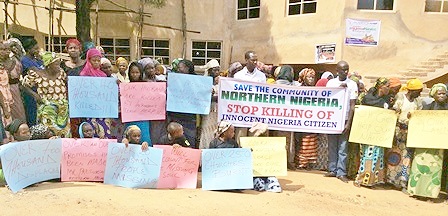
Displaced Christians expressed their anger at the headquarters of the Church of the Brethren, or EYN Church, in Jos. Nov. 17 World Watch Monitor
Displaced Christians expressed their anger at the headquarters of the Church of the Brethren, or EYN Church, in Jos.
photo: World Watch Monitor

Hundreds of Christians displaced by the Islamist insurgency in Nigeria’s North have been staging protests to express their anger over their government’s failure to protect them, reports World Watch Monitor.

On 25 November at least 78 people were killed when two suicide bombers attacked a market in northern Nigeria’s Maiduguri, the capital of Borno State, one of the most affected by the insurgency. The day before, suspected Boko Haram militants disguised as traders attacked Damasak town, near the Niger border, killing at least 48.

The demonstrators, from the northern states of Borno, Yobe, Adamawa, Gombe and others, gathered on 17 November at the headquarters of the Church of the Brethren, or EYN Church, in Jos, the capital of Plateau state.

One of the protesters, Hannatu Ishaku, had lost her husband and two sons in a night raid on their hometown of Damboa earlier this year. She said the morning following the raid, the villagers who had fled returned to the village to assess the extent of damage. That’s when she found the bodies of her husband, Yohanna Ishaku, and her two sons near a church building in the village.

“Maybe they had taken refuge at the church building when they fell into the hands of the attackers,” she said, sobbing.

Hannatu is left with two daughters. Along with thousands of Christians, they have sought refuge in Jos, the Plateau State capital.

The protest attempted to draw attention to the plight of internally displaced people, and to what they consider to be neglect by the federal government.

The Chairman of the Christian Association of Nigeria for the North Central Zone, Daniel Kadzai, said Christians in the north have lost confidence in the government’s ability to deal with the crisis.

‘‘The Federal Government has toyed with the lives and limbs of the Christians in Northern Nigeria for political gains.

“There is no explanation the government can give as to why the Federal troops will run away from the towns prior to the attack on such towns by Boko Haram without putting up any resistance, if the government does not have a hand in the whole genocide on Northern Christians as is being speculated in the local and foreign media,’’ Kadzai said.

The Church of the Brethren in Nigeria (EYN), based mainly in the northern part of the country, is the worst affected by the insurgency. Information released during the protest shows that the church has suffered heavy losses and damages over the 5 years of Boko Haram insurgency.

Over 8,000 of their members have been killed, while more than 700,000, mostly women and Children have been displaced and now scattered in places like Jos, Abuja, Kaduna and Yola. Some 270 churches have been razed completely by the insurgents.

These figures are not taking into account the most recent casualties resulting from the occupation of Mubi, Maiha, Hong and Gombi Local Governments, between September and November.

Kadzai also blamed what he said has been a slow response from the international community, despite the worldwide wave of solidarity raised by the April abduction of about 300 Chibok school girls by Boko Haram.

‘‘The international community has refused to notice the pogrom on Northern Nigerian Christians. Rather they have shifted their attention and resources only to Iraq, Syria, Gaza and Afghanistan as if those being killed in Nigeria are not human beings’’.

The Christian group urged the United Nations to send peacekeeping troops ‘‘to secure the lives of the remaining traumatized people.’’

In recent weeks, the militants have hoisted their flag over more than 25 towns and villages, and have declared the establishment of a Caliphate.

Meanwhile, the Nigerian senate has yet to vote on President Goodluck Jonathan’s request for further extension of emergency rule, which came to an end last week.

Some northern lawmakers reject the request, arguing that the emergency rule imposed in May 2013 and renewed once, has failed to protect civilians, still vulnerable to attack, in Borno, Adamawa and Yobe states.

Nigeria is ranked fourth on the Global Terrorism Index (GTI) for 2013, issued by the Institute for Economics and Peace. According to the index, more than 80 per cent of the lives lost to terrorists occurred in five countries – Iraq, Afghanistan, Pakistan, Nigeria and Syria.

The institute says Boko Haram is one of the four most-active militant organisations along with the Islamic State, the Taliban and al Qaeda.

Parliamentary questions: Iran, Sudan, asylum, Iraq and Syria

David Burrowes MP (Enfield, Southgate) (Con) has had his question, regarding the extent to which Iran fulfils its obligations under Article 18 of the UN Universal Declaration of Human Rights, answered by Foreign Office Minister Tobias Ellwood MP (Bournemouth East) (Con).

Mr Ellwood stated that in 2013, President Rouhani of Iran had made a number of comments in support of religious freedom. The Minister expressed disappointment that this had not translated in a significant change in Iran’s approach over the past year, as religious minority groups in Iran continue to face widespread discrimination. He said that the UK has repeatedly called on the Iranian Government to end all persecution of individuals on the basis of their faith.

Fiona Bruce MP (Congleton) (Con): To ask the Secretary of State for Foreign and Commonwealth Affairs, what discussions officials in his Department have had with the Iranian government on Iran’s compliance with Article 18 of the UN Universal Declaration of Human Rights (a) in general and (b) with reference to the reported comments on 6 October 2014 by Ali Yamesi, the adviser to President Rouhani on religious and ethnic minorities, on the illegality of religious conversion in Iran.

Foreign Office Minister Tobias Ellwood MP (Bournemouth East) (Con): The right to freedom of religion or belief, including the right to change one’s faith or beliefs, is a right which is enshrined in international human rights law. The UK government has consistently urged the Iranian government to respect the rights of all minority religious groups, in line with their international commitments. The UK last raised our concerns about freedom of religion in Iran during our inputs in Iran’s Universal Periodic Review at the UN Human Rights Council on 31 October. The UK’s non-resident Chargé d’Affaires to Iran also raised the issue of freedom of religion with Iranian human rights officials during a visit to Iran in March 2014.

David Simpson (Upper Bann) (DUP) has had his question, regarding the persecution of Christians in the Sudan region, answered by Foreign Office Minister James Duddridge MP (Rochford & Southend East) (Con).

Mr Duddridge said that the Government raises its concerns about freedom of religion with the Government of Sudan regularly. The Minister said that the British Embassy in Khartoum had raised this issue with the External Affairs Secretariat of the National Congress Party of Sudan recently. The Minister added that the Embassy regularly engages with Christian groups based in Sudan.

Lord Alton of Liverpool (CB): To ask Her Majesty’s Government how many refugees from the Christian communities of Iraq and Syria have been received into the United Kingdom in the last 12 months; and whether they intend to review immigration and asylum provisions for such Christian refugees in the light of the continuing attacks upon them in their home countries.

Home Office Minister Lord Bates (Con): All asylum claims are considered on a case-by-case basis in accordance with our international obligations, taking full account of the conditions in the country concerned. The Home Office does not systematically record the basis of a person’s asylum claim or the reason(s) why a person might be granted asylum, and therefore does not have accurate data on how many Christians from Iraq and Syria have claimed or been granted asylum in the UK.

In terms of reviewing our immigration and asylum provisions, the Home Office has recently updated its country information and guidance on Iraq and plans to do likewise on Syria shortly. The guidance to decision makers – as informed by the accompanying country information – recognises the precarious situation in parts of Iraq under the control of, or being contested by, the Islamic State in Iraq and the Levant (ISIL). It also recognises that particular groups, including Christians, are at heightened risk and are therefore likely to qualify for protection.

We continue to monitor the situation closely and, as the situation changes and more up-to-date information becomes available, we can and will update the country information and guidance to reflect this.

Lord Alton of Liverpool (CB): To ask Her Majesty’s Government what steps they are taking and intend to take in the future to ameliorate the situation of members of the Syriac Orthodox Church and other Christian communities in Iraq and Syria in the light of the rise of Islamic fundamentalism in those countries.

Foreign Office Minister Baroness Anelay of St Johns (Con): The British Government strongly condemns the persecution of communities on the basis of their religion, belief or ethnicity. We are concerned about the growing number of reports of Christians, and other minority groups, being targeted in Syria with many having already fled to camps in Lebanon, Turkey or Jordan. The UK has committed a total of £700 million in response to the humanitarian crisis in Syria and the region. Of this, £314 million has already been allocated to help ensure refugees from Syria are supported in neighbouring countries.

We are supporting non-governmental efforts to promote dialogue between different ethnic and sectarian groups in Syria, with a view to a future political settlement. We are also funding training for Syrian activists to document abuses to a criminal law standard with the aim that this documentation could be used in a future process of accountability. In Iraq we have committed £23 million of humanitarian assistance to help those who have fled Islamic State of Iraq and the Levant (ISIL) advances.

Following lobbying from the UK and other international partners, a resolution was passed at the Human Rights Council in September, mandating the Office of the High Commissioner for Human Rights (OHCHR) to despatch a mission to investigate and report on ISIL abuses. The Parliamentary Under-Secretary of State for Foreign and Commonwealth Affairs, my hon. Friend the Member for Bournemouth East (Mr Ellwood), met the Archbishop Athanasius of the Syriac Orthodox Church in London on 29 July to discuss the situation for religious groups in the region and issued a statement condemning reported threats against Christians in Iraq and Syria. We continue to encourage influential religious leaders in Iraq to speak out publicly and condemn sectarian violence.


Christian school in Bangladesh attacked

About 200 people, described as extremist Islamists, attacked a Christian school in Bangladesh which welcomes children of all faiths, in response to local outrage prompted by rumours stating the school was forcing Muslim children to convert to Christianity.

World Watch Monitor reports that the attack was on the morning of 5 November 5 at the South Korean funded Steve Kim Mission School located in Konabari town. The students were not physically injured, but 12 of its 14 members of staff were beaten. Sumitra Kunda, 25, a female teacher, endured a serious head injury. Another teacher, John Prokash Sarker, said that he managed to run away from six madrassa students, armed with knives and machetes, after being forced out of his classroom.

The attackers vandalised classrooms, destroyed the bakery and stole several items including computers and projectors. They also set fire to the library, burnt Bibles, hymnals and chairs; then cut the electricity lines of the school and destroyed a generator.

The vandalism lasted for about an hour and a half, and during that time, “A wave of panic swept through the school and traumatized everyone. Many students became sick in the following days.”

The school authority filed a case against 25 people in local police station after the incident. “We have arrested 17 people including three madrassa teachers,” police officer Khandoker Rezaul Hasan told World Watch Monitor.

Egypt’s President reminded of importance of religious freedom

Pope Francis met the Egyptian President Abdel Fattah Al-Sisi on Monday this week, commencing the start of the Arab leader’s first European tour. The visit was the first between an Egyptian leader and a Pope in eight years, since before the Arab Spring which ultimately propelled the Muslim Brotherhood’s Mohammed Morsi to power and the subsequent uprising which ousted him a year later. During their meeting Pope Francis stressed the importance of strengthening constitutional safeguards on human rights and religious freedom, adding that he hoped inter-religious dialogue would continue in Egypt.

A World Watch Monitor report headed ‘Kidnapping,’ forced conversion and collective punishment haunt Egypt’s Copts highlights events at Deir Gabal al-Teir village on 16 September. Egyptian security forces ambushed several Coptic homes in the middle of the night. They proceeded to steal and destroy the families’ belongings before dragging dozens of residents out of their beds, binding their hands behind their backs and beating them with batons. The police then proceeded to drag them to the police station by a single rope.

The security forces collectively punished the villagers in response to a demonstration initiated by a group of Copts the previous day. They were protesting outside the station to pressure the police to investigate the disappearance that initially occurred nearly two weeks earlier, of 39-year-old Coptic woman Iman Morqos Saroufim.

“The police brutality in this situation is similar to attacks under the former Egyptian President Hosni Mubarak’s time. It’s the same old thing,” a Cairo pastor told World Watch Monitor.

Persecution raised at Prime Minister’s Questions

Jeremy Lefroy (Stafford) (Con):
Christians and others are being murdered for their faith in Nigeria, Syria, Iraq, Pakistan and many other countries. Elsewhere, it is a crime to believe anything other than what the state sanctions. Does my right hon. Friend agree that our United Kingdom stands, above all, for freedom of speech, thought and belief, and that we must do all in our power to protect the persecuted and stand up to the persecutors, whoever they are?

The Prime Minister:
I very much agree with my hon. Friend; he is right to make this such a cause, and to pursue it in the House and outside it. Britain has a proud record of political and religious tolerance—and, of course, of freedom of speech. In our dealings with other countries, we should always make it clear that we believe that to be the right approach. There is an appalling amount of persecution of religious minorities around the world, and some now say that Christians are more persecuted than other religions in too many countries, some of which my hon. Friend has named. We should make sure that this key issue of religious tolerance is at the heart of our foreign policy.

19 November 2014