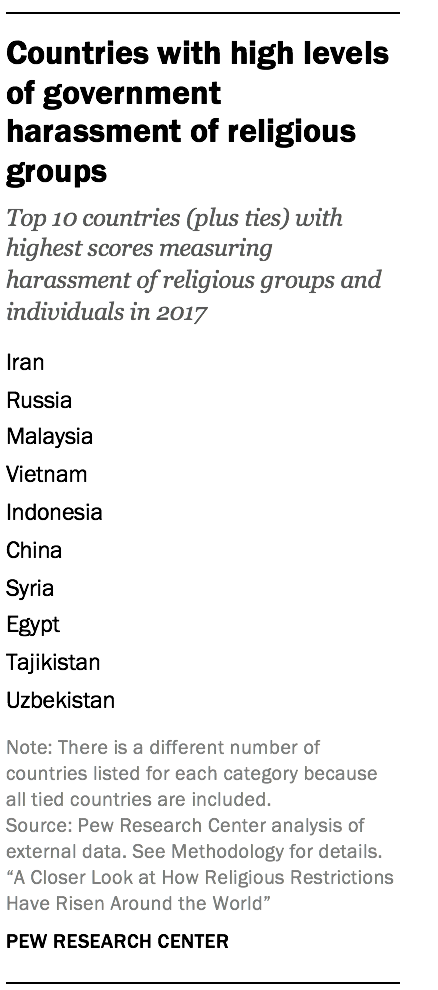
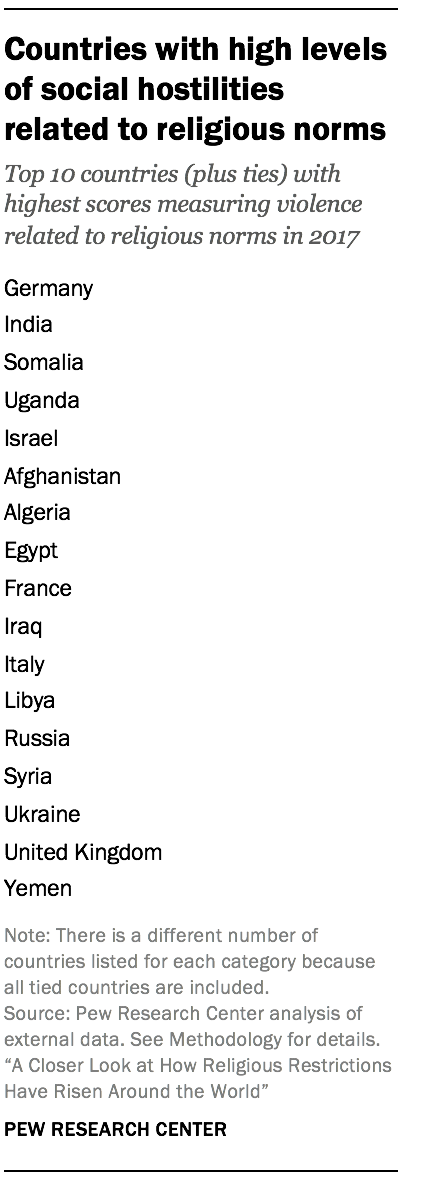
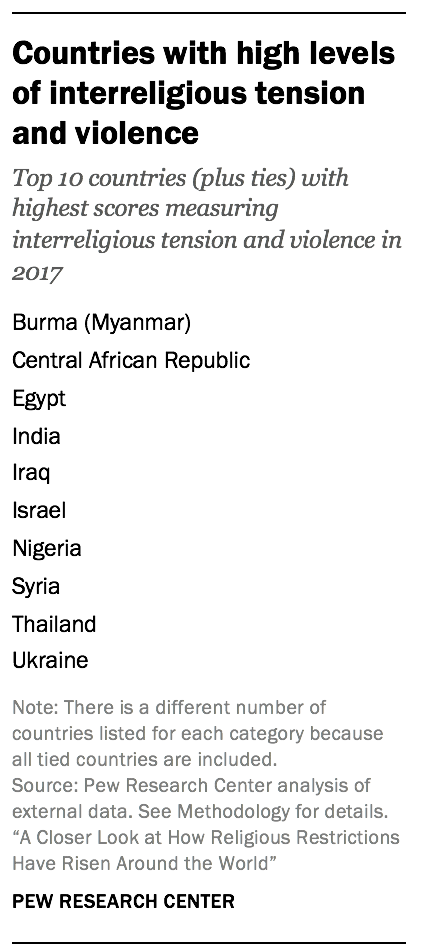
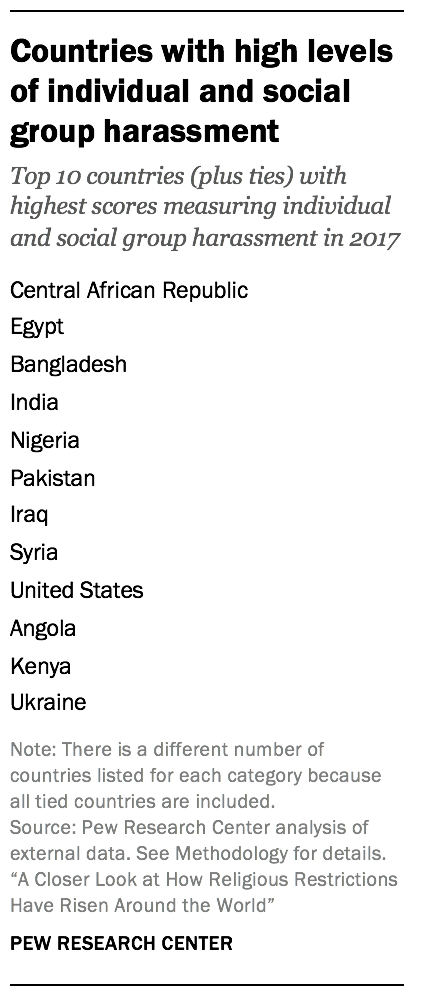
Five reasons the world needs a wake-up call on religious persecution

All over the world, people – and whole communities – are suffering from persecution purely because of their religion or beliefs. This kind of violence – including attempts to annihilate whole religious groups – is on the rise.

In the past five years alone, there have been two mass atrocities which meet the United Nations’ legal definition of genocide.

So August 22 – a day specially established by the United Nations to help raise awareness of this discrimination and abuse – shines a light on those dark corners where acts of violence based on religion or belief are a daily reality.

1) Daesh’s reign of terror

In 2014, Daesh (Islamic State, ISIS, ISIL) attacked religious Yazidi and Christian minority groups in Iraq in an attempt to destroy them and establish a purely Islamic state. Daesh’s campaign of terror involved murder, kidnapping, people trafficking, rape, sexual slavery and the destruction of cultural heritage. All this because the victims belonged to different religious groups.

2) The Rohingya crisis

In 2016, atrocities perpetrated by the Burmese military against the Rohingya Muslims in Rakhine state reached the level of genocide, resulting in more than 700,000 people forcibly displaced to Bangladesh in pursuit of a safe haven.

As the independent international fact-finding mission on Burma reported, “the nature, scale and organisation of the operations” suggested a level of pre-planning and design on the part of the Tatmadaw (military) leadership”. The atrocities reinforced the vision of the commander-in-chief, senior-general Min Aung Hlaing, who sought a solution to what he referred to as “The Bengali problem”.

By the Bengali problem he meant the Rohingya Muslims who for decades have been referred to as illegal immigrants from Bangladesh.

3) Christians in Nigeria

In Nigeria’s Middle Belt, Christians farmers have been slaughtered by Fulani herdsmen, attacks that have claimed hundreds of lives. Meanwhile in northern Nigeria, Boko Haram continues to terrorise the region and kill anyone who does not agree with its perverted ideology.

4) Oppression in China

An estimated one million Uighur Muslims have been detained in so-called “re-education camps” which are designed to strip them of their religious and ethnic identity and replace it with absolute loyalty to the state. Also in China, members of Falun Gong (a religious spiritual practice) are imprisoned and many of them subsequently disappear without a trace.

5) Persecution in Pakistan

In Pakistan, religious minorities, including Christians and Ahmadis, are subjected to severe discrimination that often translates into acts of violence perpetrated with impunity. For example a Christian couple, Shahzad and Shama Masih, were beaten and burnt alive by a mob for allegedly desecrating the Koran.

There have been instances of Christian and Hindu girls and women being abducted for forced conversion and marriage, while religious minorities suspected of blasphemy have been attacked and murdered by angry mobs.

But even the justice system is not able to provide victims with a fair trial or redress. For example a Christian woman, Asia Bibi, spent nine years on death row after being accused of blasphemy. Her conviction was ultimately overturned after an international outcry but there are many more facing death on accusations of blasphemy.

So what needs to be done?
States and civil society representatives must mark the International Day Commemorating the Victims of Acts of Violence Based on Religion or Belief uniting behind the common aim of addressing this neglected issue.

This initiative is intended to raise awareness and provide a springboard towards an action plan rather than being an end in itself. What will become of this day is up to all states, civil society and individuals. Everyone needs to play their role in making this a meaningful day – one that can bring a change to the lives of the people targeted for their religion or belief.

Any action plan needs to address the different types of atrocities perpetrated in different parts of the world and improve human rights by adjusting them to international standards. Introducing mechanisms to strengthen implementation and oversight would be key. Also, placing more focus on criminal prosecutions would help deter crime and human rights violations.

The Bishop of Truro, Philip Mounstephen, published a report in July 2019 into the Foreign and Commonwealth Office’s response to the persecution of Christians around the world. The report contains several recommendations on how to strengthen its response.

The report says more should be done to obtain reliable information about the situation of persecuted communities. It calls on the FCO to introduce new implementation mechanisms to strengthen its response to persecution and champion the international efforts on combating impunity for mass atrocities based on religion or belief. While the recommendations were written with the UK’s FCO in mind, these are valid recommendations that could be adopted by other states as well.

As Lord Ahmad – the minister of state for the Commonwealth, the UN and South Asia – has emphasised:

“Our biggest challenge is not when we stand up for our own rights and beliefs. The real test is when we stand up for the rights and beliefs of others.”

Ewelina Ochab

Reprinted, with permission, from theconversation.com  

Commemorating Victims of Violence Based on Religion and Belief

The UN Secretary-General António Guterres’ has issued this message for the International Day Commemorating the Victims of Acts of Violence Based on Religion and Belief, observed on 22 August:

Over the past few months, we have seen increasing numbers of attacks against individuals and groups targeted simply because of their religion or belief. Jews have been murdered in synagogues, their gravestones defaced with swastikas; Muslims gunned down in mosques, their religious sites vandalized; Christians killed at prayer, their churches torched.

Many assaults, like those in New Zealand, Sri Lanka and the United States, have specifically targeted places of worship. And in many conflicts around the world, from Syria to the Central African Republic, entire communities have been attacked on the grounds of their faith.

All major world religions espouse tolerance and peaceful coexistence in a spirit of shared humanity. We must resist and reject those who falsely and maliciously invoke religion to build misconceptions, fuel division and spread fear and hatred. There is richness and strength in diversity; it is never a threat.

Today we observe the first ever International Day Commemorating the Victims of Acts of Violence Based on Religion and Belief. On this Day, we reaffirm our unwavering support for the victims of violence based on religion and belief. And we demonstrate that support by doing all in our power to prevent such attacks and demanding that those responsible are held accountable.

The United Nations is stepping up action through two new initiatives – a first-of-its-kind UN Strategy and Plan of Action on Hate Speech, and a Plan of Action to safeguard religious sites. The best way to overcome the threat of violence based on religion and belief is by uniting our voices for good, countering messages of hate with messages of peace, embracing diversity and protecting human rights. The world must step up to stamp out anti-Semitism, anti-Muslim hatred, the persecution of Christians and other religious groups, and all forms of racism, xenophobia, discrimination and incitement to violence. As members of the human family, we must nurture mutual understanding. We all have a responsibility to look out for each other, to respect differences and to promote peaceful coexistence.

UN General Assembly adopts 22 August as International Day Commemorating the Victims of Acts of Violence Based on Religion and Belief

APPG Statement

Foreign Affairs Committee Inquiry into Freedom of Religion or Belief

Human rights: Freedom of religion and belief, and human rights defenders inquiry

Inquiry status: open – accepting written submissions; the deadline is Friday 20 September 2019.

Scope of the inquiry
Terms of Reference

This inquiry will examine the FCO’s human rights programmes and priorities, with a focus on its work on two issues: freedom of religion and belief (FORB) and the work of human rights defenders overseas. These have both been highlighted as priorities by the FCO. The Prime Minister appointed a Special Envoy on Freedom of Religion or Belief in July 2018, and in December of that year the Foreign Secretary announced an independent review into the persecution of Christians overseas. The FCO has committed to strengthening its support for human rights defenders, and to making this more transparent in 2019.

The Committee welcomes written submissions focusing on the following:

General

  • What changes have there been in the last year to the FCO’s human rights priorities and programmes, and to its annual report on Human Rights and Democracy?
  • What impact is the new Human Rights Ambassador expected to have?

Freedom of religion and belief

  • How effective is the FCO’s support for FORB, and is this sufficiently prioritised within its human rights work?
  • How satisfactory was the recent independent review into the persecution of Christians overseas, in its scope and its execution; what has the FCO done to follow up on its conclusions and recommendations; and what are its implications for the FCO’s work on FORB?
  • What has been the impact of the Prime Minister’s Special Representative on FORB?
  • What role does the FCO play in shaping work by DfID, the Home Office, and other departments around FORB?

Human rights defenders

  • Is support for human rights defenders sufficiently prioritised within the FCO’s human rights work?
  • How effective has the FCO been at protecting civil society space and human rights defenders? To what extent are civil society groups based in the UK and abroad able to engage with the FCO on relevant policies and programmes?
  • What role does the FCO play in shaping work by DfID, the Home Office, and other departments around these issues?
  • In light of the above, is the UK Government’s new framework for UK support for HRDs adequate,  including as regards dissemination, and monitoring and evaluation of implementation?
Send a written submission

Lords discuss FCO persecution of Christians report

Lord Singh of Wimbledon
To ask Her Majesty’s Government what assessment they have made of the recommendations of the Bishop of Truro’s Independent Review of the Foreign and Commonwealth Office’s support for persecuted Christians.

The Minister of State, Foreign and Commonwealth Office (Lord Ahmad of Wimbledon) (Con)
My Lords, the Bishop of Truro’s independent review of FCO support for persecuted Christians proposed a series of ambitious recommendations, which the British Government have considered carefully. We accept all the recommendations, and we will take them forward as part of our work to support freedom of religion or belief for all.

Lord Singh of Wimbledon (CB)
I thank the Minister for his helpful reply. Sadly the appalling treatment of Christian minorities around the world is mirrored in the persecution of other religious minorities, including the appalling treatment of his Ahmadiyya community in Pakistan. In Afghanistan a once-prosperous Sikh community of more than 20,000 people has been reduced to a few hundred. Does the Minister agree that the underlying cause of religious persecution is the religious bigotry inherent in aggressive assertions that the one god of us all, way above human emotions, favours one group of humans to the exclusion of others?

Lord Ahmad of Wimbledon
I thank the noble Lord. There is the thought for the afternoon. I am grateful for his work in this area and agree with him. I was the Prime Minister’s envoy on freedom of religion or belief when it was first suggested that we look at persecuted Christians. Of course, when we look at Christian persecution around the world, the figures and the persecution are horrendous. Equally, where Christians are persecuted we can be sure that, tragically, other religious minorities are also persecuted. It is right that this was done and we look forward to working with all across this House and beyond to ensure that we can implement effectively so we can be a voice for people of all faiths. I have been incredibly heartened and totally humbled by meeting surviving victims of religious violence and religious persecution because in their courage lies inspiration for us all.

Lord Anderson of Swansea (Lab)
My Lords, in Syria, Christians are afraid to enter UNHCR camps because of violence against them, and there is also violence in the camps in Germany, yet the Government accept only refugees from those camps, unlike Belgium and Australia. The result is that in the first quarter of 2018, no Christians from Syria were accepted in this country and the Government have steadfastly refused to give any figures since because of the likely embarrassment. Why is that? Is it post-imperial guilt or are the Government discriminating against Christians from Syria?

Lord Ahmad of Wimbledon
On a lighter note, this is the second day running that I have been asked about post-imperial guilt. The irony is not lost on me. On standing up for persecuted Christian minorities around the world, I am proud of the record of this Government and previous Governments, who have done the right thing. The noble Lord raises an important point about granting asylum and refuge to people from persecuted communities, including Christians, and I believe that the Government have focused on that. We have sought to work with the UNHCR to ensure that applications are progressed effectively and efficiently. There has been a suggestion that Christians should be prioritised over others. I believe that, whether you are Christian or of any other faith, or of no faith whatever, common humanity dictates that we stand up for the rights of others, including Christians, as well as our own rights.

Baroness Berridge (Con)
My Lords, I am grateful to my noble friend but one factor influencing the persecution of Christians is, unfortunately, that in some contexts they are seen as a leftover from the Empire. Has my noble friend considered whether the UK Government taking on the role of defining anti-Christian hatred could expose victims of persecution to more risk? Surely this is a role for communities—for example, the Jewish community has done this and the Muslim community is doing it—rather than for the UK Government. At the very least we should assess the risk to ensure that we do not inadvertently increase the risk of Christians being persecuted.

Lord Ahmad of Wimbledon
I agree with my noble friend on both her points. In answer to her and to the noble Lord, Lord Anderson, one issue that the Bishop of Truro identified in his report was that singling out Christians for support and for the processing of claims of religious persecution or requests for asylum would, as my noble friend has articulated, put them at greater risk. I also agree with her totally that it is right that community and faith leaders define religious hatred, as has been the case with the IHRA definition of anti-Semitism. We are currently looking at the issue of Islamophobia. It is for communities to do that and it is for Governments to ensure the protection of all faiths and none.

The Lord Bishop of Ely
My Lords, we on this Bench welcome the report and look forward to working with the Government as they take forward its recommendations. With regard to the recommendation to name the phenomenon of Christian discrimination and persecution, does the Minister accept that there is nothing to be gained and everything to be lost by encouraging a competition for victim status, and that such energy would be better spent in further developing the framework of international human rights protection?

Lord Ahmad of Wimbledon
I totally agree with the right reverend Prelate.

Lord Alderdice (LD)
My Lords, I welcome the Minister’s undertaking that the Government will accept all the recommendations in the Bishop of Truro’s report, and I congratulate him on his work over the last few years in the area of freedom of religion and belief. One of the report’s recommendations was that Her Majesty’s Government should use the opportunities provided by the international institutions of which they are a part. Regarding the United Nations Human Rights Council, we have had a special rapporteur going right back to the days of the Commission on Human Rights and there have been regular resolutions—I think that the last one was on 21 March this year—with lots of wonderful words. Disappointingly, however, on a daily basis members of the UN Human Rights Council, the Security Council and even the P5 disregard all the fine words in those resolutions as a matter not of accident but of public policy in discriminating against people who have a different religion or belief. How will the Government use their membership of the Security Council and the United Nations Human Rights Council to bring about a change, as identified in the bishop’s report?

Lord Ahmad of Wimbledon
On the noble Lord’s second point on the UN Human Rights Council, we have made sure, through repeated UPRs on every country, that freedom of religion or belief is a specific question raised with countries of particular concern. I agree with the noble Lord about the institutions of the UN. Currently the issue of freedom of religion or belief sits with an organisation called the Alliance of Civilizations—I must admit, when first raised with me, it took me back to my A-level history on Aztecs and Incas—which exists for that purpose, but I support the noble Lord’s view that there is more to be done. I am delighted that the United Kingdom lent support to the resolution that 22 August will be the international day marking freedom of religion or belief, focusing on persecuted minorities, faith minorities and those of other beliefs around the world. We will work on an Arria formula meeting with Poland, which will chair the Security Council in August, to ensure that this issue is given the priority that it deserves.

Twenty Years of Falun Gong Persecution in China

On 16 July, Jim Shannon MP hosted a seminar ‘How the UK Might Get China to Stop Committing Crimes Against Humanity’ marking the 20th year of persecution for Falun Gong in China.

The seminar covered the background of Falun Gong, the persecution in China as well as the recent judgment by the China Tribunal and current legislation enacted to combat organ harvesting.

“Falun Gong is an ancient Buddhist practice teaching truthfulness, compassion and tolerance,” said Caroline Yates from the Falun Dafa UK Association. She explained that when Falun Gong reached about 70 million adherents in China was when Jiang Zemin gave the directive to “eradicate” the group in July 1999.

The persecution has been long and brutal. Reports of torture and death are common and estimates of 500,000 to 1,000,000 practitioners are imprisoned at any given time for their faith.

The most horrific aspect of the persecution are the reports that Falun Gong prisoners of conscience have been killed in vast numbers in order to provide organs for the burgeoning organ transplant industry run by the Chinese state.

Professor Martin Elliott, speaking on behalf of the China Tribunal, explained how a People’s Tribunal is used when other organisations fail to address important issues. In this case, the China Tribunal was asked to investigate organ harvesting of prisoners of conscience in China.

He added how the tribunal members created a ‘firewall’ of legal counsel so as to maintain their independence. Each of the seven expert members heard and read all the submissions on organ harvesting. At each step they also asked the People’s Republic of China to contribute submissions as well in order to be even-handed.

All of the information about the tribunal working method and judgement is available here

The China Tribunal reached a final judgment on 17 June and Professor Elliott read the short form conclusion:

“Forced organ harvesting has been committed for years throughout China on a significant scale and that Falun Gong practitioners have been one – and probably the main – source of organ supply. The concerted persecution and medical testing of the Uyghurs is more recent and it may be that evidence of forced organ harvesting of this group may emerge in due course. The Tribunal has had no evidence that the significant infrastructure associated with China’s transplantation industry has been dismantled and absent a satisfactory explanation as to the source of readily available organs concludes that forced organ harvesting continues till today.”

Ms Yates also covered the legislation that other countries have enacted as a response to organ harvesting in China. To date, nine European countries ratified the Council of Europe Convention Against Trafficking in Human Organs (No 216). Israel enacted the 2008 Organ Transplant Act. Spain enacted new Criminal Code Article 156. Italy enacted legislation No 235/2016. Taiwan amended the Human Organ Transplantation Act. Belgium passed the “Bill on trade in human organs on the principle of non-punishment for victims of human trafficking”. Canada has passed a third reading in the House of bill S-240 amending the Criminal Code and Immigration and Refugee Protection Act (trafficking in human organs).

All of these enactments of legislation were a direct response to the evidence of organs from prisoners of conscience being used for organ tourism in China. The Czech Republic enacted the Council of Europe treaty in March of this year. Senator Marek Hilšer was reported to have said, “It is a public secret that China’s booming transplant industry is the result of taking organs from political prisoners and the Chinese communist regime makes money from this. If we cannot directly influence these crimes, it is our moral duty to adopt legislation to combat organ transplant tourism”

Caroline Yates
Falun Dafa Association UK


On 25 July this issue was raised in the House of Lords:

Lord Collins of Highbury
To ask Her Majesty’s Government what assessment they have made of the Final Judgment and Summary of the Independent Tribunal into Forced Organ Harvesting from Prisoners of Conscience in China, published on 17 June.

The Minister of State, Foreign and Commonwealth Office (Lord Ahmad of Wimbledon) (Con)
My Lords, I note the time and energy that the International Coalition to End Transplant Abuse in China has dedicated to this issue. Officials have reviewed the evidence thoroughly. While the evidence is not incontrovertible, we have consulted the World Health Organization and international partners. The evidence provided disturbing details about the mistreatment of Falun Gong practitioners, and raised worrying questions about China’s transplant system. We continue to monitor all available evidence in this regard.

Lord Collins of Highbury (Lab)
I thank the Minister for his response and welcome him back to the Dispatch Box. I am glad to see that he is still here; we hope he will still be here in September. The fact is that the tribunal’s evidence was pretty strong but the WHO is saying that the Chinese transplant system is ethical. Will the Minister take this up and say that the Government should ask the WHO to examine the tribunal’s evidence and explain why it does not think it sustains the argument that harvesting for transplants is going on?

Lord Ahmad of Wimbledon
I know the noble Lord has raised this question before, as have others from the opposition Benches and the government Benches, including the noble Lord, Lord Hunt. I agree with the noble Lord, Lord Collins; the ambassador and I have pressed the WHO on this very issue. The evidence that it uses is based on the self-assessment made by the country that is a signatory, and in this case that is China. The question is whether the country meets the threshold that it has signed up to; a few countries would perhaps admit that they did not. The noble Lord makes a very valid point and I assure him that I continue to press this issue directly with the WHO. We continue to press on this issue directly and bilaterally with the Chinese authorities as well.

Lord Dholakia (LD)
My Lords, is the Minister aware that government departments often make use of in-country reports, particularly on matters relating to immigration and asylum? Now that the tribunal’s report is available, will the Minister ensure that it is put on the Foreign and Commonwealth Office website so that people travelling to China for medical tourism are aware of how such organs are secured? There seems to be no transparency on this matter. We have a proud tradition of respecting the human rights of individuals wherever they may be. Surely our bilateral trade arrangements should not impede that exercise.

Lord Ahmad of Wimbledon
I will certainly take the noble Lord’s first suggestion back to the FCO. The issue of people travelling to China has been taken up before. Both I and the Minister in the other place have taken it up directly with the Home Office. We as Foreign Office Ministers have written to the Home Office to explore this issue, and my understanding is—[Interruption.] Maybe that is the Home Office calling the noble Lord, Lord Desai. My understanding is that Canada, Spain, Israel, Italy and Taiwan have now implemented schemes on the very issue of monitoring people travelling to China for transplants. That is something I wish to explore further with Home Office colleagues.

Lord Alton of Liverpool (CB)
My Lords, is the Minister aware that witnesses at last night’s inaugural meeting of the all-party parliamentary group on Uighurs expressed great concern that many of the Uighurs in detention centres—there may be as many as 1 million—along with Falun Gong practitioners and people from other minorities are being targeted through DNA tests, which they fear may then be used for the harvesting of organs?

Will the Minister respond to the question of the noble Lord, Lord Collins, about the World Health Organization, given that 34 parliamentarians wrote in April asking for a response from the WHO? As one has not been forthcoming, will he press the WHO to give that response? Will he also undertake to meet Sir Geoffrey Nice QC, who chaired the independent tribunal?

Lord Ahmad of Wimbledon
I will, of course, be pleased to meet Sir Geoffrey Nice. The other issue, as I told the noble Lord, Lord Collins, is something that I am pressing for directly. We will follow up with the World Health Organization on this matter.

Baroness Berridge (Con)
My Lords, it seems from this inquiry that the time you have to wait for an organ transplant in China is a matter of weeks, as opposed to every other country in the world, including similarly populous countries such as India, where you wait months, if not years. Could my noble friend meet his counterpart in the Department of Health and Social Care to discuss this? Maybe the Chinese have discovered some miracle option in transplant matching that the rest of the world, including the NHS, needs to know about.

Lord Ahmad of Wimbledon
I thank my noble friend for that useful suggestion. I am sitting next to my noble friend the Health Minister and I am sure she has made a note of this. We can probably arrange that meeting pretty quickly.


Commons debates Persecution of Christians Overseas

House of Commons 18 July

Chris Philp (Croydon South) (Con)
I beg to move, that this House deplores the persecution of Christians overseas; supports freedom of religion or belief in all countries throughout the world; welcomes the work undertaken by the Bishop of Truro in this area; and calls on the Government to do more with the diplomatic and other tools at its disposal to prevail on the governments of countries in which persecution of Christians is tolerated or encouraged to end that persecution and to protect the right to freedom of religion or belief.

I thank, especially, the hon. Member for Strangford (Jim Shannon), my hon. Friend the Member for Congleton (Fiona Bruce) and the hon. Member for Glasgow East (David Linden), for their work in securing the debate. I congratulate the Bishop of Truro on his report, which was published 10 days ago. I also thank Open Doors and Aid to the Church in Need for their tireless work on this issue.

Around the world, there are horrifying stories of Christians being attacked and often killed, of churches being destroyed, and of Christians being persecuted and prevented from worshipping. This is happening on an industrial scale in multiple countries. Often, the Governments in those countries turn a blind eye, or are even responsible for the persecution themselves. Christianity is the most persecuted religion in the world. The International Society of Human Rights says that 80% of religious persecution in the world is against Christians. Open Doors estimates that 245 million Christians around the world—one in nine—face persecution. Here are some examples.

In April 2017, a young Nigerian woman, Dorkas Zakka, was murdered, along with 12 others, simply for attending an Easter mass. Local priest Father Alexander Yeycock said that Nigerian military units stood by and did nothing while the murders took place. In November 2017, in Mina, Egypt, a mob surrounded a Coptic church threatening worshippers inside, many of whom were also physically attacked. Local Coptic leader Anba Macarius said that the Egyptian authorities had done nothing to bring those responsible to justice.

Sammy Wilson (East Antrim) (DUP)
The hon. Gentleman is describing very accurately what is happening to Christians across the world. Given the involvement of the authorities in the two countries that he has mentioned, and in many other countries—countries to which we give considerable aid in the form of money, expert advice and so on—does he believe that the Government could put more pressure on them by withdrawing that aid, or at least threatening to do so?

Chris Philp
Yes, I completely agree with that point and will discuss it shortly. We give lots of money to countries where the Governments themselves are turning a blind eye to, or even themselves actively encouraging or carrying out, persecution, and we should be attaching conditions to the aid we give and in extreme cases even withdrawing it entirely; I therefore agree completely with the point that the right hon. Gentleman makes.

In Pakistan, Christian woman Asia Bibi was sentenced to death for blasphemy in 2010. She is now in safety in Canada, but the very cell in which she was incarcerated now holds Shagufta Kausar, a Christian 45-year-old mother of four who was sentenced to death for blasphemy in 2014; the very cell that Asia Bibi was held in now contains another Christian woman, also under sentence of death.

Rehman Chishti (Gillingham and Rainham) (Con)
I welcome what my hon. Friend is saying. He mentioned the issue of Asia Bibi and Pakistan. Many in this House have said from the very beginning of that case that Asia was being persecuted for her faith and that countries around the world, in line with their religious belief and commitment, should have offered her asylum. The United Kingdom should have done that; we did not. Does my hon. Friend agree that after this report our foreign policy must change, so that rather than hiving off our responsibility on religious freedom to Canada and other countries, we should offer asylum to those being persecuted like Asia Bibi?

Chris Philp
That is a question that requires very serious consideration, and of course there are many persecuted Christians from countries such as Iraq and Syria who might wish to seek asylum as well.

Last year, again in Pakistan, Suneel Saleem was beaten to death by a group of doctors—a group of doctors—in the Services hospital in Lahore when he protested about the anti-Christian abuse his heavily pregnant sister had suffered at the hospital. The US State Department says that the Pakistani Government themselves have

“engaged in or tolerated systematic, ongoing and egregious violations of religious freedom”.

Yet, just a few weeks ago Pakistan’s Foreign Minister speaking in Brussels dismissed concerns as being “whipped up” by “western interests.” His attitude is not acceptable, especially bearing in mind that the UK Government send £463 million a year in aid to Pakistan—it is the single biggest recipient of UK overseas aid, but we do not attach conditions about ending persecution of religious minorities.

The litany of persecution goes on. In May 2017 two churches in Sudan were destroyed on the orders of the Government. In June 2017 some 33 Christian women in Eritrea were imprisoned by the Eritrean Government simply for taking part in prayer. And in India, 24,000 Christians were physically assaulted last year. Prime Minister Modi dismissed that as “imaginary fears”; he is wrong and we should say so.

Dr Lisa Cameron (East Kilbride, Strathaven and Lesmahagow) (SNP)
The hon. Gentleman is making an excellent speech on a very important issue. Does he agree that we must also be very careful that individuals in this country have freedom of religious belief, particularly given the level of abuse and intolerance following the votes last week on abortion? Does he also agree that we should decry the fact that at St Vincent de Paul parish in East Kilbride in my constituency parishioners arrived this morning to find that their Our Lady of the Grotto had been destroyed by mindless vandals? Does the hon. Gentleman agree that these issues are also troubling people across the United Kingdom?

Chris Philp
The hon. Lady is right. Of course, the first place that we should champion and protect religious freedom is here in the United Kingdom; that is of course our first duty as Members of Parliament, but let us not forget the duty we also owe to persecuted minorities around the world—to stand up and protect them as well.

In Saudi Arabia public places of Christian worship are banned. There are regular crackdowns and raids on private Christian ceremonies, and Christians in Saudi Arabia are regularly imprisoned. Saudi Arabian schools use textbooks that teach hatred against Christians and Jews, and the country’s Grand Mufti recently said that Christianity is not a religion.

Christians are often a target for religious extremists. The terrible attack in Sri Lanka at Easter this year saw 259 people murdered by Islamist extremists, and on Palm Sunday in Egypt in 2017 ISIS bombers murdered 45 Coptic Christians. In Pakistan the year before, again at Easter, the Taliban murdered 75 Christians. These are just a few of the terrible examples of the persecution and murder that Christians around the world are suffering.

Richard Graham (Gloucester) (Con)
My hon. Friend is making a powerful case, and the Bishop of Truro’s report is a very strong one, but I am sure that my hon. Friend would also recognise that there are terrible cases of persecution against other religions elsewhere in the world, of which that against the Muslim Rohingya in Burma is one of worst recent examples. Does he agree that there are cases about religions in general which the Foreign Office should also be considering in its policy?

Chris Philp
Yes, of course the Foreign Office should take a strong position on the persecution of any religious minorities, and of course the persecution of the Rohingya Muslims in Burma is a particularly egregious example. I am certainly not saying that we should ignore other examples of persecution, but I am drawing the House’s attention to the fact that 80% of religious persecution around the world is committed against Christians, and we should be mindful of that.

Stephen Doughty (Cardiff South and Penarth) (Lab/Co-op)
I completely agree with what the hon. Gentleman is saying about this situation, which is deeply horrific. I, too, spoke on an Open Doors panel, at the Labour party conference last year. He mentioned Saudi Arabia and Pakistan; does he accept that there is a fundamental problem here in that we have a series of alliances and relationships with these countries, but often turn a blind eye to the fact that they are persecuting Christians and indeed other religious minorities? Does he also agree that there is another problem in that we often do not know how many Christians are even in those countries, because people are fearful of stating what their religion is in the first place?

Chris Philp
I agree with both points—not knowing how many people are affected and the fact that we have quite close relationships with some of these countries.

For western Governments to fail to act makes us in many ways complicit in some of these outrages. As the noble Lord Alton has argued many times, failing to stand up to protect minorities simply serves to encourage the persecutors. Lord Alton has often referred to the fact that the world’s indifference made possible the slaughter of 1.5 million Christian Armenians between 1915 and 1917. He makes the point that ignoring some of these atrocities encourages even worse atrocities to be perpetrated in the future; Lord Alton has made that point very powerfully on many occasions.

Against that backdrop, the Bishop of Truro’s work has never been more important, and I fully support his report. The Bishop finds that the persecution and murder of Christians around the world is

“the most shocking abuse of human rights in the modern era.”

In particular, I support the Bishop’s call for a UN resolution stating that those countries that are responsible for tolerating or encouraging the persecution of Christians and religious minorities must instead protect them.

Bob Stewart (Beckenham) (Con)
I am afraid I have seen instances of Christians killing Christians; obviously, I am referring to Bosnia, where I witnessed that. So it is not just other religions having a go at Christians; it is actually Christians on Christians—almost blue on blue.

Chris Philp
I am aware of my hon. Friend’s military service in Bosnia and the fact that he was in the country when the Srebrenica massacre of 1995 took place, and we should be mindful of those sorts of atrocities as well as the other ones we are talking about today.

I also support the Bishop of Truro’s call for the Government and the UN to impose sanctions on those countries who fail to protect religious minorities, and I also support his call for British diplomatic staff to be trained on this issue and for it to be made a priority of British foreign policy to put pressure on Governments who are turning a blind eye to this.

There is even more we can do. As the right hon. Member for East Antrim (Sammy Wilson) suggested in his intervention, many of the countries where the persecution of Christians is tolerated or even state-sponsored receive direct foreign aid from the United Kingdom. Many of those countries will wish to secure trade and investment deals with us and many of them also buy arms from the UK, which requires a UK Government export licence. I would like to see the UK Government do more to link overseas aid, trade and arms exports to real progress in tackling the persecution of religious minorities. Why should we send British taxpayers’ money to a Government, or indeed sell them arms, when they allow or encourage the persecution of religious minorities? Ideally, we should ensure that these steps are taken on a multinational basis, together with our European Union and United Nations partners, but if that cannot be secured, the UK should be prepared to act alone. The UK Government cannot and must not simply mouth platitudes; we must take real action. By approving the motion today, this House will make clear its view. The Government should then act.

Susan Elan Jones (Clwyd South) (Lab)
It is a great pleasure to follow the hon. Member for Croydon South (Chris Philp), who made a very thoughtful speech. Mention has been made of the hon. Members for Strangford (Jim Shannon), for Congleton (Fiona Bruce) and for Glasgow East (David Linden), and I want to thank them for requesting this debate and for their tireless campaigning work in this area. Above all, I think we would all wish to thank the non-governmental organisations, including Open Doors, that have kept these issues in our consciousness for years. We must also thank our constituents who have kept Members across the House informed, and I would like to thank the members of the Penycae Neighbourhood Church of the Nazarene who have kept me informed of meetings that have been happening.

Freedom of belief is a basic human right. It is not a western construct; it is a basic fact of being human. Article 18 of the United Nations universal declaration of human rights makes it clear that everyone has the right to freedom of thought, conscience and religion. This right includes a person’s freedom to change their religion or belief and the freedom, either alone or in community with others and in public or private, to manifest their religion or belief in teaching, practice, worship and observance.

I commend the Foreign and Commonwealth Office and the work that the Bishop of Truro has done in looking at the specific issue of persecution against Christians, simply because of the scale of it. Open Doors is now saying that extreme persecution has increased from being found in one country to 11 countries over five years. There has been a rise in hate speech in state media and by religious leaders. This House, the European Parliament and the US House of Representatives have declared that ISIS atrocities against Christians and other religious minorities—for example, against the Yazidis and Shi’a Muslims—met the tests of genocide. I would like to see that recognised by the UK Government.

However inconvenient it might be for politicians from western democracies, we must recognise that part of that universal declaration includes the right to convert or to change religion or belief, including the right to have no belief, which is a fundamental part of religious freedom. This is not about western values; it is about universal human values, and any extreme form of nationalism that does not allow for conversion goes against that fundamental tenet.

Mention has rightly been made of the Commonwealth, which has a real role to play in this. The blasphemy laws in Pakistan are a total obscenity. They are not somehow loosely based on the codification of laws in the 1860s. Since the 1980s, crimes under these laws have increased, prejudicing religions including certain types of Islam and Christianity, and that is a disgrace.

I would also like us to reflect on an issue of general concern—the death penalty. We have seen an increased use of the death penalty, and the Centre for Social Justice in Pakistan has stated that its use has increased for people accused of blasphemy. In the United States, 29 states still use the death penalty, including some that still use a firing squad. It is simply unacceptable to those of us in the west who wish to advocate on this issue that the US still has the death penalty, and I urge the Foreign and Commonwealth Office to challenge it. I also urge everyone in the US who cares about the persecution of Christians to question the use of the death penalty in that country. Lastly, I think we must all take responsibility. I do not want to be partisan, but when people describe Muslim women wearing burqas as looking like letterboxes, that is irresponsible, wherever it comes from. We have to protect these freedoms.

Sarah Newton (Truro and Falmouth) (Con)
As the Bishop of Truro’s local MP, I am pleased to be able to speak in this debate in support of his excellent report. It has become a custom in this House to give a voice to the voiceless. This enables us to ground our debate in the real-life experiences of our constituents and draw on their expertise. I want to use the short time I have available today to give voice to the Bishop himself, as he cannot speak in this debate. I had planned to read out his personal introduction to his report, but time allows me to refer only to a few extracts from the six reasons for the review.

First, to understand why the review is justified we have to appreciate that today the Christian faith is primarily a phenomenon of the global south, and that it is therefore primarily a phenomenon of the global poor. Western voices that are quick to speak up for the world’s poor cannot afford to be blind to this issue. Secondly, this particular focus is justified because Christian persecution, like no other, is a global phenomenon. Thus Christian persecution is not limited to one context or challenge. Thirdly, Christian persecution is a human rights issue and should be seen as such. Freedom of religion or belief is perhaps the most fundamental human right, because so many others depend on it. If freedom of religion or belief is removed, so many other rights are put in jeopardy too.

Fourthly, this is not about special pleading for Christians, but about making up a significant deficit. In that sense it is an equality issue. If one minority is on the receiving end of 80% of religiously motivated discrimination, it is simply unjust that that minority should receive so little attention. Fifthly, this is also about being sensitive to discrimination against, and persecution of, all minorities. Because the Christian faith is perhaps the one truly global faith, it has become a bellwether for repression more generally. Renewing the focus on Christian persecution is therefore a way of expressing our concern for all minorities who find themselves under pressure.

Finally, historically and theologically, the Christian faith has always been subversive. “Jesus is Lord” is the earliest Christian creed, and those were not empty words. Rather, they explain why the Christian faith attracted persecution from the earliest days. To say “Jesus is Lord” was to say that Caesar was not the Lord, as he claimed to be, so from its earliest days the Christian faith presented a radical challenge to any power that made absolute claims for itself. The Christian faith should make no absolutist political claims for itself, but it will always challenge those who do. Indeed, the Christian faith’s inherent challenge to absolutist claims explains why it has been such a key foundation stone of western democratic government, and why we should continue to support it vigorously wherever it is under threat. The focus of the review’s recommendations is clearly on guaranteeing freedom of religion or belief for all, irrespective of faith, tradition or belief system, and taking full account of the scale, scope and severity of its abuse in various contexts. We must seek freedom of religion or belief for all, without fear or favour. That is something that the whole House can agree on, and I very much support the motion.

Ruth Jones (Newport West) (Lab)
It is a pleasure to be able to speak in the debate on this important issue. I would like to start, as others have done, by paying tribute to the Bishop of Truro for his important and wide-ranging report. It not only highlights many issues that we need to think about but points to how we might build a better and more tolerant world for all of us. Although I do not subscribe to the Foreign Secretary’s newfound views on Britain leaving the European Union with no deal, I do thank him for establishing the independent review into the extent and nature of the global persecution of Christians and committing to assess the quality of the response from the Foreign and Commonwealth Office and the British Government more generally.

Since April this year, I have had the good fortune and immense honour to represent my home and my community in Newport West. It is one of the most diverse and multicultural parts of Wales, and people from all communities and all cultures are able to practise and embrace their faiths there. I know that colleagues across the House believe in the importance of all communities and all people having the chance to do that right across the world, too. I thank the Bishop for making it very clear at the outset that this review is not about pitting one faith against another or about legitimising the hatred and loathing of Islam or Judaism. This is about ensuring that all our faiths are respected, and that all those who practise are free to do so safely and peacefully.

Rehman Chishti
I completely agree with the hon. Lady when she says this is about ensuring that people can practise their faith, whatever it may be. As somebody who comes from a Muslim faith and whose father, grandfather and uncles were all imams, I know that Islam itself says, “La iqra ha fiddin”: people should be able to practise their faith whatever it is—there is no compulsion. As this report sets out, religious freedom is not only a civil right, but pretty much the fundamental core of people’s own faith and scriptures: to respect each other’s faith.

Ruth Jones
I agree completely with the hon. Gentleman’s comments. The persecution of Christians across the world is attracting ever more focus and attention. This point is exemplified by the fact that the review was meant to conclude by Easter 2019, but as the scale of the task became clear, deadlines were pushed back to ensure there was enough time for the fullest of reports to be published.

As I have already said, the persecution of Christians is an increasing concern to me and to many of my constituents. I thank all those—Christian and non-Christian—who have written to me asking me to speak up for them in this debate. We must, as the Bishop notes, recognise that this is not a western problem, that many of the poorest in our world are Christians, and that they need our solidarity and support. It is easy to brush this off, but there are people living in fear, people living with often devastating consequences and people who need the British Government to stand up for them. This need to stand with them is why it is so important that the British Government get to grips with this.

Of course, it is not just us; we need to work with our partners in the Commonwealth of Nations, to raise these issues in the Security Council at the United Nations and, whatever happens with our relationship with the European Union, to work with Europe too. I know that the Foreign Secretary may not be in his place next week—who knows, he could be in No. 10—but I hope that, whoever steps into the role next week, he or she will maintain an interest in and focus on these really important issues.

I welcome the 22 recommendations in the Bishop’s report, particularly the focus on working together with our international and regional partners and allies. We must ensure that civil society plays its role in shaping views and protecting minorities. We have seen what happened with the Rohingya Muslims in Myanmar and with the Christians in the middle east and other places. The British Government can and should become a leader in defending freedom of expression and of faith too.

Like my constituents back home in Newport West, I was struck by a quote in the report of William Wilberforce saying in this very Chamber in 1791 that

“you may choose to look the other way, but you can never again say you did not know”.

Our task in this Chamber and in our communities is to ensure that we do not look the other way, and that we do not walk by on the other side either.

Andrew Griffiths (Burton) (Con)
I do not know whether I should start by declaring an interest in that I am a Christian who has newly found faith, but it is really exciting to see so many Members of all parties in this House wanting to take part in this debate. It is a shame that we are limited to such a short time today, because there are so many MPs who want to get in and make their points.

First, I want to pay tribute to the Foreign Secretary for his work in bringing about this important report. There was that old adage in No. 10 Downing Street that “We don’t do God”, but that was in a previous Administration. Christians in this country have often thought that there was a sniffiness about Christianity. All too often since I have found faith, I have heard the words “Oh, they’re do-gooders”, and a Church of England vicar sent me an email about “Jesus freaks”. We seem to do down Christianity in this country somewhat, and it is important that the Foreign Secretary has put this front and centre of the work of the Foreign Office.

We are a multicultural and multi-faith society, and we should embrace and champion that, but when we see that 80% of all religious persecutions around the world are persecutions of Christians, it is important that we as a nation stand up and say that we will not accept this and are going to come to the aid of those Christians around the world. In the same way that we deplore it and speak out when the Rohingya are persecuted in Myanmar, the Yazidis in Iraq and the Uyghur Muslims in China, so we must, with all our might and all our voice, speak out in defence of Christians around the world.

It touched me recently when, at the church that I attend in Uttoxeter—the Renew Church—we had Open Doors come and present to us one Sunday. The scale at which Christian persecution around the world is taking place is scary, as is the speed at which it is increasing.

Jeremy Lefroy (Stafford) (Con)
I very much thank my hon. Friend for what he is saying. Does he agree that we should approach all this in a real spirit of humility, because we ourselves in this country have seen religious persecution over the centuries? However, we know what it is to put that behind us, and the advantages it brings to our society when we do not do it any more. I myself come from a Huguenot background: we fled to this country because of religious persecution elsewhere. British people have had to flee to the low countries—the Netherlands—because of persecution here. We need to approach this in a spirit of humility, as well as of upholding the name of Jesus Christ.

Andrew Griffiths
I absolutely agree with what my hon. Friend says. He is a true example of somebody who is living a Christian life, and he is absolutely right when he says that the UK was the first country to establish human rights such as freedom of religion. It was us who established this, and spread it around the world—to America, and to Australia and New Zealand. It was in 1547 that the freedom to read the Bible in public was first established, and it was 1559 when we first had the freedom to interpret the Bible without Government interference. There are centuries of examples of Britain leading the way in protecting religious freedoms of all kinds, and certainly in standing up for Christianity.

Mr Shailesh Vara (North West Cambridgeshire) (Con)
At the outset, my hon. Friend mentioned that we had cross-party support for this motion. May I gently add that that support is not only cross party but multi-faith among the Members of Parliament here?

Does my hon. Friend agree that Britain has a significant role on the global stage—we are a permanent member of the UN Security Council, head of the Commonwealth and a major economic power—and that we use our influence on the global stage for a whole variety of reasons and causes, and should ensure that the protection of Christians is put high on the list and that we use our influence for that purpose as well?

Andrew Griffiths
My hon. Friend speaks with great common sense, as always. I am very proud to represent a multicultural, multi-faith community. I have some 7,000 Muslims in my community, and they make a massive contribution to my society and it is a joy to be their Member of Parliament. He is absolutely right that we have this historical connection and historical influence with which we can do good. We can use that for the benefit of Christians, for the benefit of religious freedoms and for the benefit of democracy around the world.

In many respects, because of our history, we almost shy away from confrontation. Because of that colonial past, we are often too afraid to be seen to be interfering in the business of other independent nations. Actually, as we heard in the magnificent opening speech from my hon. Friend the Member for Croydon South (Chris Philp), whom I commend for securing this debate, we see that effect on a global scale, and it is only right for Britain to stand up and take its responsibility seriously.

I pay tribute to the Bishop of Truro for his brilliant, incisive work, but I hope that this is just the first step towards the Government standing up and taking religious persecution and the persecution of Christians very seriously. A bit like a stick of Blackpool rock, I want this to run through the middle of all our Foreign Office policy, aid and trade. We have the levers to change behaviour and save lives. When people are being victimised, persecuted, murdered, stabbed and bullied simply for reading the Bible and worshipping Jesus Christ, we must act. The Bible states that Christ said:

“And ye shall be hated of all men for my name’s sake: but he that endureth to the end shall be saved.”

I absolutely believe that this motion is an important step forward in ensuring the safety of Christians around the world.

Brendan O’Hara (Argyll and Bute) (SNP)
I begin by adding my congratulations to the Bishop of Truro on the publication of his excellent report and by thanking my hon. Friend the Member for Glasgow East (David Linden) and the hon. Members for Croydon South (Chris Philp), for Congleton (Fiona Bruce) and for Strangford (Jim Shannon) for securing today’s debate. I also put on the record my appreciation for the work of the all-party parliamentary group for international freedom of religion or belief in promoting the right of people of faith or none to have the freedom to pursue their beliefs. I am sure that the whole House will want to join me in sending our best wishes to Catherine Thane, who until recently was the operations director for the APPG and who was married to George on Saturday.

I thank all those people for being such a powerful voice for persecuted Christians around the world because, sadly, that voice is necessary now more than ever. No matter where one looks in the world right now, anti-Christian discrimination and persecution is on the rise.

Emma Little Pengelly (Belfast South) (DUP)
Does the hon. Gentleman agree that one of the most important aspects of this report is that right across the United Kingdom, including within churches, there is still significant ignorance and a lack of knowledge about the sheer scale of the persecution of Christians right across the world? One of the things that we can do as Christians and as Members of Parliament is raise that awareness through the likes of this report and these debates.

Brendan O’Hara
The hon. Lady is absolutely right. As Christians in this country, we have become very comfortable in our freedom to believe as we do, and we should always have at the forefront of our minds that our brothers and sisters around the world are not in such a privileged position. His Holiness Pope Francis said recently:

“It might be hard for us to believe, but there are more martyrs today than in the first centuries. They are persecuted because they speak the truth and proclaim Jesus Christ to this society.”

Increasingly, however, society’s response to those speaking that truth is to imprison torture, kidnap or murder them. As we have heard, the Open Doors charity publishes an annual watchlist of countries where it believes persecution to be extreme, very high or high. One country was on that list five years ago: North Korea. Today, no fewer than 11 countries are considered to be in the extreme category, and we have all watched in horror the systematic attempt to eradicate all traces of Christianity from the ancient middle east homeland that we all love.

Of course, many charities and NGOs are working hard and doing some great work, and I pay tribute to the work done by Aid to the Church in Need, which funds over 5,000 projects in 140 countries each year, helping to support persecuted Christians live out their faith and provide practical and spiritual support to millions of people. In January, I was privileged to join Aid to the Church in Need on a visit to Lebanon and the Syrian border to see that practical and spiritual support and action for myself. We met Christian families who had fled Syria, Iraq and other places in the middle east to seek refuge in Lebanon and who would be destitute were it not for the day-to-day support and pastoral care provided by ACN.

On the feast of the Epiphany in January, in the town of Zahlé on the Syrian border, we went to a food centre called Saint John the Merciful Table, where ACN, along with the Melkite Greek Catholic archdiocese, provides 1,000 people with a hot meal every single day. It was a small but wonderful example of how Christian organisations are helping those fleeing persecution.

However, given the number of people in need, the situation cannot be left to charities and NGOs, which is why I commend the Bishop of Truro’s report. I sincerely hope that the Government take heed of what it says and act upon its recommendations. In particular, I urge the Government to heed his words about the UK being a global leader when it comes to championing the freedom of religion or belief across the world. I wholeheartedly agree with the hon. Member for Croydon South that the UK Government must be prepared to impose meaningful sanctions against perpetrators who abuse the religious belief of others.

Finally, as the chair of the all-party group on the Yazidi people, as we approach the fifth anniversary of the genocide, I highlight the Bishop’s recommendation that the Foreign Office should take a lead role in pursuing the prosecution of the perpetrators of sex crimes against Yazidi and Christian women, and not only as terrorists.

Andrew Selous (South West Bedfordshire) (Con)
On 31 May 2014, The Times newspaper had an editorial headlined “Spectators at the Carnage”. This was a charge against western politicians—we in this Chamber and others throughout the western world—who have not taken this issue sufficiently seriously. I am very grateful to my Friends who have brought this debate to Parliament.

Like many others, I follow what Open Doors says. We know from its report that some 245 million Christians are at “high”, “very high” or “extreme” risk of persecution. That figure is rising—only a few years ago, there were 200 million, so the situation is getting worse. In China, over 1,000 Christians have been detained without trial or have been unfairly arrested and hundreds of thousands of Uyghur Muslims are being interred or the families are being separated. In Nigeria, 3,731 Christians were killed for their faith. The situation in China is getting worse: on the Open Doors world watch list, it has risen from 43rd to 27th place—a significant deterioration. For the first time, India has entered the top 10 countries of most concern.

The figures for deaths and for churches destroyed around the world are really serious. In 2016, there were over 4,000 deaths in Nigeria, with 198 churches destroyed. In the Central African Republic, 1,269 Christians were killed and 131 churches were destroyed. In Chad, 750 Christians were killed and 10 churches were destroyed. In the Democratic Republic of the Congo, 467 Christians were killed and 13 churches were destroyed. In Kenya, 225 Christians lost their lives, and in Cameroon 114 Christians were killed, with 10 churches destroyed. This is happening on a very large scale. William Wilberforce said to this House in 1791 that

“you may choose to look the other way but you can never…say that you did not know”.

That is as relevant now as it was then.

Rehman Chishti
My hon. Friend has put forward a concerning picture from around the world. On addressing that challenge, does he agree with the former Bishop of Rochester, Bishop Michael Nazir-Ali, who said that the greater use of our aid for persecuted Christian communities around the world is something that we should seriously consider? He gave the example of supporting the Iraqi Christian homes on the Nineveh plains and listed a number of others. As a passionate supporter of international development aid, I ask my hon. Friend: should that now be targeted to support persecuted Christian communities around the world?

Andrew Selous
I strongly agree with my hon. Friend’s point. I will illustrate the sort of thing that is going on by quoting Bishop William Naga of Borno, who said of some of the refugee camps in Nigeria:

“When the care of the camps was handed over to other organisations, the discrimination started. They will give food to the refugees, but if you are a Christian they will not give you food. They will even openly tell you that the relief is not for Christians. There is an open discrimination.”

It is really important that DFID, if it is involved in helping those refugees, makes sure that British aid is going to everyone who needs it, regardless of their faith, and that that sort of discrimination is not allowed to happen. My hon. Friend is absolutely right: we need to make sure that where overseas aid, trade and arms exports are concerned, they should be subject to requiring robust action on dealing with persecution.

Robert Courts (Witney) (Con)
My hon. Friend is making a very powerful speech. Like him, I pay tribute to the work of Witney-based Open Doors for its powerful advocacy on this very serious issue. He mentions Nigeria, and one of Open Doors’ other points is that progress should be pursued in areas where progress has already been made. Perhaps if the Foreign Office were to engage alongside the Government of Nigeria, as they already have, great progress will continue to be made.

Andrew Selous
My hon. Friend makes a powerful point, and I am grateful to him for putting it on the record.

This is a harrowing debate—rightly, because we need to bring these matters into the public domain, and to keep doing so until things get better. However, I end my speech by drawing the House’s attention to examples of one people group or faith coming to the aid of another that is being persecuted. In the second world war, when Jews were being rounded up into railway trucks for deportation, the Patriarch of Romania, in full ecclesiastical dress, came to the station and quoted the words of Ruth from the Old Testament:

“Where you go I will go, and where you stay I will stay. Your people will be my people and your God my God.”

We need more of that type of intervention.

In Pakistan, about which we have heard quite a lot today, on the Sunday a week after the Peshawar bomb, Muslims formed a human chain around some churches to protect Christians who were going to worship. In Oman, a Muslim country, it is possible for Christians to worship openly in the Jesus the Good Shepherd church in Muscat; I have been able to worship there myself. That is an example that other Muslim countries should follow. In Mandera in Kenya, Muslims stood up for Christians who were being attacked, saying, “You kill all of us or you kill none of us.”

As I say, this is rightly a grim debate, because these facts deserve much greater circulation, and all of us want follow-through from the Government. However, it is important to look at how we can do things differently, and to look at signs of hope and examples of people from one faith standing up against the persecution of people from another.

I thank the Foreign Secretary for commissioning this excellent report. He has taken a bold and important step in opening the Government up to challenge. He did that for good reason. We all look forward to the Government following through on the recommendations, as they very much need to.

Dr David Drew (Stroud) (Lab/Co-op)
I follow on from my dear friend the hon. Member for South West Bedfordshire (Andrew Selous) in giving a big thank you to the Foreign Office. I also thank the Bishop of Truro for conducting this investigation, and the hon. Members who managed to get this debate. Of all the excellent organisations that have been name-checked, I particularly praise Christian Solidarity Worldwide. I have made two visits abroad with it. The first was to Nigeria, where I witnessed the words of the Bishop of Jos, whose wife was raped by extremists. He gave a graphic account of what things are like in northern Nigeria.

I also visited Pakistan, where I met the inestimable Shahbaz Bhatti, who was the Minister for Minorities. He was slaughtered for his beliefs. I hope that in due course the Catholic Church will recognise what that wonderful man has done. Pakistan is an interesting country; it has people of all persuasions in its Government, but Shahbaz always knew that he took the risk of losing his life, though he carried on nevertheless.

I spend a lot of time worrying about Sudan. It is obvious what is going on there. I got very interested in it because of the religious divide, but when I learned more about the situation, I found that it is not just Muslims against Christians; the hon. Member for Beckenham (Bob Stewart) talked about Christians sometimes fighting Christians, and sadly that happens in southern Sudan. Also, religion is used as a franchise, and people of extreme views use those views to maintain power. I ask the Government to keep a very close eye on the Christians who remain in the north in Sudan, of whom there are many millions, and to try to bring peace to the south.

In the two minutes remaining to me, I will concentrate on a couple of points in the Bishop’s report that are worthy of emphasis. First, it is very important that our embassies and those who advocate on behalf of the British Government recognise the importance of freedom of religious belief, are properly trained, and look out for it. That is an important recommendation from the Bishop, and I hope that the Minister will take it up. Often there are other connected issues, such as sexuality and gender. It is important that we tease away what may be a veneer of religion and look below the surface.

At the end of the day, we are talking about the mass exodus of Christians from many places in the world. That is unacceptable and we as Christians have to do something about it. We must talk about it in this place and represent those communities. Of course, this is not just about Christians. The Ahmadis have already been mentioned, and the Baha’is are another religious group who are heavily discriminated against in many parts of the world.

In conclusion, the one blemish—I was sad about this —is that the Bishop was called in by the Israeli ambassador to be admonished about the fact that he chose to mention Israel and Palestine as a reason why Christians have left the middle east. It is important that we stand with the Bishop and make it clear that, whatever the discrimination, those who may not be openly discriminatory are still, none the less, covertly allowing such things to go on. We should stand with the Bishop in what he has said and done, and in how we follow up on it.

Theresa Villiers (Chipping Barnet) (Con)
Just a few months ago, this Chamber stood shocked in the aftermath of the appalling Easter Sunday attacks in Sri Lanka. It is so sad to have heard in this debate that that was just one of the most recent of a whole series of terrible atrocities committed against Christians in many parts of the world.

I was struck by the quote from The Times that the Bishop of Truro put at the start of his report:

“Across the globe, in the Middle East, Asia and Africa, Christians are being bullied, arrested, jailed, expelled and executed. Christianity is by most calculations the most persecuted religion of modern times. Yet Western politicians until now have been reluctant to speak out in support of Christians in peril.”

That is a pithy summary of the terrible injustice on which we are reflecting.

Christian persecution is a global phenomenon with multiple drivers. It is very important to remember that Christianity is not just a religion of the west—it is a genuinely global faith. The victims of persecution are, in the main, from some of the poorest and most deprived communities on earth. Open Doors has identified in a succession of “World Watch List” reports the worrying phenomenon that, where Christians are in the minority, they are increasingly portrayed as somehow western or alien, despite the fact that their communities date back hundreds of years in their home countries.

That is a particular problem in the middle east. Christians have been living in the middle east since the earliest days of the faith. They have an unbroken presence of 2,000 years in the middle east, and yet they are under pressure in Egypt, Iraq, Syria, Libya and Yemen; and, of course, horrific atrocities have been committed against them in the region, including gender-based violence.

The situation is so severe that the very survival of Christianity as a living religion in the middle east is now in doubt. A century ago, 20% of the population was Christian, but now, according to the report, the figure has fallen to 5%. It is distressing to read the Bishop of Truro’s finding that some of Christianity’s

“oldest and most enduring communities”

are facing what he calls “decimation”. There are tragic parallels with the situation of the Jewish community, whose connection with that region goes back just as far and who were largely forced out—800,000 of them were forced out—in the years between 1948 and the 1970s. My terrible fear is that history is repeating itself.

In responding to the Bishop of Truro’s report, the Foreign Secretary acknowledged that the efforts made to tackle the problem of attacks on Christians around the world has not matched the scale of the injustice perpetrated. I welcome that frank acknowledgement. I hope that the Bishop of Truro’s report marks a turning point where that inadequacy begins to change. We cannot just stand by and let this continue to happen.

The Open Doors website quotes 1 Corinthians, chapter 12, verse 26:

“If one part suffers, every part suffers with it”.

We have a responsibility to act. As the Bishop’s report says, the vague language of general condemnation must be replaced by action to address the specific problem of Christian persecution. A key task is to spread that message to Governments around the world. The editorial in The Times that I quoted at the start of my speech said:

“We cannot be spectators at this carnage.”

This has been a powerful debate on a hard-hitting report that I hope will change the direction of UK foreign policy in a profound way.

Lyn Brown (West Ham) (Lab)
Boko Haram has been persecuting and killing Christians for more than 10 years. In a decade, thousands have died. I am going to focus on the story of just one woman.

Saratu’s home was one of those targeted. She saved her family as her village burned, making sure they got away. They hid together in the forest, but she knew she would have to go back. They had nothing to eat and she could not let her children die of hunger. She was spotted, chased, captured and beaten. Saratu was taken to a holding camp with hundreds of other women and children; they were held like animals. She feared the worst. She had heard the stories of rape, torture and murder, and of forced conversion, forced marriage and slavery. But her spirit was not broken. She was determined to get back to her children and save the other women with her. Two nights later, she escaped with more than 20 women and children.

Twenty thousand Nigerian Christians have been killed, and many more have endured kidnapping, forced conversion and torture. The kidnappings have not stopped. Christians across the middle belt of Nigeria still live in fear and the violence has spread to neighbouring Niger. Just last month, Boko Haram kidnapped a woman from the city of Diffa, in an area that has provided refuge for the tens of thousands fleeing the attacks in Nigeria. They used that woman to send a message of terror—a letter saying to all in Diffa: “Leave within three days or be killed”. Many Christian families have fled in fear, but others simply cannot afford to leave and remain at risk. It may become yet another story of religious cleansing and murder.

The Diffa region has already seen what Boko Haram will do: 14 people were killed and 37 kidnapped in two separate 2017 attacks. Soon afterwards, the daughter of the region’s Christian pastor was taken as well. The persecution caused by Boko Haram is extreme. Some 8,000 children have been used as soldiers, targeted because of poverty and vulnerability, and exploited, lied to and manipulated. Many are orphans, and some had been abandoned to the streets by parents who could simply no longer look after them. In 2018, according to UNICEF, 48 of those children were used as suicide bombers— 48 children died to murder others. In that year, they were mostly girls. In 2017, the number was 135. The campaign of religious violence has not stopped, and less than a month ago three children were used as a weapon in a communal hall; 30 were murdered and 40 injured. Religious differences have been exploited to create this violence. Christians—the minority in the north of Nigeria—have been made scapegoats. Hatred has been created and fuelled.

President Buhari has made clear commitments to improve security, including for Christian communities in Nigeria, but frankly such promises have been made before. I want to know what the Government are going to do to work proactively with Nigeria, Niger and others to make that basic promise of security a reality.

Steve Double (St Austell and Newquay) (Con)
It is an honour to take part in this important debate, and particularly to follow the hon. Member for West Ham (Lyn Brown). I am sure none of us have been anything but moved by the accounts we have heard.

I pay tribute to the Bishop of Truro for his excellent report. The persecution of Christians has been raised many times in this House since I have been elected, but never have we had such a comprehensive and well put together report, which really presents a picture of what is taking place in the world. I draw attention to the fact that, in the report, the Bishop included a quote from William Wilberforce, from one of his first speeches in this House against the slave trade. He said:

“You may choose to look the other way but you can never again say you did not know.”

That is what the report does to this House—never again can we say that we do not know what is going on in our world today. It is therefore down to us to decide what we do with the information with which we have been provided.

Like many other Members, I wish to pay tribute to the many organisations that work tirelessly to raise the issue of the persecution of Christians. They even put their own lives at risk to work for the protection of those who are persecuted for their faith. I have had the pleasure of working with Open Doors and Christian Solidarity Worldwide, and I thank them for the amazing work they do.

The persecution of Christians is nothing new. Right from the very beginning, the Christian Church faced persecution, but I am sure that if we spoke to those first early Christians and told them that, more than 2,000 years later, the persecution of Christians for their faith would get worse, they would have struggled to comprehend how that could possibly be the case. None the less, that is the situation in which we find ourselves. As other Members have highlighted, the vast majority of people—some 80% of them—who are persecuted for their faith around the world are Christians. The persecution of Christians can be seen as a bellwether of the broader persecution of other faiths. Often, how a country behaves towards its Christians is a test of how other religious minorities will also be treated, which is why it is important that the Foreign Office, through this report from the Bishop of Truro, has chosen to focus on the persecution of Christians around the world.

It is often difficult for those with no faith to understand exactly what it is like for someone to find that their right, or their freedom, to worship, to practise and to express their faith is taken away. It is as if their identity has been taken away. To take the right of freedom of faith away from anyone is the ultimate violation of human rights.

We must never take for granted the freedom that we have in this country. Like the hon. Member for East Kilbride, Strathaven and Lesmahagow (Dr Cameron), who is no longer in her place, I have been horrified by some of the abuse that Members here have experienced over the past week or so simply because they followed their conscience and voted in a particular way in this House. We should all make it absolutely clear that there is no place for that in this country and that people should be free in this House to vote in the way that their conscience dictates. That is an ultimate freedom that we should defend and never lose sight of.

Jim Shannon (Strangford) (DUP)
I thank the Backbench Business Committee for granting this important debate. I also thank my hon. Friends the Members for Croydon South (Chris Philp), and for Congleton (Fiona Bruce), and the hon. Member for Glasgow East (David Linden) for joining me to present the case to the Committee. I thank, too, the Minister for Europe and the Americas and the Foreign Secretary for their commitment to this issue—the Foreign Secretary has been much committed to this issue—and the right reverend Prelate the Bishop of Truro for his efforts in carrying out the review of the Foreign and Commonwealth Office’s work to support persecuted Christians.

In the past year, 100,000 Christians will have been murdered because of their faith and 200 million will have been persecuted because of their faith. Some 2 billion people live in what is referred to as an endangered neighbourhood. That is the magnitude of this issue and why it is so important to have it before us in the House today.

Gavin Robinson (Belfast East) (DUP)
I am very grateful to my hon. Friend for allowing me to intervene. As he praises the commitment of others across the House, may I just pay tribute to the work that he does in his role as chair of the all-party group for international freedom of religion or belief. He represents incredibly well our party, our constituents, and, I think, all those of faith who believe that we have more to do, so I thank him.

Jim Shannon
My hon. Friend is most generous. I have been working to raise the issue of the persecution of Christians, people of other faiths and people with no faith.

Paul Girvan (South Antrim) (DUP)
I have a sister who is a missionary in Africa. Her team encounter persecution on a daily basis, and have faced particular difficulties in the Democratic Republic of the Congo. Some of this persecution has sometimes been called tribal violence. It is not tribal violence; it is tribes rising against Christians, and it has been covered up by the world media. We also need to highlight that issue.

Jim Shannon
I thank my hon. Friend for his intervention. My hon. Friend the Member for Belfast South (Emma Little Pengelly) said that it is the job of Members of this House to raise awareness, and she is right. But it is also our job to speak out for those who cannot speak for themselves.

Emma Little Pengelly
May I pay tribute—I am sure that my hon. Friend agrees with me—to the absolutely sterling work done by organisations such as Open Doors? Although I have attended church throughout my entire life, before I came to this place I was completely unaware of the sheer scale of the persecution of Christians. This issue is incredibly important to all of us. We talk to each other, and most people in the Chamber have read the report and know the scale of the situation, but there is still a huge amount of work to be done out there. It is our duty not only to speak in this House, but to go out and speak to our constituents on our social media accounts and through the media to ensure that everybody is aware of the plight facing many millions of people right across the world—people of the Christian faith in particular, as that is the subject of today’s proceedings, but also people of other faiths. We should also make people aware of the incredible work that the APPG does in trying to raise awareness across all faiths.

Jim Shannon
I thank my hon. Friend for her very kind intervention.

There are some 80-plus churches in my constituency. I write to them and let them know what is going on, and this debate will go out to every one of those 80 churches of all faiths across my constituency next week when the girls in the office get the work done.

As the APPG noted in our published statement, all religious or belief communities throughout the world face violations of article 18 of the universal declaration of human rights, and protecting one group requires protecting all groups. I visited Pakistan last year, and it was poignant and emotional to see the position of Christians there with respect to education and qualifications, job opportunities, the right to worship and the right to convert. In fact, we are well aware of the issues across the whole middle east.

In Syria, 1.5 million Christians have left their country. There are only a quarter of a million Christians left in Iraq and fewer than 100,000 in Iran. In Colombia, Christian peasant farmers have been persecuted, tortured and murdered by Government forces and paramilitary groups. There are similar situations in Libya and in Nigeria, which the hon. Member for West Ham (Lyn Brown) mentioned, where Boko Haram has carried out murders to a large degree. The Easter massacre in Sri Lanka is all too real in our lives. In eastern Ukraine, where Russia has influence, Baptist pastors have gone missing and churches have been destroyed. And then there is North Korea, where people cannot even mention the word “Christian” without being put in prison right away. There are also unbelievable abuses in China, as has already been mentioned today.

FORB is a hugely important issue. Indeed, the Religious Freedom and Business Foundation published its analysis on the same day as the launch of the report. I would strongly encourage any future UK Government of any colour to take this issue very seriously. The Minister knows that I am fond of him and he always responds well to our questions, so I look forward to his response. I have a couple of questions for him today. Has he initiated any action under the Sanctions and Anti-Money Laundering Act 2018 against FORB violators such as the generals in Burma? Have we ever needed reminding how much the Rohingya in Burma have been butchered, violated, murdered, raped, abused and burnt alive, or that their babies have been killed almost at birth? Those generals need to be made accountable. I look to the Minister to see what we can do in that regard. What discussions has he had with the Department for International Development and the Ministry of Defence to ensure that they can also be part of the changes that are needed? I commend the charities—Christian Solidarity Worldwide, Open Doors, Release International, the Barnabas Fund and Aid to the Church in Need—for all they have done.

I commend the Bishop of Truro for his efforts with this review. Will the Minister ask a Select Committee to assess the review to determine lessons learned and provide support and guidance for future reviewers? Recommendation 22 of the review states that in three years there should be a review to assess the Government’s progress in implementing the recommendations of the report. Will the Government also consider asking the Foreign Affairs Committee to carry that out?

Fiona Bruce (Congleton) (Con)
The hon. Member for Strangford (Jim Shannon) has an enormous heart and often speaks from it. I admire, respect and have affection for him.

I welcome the final report of the Bishop of Truro and thank him for it. I commend the depth of research in it. I want to speak rather technically about some of the recommendations, but before that—and more briefly than I would have liked—I want to affirm what colleagues have said. It is so important to protect the right to freedom of religion or belief; when it is encroached on, that so often also involves the violation of other human rights, including the right to life, the right to be free from torture, inhuman and degrading treatment or punishment, the right to freedom of assembly or association, the right to freedom of expression and many more.

That recognition must be clearly visible in the strategy of the Foreign and Commonwealth Office. Protecting the right of freedom of religion and belief is so important because its violation is often the root cause of so many other human rights violations across the world, as we have heard today.

Jeremy Lefroy
I praise my hon. Friend for all the work she has done, along with my hon. Friend the Member for Strangford (Jim Shannon) and others in this House.

Most countries in the world have signed the universal declaration on human rights. That is there—it is a commitment that they have made. All who have signed it, including the United Kingdom, need to be held accountable. Every year, the United Nations needs to hold to account all the nations that have signed the declaration but are not living up to it. Does my hon. Friend agree?

Fiona Bruce
Absolutely. I commend the report’s recommendation that the UK engage better with international human rights mechanisms, but I do not think that the recommendation for a universal periodic review will help enough. A review conducted every three or four years is not enough to enable us to address some of the freedom of religious belief-related issues.

As my hon. Friend said, we need a solid review plan for a rolling oversight of the FCO’s obligations under the universal declaration of human rights and the international covenant on civil and political rights—international standards—so that we can monitor the situation of the affected communities, tailor the FCO’s response and oversee implementation. For that reason, I am somewhat sceptical about the suggested introduction of a diplomatic code. actually, we have the international standards; we should be judged against those.

I commend the recommendation for the UK to champion the call for other countries each to have a special envoy position for freedom of religious belief—something that I emphasised in my communications with the independent review. I stress that we need to strengthen the mandate of our own Prime Minister’s special envoy on freedom of religious belief, to ensure that he has all the resources and powers that he needs to be effective. I am not sure that that is the case at present. I see the good work that Lord Ahmad is doing, but time and again I see how stretched he is. I wonder whether the role should be distinct from that of a Foreign Office Minister, so that action on many of the review’s recommendations can be held to account independently.

Stephen Kerr (Stirling) (Con)
My hon. Friend is right to echo the call in the report for the United Kingdom to become a champion of freedom of religion or belief, but does she share my concern about the deterioration of tolerance towards Christians in this country? I point to the example of the hon. Member for East Kilbride, Strathaven and Lesmahagow (Dr Cameron), who has been subject to the most intolerable feedback in relation to her vote of conscience last week.

Fiona Bruce
I agree—we must call out criticism of those in this place and elsewhere who simply want the freedom to express their biblically-based beliefs. My hon. Friend is right. Along with many others in this place, I have been the subject of some really unpleasant attacks during the past week, particularly on social media, simply for speaking out in this place and voting on biblically-based beliefs on abortion and marriage.

I turn to the issue of genocide. I welcome the recommendation in the report that the Government should introduce

“mechanisms…to facilitate an immediate response to atrocity crimes, including genocide through activities such as setting up early warning mechanisms to identify countries at risk of atrocities, diplomacy to help de-escalate tensions and resolve disputes”.

I have spoken about this issue many times in this Chamber, raised questions about it and put forward the Genocide Determination (No. 2) Bill, which would help to deal with it. I commend the Bishop of Truro for highlighting the issue.

It is important to point out that the FCO does not have appropriate mechanisms to consider mass atrocities and determine whether they amount to genocide. When asked about genocide, the Government’s usual response is that such a determination is not for politicians to make, but for the international judicial systems. That needs to be reviewed. The FCO needs to review its long-standing policy of outsourcing the determination of genocide to the international judicial systems, which often do not exist. We need to introduce an FCO-based team focused on genocide and religious persecution to consider situations, identify red flags and inform the FCO response. We also need to ensure that the FCO works closely with other Departments, such as the Home Office and the Department for International Development, to ensure that we are applying the principles in this report internationally and at home.

Finally, I welcome the recommendation about improved religious literacy training. The FCO has a FoRB toolkit, but as the Bishop of Truro has said, barely anyone applies it in their work or takes notice of it. We need to improve that.

Ross Thomson (Aberdeen South) (Con)
I congratulate the Members who helped secure today’s debate on this very important matter. The persecution of Christians around the globe is felt by many both within and outwith the Church, in my constituency and further afield. Leaving Christians overseas vulnerable to persecution would be a gross abdication of the global responsibilities that this country has worked ceaselessly to uphold over many years.

The very birthplace of Christianity is under threat. Christians in countries across the middle east find themselves driven from their homes and imprisoned, tortured or killed on the basis of the faith that they hold or the texts that they follow. Daesh in Iraq and Syria, and the continuing spectre of Boko Haram in central Africa, present a real existential challenge for the free practice of religion in those regions. The presence of Christianity in more and more parts of the world faces nothing short of complete extinction, while Governments fail to provide a bulwark against the tide of attacks.

Christians in communities across the world under oppressive Governments, or who are the target of militant groups, take little comfort from warm words. For a child left parentless after her family was executed for attending church, condemnation provides no salve. For a pastor standing in the ruins of his church, statements of support ring hollow. We can do more, and we must do more, to help bring the persecution of Christians to an end.

I welcome the Bishop of Truro’s recommendations, which show the clear steps that this Government can take. I am encouraged by the words of many colleagues, which demonstrate the constructive spirit in which we all are willing to work. The challenge that faces all of us in ending discrimination and violence against Christians is monumental, but this report leaves me optimistic about the future of religious freedoms. This review makes concise, achievable recommendations that draw on the talents of our unparalleled diplomatic network. The Foreign and Commonwealth Office has immeasurable experience in helping some of the world’s most vulnerable people when they need it most. Now is the time to use that experience and influence to protect Christians, who face the most unimaginable treatment for following their faith. I congratulate the Government on their unequivocal support for defending the rights of Rohingya Muslims in Burma, because that demonstrated the impact and reach that our country can have when we lead international responses to protect those suffering from religious persecution.

The systematic denial of freedom of religious belief is becoming entrenched by extreme nationalism and militant extremism in all corners of the world. We cannot afford to hesitate. The Government have shown that they are able and willing to lead an international response to tackle these injustices. The responsibility now rests with the Government to agree a strong collective response that has freedom and tolerance at its heart.

Stephen Kerr (Stirling) (Con)
I congratulate my hon. Friend the Member for Aberdeen South (Ross Thomson) on his speech. It is deeply humbling for me to follow my hon. Friend the Member for Congleton (Fiona Bruce) and my friend the hon. Member for Strangford (Jim Shannon). When I think of those two Members, I think of the line from Paul’s epistle to the Romans, chapter 1, verse 16:

“For I am not ashamed of the gospel of Christ”.

The speech delivered by the hon. Member for Strangford reminded me of the famous saying of St Francis of Assisi:

“Preach the gospel at all times and, if necessary, use words.”

The emotion behind what he said was very powerful.

I thank my right hon. Friend the Foreign Secretary for commissioning the report—it is a measure of that particular Member of this House that he felt the need to commission it in the first place. I also thank the Bishop of Truro for the work that he has done to highlight the scale of Christian persecution around the world. It is an excellent report, and I hope that its conclusions and recommendations will be studied carefully, and accepted and actioned. I cannot truly convey the emotions I felt when reading the report, because the scale of Christian persecution that it describes is truly shocking and horrific. Nobody should be persecuted because of how or who they worship. It is a fundamental part of the spiritual DNA of many Members of this House that everybody should have the basic human right of freedom of thought, conscience and religion.

I fully support the Bishop’s recommendation that freedom of religion or belief should become the underpinning of the operation of the Foreign and Commonwealth Office. Unlike my hon. Friend the Member for Congleton, I endorse the need for a diplomatic code. I think that some of our diplomats need to have a clear direction on the appropriate response to the persecution of Christians, because I feel ashamed that so many Christians have been persecuted around the world and we have done so little to stop it, or even to speak out about it. It is right that we have spoken out to condemn violence against other minority groups, but it is wrong that at times we have been too restrained—or indeed silent—in condemning the persecution of Christians.

I also agree with the Bishop that calling out the persecution of Christians is neither imperialistic nor a case of white privilege. As my hon. Friend the Member for Truro and Falmouth (Sarah Newton) noted, the Bishop said that it is not about special pleading for Christians, but about making up for a significant deficit, because Christian persecution accounts for 80% of all religious persecution around the world.

Our county must act. We have a special responsibility—a moral responsibility—because of our privileged status in the world, and with our Head of State being the head of a Christian Church, to speak out and protect Christians around the world. Renewing a focus on Christian persecution, as the Bishop said, is actually a way of expressing our concern for all minorities who find themselves under pressure. Ignoring Christian persecution might well mean ignoring other forms of repression.

May I make a plea to the Minister that we will use our soft power to exercise as much influence as possible in speaking up for persecuted Christians? It is high time we escalated the role of the Prime Minister’s special envoy on freedom of religion or belief. We need to follow the American example by having a dedicated ambassador at large for international freedom of religion or belief, with a formal structure of support, engaging with faith leaders at home and abroad and articulating recommendations for cross-Government action on this.

David Linden (Glasgow East) (SNP)
As others have done, I pay tribute to the hon. Member for Croydon South (Chris Philp), who opened today’s debate. He eloquently set the scene for what has been an excellent debate that, as some of us predicted, has been squeezed due to time. Alongside the hon. Members for Strangford (Jim Shannon) and for Congleton (Fiona Bruce), I appeared before the Backbench Business Committee in support of the application for the debate. Both Members have been serious champions for the persecuted Church in this House. I know I speak on behalf of everyone when I thank them for their pursuance of this issue.

I have the privilege of winding up today’s debate on behalf of the Scottish National party, which endorses the report and the recommendations made by the Bishop of Truro. We extend our grateful thanks to Philip and his team for doing so much work in such a short period of time. It was great that the Foreign Secretary committed to the review being undertaken. The relatively tight timescale for the report to be conducted and produced has raised some eyebrows, but we are where we are. It is important that the next Foreign Secretary is as committed to this issue as the current office holder.

Over the course of the afternoon we have had no fewer than 15 contributions from the Back Benches, from the hon. Members for Croydon South, for Clwyd South (Susan Elan Jones), for Truro and Falmouth (Sarah Newton), for Newport West (Ruth Jones) and for Burton (Andrew Griffiths), my hon. Friend the Member for Argyll and Bute (Brendan O’Hara), the hon. Members for South West Bedfordshire (Andrew Selous) and for Stroud (Dr Drew), the right hon. Member for Chipping Barnet (Theresa Villiers), and the hon. Members for West Ham (Lyn Brown), for St Austell and Newquay (Steve Double), for Strangford, for Congleton, for Aberdeen South (Ross Thomson) and for Stirling (Stephen Kerr).

For my own part, one of the most powerful images I have ever seen was from Egypt’s Tahrir Square in 2011. That scene, of Christians forming a human shield around Muslims who were on their hands and knees praying, is one that will never leave me. For me, that kind of solidarity and fellowship is the very essence of freedom of religion and belief. However, freedom of religion and belief is not just some romantic idea. It is enshrined in the UN universal declaration of human rights:

“Everyone has the right to freedom of thought, conscience and religion; this right includes freedom to change his religion or belief and freedom, either alone or in community with others and in public or private, to manifest his religion or belief in teaching, practice, worship and observance.”

The review is to be warmly welcomed, and it is especially welcome that it has a very specific focus on the persecution of Christians. Whether it is a subconscious post-colonial guilt or not, there is sometimes a feeling that the persecution of Christians is often ignored or given less attention. That is alarming when we consider the sheer scale of the persecution of those of us who follow Jesus Christ. We know that Christianity is the most persecuted religion in the whole world. Indeed, in 2016, the Pew Research Centre found that Christians were singled out and persecuted in 144 countries across the world. That was up from 125 the previous year. We know from the excellent work done by organisations such as Open Doors that a quarter of a billion Christians in the top 50 countries for persecution still suffer intolerable levels of persecution and risk simply for following Jesus Christ.

Others have already done justice to the report by going through its recommendations, and the Foreign Office should absolutely give them serious consideration. I want to focus on where we go now and how the British Government interact with other countries in the years to come. At the moment, I am particularly concerned about persecution of Christians in Latin America and southern Asia.

Alarmingly, we saw India shoot up the world watchlist this year, entering the top 10 countries for persecuting Christians. That is particularly worrying, because the hostility towards Christians has grown enormously in just five years or so. Put simply, the persecution in India can be attributed directly to Prime Minister Modi’s Hindu nationalist movement. India is the world’s largest democracy, yet we are still hearing of prayer meetings being disrupted by Modi’s thugs and Christians being beaten simply for gathering to study God’s word and to pray.

Moving from India over to Pakistan, we are reminded of those paying the price twice: first, for being female; and, secondly, for having the temerity to have a different faith. In Pakistan, Christian women are particularly vulnerable to abduction, rape and forced marriage. It is estimated that 700 girls are vulnerable to that every single year.

I want to turn now to Latin America, which is in the Minister’s brief and which he is familiar with. There are a number of factors in play in Latin America, and we know that the main driver of persecution is a depressing cocktail of cartels, state authorities and rival human rights claims by indigenous groups. In Mexico, for example, murder is a regular occurrence, with the Roman Catholic Multimedia Centre reporting the murder of 45 priests and one cardinal between 1990 and 2017. Even today, Mexico is still considered one of the most dangerous places on earth to be a Catholic priest.

Earlier in the year, I wrote to the Minister about the situation in Chile and he, in his usual courteous but robust style, disputed that it was a place of hostility for Christians. However, in recent years, we have seen a co-ordinated campaign of arson attacks on churches, both Catholic and Protestant, so I would be grateful if, in summing up, he could specifically refer to Chile and the latest situation there.

The reason I mention some of these countries and not the typical ones, such as Iraq and North Korea, is that they are ones with which we seek to have a good relationship in the context of global Britain; indeed, the Government actively want to do post-Brexit trade deals with them. I guess my main ask today is that human rights and freedom of religion and belief are not overlooked in some mad scramble to do a post-Brexit trade deal. As with any negotiation, there are trade-offs, but turning a blind eye to the persecution of Christians cannot be one of them.

That brings me rather nicely to the final thing I want to quote, which is the Bishop of Truro’s last words in the report:

“Perhaps the most dystopian aspect of George Orwell’s 1984 is the existence of the ‘Thought Police’ and the possibility of prosecution for ‘thought crime’. The freedom to think for oneself and to choose to believe what one chooses to believe, without fear of coercion, is the most fundamental human right, and is indeed the one on which so many others depend: because if one is not free to think or believe how can one order one’s life in any other way one chooses? And yet everywhere in our world today we see this right questioned, compromised and threatened. It is a grave threat which must be resisted—both because it is an evil in itself, and because it threatens so much else. It is on the basis of that conviction that these recommendations have been formulated. And those who find these recommendations unpalatable should simply ask themselves this question: what exactly would the consequences of inaction be? And how grave does this situation have to become before we act?”

Liz McInnes (Heywood and Middleton) (Lab)
I thank the hon. Members for Croydon South (Chris Philp), for Congleton (Fiona Bruce), for Strangford (Jim Shannon) and for Glasgow East (David Linden) for securing this important debate. I also thank the hon. Member for Glasgow East for his summing-up. The hon. Member for Strangford, in particular, has done some excellent work as the chair of the all-party parliamentary group for international freedom of religion or belief to highlight the persecution of Christians and, indeed, of those of other faiths and none. I commend him for his passion for the subject. Yes, sometimes it is emotional, and there is absolutely nothing wrong with that.

We have heard 15 excellent speeches from hon. Members, and the representation here has been impressively cross-party and multi-faith. Genuine action on the persecution of Christians is long overdue; many people have been trying to draw the world’s attention to the deeply worrying scale of Christian persecution for many, many years. Like other Members, I was shocked to hear that 80% of religious persecution globally is against Christians. Clearly, there is a serious problem here that needs urgent action from all Governments.

The report rightly highlights that persecution for one’s religion or belief is not limited to Christians or indeed to any one religious or non-religious group. The unfortunate reality is that countries that do not respect religious freedom, or indeed the right to no belief, invariably do not respect other basic human rights. The persecution of Christians often goes hand in hand with the persecution of other religious groups and minorities. For example, we might look at India, where the rise of Hindu nationalism affects millions of Muslims, Sikhs and Christians, or at Pakistan, which is about 95% Muslim and 2% Christian, and has some of the harshest blasphemy laws in the world, including a mandatory death penalty for insulting the Prophet Mohammed.

The case of Asia Bibi was particularly concerning. While we are all relieved that Asia and her family have now settled in Canada, it was a real shame that our Government could not confirm at the time that they would offer her asylum in the UK. I had numerous conversations on the subject with the then Minister for Asia and the Pacific, and each time he urged caution in making the case too public. Now that the current Minister is in a position to comment on Asia’s case without jeopardising her move, can he clarify whether it is correct that the Foreign and Commonwealth Office vetoed the suggestion that she be allowed to move to the UK?

I very much welcome the Government’s initiatives to put the persecution of Christians centre stage globally. However, human rights groups and others are concerned about whether they will maintain the momentum. In July 2018, the Prime Minister took the very welcome step of appointing Lord Ahmad as her special envoy on freedom of religion or belief. One way to alleviate the concerns of human rights groups would be to make the role of the special envoy permanent, providing appropriate resources and an ability to work across Departments, and I hope the Minister will be able to confirm today that the Government will do that.

The Bishop of Truro said in his review that we must be prepared to consider imposing sanctions on perpetrators of serious human rights abuses against religious minorities, including Christians. Such a measure to hold nations to account over their human rights violations could be a very significant step, and would be a real statement of intent, showing that the Government were committed to protecting religious minorities. Another potential measure is to include human rights clauses in future trade agreements. EU trade policy is increasingly incorporating human rights considerations. Can the Minister give an assurance that the significant work of the Foreign and Commonwealth Office on the persecution of Christians can be mainstreamed through new trade agreements?

The Bishop of Truro also recommended that the Government seek a Security Council resolution urging all Governments in the middle east and north Africa to protect Christians, and other persecuted minorities, and allow UN observers to monitor the necessary security measures. That too would be a welcome step, and I hope that the Minister will comment on it, but I suggest that we need to go further. Rather than monitoring situations, we need to actively pursue progress on the persecution of Christians. That could start with countries with which we have good relationships, such as Nigeria. The report notes the internecine violence between Muslim herdsmen and Christian farmers across Nigeria’s middle belt. If the Foreign and Commonwealth Office were to work with the Nigerian Government to prioritise engagement on freedom of religion and belief, investing the necessary resources, a real difference could be made over time.

It is true that the conflict in Nigeria is not simply religious, but is also driven by climate change and a rapidly growing population. It is clear that more needs to be done to promote reconciliation between religious communities. I hope that the Minister will clarify how the UK will work with other Governments to support freedom of religion and belief. Numerous options are available to the Government to show that they are committed to protecting religious minorities, and many of them are contained in the Bishop of Truro’s review. I am sure the whole House looks forward to hearing from the Minister which recommendations the Government will be implementing, and what specific action they will be taking in the light of this review.

The Minister for Europe and the Americas (Sir Alan Duncan)
I am grateful to my hon. Friends the Members for Croydon South (Chris Philp) and for Congleton (Fiona Bruce), and to the hon. Members for Strangford (Jim Shannon) and for Glasgow East (David Linden) for securing the debate. The Minister for the Middle East, my right hon. Friend the Member for South West Wiltshire (Dr Murrison), would have liked very much to be here to respond to the debate, but he is currently engaged in a parallel debate, so the honour falls to me.

I am grateful for the contributions of all Members. This really has been a most dignified and passionate debate. I pay particular tribute to the hon. Member for Strangford. I have only a day or two left as a Minister—by choice; or perhaps, anyway—and I have to say that in my three years as a Foreign Office Minister, I have responded to many, many Westminster Hall debates, and without exception, when any topic involving human rights, religion, persecution of international justice is being discussed, the hon. Gentleman has been unfailingly present. I shall miss him, if not all Westminster Hall debates.

There are not many saints in this House, but the hon. Gentleman is about as close as anyone gets to being one.

On Monday 8 July the Foreign Secretary welcomed the publication of the Bishop of Truro’s independent review of the persecution of Christians worldwide, and I would like now to set out in more detail the response of the Foreign and Commonwealth Office.

The world is an increasingly challenging place for people of faith, and in some parts of the world for those of no faith. In the past two years, appalling atrocities, as we have heard today, have been committed against the Rohingya Muslims in Myanmar and the horrific shootings in two Christchurch mosques shocked us all, but there are so many other stories of suffering that gain far less news coverage, and the statistics tell us, as we have heard again today, that Christians suffer more persecution than any other religious group in the world, yet we hear far less about this than one would expect. We are too reticent about discussing Christian persecution, and we must overcome this mindset; the evidence justifies a much louder voice.

As the Bishop of Truro states in the introduction to his review, the majority of Christians are found in the global south and among the global poor, and the review takes case studies from China, India, Nigeria and Sri Lanka, where persecution stems from state oppression, terrorism and ethnic or nationalist conflict. As Christianity is perhaps the most truly global of religions, the persecution of Christians often indicates wider violations of the rights of all minority groups, and the report notes the large body of evidence for this. In some places the persecution of Christians is closely linked with poverty and social exclusion, and elsewhere it is compounded by discrimination against women, so increasing the attention given to Christian persecution does not dull but sharpen our focus on human rights for all.

Sir John Hayes (South Holland and The Deepings) (Con)
The Foreign Office has taken the lead on this, but the Minister will know that a number of hon. Members have argued that there needs to be a cross-Government approach for the very reason he has just set out: that this touches on so many areas. May we have a strategy across the whole of Government to address this alarming persecution?

Sir Alan Duncan
I absolutely agree with my right hon. Friend, and in fact he is making my point for me: this is not just a Foreign Office thing. Indeed, it is not just an envoy thing; it is an everything thing, which means that all Departments, all of Government, and all Government policies must bear this in mind. And in doing so we should not be timid; we should be bold and ensure that the UK’s response to Christian persecution is in proportion to the problem, and that, as the report suggests, now demands serious effort.

Fiona Bruce
Does the Minister also agree that if we are to call this out internationally, we must also call out criticism of those in this country who feel inhibited perhaps and unable to speak out on issues as a result of their religious views? That is wrong.

Sir Alan Duncan
We cannot have one set of standards for abroad and a different set of standards for our own domestic life; they all have to be consistent, and in that sense my hon. Friend is absolutely right.

Freedom of religion or belief is already a fundamental part of Foreign Office work, in accordance with article 18 of the universal declaration of human rights. We have a team here in London dedicated to this agenda, and our overseas network promotes and supports freedom of religion on a daily basis. Over the past year we have spoken out about the rights of the Baha’i in Yemen, Jehovah’s Witnesses in Russia, the Rohingya in Myanmar and religious minorities in the middle east.

However, belief is a sensitive issue where more can sometimes be achieved through quiet persuasion and discreet negotiation. Sensitive cases often depend on strong diplomatic relations. With this in mind, the Foreign and Commonwealth Office has been tackling religious persecution on three levels: first, we work with the United Nations and other global organisations to create international consensus to support freedom of religion or belief; secondly, at country level Ministers and officials raise individual cases with their hosts and lobby on behalf of the United Kingdom against practices and laws that discriminate on the basis of religion or belief; and thirdly, the Government, through the FCO, fund and support projects that promote respect for all people of faith and those of no faith.

The UK argues strongly for civilian and refugee protection, for humanitarian access and for the improvement of the effectiveness and funding of the international response across the world. We support efforts to ensure that Christians can return to their homes in areas of Iraq liberated from Daesh, and we are leading global efforts to bring Daesh to justice for their crimes. Two years ago, the UN Security Council unanimously adopted the UK-drafted Daesh accountability resolution 2379, which called for the establishment of an investigative team to collect evidence of Daesh’s crimes. Last year, the Prime Minister appointed my noble Friend Lord Ahmad of Wimbledon as the first special envoy on freedom of religion or belief. Lord Ahmad has worked tirelessly on this issue to offer our support to those who suffer. Good work is being done, but we must of course reflect on whether there is more we can do to protect Christians who are persecuted on the basis of their religion.

The report suggests that there is more to be done, and I am pleased to announce—in answer to the hon. Member for Heywood and Middleton (Liz McInnes)—that the Government have decided to accept every recommendation in full. The following list of commitments is not exhaustive, but I hope that it illustrates the scale of our ambition. We will put freedom of religion or belief at the heart of FCO culture, policy and operations. We will publicly articulate our goals, and give guidance to our diplomats on how to reflect these values. We already engage on freedom of religion or belief in a range of international forums, but we will strengthen our approach with an advocacy strategy. We will carefully examine whether adopting the label “Christophobia” would better inform FCO policies to address the problem.

We will strengthen our data on freedom of religion or belief, and we already have the Magna Carta project that is investigating ways to improve the data. We will also work with the Department for International Development’s freedom of religion or belief programme to look at how better data can inform the development of international policy. We will respond immediately to any atrocity, including genocide, and we will continue our work to impose sanctions on the perpetrators of religious or faith-based persecution.

We will encourage arm’s length bodies and partners such as the British Council to develop appropriate policies on freedom of religion or belief. To promote religious literacy, which was mentioned by my hon. Friend the Member for Congleton (Fiona Bruce), all Foreign Office staff will undergo mandatory training where this is relevant to their job. We will create a clear reporting framework to formalise how we engage with minority and religious leaders on the ground, and we will use the recommendations to tailor responses to violations. We will ensure that human rights reporting mentions faith-based persecution wherever relevant.

To improve co-ordination, we will investigate whether new Whitehall structures could strengthen cross-Government thinking. We will initiate regular themed discussions with civil society representatives, and convene Ministers across Government to give a consistent international approach. At the United Nations, we will explore how best to deliver a new Security Council resolution urging all Governments in the middle east and north Africa to protect Christians, and to allow UN observers to monitor the necessary security measures. My right hon. Friend the Foreign Secretary will follow up on the recommendation that this report should also inform the work of other public authorities through a future full Cabinet meeting. Finally, we recognise the importance of measuring the impact of our work, so a review will be commissioned after a suitable length of time.

We warmly recommend this review for helping to give the worldwide persecution of Christians the attention that it demands. The review provides us with new evidence and raises concerns to which we must respond. I hope that Members here today will agree that the Foreign and Commonwealth Office is demonstrating its firm commitment to addressing the recommendations of the review and to improving freedom of religious expression around the world, and I am more than happy that my final words in this House as a Minister should be in support of such a worthy cause.

Chris Philp
This afternoon’s debate has been a really excellent one. I would like to pay tribute to all the Members who have contributed to it, but in particular to my hon. Friend the Member for Congleton (Fiona Bruce), and to the hon. Member for Strangford (Jim Shannon) for his emotional and powerful contribution earlier. I strongly suspect that the final words of my right hon. Friend the Member for Rutland and Melton (Sir Alan Duncan) in the Chamber will not be those he has just spoken. I look forward to hearing his words for many years to come.

I strongly welcome the response we have just heard. It is fantastic news that the Government are accepting all the recommendations in the Bishop of Truro’s report, and I am delighted we have heard that announced in the House this afternoon. It is very important that all of us in this House and in the Government take responsibility for protecting and promoting human rights around the world. Just because atrocities are happening across the oceans or across the seas does not make them any less serious. We should never pass by on the other side.

I hope this afternoon’s debate will provide the Government with the motivation to redouble their efforts—not just in adopting the recommendations in the report, but in going further and looking at the ways we can use aid, trade and other tools in the Government’s toolbox to protect the rights of religious minorities, particularly Christians, around the world, where persecution occurs. Today’s debate has been an excellent one, and I hope action results. Once again, I thank everybody for participating in it.

Question put and agreed to.

Resolved,

That this House deplores the persecution of Christians overseas; supports freedom of religion or belief in all countries throughout the world; welcomes the work undertaken by the Bishop of Truro in this area; and calls on the Government to do more with the diplomatic and other tools at its disposal to prevail on the governments of countries in which persecution of Christians is tolerated or encouraged to end that persecution and to protect the right to freedom of religion or belief.

Religious Restrictions Rising Around the World – Pew Research

The Pew Research Center’s tenth annual report dives deeper into the ways government restrictions on religion and social hostilities involving religion have changed, from 2007 to 2017.

Since 2007, increasing number of countries have high/very high levels of government restrictions on religion, social hostilities involving religionThe latest data shows that 52 governments – including some in very populous countries like China, Indonesia and Russia – impose either “high” or “very high” levels of restrictions on religion, up from 40 in 2007. And the number of countries where people are experiencing the highest levels of social hostilities involving religion has risen from 39 to 56 over the course of the study.

Government restrictions have risen in several different ways. Laws and policies restricting religious freedom (such as requiring that religious groups register in order to operate) and government favoritism of religious groups (through funding for religious education, property and clergy, for example) have consistently been the most prevalent types of restrictions globally and in each of the five regions tracked in the study: Americas, Asia-Pacific, Europe, Middle East-North Africa and sub-Saharan Africa. Both types of restrictions have been rising; the global average score in each of these categories increased more than 20% between 2007 and 2017.

Meanwhile, a fourth category of social hostilities – interreligious tension and violence (for instance, sectarian or communal clashes between Hindus and Muslims in India) – has declined markedly since the baseline year (17%). By one specific measure, in 2007, 91 countries experienced some level of violence due to tensions between religious groups, but by 2017 that number dropped to 57 countries.

These trends suggest that, in general, religious restrictions have been rising around the world for the past decade, but they have not been doing so evenly across all geographic regions or all kinds of restrictions. The level of restrictions started high in the Middle East-North Africa region, and is now highest there in all eight categories measured by the study. But some of the biggest increases over the last decade have been in other regions, including Europe – where growing numbers of governments have been placing limits on Muslim women’s dress – and sub-Saharan Africa, where some groups have tried to impose their religious norms on others through kidnappings and forced conversions.

In the Asia-Pacific region, government favoritism of particular religious groups also has increased since 2007. In Thailand, a new constitution came into force in 2017 with a provision that elevates the status of Theravada Buddhism by mandating “special promotion” through “education, propagation of its principles, and the establishment of measures and mechanisms ‘to prevent the desecration of Buddhism in any form.’” There also has been an increase in Asian governments deferring to religious authorities, texts and doctrines since 2007. For instance, in Turkey, the government passed a law in 2017 giving Muslim religious authorities at the province and district level the authority to register marriages and officiate at weddings on behalf of the state. The government contended that this would make the registration process more efficient, while critics argued that it violated principles of secularism in the country’s constitution and did not meet the needs of other (non-Muslim) religious groups.

Most countries with the highest scores in government favoritism as of 2017 (including Afghanistan, Bahrain and Bangladesh) have Islam as their official state religion. This dovetails with an earlier finding that, as of 2015, Islam is the most common state religion around the world; in 27 of the 43 countries that enshrine an official religion (63%), that religion is Islam.

But not all the countries on this list favor Islam. In Greece, Iceland and the United Kingdom, different Christian denominations are the official state religions. The Greek government recognizes the Orthodox Church as the “prevailing religion” and funds the training of clergy, priests’ salaries and religious instruction in schools. Iceland’s government provides the official state Evangelical Lutheran Church with financial support and benefits not available to other religious groups. And in the UK, the monarch is the supreme governor of the Church of England, and must be a member of that church.

At the country level, one of the largest increases since 2007 in the favoritism category occurred in the Pacific island nation of Samoa. In 2011, the Samoan government began to enforce a 2009 education policy that makes Christian instruction mandatory in public primary schools. And, in 2017, Samoa’s parliament amended the constitution to define the country as a Christian nation.

Countries with high levels of government harassment of religious groups

Countries with high levels of social hostilities related to religious norms

Countries with high levels of interreligious tension and violence

Countries with high levels of individual and social group harassment

Countries with high levels of religious violence by organized groups

Lord Alton’s speech at the US Ministerial to Advance Religious Freedom

In his opening remarks Ambassador Sam Brownback told us that we are launching a global movement for religious freedom, tearing down the iron curtain of religious persecution.

Many here will have been disturbed by what they have heard today and be asking what can they do?

Thanks to Ambassador Brownback and the Potomac Declaration, and Plan of Action, a good beginning has already been made.

That Declaration insists“The freedom to live out one’s faith is a God-given human right that belongs to everyone. The freedom to seek the divine and act accordingly—including the right of an individual to act consistently with his or her conscience—is at the heart of the human experience. Governments cannot justly take it away. Rather, every nation shares the solemn responsibility to defend and protect religious freedom.”

This is the cornerstone of the movement we are building.

The reality is that Governments do routinely take away that freedom and ignore their responsibility to defend religious freedom.

Just a week ago an Independent Inquiry reported to the British Foreign Secretary that the persecution of 250 million Christians
comprises the “most shocking abuses of human rights in the modern era”.

They are the most persecuted group in the world.

The report specifically highlights the failure to declare as a genocide the murder of Christians Yazidis and other minorities in Iraq and Syria.

Our priority must be to bring perpetrators to justice.

And look at the consequences when we don’t.

In 1915 a slow-burn genocide, still unrecognised by the UK, took the lives of 1.5 million Armenian Christians – a horror story captured in Franz Werfel’s novel, 40 Days on Musa Dagh, among the books suppressed and burnt by the Nazis.

Hans Morgenthau Sr the US Ambassador to the Ottoman Empire, called it ‘race murder’.

Hitler took the world’s indifference and unwillingness to insist on justice as a signal that he could butcher Jews, disabled people, gypsies, homosexuals, Roma and non-compliant religious minorities, famously saying, “Who now remembers the Armenians?”

The Jewish lawyer Raphael Lemkin, 49 of whose relatives were murdered in the Holocaust, was a student of those events. He coined the word genocide, developing the Genocide Convention which requires us to prevent, protect and punish.

Genocide begins when we ignore the“canary in the mine” and when we forget our duty to uphold justice.

Ignore it and it emboldens perpetrators who believe we are too weak or too disinterested to ever hold them to account.

In Armenia, in 1915, the wider World War was used as a reason not to act. During the Holocaust, claims that things could not be so bad, triggered silence until it was very late. In Srebrenica, appeals for help were ignored, even by the commanders of European soldiers stationed nearby.

I visited Darfur during a Genocide that took 300,000 lives and displaced 1 million. I have visited the harrowing genocide sites in Rwanda, where we ignored the warning signs, too.

To other their targets Rwanda’s genocidaires called their victims ‘cockroaches’ .

At the beginning of 2014 we saw a new “othering” and a wave of mass beheadings: this time of“infidels”.

People were thrown from high buildings, prisoners burned in metal cages, women raped, and homes looted – atrocities against Yazidis Christians, and others, intensifying in number and scope .

The British House of Commons, the US Congress, the European Parliament, and many others. declared these horrors to be a genocide.

But, even now, many Governments, including my own, refuse to name these crimes as genocide, saying it is a matter for the legal authorities, knowing that no judicial process exists to give this effect.

In 2017, the Security Council’s Resolution 2379, has led to the collection of evidence of these appalling crimes. But, through fear of veto by Russia, no mechanism was established to bring those responsible to justice.

There is little point collecting evidence if we do nothing about it.

Demonstrating their belief in the rule of law, like-minded nations, signatories to the Genocide Convention, should establish ad hoc tribunals and legal mechanisms of their own.

If we are launching a global movement for religious freedom fundamental to this must be a new deterioration to uphold justice.

The alternative is to allow mass murderers to grow old, unpunished and to believe they can continue their depredations with impunity, never facing their Nuremburg Moment.

Let me give another example.

I co-chair the British Parliamentary Group on North Korea, which I have visited on four occasions.

An edict from Kim Il-sung once declared that,“religious people should die to cure their habit”. And for 70 years that is exactly what has happened.

In 2014 a United Nations Commission of Inquiry, concluded that it is, “a State that does not have any parallel in the contemporary world; that Christians have been singled out for especially brutal treatment in “the horrors of camps that totalitarian States established during the twentieth century”.

The Inquiry found“an almost complete denial of the right to freedom of thought, conscience and religion,”;and that “Severe punishments are inflicted on…people caught practising Christianity”.

It catalogues crimes against humanity, including“extermination, murder, enslavement, torture, imprisonment, rape, forced abortions”, enforced disappearances, and starvation, detailing“unspeakable atrocities” faced by 120,000 incarcerated in the prison camps .

During Hearings in Parliament we heard from two Christian women escapees from those camps. Jeon Young-Ok said: “They tortured the Christians the most.”Hea Woo said:”The guards told us that we are not human beings …the dignity of human life counted for nothing.”

Mr. Justice Kirby, who chaired the Inquiry, said evidence adduced “was very similar to the testimony one sees on visiting a Holocaust Museum by those who were the victims of Nazi oppression”

Hogan Lovells, an international law firm, concluded that North Korea’s targeting and extermination of religious groups could constitute genocide.

But the UN Inquiry said no official or institution is held accountable, because“impunity reigns”.

So what have we done?

Despite urging a referral to the International Criminal Court, through fear of a Chinese veto, five years later, nothing has happened.

Not only this, but through their forcible repatriation of escaping Christians, China is in total breach of the 1951 Convention Relating to the Status of Refugees and the 1967 Protocol, and the Convention against Torture and Other Cruel, Inhuman or Degrading Treatment or Punishment, which it ratified in 1988. It prohibits the return of persons to States “where there are substantial grounds for believing” that they would be”subjected to torture.”

But this is unsurprising as Communist China has retreated from the welcome transformative reforms of Deng Xiaoping, into a new and brutal Cultural Revolution. Ambassador Brownback has said that the Chinese regime is“at war with faith.”

Show trials, executions, and the torture of prisoners are among its hallmarks. Believers and their lawyers have disappeared. Churches and shrines destroyed. I have been in Western China and Tibet. I think of at least 1 million Muslim Uighurs detained without charge in Siberian-style re-education camps. What a disgrace that we sell face reconstruction and other surveillance equipment to a regime that has incarcerated its own people.

Or think of the treatment of Christians, Tibetan Buddhists and Falun Gong – which the European Parliament has called a “a new low point”.

After investigating forced organ harvesting from prisoners of conscience, the independent China Tribunal recently found that crimes against humanity, as defined in Article 7 of the Rome Statute, have been committed.

Little wonder that millions of protestors in Hong Kong, fearful of losing their right to religious freedom and political freedoms have taken to the streets singing as their anthem,Hallelujah to the Lord. I salute the courage of the people of Hong Kong.

When you ignore the canary in the mine it leads to the incarceration of Uighurs in China, the unfolding Jihad in Nigeria, the burning alive of Christians in Pakistan, the displacement of Muslim Rohingya and Christian Kachin in Burma – and to genocide. Genocide unchecked; Genocide unchallenged; Genocide unpunished.

After Raphael Lemkin died, in 1959, the world went silent regarding the Genocide Convention.

From 1953 to 1967 not a single US Senate voice was raised calling for the US to ratify it – 14 years of silence.

Then in 1957 William Proxmire, was elected to the Senate, in Wisconsin. A friend introduced him to Lemkin’s legacy .

Ten years later he rose in and told the Senate that lack of ratification was a national disgrace.

He did the same on 3211 occasions, speaking every day the Senate was in Session – finally getting ratification in 1986. Often caricatured as an irritating gadfly – but there’s a lot to be said for the awkward squad in politics.

Proxmire’s successors need to return to rise up in legislative fury and with an urgent sense of social and political righteousness.

This is not only right but also hard headed and sensible

Consider how religious persecution from Eritrea to Pakistan, North Korea to Sudan, adds vast numbers to the flow of refugees and how persecution correlates to the hobbled economies of the countries from which they flee.

Societies that have religious freedom are the most prosperous and the least dependent on foreign aid and military assistance.

But to enable more countries to take this as their lode star we need to do the heavy lifting, designing and advancing new legal routes to justice for the persecuted.

And we need to shape our aid programmes – which are too often religion blind – and promote international policies to reflect this priority: and do it because it is the right and the wise thing to do.

The suffering and the pain which we have heard about today requires those of us with the privilege of political freedom to demand justice and human dignity for those who do not enjoy these freedoms.

We cannot afford the luxury of silence.

The Protestant theologian, Dietrich Bonhoeffer, executed by the Nazis famously said,“not to speak is to speak, not to act is to act”.

In contesting the persecution of millions, including 250 million Christians, truly described as,“the most shocking abuses of human rights in the modern era”,future generations will judge us on how we responded.

And rightfully so.

The test for each of us will now be: how will we speak, how will we act?

What are we going to do about it? Now, not later


The US State Department’s second Ministerial to Advance Religious Freedom took place from July 16 to 18, 2019. It was attended by more than 1,000 civil society and religious leaders, and more than 100 foreign delegations were invited. Lord Alton addressed the Ministerial on 16 July.

House of Lords debates religious persecution

Lord Elton
That this House takes note of the extent of persecution of people of faith in this century.

Lord Elton (Con)
My Lords, I cannot possibly do justice to this vast subject; I doubt that anybody could. However, together we may arrive at useful conclusions and certainly spread useful information. The Motion draws attention to the scale of what is going on. To dispose of an outline of that straightaway, I quote the United Nations special rapporteur on freedom of religion or belief, who said that,

“a large share of the world’s population in 2016—83%—lived in countries with high or very high religious restrictions (up from 79% in 2015)”.

He immediately qualified that by saying that,

“these restrictions … do not necessarily affect the religious groups and citizens of these countries equally, as certain groups or individuals … may be targeted more frequently by these policies and actions than others. Thus, the actual proportion of the world’s population that is affected by high levels of religious restrictions may be considerably lower than 85%”.

That is not in itself reassuring, because we are still left with a very large number, so I looked for something more exact.

Before I go further, I should declare an interest, as all noble Lords are supposed to do at the beginning of their speeches. My principal interest in this is that I am a Christian believer. I undertake to try not to make this an occasion to plead a special cause for my faith. The important aspect of this is that it relates to all faiths. We are all in the same rather small and leaky boat.

When he commissioned the Bishop of Truro, the Foreign Secretary said:

“I was deeply disturbed to learn that 215 million Christians faced persecution in 2018, according to a study by the campaign group Open Doors. Christians faced harassment in 144 countries in 2016, according to the Pew Research Centre, compared with 128 in 2015”.

The numbers are enormous, and going up. Open Doors, a respectable organisation which specifically monitors Christian persecution around the world, has put this more dramatically and estimates that, on average, 345 Christians are killed every month for faith-related issues.

The Truro report is an impressive piece of work. It convincingly estimates that 80% of all religious-based persecution affects Christians. I repeat that I do not wish to bias what is said. This does not mean that their plight should monopolise our attention, because the other 20% is still a vast number. Persecution is a shared burden, so I turned to a supposedly neutral source: the Foreign and Commonwealth Office. Every year it publishes its Human Relations and Democracy Report: the latest was in 2018. Chapter 5 contains a priority list of 27 countries for human rights, up from 19 in 2015. Most of these have FoRB; I should explain that the shorthand for what we are discussing is “freedom of religion or belief”. That term is not mentioned in the Motion but it is definitely what one has to have, as we shall see later.

I remind noble Lords of something that is not often enough brought to our notice but which is a hidden driver of this sort of atrocity. We all know about flight or fight as an instinctive human reaction but, to decide between flight and fight, you have to decide between “us” and “them”. The awkward thing about that is that it is instinctive: we tend to feel safe among people like us, preferably people we know. When we are among others, the “them”, we are not safe; when we are with “us”, we are. That powerful instinct is very handy for dictators, unscrupulous politicians and scurrilous criminals, as it is very easy to whip up a feeling of “they are other” about anyone who has an obvious marker.

One obvious marker is the faith of the quarry, if I may call them that. Too often they are people of faith but when they are persecuted they are almost always in a minority. That gives them two sorts of difference: first, to the others, “they are not us”; and secondly, “They are not so important. There are less of them, but they are a threat”. That is the background and it seems to me that “them or us” is a cry that has gone up over centuries—thus Margaret Thatcher’s cry in her urgent response to a suggested promotion of a particular person to an important post, “Yes, but is he one of us?” That same question has been asked in thousands of languages over tens of thousands of years within the human race.

As I say, persecuted faiths are almost always in a minority and easily identified, but there are often other dimensions of difference. Those few Rohingya who still exist in Myanmar, for instance, are not only Muslims among the Buddhist majority, they are also Indo-Aryans among a Bamar majority: they are an ethnic as well as a religious minority. Another dimension, crucial in the rare examples of persecution where the majority/minority nexus is contingent to but not part of the problem, is at the interface between the predominantly Muslim north and the predominantly Christian south of what used to be simply Sudan—the area that divides them. The Christians are settled there and are arable farmers and horticulturalists. Their persecutors are nomadic, and are graziers and drovers. Hence we get the awful pillaging that goes on along that corridor, and it can be argued that it is entirely religiously motivated—if we are told that it is not, then why are the churches always burned down?—or one can say that it is entirely due to the pressing needs of feeding families. The fact is that it is never simple. What we need to make sense of this, and possibly to cast a little faint light by which to proceed further, is a core definition in a meaningful political and historical context.

I cannot believe that I have been going for nine minutes, but if it is true I have not got much longer—noble Lords probably think I have been going on much longer already.

We are looking at a truly global phenomenon, affecting the quality and even the continuation of the lives of millions of people. The definitive statement of human rights was made by the United Nations in 1948 in the Universal Declaration of Human Rights, and it is the nearest thing we have to an agreed statement by the human race about what it wants its future to be. To resile from it would be a huge betrayal of hope, and of generations of effort. That is a fitting context, and the directly relevant part is Article 18, which states:

“Everyone has the right to freedom of thought, conscience and religion; this right includes freedom to change his religion or belief, and freedom, either alone or in community with others and in public or private, to manifest his religion or belief in teaching, practice, worship and observance”.

One of the most poignant and least often cited examples of persecution is what has happened to the Ahmadiyya people in Pakistan. This is not on the horrifying scale of the Rohingya but there are 5 million of them in a population of 197 million—a significant minority. The founder of Pakistan, Muhammed Ali Jinnah, issuing his call to the faithful of his persuasion, gave the strongest reassurance possible to those of other faith:

“You are free; you are free to go to your temples. You are free to go to your mosques or to any other places of worship in this State of Pakistan. You may belong to any religion, caste or creed—that has nothing to do with the business of the state”.

That was in 1947. In 1974, Prime Minister Zulfikar Ali Bhutto amended the constitution with the effect that Ahmadis were from that point non-Muslim for all legal purposes. In 1984 the President, General Muhammad Zia-ul-Haq, issued Ordinance XX, by which an Ahmadi could get three years in prison, a fine or the death penalty for calling himself Muslim, for calling his faith Muslim, for calling his place of worship a mosque, for uttering the call to prayer which we hear coming from minarets in thousands of cities, for preaching, or even for using the greeting “Peace be on you” in Arabic or “posing as a Muslim”. The closure of mosques, defacement of graves and memorials, and charges of blasphemy and killings followed.

Other faiths are caught up in this—

Lord Garel-Jones (Con)
I know the whole House will be extremely grateful to the noble Lord for raising the important matter of religious persecution. Has it occurred to him that very frequently religious persecution happens when one religion opposes another, and consequently that religious faith can be one of the principal causes of religious persecution?

Lord Elton
I am absolutely with the noble Lord; he has just got there quicker than me—another sign of impatience in the audience. It is more complicated than that because a lot of persecution, as I have just demonstrated, is between people of the same faith. That is a challenge to us all. However, there is something we can do in our own community, first of all, because the atrocities that affect the Ahmadis also affect, on a far greater scale, the Christians in Pakistan. It is a mystery to me why we continue to pour in huge sums of money in aid without raising any concern about something which is part of the Foreign Office brief. I look to the noble Lord, Lord Alton, to speak on this: he is well practised but not all noble Lords may have heard him do so.

I welcome the submission of the Truro report, which burst amazingly on to the scene just a couple of days ago. It is admirable, but its terms of reference are too narrow. It is concerned with only the Christian faith. We are here to try to redress that balance—to show that, as Christians, we believe and see that we are all involved in this together, and that the death of someone of another faith is as much a violation of God’s peace as the death of one of ours. That was the substance of the submissions of the Cardinal Archbishop and the most reverend Primate the Archbishop of Canterbury to the Bishop of Truro on his call for evidence.

Maybe the World Council of Churches can do something on this but, however much we are strengthened by recognising and acting on community and seeking to change those already caught up in this vile problem, that is simply to clip the growth at the top of the tree. We need to tackle the roots. If only we had some central non-religious body that could instigate and foster programmes to address young people in all countries and of all creeds and draw them away from traditions of discrimination that are buoyed up by the “us and them” instinct, whether they are exploited by politicians, clerics or simply criminals. If only. Well, we have one: the Commonwealth. It has already started working to make community, the shared good of the nations, a reality and not a dream. Do not forget that the Commonwealth comprises 2.4 billion people, which is one-third of the world’s population. Somewhere I will try to get an opportunity to say the rest of my praise for what it is doing; I commend it to my friend the right reverend Prelate and to your Lordships, in pursuit of true peace.

Lord Anderson of Swansea (Lab)
My Lords, I congratulate the noble Lord on his initiative and his timing, coinciding as this debate does with the publication of the final report of the Bishop of Truro.

Your Lordships’ House is blessed with the presence of a number of champions of persecuted minorities. Some I see here: the noble Baroness, Lady Cox, the noble Lord, Lord Alton, and the noble Baroness, Lady Berridge, who chairs the all-party group which produced that valuable report last year. In addition, my noble friend Lord Collins has been a persistent voice for persecuted minorities, just as the Ministers—the noble Baroness, Lady Anelay, and the noble Lord, Lord Ahmad—have shown real zeal for the subject. We in the UK are fortunate to have the benefit of a large number of NGOs active in this field: CSW, Open Doors, Barnabas Fund, Aid to the Church in Need and Release International. All are ever ready to brief parliamentarians.

Appropriately, the bishop called the Government’s performance, like the curate’s egg, good in part. Last week’s debate on the human rights record of Pakistan and possible conditionality of our aid revealed that the Government, by failing to provide refuge in the UK for Mrs Bibi, acted in a cowardly way, probably because of fear of extremists in this country. Another negative example is the Government’s record on resettling Christian refugees from Syria. The figures for the first quarter of last year were released last July, only in response to an FoI request from the Barnabas Fund and an order from the Information Commissioner’s Office threatening the Government with contempt of court proceedings.

Of the 1,112 Syrian refugees resettled in that first quarter, there were no Christians and no Yazidis. All were Muslims. This appears to be evidence of government discrimination. Christians are specifically targeted by jihadists. The Home Office has refused to publish further figures in response to Parliamentary Questions, allegedly to protect the privacy of those being resettled and to support their recovery—surely weasel words designed to mask the reality of a failure of policy.

The Government rely on the UNHCR to select candidates, but Christians and other vulnerable groups such as the Yazidis fear taking shelter in UNHCR camps because of religiously motivated violence. Other countries, including Australia and Belgium, have no such problems and rely in part on charitable institutions and churches for candidates.

The Government’s response is surely shameful, as if they are uncomfortable about assisting Christians because of political correctness or colonial guilt. This should also be seen in the context of the refusal of visas for three bishops from the region and the Government’s failure to accept visa applications from the Nineveh Plains, where Christians are increasingly subject to ethnic cleansing. Can we expect a change of policy? Figures show that Christians are the most persecuted minority in the world; Muslims are the second, but much of their discrimination is Muslim on Muslim.

I offer a few random reflections. First, there are many relevant international conventions, including the universal declaration. The problem is not declaration, but implementation. As Pope Benedict XVI told members of the diplomatic corps in 2011,

“it seems unnecessary to point out that an abstract proclamation of religious freedom is insufficient”.

The Commonwealth is hardly a shining exemplar, in spite of brave declarations from Harare onwards. The Open Doors 2019 world watch list has 50 countries where it is most difficult to be a Christian: nine are Commonwealth members, including Brunei, with its record on the gays, and the Maldives, which is reapplying for membership. We hear little of this in parliamentary debates on the Commonwealth and should be more honest about Commonwealth failures in this field. Five of the seven focus countries in the bishop’s report are in the Commonwealth.

Secondly, tolerance should begin at home. If our representations abroad are to be taken seriously, we should be strong on Islamophobia; otherwise, this will blunt our pressure on cases such as that of Mrs Bibi and the blasphemy laws. Equally, if we turn a blind eye to anti-Semitism at home, including in our student unions, we will be less credible abroad. I hope our political leaders will heed this. We should listen carefully to the Jewish community and publicise more of its massive contribution to our national life.

My third reflection is about UK performance. It is clear that there has been some improvement in the Foreign Office since I joined it in 1960. The bishop’s welcome survey actually shows huge discrepancies in the performance of missions abroad, some simply because of the zeal or otherwise of individuals. What plans do the Government have to follow up the recommendations? There should be a more serious effort at mainstreaming, training and improving liaison with NGOs. The bishop’s survey showed the FCO’s response to be “patchy and inconsistent”.

The US provides the gold standard and we should be ready to learn from it. For example, the US is bolder on Saudi Arabia, where citizens are not entitled to hold Christian meetings even in the privacy of their own homes. I recall that in the past our embassy there did not even hold Christmas services. Has that changed? The Emiratis, to be fair, are more enlightened. The temptation is always to be strong on the weak and weak on the strong. We should not hold back from criticising the treatment of Uighurs in China, but quiet diplomacy may produce more of an effect there, as I found when I was a member of the human rights mission to China initiated in 1992 by John Major and wonderfully led by the late Geoffrey Howe.

I have two final, speedy observations. There is a danger of being picked off for sanctions if one works alone, as happened to Denmark with The Satanic Verses. It is far better to work with allies to cover one’s back. Our weight is likely to be diminished if we do not remain part of the European Union but become a mere lobbyist of it.

Finally, if we feel the need to refresh our commitment to religious freedom, we need go no further than room 52 at the British Museum and gaze in wonder at the Cyrus Cylinder, created in 539 BC—a true symbol of tolerance and freedom, which some view as the first charter of human rights in liberating the Jewish minority from its Babylonian captivity. This is an example for today’s Iran and for the growing anti-Semitic movements in our Europe today.

Lord Alton of Liverpool (CB)
My Lords, the noble Lord, Lord Elton, has provided the House with this perfectly timed debate, coming as it does in the week in which the independent report to the Foreign Secretary concluded that the persecution of 250 million Christians comprises the,

“most shocking abuses of human rights in the modern era”.

Many others, believers and non-believers, suffer too. Jeremy Hunt is to be congratulated for commissioning the report, and Bishop Mounstephen, Bishop of Truro, and his admirable team on producing such robust, evidence-based findings. I was particularly struck that the Truro report highlights the failure to declare as a genocide the murder of Christians and Yazidis in Iraq and Syria, and it goes on to forensically analyse, country by country, the UK’s response.

Departmental institutional weaknesses notwith-standing, like the noble Lord, Lord Anderson, I place on record my admiration for the work of the noble Lord, Lord Ahmad of Wimbledon, in tirelessly championing Article 18 commitments to freedom of religion or belief and the new United Nations day on religious freedom, which is being commemorated in your Lordships’ House on 23 July.

In recommendations 15 to 19 and 21, the report spells out why all government departments need to collaborate in prioritising this issue, and they should note that both Jeremy Hunt and Boris Johnson have said that they will act on the report’s recommendations. However, the report has sent half an unfinished message on one fundamental issue: genocide.

Over the last 19 years, on 300 separate occasions I have referred to genocide prevention and prosecution, beginning in 2000, after seeing first hand what the Burmese military had done in Karen state. In 2000, it was the Christian Karen. Today it is the Muslim Rohingya and Christian Kachin. From Burma to North Korea and Darfur, from China’s Uighur Muslims to Nigeria’s beleaguered Christians, from Pakistan’s Hindu, Christian, Ahmadi and Kalash minorities to Syria and Iraq’s Yazidis and Christians, the story is the same. Ignore discrimination and tolerate persecution and crimes against humanity, and genocide is never very far behind.

In 1915 a slow-burn genocide, still unrecognised by the Foreign and Commonwealth Office for political reasons, took the lives of 1.5 million Armenian Christians. Hitler took the world’s indifference to the slaughter of the Armenians as a signal that he could butcher Jews, disabled people, gypsies, homosexuals, Roma and non- compliant religious minorities, famously saying,

“Who now remembers the Armenians?”.

As the Truro report notes, just over a century ago, Christians constituted 20% of the Middle East’s population. Today it is below 5%. It began with the Armenians but it did not end there. A student of those events, the Jewish lawyer Raphael Lemkin, 49 of whose relatives were murdered in the Holocaust, coined the word genocide, and the United Kingdom signed up to the genocide convention which he helped develop, and which requires us to prevent, protect and punish.

As the Truro report reminds us, the killing begins when we ignore the “canary in the mine”; it emboldens the perpetrators into believing that we are too weak or too disinterested to ever hold them to account. It is a green light to the world’s tyrants, lawless militias, totalitarian regimes and hate-filled ideologues, who despise difference and believe that minorities are a curse, not a blessing.

The beginning of 2014 saw the commencement of a new wave of mass beheadings of “infidels”. People were thrown from high buildings, prisoners burned in metal cages, women raped and homes looted. These atrocities then intensified in their number and scope. On 3 August 2014, ISIS attacked Sinjar, killing thousands of Yazidis, abducting thousands of women and girls, and forcing the rest to flee. This attack on the Yazidis was followed by subsequent mass atrocities in the Nineveh Plains, where Christians were forced to flee or die. ISIS was responsible for murder, enslavement, deportation, the forcible transfer of populations, exploitation, abuse, abductions of women and children, forced marriage and enforced disappearances. Christian homes and shops were looted after being daubed in Arabic with the letter N, for Nazarene. Churches were destroyed.

In every sense, these atrocities perpetrated against religious minorities are crimes against humanity and genocide, but to date, the UK Government have still failed to name these crimes for what they are. The Truro report notes that although the House of Commons, the United States Administration, the European Parliament and many other parliaments have said that these events,

“constitute a genocide according to the established UN criteria, this has not been recognized by the UK Government”.

None the less, says the Truro report,

“the evidence from Syria certainly suggests that the UK government should examine its historic unwillingness to deal with the issue of genocide determination and be prepared to make a prima facie assessment as to whether genocide has been committed, whilst still safeguarding its long-held principle that the ultimate determination must be legal not political”.

This is a fundamental question. It is why I have argued that there needs to be a judicial mechanism free of political interference. The FCO should act at least on the recommendation to examine this “historic unwillingness”. I hope that the Minister, whom I questioned about this during Oral Questions yesterday, will give us some assurance that that will happen. After all, this is the crime above all crimes, and the FCO should separate itself from genocide determination and put in place independent legal mechanisms that work.

In 2017, through Resolution 2379, the UK successfully persuaded the Security Council to collect evidence of these appalling crimes and of the mass graves. The FCO deserves credit for that. But the Security Council has failed to establish a mechanism to create ad hoc tribunals to try those responsible. We should now work with our allies—if necessary outside the Security Council—to create such a mechanism. What is the point of collecting evidence if we do not do anything about it? The alternative is to allow mass murderers to grow old, unpunished.

I will give one other example from the Truro report. I co-chair the All-Party Parliamentary Group for North Korea. The report says that the DPRK,

“has consistently registered for the past 18 years as the most dangerous country in the world for Christians”.

This echoes the 2014 United Nations Commission of Inquiry, which concluded that Christians have been singled out for especially brutal treatment and that this is,

“a State that does not have any parallel in the contemporary world”.

It says that the regime,

“considers the spread of Christianity a particularly severe threat”,

and that what is happening resembles,

“the horrors of camps that totalitarian States established during the twentieth century”.

It concludes that no official or institution is held accountable, because “impunity reigns”.

That UN report said that there should be a referral to the International Criminal Court. Five years later, through fear of vetoes, nothing has happened. Those North Koreans are among the suffering people highlighted in the Truro report. If the persecution of 250 million people can be truly described as,

“the most shocking abuses of human rights in the modern era”,

the test for us will now be: what are we going to do about it?

Baroness Berridge (Con)
My Lords, I too thank my noble friend Lord Elton for the timing of this debate, a few days after the review into the persecution of Christians. I appreciate that this debate is about the persecution of all on the basis of their faith or belief, but I will focus on the review. I declare my interests as a practising Anglican and as the co-chair of the all-party parliamentary group.

It is most welcome that the majority of the 22 recommendations in the report focus on freedom of religion or belief. Only six specifically mention Christians, and the majority of the recommendations have been raised repeatedly in your Lordships’ House and in the other place. I am pleased that the Foreign Secretary initiated this review, as it has raised awareness of the scale of the persecution of Christians. I too put on record my thanks to numerous individual Ministers who have sought to raise FoRB over many years: my noble friends Lord Bates and Lady Warsi, Alistair Burt, and of course my noble friend Lord Ahmad. I also thank the right reverend Bishop of Truro for his industry and good intentions, having worked to such a tight timescale.

I welcome the new research in the review on what diplomatic posts know about FoRB, their use of the toolkit and whether they are taking action on behalf of Christians who are persecuted. There is also a good recommendation on the need for research and accurate data, as well as religious literacy training, which has been raised by numerous parliamentary colleagues.

However, the priority for any report or work in this area is to review the effects it will have on those who are already being persecuted and are at risk. What might seem like a good idea in London might have very different outcomes for vulnerable communities in, say, Pakistan, especially when messages travel globally in a nanosecond on a smart phone.

I have read all 136 pages of the report, but I cannot find the evidence or analysis to support recommendation 3:

“Name the phenomenon of Christian discrimination and persecution and undertake work to identify its particular character alongside similar definitions for other religions, to better inform and develop tailored FCO policies to address these”.

There is a recommendation at page 137 to,

“commission further research into the particular features of this phenomenon. This should specifically, include the naming of the phenomenon”.

Despite 40 pages of footnotes, there is no indication of where that recommendation came from.

I have never heard anyone in your Lordships’ House suggest that this is a role for the UK Government—and I have heard many suggestions. One must be very careful of the perception that could be created by a Church of England bishop recommending to a Foreign Secretary that they take charge of coming up with a definition of Christian persecution. The Foreign Secretary used a word that has been introduced to the vocabulary, Christianophobia. Even if that is possible to define, is it wise for the UK Government to do it? The danger is that this word may refer to the religion, not the people—a criticism similarly made of the word “Islamophobia”. In this situation, where the religion and the overwhelming majority of adherents share the same root word, we need to be very careful.

As I said in your Lordships’ House when talking about anti-Semitism, we need to be very clear about the distinction between hating or criticising a faith’s tenets and hating people. The latter is the issue we are dealing with, and the report itself makes the mistake in recommendation 3 by referring to the,

“particular character alongside similar definitions for other religions”.

Article 18 protects people, not religions. Anti-Semitism is defined by the International Holocaust Remembrance Alliance and, of course, means Semite people. It is worth noting that both Islamophobia and anti-Semitism are being defined by the communities. Who authors a definition does matter. For instance, if anti-Semitism were to be defined by the Israeli Government, it would muddy the issue and potentially put Jews at greater risk.

It is an incontrovertible fact that one risk factor to Christian communities in the MENA region, south Asia and other areas is that they are seen as following a Western religion, are foreigners, are not loyal subjects or are a leftover from Empire times. Where is the evidence in the review that this recommendation will benefit persecuted Christians? Where is the risk analysis to ensure that we do not make the situation worse? Which Church leaders in persecuted communities did the review speak to? Which leaders in India, Pakistan or Iraq said, “I tell you what is a good idea and will help us here”? Were they asked? Did the review speak to the UN special rapporteur on freedom of religion or belief, Dr Ahmed Shaheed, a UK academic?

While we should not ignore Christian persecution due to leftover guilt, we still need to be aware of the risk factor to vulnerable communities of association of Christianity with the West and its foreign policy. Given the lack of any evidence or analysis in the review, will Her Majesty’s Government consider removing, or asking the bishop to remove, this recommendation before it gains more energy? Will they at least risk-check it with the UN special rapporteur? Will my noble friend please do that urgently, because the United States of America is holding a freedom of religion or belief ministerial symposium next week, and one danger currently for FoRB is the alignment with American priorities, which are perceived to be more about persecution of Christians than freedom of religion or belief?

The review has set a hare running, and I hope I do not see a tweet next week about the United States joining the efforts of the United Kingdom Government to define Christian persecution. We just do not know what impact that would have for persecuted Christians. My view is that if the term needs defining, it is for the World Council of Churches and the Vatican to do so.

I am troubled to see in the review such a recommendation without evidence or analysis, which could pose further risk to Christians. I should be grateful if my noble friend ensured that the Foreign and Commonwealth Office and the Cabinet Office review what support and training should be given to the chair of any inquiry who has never conducted an inquiry before, has not had the opportunity to learn about Whitehall from being in your Lordships’ House and is new to the subject area, to ensure that the taxpayer-funded secretariat has the necessary expertise to assist. In particular, when time pressures mean that taxpayer-funded appointments are made without advertising, how are departments ensuring that equality and diversity requirements are still adhered to?

Reviews and inquiries come in all shapes and sizes and are an important part of how our government works. The response to the judge-led-only inquiry into the Grenfell tragedy means that the world of who the public have confidence in is changing. I note that Lord Justice Leveson was wise enough to have six panel members to assist him. I regret that this report was conducted only by Christians; I hope your Lordships agree that to believe in freedom of religion or belief, you do not need to have a particular faith tradition. I hope that the religious literacy training in the Foreign Office and in DfID will mean that the speed-dial will carry them first, for global issues, to the Catholics, rather than anywhere else.

Lord Taverne (LD)
My Lords, that was a most interesting speech, and it certainly makes me want to look again at some of the recommendations. I congratulate the noble Lord, Lord Elton, on tabling this debate, because an extremely important issue is involved. To declare an interest, I speak as a humanist and, as such, I care as passionately about the persecution of religious minorities as of non-faith groups. I care equally passionately about the right of freedom of religion or belief to be realised by all. Therefore, I welcome the general tendency of the review, which shines a light on the persecution faced by humanists and the non-religious as well as faith groups.

I mention in passing that Ahmed Shaheed, the United Nations special rapporteur on freedom of religion or belief, said at a humanist conference:

“Humanists are attacked as viciously and brutally as any other groups. In many countries around the world, it is illegal to be non-religious or humanist. There are places where leaving the state religion is punishable by a prison sentence or death and also where those who express their non-religious or humanist beliefs can be deemed to have committed a crime of blasphemy and again face the death penalty”.

I therefore trust that the Minister will reassure us that the Government will implement the review’s recommendations as inclusively for the non-religious as for the religious. Further, given the persecution faced by the non-religious around the world, I ask the Minister to commit to establish a similar review into the persecution faced by the non-religious.

The crucial principle is tolerance and the issue is democracy. Both are relevant to this debate. The turning point in the history of civilisation was the Enlightenment, when the authority of the Church was dethroned as the arbiter of truth, evidence was installed instead, and science taught us that in our search for truth we should have due regard to uncertainty. It was memorably summed up by John Locke—not himself a humanist but a man of faith—who argued that the rights of the individual and of minorities and the rule of law were central principles of democracy. Let me quote one of my favourite passages in political philosophy from one of his books. The print is very small, so I shall have to read it carefully. He said that,

“it would, methinks, become all men to maintain peace, and the common offices of humanity, and friendship, in the diversity of opinions; since we cannot reasonably … embrace ours, with a blind resignation to an authority which the understanding of man acknowledges not … For where is the man”—

this is key—

“that has incontestable evidence of the truth of all that he holds, or of the falsehood of all he condemns; or can say that he has examined to the bottom all his own or other men’s opinions?”

The Enlightenment promoted tolerance, which is absolutely essential to democracy. Locke was a founding father of parliamentary democracy. I am sorry to say that today’s Parliament has almost uncritically abandoned the philosophy of Locke and Burke in favour of the pernicious doctrine of Rousseau: the will of the people must always prevail. MPs have become delegates, not representatives, and now feel that they must vote as instructed by their party or, above all, as instructed by the will of the people in the referendum held more than three years ago. They no longer believe, as Burke argued so eloquently, that they should use their own judgment after hearing the evidence and argument. Many also clearly believe that party unity matters more than the welfare of the country.

As I said, that is not irrelevant to the debate. Our likely next Prime Minister is prepared to consider proroguing Parliament and denying MPs a vote to ensure that the will of the people prevails. Papers such as the Daily Mail denounce judges who dare to ignore the referendum verdict as “enemies of the people”. Please note: in Pakistan, for not dissimilar local reasons, a mob claiming to represent the true religion denounced a court ruling that Asia Bibi should not be condemned to death, forcing her to flee for her life to Canada. The will of the people and the dictatorship of the majority can be just as big a threat to individual and minority rights and faith as those who preach religious intolerance or populist autocrats such as Hitler, Mussolini or Erdoğan—all disciples of Rousseau. We in Britain should not be careless about how we treat democracy.

Lord Green of Deddington (CB)
My Lords, I also congratulate the noble Lord, Lord Elton, on securing the debate. I declare an interest as a former trustee of Christian Solidarity Worldwide, which for 30 years has been doing sterling work advocating on behalf of persecuted Christians.

This is a huge and important subject. We certainly need to raise awareness of the suffering of Christians and those of other faiths throughout the world for doing nothing more than belonging to a faith community and expressing that faith in words and actions. Indeed, it is frequently humbling to read of the courage that so many of them display in such difficult circumstances.

I will focus on Christians because, according to the Pew Research Center, which has been mentioned, they face more religious restrictions than any other religious group. According to the International Society for Human Rights, they are the victims of 80% of acts of religious discrimination, despite accounting for only 30% of the global population. What can be done? Like other noble Lords, I start by commending the Foreign Secretary’s firm and courageous speech in launching the independent review led by the Bishop of Truro. Of course, I accept that the persecution of people of other faiths is no less important.

I will stick to two aspects of which I have direct personal experience: the Foreign Office and Syria. I looked through the bishop’s very thorough report, published just a few days ago. It was certainly tactfully written but it confirmed my suspicions that, all too often, Foreign Office officials have simply been going through the motions when dealing with religious persecution, including the persecution of Christians. I agree with the recommendation that religious literacy should be an integral part of induction training. Religion is enormously important in understanding the many foreign societies on which such officials will have to report in the future; they should start by understanding the ins and outs, and the massive importance of religion for so many people.

Many of the report’s recommendations provide a helpful framework. However, I make a plea for some realism. That would include the recognition that no Government welcome what they regard as interference in their internal affairs. Some depend on religious supporters to retain their power and some have only limited capability to deal with low-level harassment, yet others have judicial systems based in religion, such as in the Islamic world. Realism would also have to accept that our diplomatic posts are there to promote and defend British interests and that, especially nowadays, they have very few UK-based staff. That said, you can make the argument that religious persecution is contrary to our interests, but you must have a hierarchy in the work that you ask your posts to do.

This serious and thorough investigation deserves to be commended and, so far as is possible, put into practice. I endorse the remark of the noble Baroness, Lady Berridge, that Church and religious leaders in foreign countries should be consulted; they know how to find their way around the many difficulties that they and their people face. Before we leap into action in some distant country, we should know that we have consulted them and understand what they are dealing with.

Lastly, I turn to the report’s chapter on Syria. I declare another interest as a board member of the British Syrian Society. The report makes incredibly dismal reading for someone who has a great deal of respect and affection for the Syrian people, whatever their religion or sect. It rightly focuses on Islamic extremists as the perpetrators of what amounts to genocide against Christians, as the noble Lord, Lord Alton, mentioned. Fortunately, the report does not fall into the absurd error of accusing the regime of discriminating against Christians. Quite the contrary—the Alawites, themselves a minority of only about 10%, have long looked to the Christian community for support, or at least acquiescence. That continues to be the case. None the less, as we know, hundreds of thousands of Christians have been forced to leave Syria as a result of the conflict. The British Government are to be warmly commended for the massive amounts of aid that they provided to the UNHCR to provide for the basic needs of these refugees. The Government do not receive the credit they deserve for this considerable expenditure, not even in this House.

I have one criticism of the Government; here I strongly support the remarks of the noble Lord, Lord Anderson of Swansea. Taking only refugees recommended by the UNHCR has the effect of discriminating against Christians, for whom it is unsafe to live in refugee camps, including those in south-east Europe. Indeed, the report acknowledges that. Let us be frank: this policy smacks of political correctness. It is high time that it changed and I hope we will hear an appropriate response from the Minister.

Lord Bhatia (Non-Afl)
My Lords, I thank the noble Lord, Lord Elton, for initiating this timely debate on the persecution of people of faith in this century.

There are a number of national and international treaties on this subject; I will not repeat them because the noble Lord has already referred to them. Despite that, these treaties continue to be violated.

When I was introduced to the House of Lords, I took my oath with a Holy Koran and quietly started with the word “Bismillah”, meaning, “In the name of Allah, most beneficent and most merciful”. I have never differentiated between faiths. As a Muslim, my closest friends have been Hindus, Sikhs, Christians, Buddhists, Jews and those of no faith. The Holy Koran, in surah 2, says: “The Apostle believeth in what hath been revealed to him from the Lord, as do the men of faith. Each one of them believeth in God, His angels, His books and His apostles. ‘We make no distinction (they say) between one or another of His apostles’”.

As an ex-trustee of Oxfam, I met another trustee, Ansel Harris, and we became very good friends; our children and spouses became good friend as well. We travelled together to Israel, India and the Middle East. We learnt about the practice of each other’s faiths and shared each other’s jokes and stories. Ansel and his wife Lea were to attend my introduction to the House of Lords—but Ansel had another appointment, with his maker.

I attended the funeral and saw very little difference between Muslim and Jewish rituals. A few weeks later, there was a memorial service in Hampstead Town Hall. I was asked to speak and made my speech. Chief Rabbi Jonathan Sacks was present, and after a few days he wrote an article in the Times. I have deposited the full article in the Library, but will quote a few sentences:

“At the memorial service recently, one of the speakers was Lord Bhatia, whom he had come to know through his work for Oxfam. It was clear from the tone of his tribute that the two men shared a moral vision and had been close friends …

What held them together, one a passionate Jew, the other a no less committed Muslim? The short answer is that they cared for something larger than their respective faith communities … When they saw disease, poverty and despair, they didn’t stop to ask who was suffering; they acted.

They knew that tears are a universal language, and help a universal command. They saw faith not as a secluded castle but as a window onto a wider world. They saw God’s image in the face of a stranger, and heard His call in the cry of a starving child.

Does faith make us great or does it make us small? On this question, much of the future of our world depends. Jews, Christians and Muslims can live together in friendship, so long as we never forget those things that transcend religious differences – of which human suffering is one.

When we focus, not on ourselves, but on those who need help, our separate journeys converge and we become joint builders of a more gracious world”.

To conclude, whenever someone attacks Christians, I feel that they have attacked my faith. This is my contribution to this important debate. The world will be a better place if attacks on any faith are dealt with by the full force of the law. These attacks on faith are made by a small number of people who, in the name of their faiths or for political or personal gain, attack other faiths.

Lord Farmer (Con)
My Lords, I too join in congratulating my noble friend Lord Elton on securing this important debate. We have not focused on persecution on the grounds of faith in this House for several years, although obviously it has often arisen when discussing other business.

I also welcome the Foreign Secretary’s perspicacity in commissioning the Bishop of Truro to review his department’s work on persecuted Christians. My remarks employ the Bishop’s working definition of persecution: namely,

“discriminatory treatment where that treatment is accompanied by actual or perceived threats of violence or other forced coercion”.

I agree with him that establishing a standard definition will help several different departments of government.

While the Foreign Office is self-evidently not the responsible department for domestic policy, the implication is that other government departments—which are—need to have regard to equalities protection enshrined in legislation when considering how British Christians and their beliefs are treated. Can my noble friend the Minister report if and how other departments plan to respond to the Bishop’s findings?

It is a truism in our value system that persecution on the basis of anyone’s faith or religion should always be unreservedly decried, not least because, however nonsensical or even potentially offensive these may appear to non-believers, they provide meaning and belonging—deemed by social scientists to be two of their most important functions. Deeply held religious views are essential to a believer’s identity, their sense of who they really are. Australian sociologist Professor Hans Mol made identity the key concept in his definition of religion as the “sacralization of identity”. By way of example, those who have accepted Jesus Christ have, through him, been adopted as sons of God. This bestows a weighty, indeed sacred, sense of identity. So an attack that goes beyond mere criticism—part and parcel of freedom of speech—and threatens or delivers real harm is actually a profound attack on the inner core of each adherent, not just on their livelihood or safety.

Leafing through the Bishop of Truro’s accounts of atrocities and judicial oppression is a sobering, chilling process, and he provides a much-needed wake-up call. I could have concentrated on any one of his focus countries today. However, I feel compelled instead to talk about how Christian brothers and sisters are treated in our own country. Indeed, I would gently challenge his justification for the focus on Christianity, which emphasises that,

“today the Christian faith is primarily a phenomenon of the global south – and … therefore … of the global poor”,

rather than,

“primarily an expression of white western privilege. If it were we could afford to ignore it – perhaps”.

This “perhaps” is an important caveat because, if the persecution of Christians in the West, and more specifically in our own country, could be ignored on the basis that they live in a relatively privileged society, this is distinctly at odds with how we treat other minorities. As Jeremy Hunt said this week, this country,

“has always been a beacon for freedom and tolerance”.

We cannot call out intolerance abroad if we continue to tolerate intolerance towards Christians on our own shores.

Mr Hunt also pledged to develop a term for anti-Christian hatred equivalent to “Islamophobia” and “anti-Semitism”, as we heard from my noble friend Lady Berridge. The term “Christophobia”, suggested by various religious leaders, is popularly considered to have been coined in 2003 by law professor JHH Weiler, himself an Orthodox Jew. Weiler challenged wider Europe’s fixation with what Canadian philosopher Charles Taylor refers to as “exclusive humanism”—humanism determined to exclude transcendent reference points from cultural, social and political life.

A striking example of how this played out was in 2004 when the Catholic convictions of Professor Rocco Buttiglione were deemed by European parliamentarians to disqualify him from high office in the European Commission. Despite his sworn commitment, backed by a lifetime of work, to uphold and defend the legitimate civil rights of all, his convictions—not any actions—were held to be in direct contradiction of European law. Yet the deepest roots of European law and culture do not rest in the soil of the Enlightenment but further back in Europe’s Christian history.

Perhaps this is an inconvenient truth, but a civilisation cannot selectively jettison aspects of its developmental trajectory. I could give many examples but have only time to mention a couple. The Christian doctrines of incarnation and redemption taught European man his own dignity and a proper respect for individuality. The Christian idea of vocation—each person’s unique role —is an important precursor to the western idea of individualism. Democratic notions of tolerance, dialogue and persuasion are foundational to the free-will relationship Christianity offers with a creator God. Of course, this has not always been perfectly followed, but historical coercive practices have been rightly disavowed as offences against true doctrine.

A similar day of realisation also needs to come for the adherents of intolerant and coercive liberalism, who judge politicians such as Tim Farron unfit to lead political parties unless they renounce their beliefs on various aspects of morality. Pope Francis has described how Christians in the West face a form of polite persecution that,

“takes away … their freedom, as well as their right to conscientious objection”.

There are many politicians, academics and others who have been stalled in their careers because they vocally, yet politely, resisted the dictatorship of orthodoxy and have been crushed under the weight of confected opprobrium. Even the established Church has to restrain itself from attempting to coerce conformity to liberal societal values on believers who disagree with these on grounds of conscience, not contrariness or cruelty.

All Christians are called to represent faithfully the image of God. The self-giving “imago Dei” was, lest we forget, the inspiration behind the societally transforming movements to end slavery, establish probation and other professions to further human flourishing and drive much philanthropic endeavour in the 19th century. The overthrow of Communism in the 20th century owed much to many eastern bloc Christians, such as the Lutheran pastor in Timisoara, Romania—a clear example. If we airbrush out these aspects of our recent history, disavow the very roots of our social order and, more brutally, bind and gag contemporary Christians who dare not conform with current orthodoxies, we shall have no moral authority when challenging other countries and we shall all be the poorer for it.

Lord Carey of Clifton (CB)
My Lords, I too am grateful to the noble Lord, Lord Elton, for introducing the debate and doing it so well. I also thank the noble Lord, Lord Farmer, and the noble Baroness, Lady Berridge, for their excellent addresses.

I want to take a broader approach. It is often claimed that war between the religions is the cause of so much unrest and violence in the world. That is certainly not my experience. Six weeks ago I attended a conference in Tokyo, where I had the privilege of sharing in the G20 Interfaith Forum which met just before the G20 summit. Some 200 delegates were there with 4,000 participants. There were faith leaders from many organisations, including the World Faiths Development Dialogue, which I co-founded and chair, the United Nations Interagency Task Force and Faith Council, the Joint Learning Initiative, the King Abdullah bin Abdulaziz Centre for Interreligious and Intercultural Dialogue, the Parliament of World Religions, and Religions for Peace.

The aim of the conference was not to settle scores between the religions but to share and participate in a common commitment to the world and to the securing of the sustainable development goals set by the United Nations. My experience over many years, starting when I was an 18 year-old in the Royal Air Force doing my national service in Iraq in the 1950s, is that there is compelling evidence that people of faith and good will have much in common and have lived in harmony for hundreds of years. I echo what my noble friend Lord Bhatia said about Muslims, Christians and Jews in the Middle East. Just two days ago a Christian man, who was having lunch with me here, told me of a mosque in Madaba, Jordan, which is called “Christ Jesus, Son of God, Mary”. What a remarkable statement of some shared belief.

It is a fact that mainstream religions recognise religious diversity and differences and have co-operated in fostering intrafaith and interfaith religious harmony and dialogue. There is increasing recognition that all religions should enhance mutual understanding and empathy through dialogue. “Harmony without uniformity” is a phrase often used in religious discussions as we learn to respect each other and jointly serve our communities. There is agreement that the use of religion for political purposes should be opposed and that religious extremism should be vehemently rejected. This is not to say that ideological differences do not exist between, say, Islam and the West, Islam and Christianity. They do exist, but on the whole mainstream faiths are not at war.

However, let me lay before your Lordships three destabilising facts that we must face. The first is that part of the picture is the worrying rise of authoritarianism and totalitarianism. Those of us of an older generation will remember the repression of religion behind the Iron Curtain, but just as notable is the persecution of the Rohingya Muslims in Myanmar, or indeed the Karen Christians in the same country, the widespread crackdown on house churches by President Xi’s regime and the campaign against Muslims, who have reportedly been forced to eat pork and whose families have been separated. Such is the degree of internment and re-education in the province of Xinjiang that it is estimated that some 1.5 million ethnic Uyghurs and other Muslim minorities are being held. Some have called this,

“the largest attempt at cultural annihilation of the 21st Century”.

It is horrifying and yet, according to Jonah Goldberg in the National Review, the United States Government, so vociferous about trade wars with China, are completely silent about human rights. We are grateful that the United Kingdom Government have been less reticent.

A second aspect of this century’s renewed persecution of people of faith is nationalism. It is the way in which political movements often co-opt faith as a marker of national identity, and in turn they exclude or scapegoat minorities. Hinduism, Buddhism, Islam and even atheism have all been wrongly used in this way. There are worrying signs, for example, that even in the world’s largest and most successful south Asian democracy, India, Muslim and Christian minorities are living in anxiety as Hindu nationalism creates an atmosphere of hostility and leads to many increasing incidents of persecution. In Pakistan, Christians making up less than 2% of the population are regularly persecuted and live in fear for their lives. If we think that all this has to do with “them over there”, we have only to think of anti-Semitism lurking in every aspect of western life and infiltrating our political parties. We should not be complacent.

The third aspect is the failure of the West. Other speakers have already drawn attention to this. On one level there is a failure of the West, until very recently, to notice that there is a problem. This is partly due to increasing religious illiteracy in western democracies. The contribution of Bishop Mounstephen’s recent report on freedom of religion and belief is an important aspect of the awareness raising that is needed. I hope that the House will eventually debate that report.

To take one region, the Middle East and North Africa, I regret to say that our foreign policy mistakes have contributed greatly to the near extinction of Christianity in some countries. In places where sizeable Christian communities have flourished for centuries, including Syria and Iraq—I echo what the noble Lord, Lord Green, said—Christians have been subjected to a savage genocide. They have had either to flee or be killed, and a tiny minority live in fear for their lives.

My time is up, and I regret that I cannot add to what I have said. In conclusion, the strength, resilience and significant presence of religious communities on the ground throughout the world indicate that they have huge potential in fighting prejudice and extremism. It would be a grave mistake to ignore a potential ally in our war against extremism.

Baroness Stroud (Con)
My Lords, I thank my noble friend Lord Elton for securing this important debate. It is particularly timely, given the publication of the Bishop of Truro’s independent review. We are privileged to be able to stand here today and say that religious freedom is a fundamental building block for the prosperity of this nation, having been fought for throughout our history. Contrary to what some may believe, religious freedom is not a minor issue, and religion plays a significant part in our world today.

Around the world, almost 85% of people identify with a religious faith. Demographically, over the next century the world is likely to become more religious, not less. Between 2015 and 2060, the world’s inhabitants are expected to increase by 32%, but the Muslim population is forecast to grow by 70% and the number of Christians is also forecast to outstrip overall population growth rates. Having the freedom to express faith does, and will, continue to matter to the majority of people.

However, it is estimated that around a third of the world’s population suffers from some form of religious persecution, with Christians, as we have heard, the most persecuted group of all. It is easy to think of the persecution of Christians as something from the medieval age, relegated to history, but the reality of religious persecution is that it is a very modern phenomenon. As we have heard, Open Doors UK has estimated that, on average, each month 345 Christians are killed for faith-related reasons. Research from earlier this year shows that approximately 245 million Christians living across 50 countries face the most extreme persecution and are at severe risk just for following their faith.

This persecution is increasing in severity and has spread at a significant rate. According to the Pew Research Center, Christians were targeted in 144 countries in 2016, an increase from 125 countries the previous year. According to Open Doors UK, in the past five years the number of countries classified as having “extreme” persecution has risen from one—North Korea—to 11. Yemen, Iran, India and Syria, among others, are now included in the most dangerous places to be a Christian. This has not just happened as a social phenomenon; it is accompanied generally by an increase in government restrictions on religious freedom.

The Legatum Prosperity Index, in which I declare an interest, shows a reduction over the past decade in the number of people reporting freedom of religion and belief being effectively guaranteed in 65 countries. Even then, this does not fully capture the deterioration of rights for many groups targeted in countries such as China and Myanmar, as we have heard. Generally, in the past decade personal freedoms have marginally improved around the world—for example, tolerance of immigrants or the LGBT community has risen globally—which makes the concurrent significant decline in religious freedom particularly concerning.

Even in the UK, although we generally think of ourselves as a tolerant society, perceived freedoms, as we heard from my noble friend Lord Farmer, have been reducing in the past decade. According to the Pew Research Center’s social hostilities index, which captures the degree to which social hostilities with religious motivation are present, the UK has seen a significant increase in hostilities over the past 10 years. The UK now ranks just below Algeria and Turkey for social hostilities towards religion. This is not to say that those of faith in the UK are persecuted, but that we should be careful that we are not undermining personal freedoms at home and that we continue to be vigilant as we create a genuinely tolerant society.

Generally, in the UK today there is a high level of religious illiteracy, as we have heard in this debate. This has led to many situations where religious belief is misunderstood and a move towards the assumption that religious belief should be a private activity, whereas our unique history as a nation clearly demonstrates the weaving of faith through the public square. Will my noble friend the Minister say how the UK Government will work to reverse this rise in religiously motivated social hostilities in the UK?

For a country to truly prosper, religious freedom is paramount. Societies that foster strong civil rights and freedoms tend to enjoy increased levels of satisfaction among their citizens. A study undertaken by researchers at Georgetown University and Brigham Young University in 2014 found that countries with low religious restrictions and hostilities are twice as likely to be strongly innovative. Generally, a country benefits from higher levels of national income when its citizens’ personal liberties are protected and when it welcomes the social diversity that stimulates innovation. According to the Human Freedom Index, countries in the top quartile of freedom enjoy a significantly higher average per capita income—more than three times higher than those in the bottom quartile. Religious hostilities and restrictions create a climate that can drive away local and foreign investment and hamper the development of a nation. According to data from the Pew Research Center, there is a clear correlation between government restrictions on religious freedom and education and health outcomes.

This would not be a debate on religious persecution were we not to raise the subject of Nigeria. We have to ask ourselves: are we being sufficiently vigilant? Systemic, targeted violence against Christians, perpetrated by Boko Haram, arguably meets the UN definition of genocide. In 2018, over 3,700 people were killed for reasons directly related to their faith—more than anywhere else in the world—and another 200,000 are at risk of being killed. Historically, given that the denotation of genocide is a judicial matter to be decided at an international level, the UK Government have opted not to term this situation thus. However, given the content of the Bishop of Truro’s report, and the growing body of evidence that Boko Haram’s activities in Nigeria meet the criteria for genocide, can the Minister say whether the UK Government believe this to be genocide and, if not, what would need to happen before they categorised it as such and took the appropriate action?

Given the importance of this issue, the focus that the Government have chosen to give to freedom of religion and belief under the leadership of the Secretary of State is to be applauded. I thank my noble friend for seeking this debate and look forward to hearing the Minister’s response.

The Lord Bishop of Chelmsford
My Lords, I too am grateful to the noble Lord, Lord Elton, for this opportunity to examine the extent of persecution of people of faith. I will not repeat the heart-breaking stories of the terrible atrocities that besmirch our world, but they are of course the day-to-day reality for so many people of faith. I thank the noble Lord, Lord Alton, and others for telling those stories—they need to be heard.

The diocese I serve as Bishop of Chelmsford covers east London and Essex and contains some of the most diverse and rapidly changing communities in our land. Here, faith leaders and grassroots worshippers from all religions are engaged in some of the most humbling and encouraging initiatives to hold fast to that most irreducible of godly virtues: peace. Although east London is often a place where bridges are built, sadly, it is also too often an arena where the backwash from religious intolerance, persecution and strife from around the world is felt. We are a global village, but sadly we are also a global playground where much cruelty and intolerance go unchecked.

Your Lordships may be familiar with the work of Brian Grim and Roger Finke and their thesis The Price of Freedom Denied. They have analysed annual reports published by the United States State Department and observe that worldwide religious persecution, defined here as physical abuse or displacement from homes because of religion, is “pervasive and pernicious”. Of 143 countries analysed, 86% have documented cases of religious persecution, spanning every region of the globe and every faith community. Grim and Finke conclude that religious freedom is a key ingredient to peace, stability and prosperity. Therefore, when Her Majesty’s Government defend and promote freedom of religion and belief, they build peace.

I commend the recommendations of the report commissioned by the Foreign Secretary into the Foreign and Commonwealth Office’s support for persecuted Christians, published on Monday this week. We on this Bench welcome the report. We congratulate the Foreign Secretary on launching the review and the Bishop of Truro on producing such a comprehensive report in such a short timeframe.

It is encouraging that several of the recommendations in the final report mirror those set out in the joint submission by the Church of England and the Catholic Bishops’ Conference of England and Wales. I am encouraged that the review has grounded its analysis and recommendations in a human rights framework, in a way that will benefit all those who suffer bias, discrimination, societal hostility or violence as a result of their religion or belief.

The Foreign and Commonwealth Office has made significant progress in recent years in the way that it addresses these matters, and should be congratulated on doing so, but this report and its recommendations set out areas where further steps can be taken to improve its focus and engagement and make the necessary step change. Bearing in mind the very helpful observations of the noble Baroness, Lady Berridge, I hope that subsequent steps will not get bogged down in endless debates on the definition of the phenomenon of Christian discrimination and persecution.

As the most reverend Primate the Archbishop of Canterbury and the Cardinal Archbishop of Westminster recognised in their letter to the review,

“our Christian sisters and brothers face persecution of an intensity and extent unprecedented in many centuries”.

We do not need a definition to know that this persecution is real and ongoing. Our focus now should be on how we arrive at interventions that can end this predicament. This will take time, but it also takes commitment.

In taking this forward, the Government should be assured that they will of course find a very willing partner not only in the Church of England and other Christian Churches but in other faith communities. I know from the work I do in east London with the leaders of those communities that we stand together in wanting to make progress on this, because these freedoms of religion and belief need cherishing and protecting. The societal benefits of this will be felt not just in those places where the terrible persecution of Christians and others is a daily reality but in east London, in this country and right across the world.

As some of your Lordships will know, this year is the 800th anniversary of one of the greatest events in Christian-Muslim dialogue. It happened during the Fifth Crusade, at the Siege of Damietta. St Francis of Assisi, with a single companion, crossed the battle-lines at terrible personal risk. He did this 800 years ago to seek out the godly and devout Sultan al-Malik al-Kamil, who was known for his tolerance of Christian minorities in Egypt. He did it for one purpose: to seek peace. He sought to build a different sort of world, one where we respect each other’s beliefs and work together for the greater good. I hope this debate and these reports will lead to the same determination. I nearly said “amen” at the end; that is how bishops end talks, so forgive me.

Lord Sheikh (Con)
My Lords, I thank my noble friend Lord Elton for introducing this important and timely debate. Religious persecution has, unfortunately, been a recurring theme in societies throughout history. Historically, people of faith have been targets for persecution and discriminatory practices.

Although the title of this debate refers to the extent of persecution in this century, I will first touch on an event which occurred in the 20th century but which has had a lasting impact. When discussing religious persecution, I must draw upon the horrors of the Holocaust. This was the state-sponsored killing of 6 million people of the Jewish faith. We must not allow anything like this ever to happen again. I fully support the setting up of a Holocaust memorial and learning centre in Victoria Tower Gardens.

I have previously spoken in your Lordships’ House about the abhorrence of anti-Semitism. The fact that anti-Semitism is still prevalent in many societies is a great cause for concern. It suggests that there remains more work to be done in educating communities about historical injustices that must never be repeated. I was disturbed to learn that the Equality and Human Rights Commission felt it necessary to launch a formal investigation into reports of anti-Semitism in the Labour Party. Any such behaviour in a political party is totally unacceptable. Something is not quite right in the Labour Party if three Members of your Lordships’ House have recently resigned from it. The party must take remedial action immediately.

In December 2018, I led a debate in your Lordships’ house on Islamophobia in the UK. Shortage of time means that I cannot go into the details here. I simply ask the Minister whether the Government now accept the definition of Islamophobia proposed by the APPG on British Muslims, to ensure that we can make meaningful change for Muslims in the UK.

The Balkan wars of the 1990s were driven by nationalism and culminated in the enforced deportation and senseless bloodshed of civilians, and the destruction of religious sites such as the 16th century Ferhadija mosque in Bosnia. This week is the UK’s Srebrenica memorial week, and we should always remember the Srebrenica massacre. We can draw parallels between past events in the Balkans and the present situation in Myanmar. The Rohingya have been brutally persecuted in Myanmar and driven out of their homes in Rakhine State. The Burmese army has led a pogrom against the Rohingya, and has been accused of raping, torturing and killing citizens while systematically burning Rohingya villages. This has led to the displacement of more than 1 million citizens. The United Nations Human Rights Council has referred to the treatment of the Rohingya as genocide. I would be grateful if the Minister informed your Lordships’ House whether Her Majesty’s Government would support efforts by the UN Security Council to refer Myanmar to the International Criminal Court.

I have spoken in your Lordships’ House and elsewhere against the persecution of minorities. Most recently, I spoke in a debate in the Moses Room regarding the rights of minorities, in particular of Christians in Pakistan. What are we doing to provide assistance to Pakistan to improve the position of minorities in that country?

Unfortunately, some people have hateful ideologies and discriminate against anyone who is different from them in any way. The plight of the Uighurs in China has worsened, with estimates of the number who have been detained without trial in so-called vocational and educational training camps varying from several hundred thousand to more than 1 million citizens. What representations have the Government made, alongside international partners, to the Chinese authorities in this regard? Christians in China have been subjected to harassment and intimidation by the authorities, and there has been interference with where and how they can worship.

The right reverend Prelate the Bishop of Truro detailed in his recent report the extent of the increased discrimination against the Chinese Christian community, and commented on discrimination against Christians in several other countries. What steps are the Government proposing to take to implement the recommendations made by the right reverend Prelate?

I wholeheartedly support the efforts and investments made by the Government to defend the right to religious freedom. I also welcome the fact that the UN General Assembly has recently adopted a resolution for an international day commemorating the victims of acts of violence based on religion or belief. It is vital that we parliamentarians show leadership, stand in solidarity against all types of faith-based discrimination and adopt a societal philosophy that an attack on one group is an attack on us all.

I end with a famous poem by Pastor Martin Niemöller:

“First they came for the socialists, and I did not speak out—

Because I was not a socialist.

Then they came for the trade unionists, and I did not speak out—

Because I was not a trade unionist.

Then they came for the Jews, and I did not speak out—

Because I was not a Jew.

Then they came for me—and there was no one left to speak for me”.

There is a powerful message in this poem.

Baroness Cox (CB)
My Lords, I congratulate the noble Lord, Lord Elton, on initiating this timely debate and on his comprehensive opening speech. As other noble Lords have highlighted the disturbing scale of persecution in our world today, I will focus on those suffering from persecution whom I have met, and seek to be a voice for them. Time allows me to highlight only three often neglected situations: the persecution of Muslims in parts of Sudan, Christians in northern and central Nigeria, and those in Thailand who have had to flee for their lives from the application of sharia law in Pakistan. It is with a heavy heart that I report the findings from my visits, especially because those who endure such suffering are largely unreached by the world’s major aid organisations and off the radar screen of international media.

I visited Sudan over 30 times during the war waged between 1989 and 2005 by President al-Bashir and witnessed the scale of brutality inflicted on the Sudanese people, while the United Kingdom Government allowed the regime to continue its genocidal policies with impunity. Despite al-Bashir’s removal, severe human rights violations continue across the country. The recent massacres in Khartoum received some publicity, but attacks on people elsewhere are largely unreported.

For example, in Blue Nile state the Government of Sudan’s army targets indigenous, courageous Muslims who oppose the Islamist regime in Khartoum. On a recent visit to Wadaka, in Blue Nile, we met 9,000 Muslims who had had to flee the fighting. They were scavenging grass and roots with no nutritional value. One lady told me: “We lost everything. On the journey, some people were injured”, while the regime, she said, “took all our cattle. We fled without anything. When we came here, there was nobody to help us”. It is a policy of my small NGO, the Humanitarian Aid Relief Trust, or HART, to reach such people who are trapped in these situations. As we were the only NGO in that region, we made an emergency appeal and obtained £50,000 for food aid. That may not sound much but £27 will feed a family of seven for three months until the rainy season comes, so we were able to save many lives and bring hope to people suffering severe persecution. I hope that the Minister will be able to offer some reassurance as to how the United Kingdom will contribute to the international community’s duty to provide for and protect civilians dying from persecution by their own Governments, such as the Muslims in Blue Nile.

In Nigeria, the 12 northern states and Plateau state have suffered for many years from religious persecution. Thousands of Christians and many Muslims who defy the ideologically motivated Boko Haram and Islamist Fulanis have been killed. Hundreds of churches and some mosques have been burnt. The motives behind the growing wave of attacks by Islamist Fulani militants have been widely debated, but the Bishop of Truro’s very good report devotes nine pages to analysing the Fulani insurgency and claims that,

“targeted violence against Christian communities in the context of worship suggests that religion plays a key part”.

Before most of the attacks in Plateau, Benue, Taraba, southern Kaduna and Bauchi states, the Fulani sent a warning signal via a note or phone call—in accordance with the rules of jihad—to tell the villagers that an attack is imminent. During many of these attacks, the Fulani are reported to have shouted “Allahu Akbar”, “Destroy the infidels”, and “Wipe out the infidels”. I have visited many of the worst affected areas and seen the tragedies of death and destruction. I have stood in the ruins of the house of a Christian pastor, where he was martyred.

One survivor told me: “The Fulani militants took my brother, his wife and all their six children. They tied and slaughtered them like animals. My sister was raped, and her wrists cut off before she was shot through the heart”. A lady from a neighbouring village shared a similar story. She said: “The Fulani were hacking and killing people, making sure that those that were shot were finished off. They wore red to conceal blood … on their clothes as they butchered their victims”. In every village, the message from local people is the same: “Please, please help us! The Fulani are coming. We are not safe in our own homes”. Yet time and again, our Government have ignored their cry for help.

As the noble Baroness, Lady Stroud, highlighted, our Government have shown a reluctance to acknowledge the scale of suffering endured by Christians there. Ministers refer to the Fulani attacks as a consequence of population growth, land and water disputes or tit-for-tat clashes between farmers and herders. This does not reflect the reality on the ground, which has been identified by leading people within Nigeria as genocide. Can I urge the Minister to revisit Her Majesty’s Government’s characterisation of this violence? There are many complex issues but blatant religious persecution cannot be explained by desertification or poverty. Fulani militants are engaged in a strategic land-grabbing policy, motivated by an extremist Islamist ideology and equipped with sophisticated weaponry, which has led to thousands of Christians being massacred and to the permanent displacement of hundreds of Christian communities in recent years. These are examples of situations where Her Majesty’s Government seem to be wilfully faith-blind. If they remain blind to ideological aspects of persecution, they will be ineffective—a point emphasised on pages 123 and 124 of the Bishop of Truro’s report.

Finally, in Pakistan, Christian and Hindu girls are frequently abducted, forced into marriage and to change their religion. Ahmadi Muslims are also targeted because of their beliefs. They suffer violence, murder and attacks on their mosques, businesses and properties. Some have been forced to seek asylum in Thailand. I met some of the families who had escaped to Bangkok. I wept with those who have endured horrendous suffering. One man was kidnapped by a mob in Pakistan for being an apostate. The mob shackled him with metal chains and attempted to amputate his leg. He eventually escaped with his wife to Thailand, but his relatives in Pakistan are still in danger. He told me, weeping: “Even last week my brother and my 16 month-old nephew were taken captive. They grabbed the baby, repeatedly smashed him into a wall and demanded to know my whereabouts”.

It is the privilege of my small NGO, HART, to be with our partners suffering from ignored persecutions. We always return humbled and inspired by their courage, resilience, faith and dignity. Across the world, many people are targeted because of their faith. We must no longer deny the reality of the cause of their suffering. I conclude with one of the conclusions from the Bishop of Truro’s report:

“The danger confronting policy makers is to begin to think that to prioritise FoRB”—

freedom of religion or belief—

“presents too great a risk and consequently to prioritise other areas. To do so, however, would be to renege on commitments to minority communities and to allow the continuation with impunity of the most shocking abuses of human rights in the modern era … To give Freedom of Religion or Belief the Priority it deserves within a broader human rights framework would simply be to enable the FCO to do its job better”.

Baroness Eaton (Con)
My Lords, I add my thanks to my noble friend Lord Elton for initiating this interesting debate. Persecutions of Christians is a growing problem around the world, according to the Henry Jackson research fellow Dr Rakib Ehsan and Dr Matthew Rees of Open Doors UK. This is a worrying situation, also highlighted by the Bishop of Truro’s independent review, many others who have researched this area and the many noble Lords who have spoken on this subject.

Yet the persecution of Christian minorities has become a marginalised issue in much of the western world. An example of this is the underwhelming response to the persecution of Christians, juxtaposed with the reaction to attacks on Muslims by far-right terrorists. After the Christchurch attack, there was unequivocal condemnation, expressions of solidarity with the global Islamic community and clear identification of the perpetrator. After the Easter Sunday suicide bombings in Sri Lanka, there was a much more muted response, avoidance of clear identification of the ideology of the perpetrators and the rebranding of Christians as Easter worshippers.

Western metropolitan liberal politicians, who have adopted identity politics domestically, view Christians through this lens as white and privileged. This leaves western liberal elites, who seemingly celebrate the decline of Judeo-Christian norms, unsure how to approach cases of religious persecution affecting Christians across the world. Followers of Christianity across the world are becoming increasingly demoralised over the lack of urgency shown by western politicians over global persecution of Christian minorities.

There seems to be a view that government departments, such as the Home Office and Foreign Office, are uncomfortable with religion in general and Christianity specifically. This is probably best described as a lack of religious literacy, which has already been mentioned by others. Another big issue is that no one is aware that Christians exist in large parts of the world—for example, the Middle East and Egypt—which have low levels of persecution. There is a degree of political cynicism: politicians loudly condemn the persecution of Muslims in Myanmar, but not Islamist-led attacks on Christians in Myanmar.

Academic historian and Telegraph columnist Dr Tim Stanley speaks of the example of the Nineveh plains, where the persecuted Christian minority has lived since the first century. Iranian-supported Shia militia are persecuting the Christian community. Under Islamic State, these Christians had a choice of leaving, converting or dying, with churches being turned into torture chambers. The Shia militia are now making life incredibly difficult for these Christians, who want to rebuild their lives. The Christian community suffers from various types of persecution: economic, where people are encouraged not to trade with Christians; religious and cultural cleansing, where Shiite heroes’ portraits are displayed in front of Christian monuments and the Islamic call to prayer is blasted from megaphones directed at the Christian parts of the town; and ethnic cleansing, where Christians are encouraged to leave but unverified restrictions on British visas and changes to USA immigration systems make things difficult, according to local sources. According to the Open Doors world watch list, three major trends have shaped persecution against Christians this year. First, authoritarian states are clamping down and using legal regulations to control religion. Secondly, ultra-nationalists are depicting Christians as “alien” or “western” and trying to drive them out. Thirdly, radical Islam has moved from the Middle East to sub-Saharan Africa.

I am sure all noble Lords were delighted when, in July 2018, my noble friend Lord Ahmad was appointed the Prime Minister’s special envoy on freedom of religion or belief, and compliment him on the work he has been doing. This and the commissioning of the Bishop of Truro’s report show that Her Majesty’s Government are taking steps to address the worrying global increase in persecution. Governments cannot interfere in the governance of other nations, but can DfID be more specific about the terms on which aid is given to countries where persecution takes place? Does it know the ethnic breakdown of the populations that benefit from aid programmes? Can restrictions be put in place where it is known that Christian groups are discriminated against? Can Her Majesty’s Government identify Christianity in certain countries as a vulnerability that we should favourably factor in when considering visa applications? There are suggestions that the Home Office is not accepting Christian visa applications from Syria. Will my noble friend investigate this? DfID provides financial aid to countries such as Nigeria and Pakistan. Should we not couple aid with expecting better domestic behaviour? Red Wednesday is the day for commemorating the world’s persecuted Christians. Could we, collectively, do much more to raise awareness of that day?

The most important liberal democratic value is the right to practise religion, free from harassment, discrimination and persecution. The United Kingdom should protect and promote that principle relentlessly across the world, irrespective of religious background.

Baroness Flather
My Lords, it is a privilege to follow my noble friend Lady Cox. It is mind-boggling how much she has done, and is doing, and how much she knows. We should all listen to her with interest and see how we can help her.

I was born in Lahore, which is now in Pakistan but was then part of united India. I was born a Hindu but grew up close to a family of Muslims; it felt like one big family. We never thought about religion. We all did what we wanted to do. My mother, who was a very old-fashioned Hindu, did not mind when I went to the imambara—they were Shia—the place of worship where the lady went. So I went with her and there was no question of, “Why are you going there, what are you doing?”. It was a really amazing thing.

The other thing was that my great-grandfather was a very respected person in Lahore. Even now, people in Lahore call him the father of Lahore. So we had a wonderful life, but we became refugees after Pakistan happened, because Hindus really could not stay there, there was so much killing and so on, so we had to leave. It is awful to think that people just left their homes and went. As we have heard from other speakers, people just left everything. We also left everything: our home, our belongings, everything. But I cannot complain, because we were not in the same situation as many other people—we were better off—and things improved anyway.

That is enough about me, except that when I learned about the Holocaust I became a non-believer. I thought, if 6 million people, who prayed and were good people, had no response, I am not going to waste my time. I have never thought about changing, because when you rely on yourself you do better than relying on God. It is perhaps heretical to say that; I do not know if that still follows. I really believe that if you say to yourself, “I am responsible for myself”, it is quite strengthening and it makes you free as well. That is my personal story.

I have been thinking about all sorts of discrimination and the nasty things that happen to people. One of the worst things is faith to faith—the same faith and people being persecuted. We know about the Shia and the Sunnis, and countries that are Shia and Sunni and ready to fight one another. That is faith to faith, which is also appalling. Then there are also smaller groups of the faith who are treated like that. We have heard about the Ahmadiyyas, but noble Lords may not know—maybe I am not supposed to say—that the noble Lord, Lord Ahmad, is Ahmadiyya. Why is he here? Why is he sitting here as a Minister? Because he is of the Ahmadiyya tradition, which believes in education and participation. It would be good if everyone who came here, especially Muslims, believed in that. Ahmadiyyas believe in it, but everyone who comes to live in a country should believe in it. I believed in it. I was very lucky, I got a good education, but if you do not put yourself to do something in the country, why would you expect that everybody should fall over themselves to help you?

There is a real reluctance by the less educated Muslims to do anything to become any part of this country, and they never will. Some European countries have become much stricter; for example, Denmark says, “We will cut your benefits if you don’t learn Danish”. Everybody living in this country should be forced to learn English, because that is the only way they will participate in anything; otherwise, you are deaf and dumb. That is what is happening to so many people living in this country. We are just so soft, we never say to anybody, “You must do this”. Why should women cover their faces? It is not in the Koran, actually: the Koran does not say you have to cover your face. A headscarf is fine, but we ought to be able to see people’s faces. We ought to stop this sort of thing, because we are going the wrong way round—the other way round.

There is one last thing I want to bring up. My noble friend Lord Alton spoke very passionately. He is a very fine speaker; his voice rings through the Chamber. He has knowledge as well, but there is one thing he is not good on: he does not care about how women feel. I heard him yesterday—he cannot interrupt me now. They are not a minority but a huge number of people who are discriminated against by their own faiths. We should not forget that. Women have never been supported by their faith.

My noble friend Lord Singh said that the Sikh religion supports women. I agree with him; the Sikh religion is wonderful and supports women. But Sikhs do not. Somebody once asked me, “Does Hinduism discriminate against women?”, and I replied, “No, Hindus do”. You can have something in your faith and not follow it. Most people do not even properly know what is in their faith. Women have suffered, and, if you think about it, they are the great carriers of faith and religion; they are the ones who care; they are the ones who go to the temple; they really do believe, but they are treated appallingly by the men. While we are talking about discrimination, we also ought to keep in mind discrimination against women.

I mean, what did Asia Bibi do? She drank from a well, and was told that she was not allowed to. That is just amazing. She got five years in prison, and we did not take her. I want to make this a real point—I am ashamed that we did not take her. On that note, remember the women.

Lord Singh of Wimbledon (CB)
My Lords, I too thank the noble Lord, Lord Elton, for tabling this important debate and allowing us to hear my noble friend Lady Flather’s robust common sense, much of which I agree with.

The Bishop of Truro’s report on the worldwide persecution of Christians makes for disturbing reading, as does the persecution of Muslim and Hindu minorities in Sri Lanka, Muslims in Myanmar and Yazidis in the Middle East. I could go on. The question arises: why are religions, which are all about justice and fairness in society, suffering so much persecution all over the world?

Mobs who kill and maim fellow citizens do not do so after a detailed study of the actual beliefs and teachings of those they wish to harm, but because of a latent ingrained fear of difference that is all too easily exploited by unscrupulous religious and political leaders. There seems to be a law of human behaviour which I will call Indarjit’s law: when two or more people find enough in common to call themselves “us”, they will immediately look around for a “them” to look down on to strengthen their sense of common identity. We see this in a less harmful form in the behaviour of football fans. In the 1930s, Hitler exploited latent fear and envy against the Jewish minority to blame it for all the country’s economic and social ills. It carried him to political power.

In India, at the start of 1984, Prime Minister Indira Gandhi saw her Congress Party trailing in the opinion polls and heading for defeat in the autumn elections. A child of the 1930s, she blamed India’s less than 2% minority for all of India’s social and political ills. This led to the brutal killing of thousands of Sikh men, women and children throughout the country. At the end of the year her Congress Party secured a record landslide victory. The rise to power of Narendra Modi, India’s current Prime Minister, was widely attributed to his association with majority bigotry, which led to the killing of thousands of Muslims. For several years he was persona non grata, in this country as well as in the United States. But political power all too easily leads to wider political acceptance.

Sadly, considerations of trade frequently override human rights. In 1984, I asked the then Home Secretary, who I knew well, “Why do the British Government not speak up against the persecution of Sikhs in India?”. He looked me straight in the eye and said, “Indarjit, it’s very difficult—we’re walking on a tightrope. We’ve already lost one important contract”. A Minister of Trade in David Cameron’s Government said, “When we talk trade with China, we should not talk about human rights”. In this House, we have had numerous questions on the abuse of political and religious power by countries in the Middle East, yet we are always softer on Saudi Arabia, perhaps the greater abuser, because, let us be frank, it is a major customer for our arms exports.

This brings me to the abuse of religious freedom in the name of religion. We are all aware of the conflict between Shias and Sunnis in the Middle East. Small theological differences are magnified by irreligious religious leaders, and used to appeal to majority bigotry, leading to the murder of thousands of innocents and a huge refugee crisis. Russia, Britain, America and other powers jump in to take one side or another, adding to the suffering and the flood of refugees.

Religions, which bear the brunt of the suffering, also have the key to reducing conflict, if, instead of focusing on supposed superiority and difference, they emphasise common aspirations and beliefs. This year is the 550th anniversary of the birth of Guru Nanak. In a message highly relevant to today’s times, he taught that the one God of us all was not in the least bit interested in our different religious labels but in what we do to work for a more harmonious and peaceful life. He taught that our different religions were simply different paths up a mountain towards an understanding of God. The paths are not mutually exclusive but frequently merge to highlight common imperatives that can defeat bigotry and fanaticism. That is the direction in which we have to move for greater peace and harmony.

Baroness Smith of Newnham
My Lords, this time standing up at the right time, I must start by apologising to the noble Baroness, Lady Flather. I was so sure that the noble Baroness, Lady Cox, was the penultimate speaker before the gap that I did not turn over the page.

I thank the noble Lord, Lord Elton, for bringing this debate this afternoon. As so many noble Lords have said, it is a very timely debate, and in many ways it is profoundly shocking. We have heard from so many noble Lords of cases of religious persecution, and obviously the particular timing comes alongside the Bishop of Truro’s report, but other themes could have been explored in even more detail this afternoon.

Some noble Lords declared an interest of one sort or another, so I thought that I ought to declare an interest as a Roman Catholic and as a member of the APPG on Christians in Parliament, which began an inquiry on the position of Christians in the United Kingdom. As far as I know, there has not yet been a report from that inquiry, because so much evidence was taken that the chairman of the group has not yet arisen from the thousands of submissions.

One point about religious literacy came very close to home on Ash Wednesday. As a cradle Catholic, who went to a Catholic school where all my friends were Catholic, my Brownie pack was Catholic—essentially, as a small child I did not know people other than fellow Catholics—I was used on Ash Wednesday to having ashes put on my forehead, and nobody ever asked me what they were. When I became a school governor in a non-religious school in Cambridge, I was a little surprised to turn up to a governors’ meeting and be told by the headmistress, “You’ve got a dirty mark on your forehead”. Over the years, I became a little more used to that. This year, we had votes on Ash Wednesday, and several MPs and Members of your Lordships’ House came to mass at 6 o’clock where we had ashes imposed. When we came to vote, some of us, like the noble Lord, Lord Alton, thought, “We don’t want to demonstrate that we are wearing ashes, because it seems to go against Christ’s teaching that if you are fasting, do not wear sackcloth and ashes”. I wondered about taking my ashes off. I did not. People kept saying, “What’s that?”. I spent quite a long time explaining to people the concept of wearing ashes, and the noble Lord, Lord Alton, and I talked about it afterwards and discussed whether it was the right or wrong thing. It was very clear that the idea of wearing ashes—which is something that Catholics just do—is something that even fellow Christians find somewhat strange. Even within a Christian country with an established Christian Church, there are things that divide us but divide us in a way that can be easily explained.

As the noble Lord, Lord Elton, made clear in opening the debate two and a half hours ago, freedom of religion or belief is a human right enshrined in Article 18 of the Universal Declaration of Human Rights, yet we have heard this evening just how many countries face religious persecution across the globe. The statistics are absolutely shocking. It is not just in parts of the world where we are used to seeing terrorist attacks. It is not just in the Middle East, where IS has been so prevalent and the fate of Christians and Yazidis has been so clear. It is in Africa, in Nigeria, as the noble Baroness, Lady Stroud, said—a country which is part of the Commonwealth. That is not a genocide led by the Government; it is in a part of Nigeria, but it is a very significant phenomenon. As several noble Lords have said, in some cases Christianity is portrayed as something western and part of the western elite, but vast parts of Nigeria are Christian, and other parts are not. Those people should be able to live in toleration.

My noble friend Lord Taverne talked about tolerance, which is one of the things that we need to refind in the dialogue of faith. It should not be about us and them—though, as various noble Lords, including the noble Lord, Lord Sheikh, said, it can be about us and them, and that needs to be overcome. If we want to stop persecution, we need to find ways to bring together the common strands of our faiths rather than talk about the differences. As the noble and right reverend Lord, Lord Carey, said, in many ways the common strands of the major faiths are very similar in what they teach, so that persecution should not exist.

Various noble Lords have touched on the situation in the United Kingdom, where we pride ourselves on our tolerance and human rights and think that there should not be discrimination on the grounds of a whole range of things, including religion or belief. However, as the noble Lord, Lord Farmer, pointed out, and as evidence we took in the Christians in Parliament APPG inquiry showed, there are Christians in this country who feel that their jobs are very difficult to fulfil because their faith puts them at odds with the norms of this country. If we are a liberal country and a liberal democracy, we need to find ways to ensure that people can live out their faith or absence of faith equally. At times, that is difficult.

Of course, Christians in this country are not persecuted. I hope that Jews and Muslims are not persecuted in this country either, but anti-Semitism and Islamophobia are clearly on the rise. As the noble Baroness, Lady Berridge, said, getting into definitions is not helpful but if, even in this country, there is a rise in opposition to people of faith, that is something about which we should not be complacent.

The Bishop of Truro’s report was commissioned by the current Foreign Secretary. I hope that the Minister can assure us in her response that whoever is Foreign Secretary or Prime Minister after 24 July will feel equally inspired to say, “We need to ensure that the UK is willing to stand up and be counted against persecution on the grounds of faith”.

Before noble Lords start looking at the clock, I should say that the Government Whip told me that there had been a mistake and that I am allowed 10 minutes—like the Government Front Bench—so I have another two minutes left.

I want to touch on an underlying concept in discussions about persecution in so many parts of the world, and that is genocide. In Myanmar, in Nigeria and in other parts of the world, particularly in the Middle East, there are activities that look like genocide, where an ordinary person looking at the definition of genocide would say, “We think that this is a genocide”. Yet Her Majesty’s Government, like many western Governments, have been reluctant to call things genocide and take them to the UN Security Council, perhaps on the grounds that there may be disagreement or that countries such as China might say that we should not interfere in other countries. Clearly, we should not interfere in other countries, but there are also international laws that say that, when something is a genocide, it is appropriate to act. Are Her Majesty’s Government willing to raise some of these issues with the UN Security Council?

Finally, there has been a lot of discussion about DfID and whether it could look more at the contracts that it lets. If the Government and the Foreign Office believe that genocide is happening and that people are being persecuted for their faith in various countries, will the Minister undertake to talk to the Home Office to make sure that there is adequate religious literacy there when asylum cases are brought forward? It is vital that all parts of Her Majesty’s Government speak with one voice on this issue.

Lord Collins of Highbury (Lab)
My Lords, for the record and for the benefit of my party’s leader, I am not sitting on the Government Benches; I am of course speaking from the Opposition Benches. I too thank the noble Lord, Lord Elton, for initiating this vital debate. Like the noble Baroness, Lady Berridge, I am a proud member of the APPG for International Freedom of Religion or Belief.

Why do I, as a humanist and a gay man who has been subjected to religious bigotry—and whose community is subjected to religious bigotry throughout the world—support freedom of religious belief? The harsh reality is that, in today’s world, countries that do not respect religious freedom or the right to no belief invariably do not respect other basic human rights. That is a vital point. As the noble Lord, Lord Singh, said, the persecution of Christians often goes hand in hand with the persecution of other religious groups. He mentioned India, for instance, where the rise of Hindu nationalism affects millions of Muslims, Sikhs and Christians.

I very much welcome the Government’s initiatives to put this issue centre stage globally. The 2016 FCO conference, convened to share ideas and to extend and defend the right to freedom of religion, was certainly a great success; we had participants from 38 countries.

I welcome the recognition given to the important role that freedom of religious belief can play in tackling extremism and promoting democracy. That is why we committed in our 2017 election manifesto to the appointment of a special envoy for freedom of religion or belief, an individual who would ensure that the defence of religious freedom was mainstreamed throughout the work of every government department. Of course, in June 2018 the Prime Minister appointed the noble Lord, Lord Ahmad of Wimbledon, as Special Envoy on Freedom of Religion or Belief. I think all noble Lords recognise his hard work in delivering this agenda.

I share the concerns expressed by many human rights groups and other groups about how the Government will ensure that they maintain the momentum on freedom of religion or belief. Of course, the Bishop of Truro’s report was commissioned by the Foreign Secretary last December to review whether the Government could do more to address the persecution of Christians worldwide. We have heard reference to the Open Doors 2019 report on the persecution of Christians, which found that it was both more widespread and more serious. As noble Lords have referred to, of the 50 countries listed in the report, 40 are places where Christians experience very high or extreme levels of persecution. In 2014 only 22 of the countries in the report were given that rating, so something is getting worse.

Earlier this week the bishop’s report was published. I certainly accept its conclusion that Christians are the “most persecuted” religious group in the world and that we must act to address this. But in doing so we must recognise what the bishop said about Christian persecution having,

“multiple drivers and as such it deserves special attention. More specifically it is certainly not limited to Islamic-majority contexts. So this review is not a stalking horse for the Islamophobic far-right”—

which we saw marching outside Parliament this afternoon —and does not,

“give the Islamophobic right a stick to beat Islam with”.

It is really important to make that point.

The noble Lord, Lord Sheikh, referred to the terrible events in Srebrenica. Today is the anniversary of that dreadful massacre, in which over 8,500 Bosnians—young men and boys—were murdered by people who professed to be of the Christian faith. After I asked a question of the Minister yesterday, the noble Lord, Lord Bourne, responded to me in writing this morning and updated me on his department’s support for Remembering Srebrenica, a charity that has been funded by the department since 2013. I mention that because of that charity’s work in organising 800 commemorative events across the UK to mark the 24th anniversary. It will both honour the victims and foster stronger community relations in Britain. It is through education about those horrendous events that we will really change opinions.

I very much welcome the bishop’s report, its important findings and most of its recommendations. However, like the noble Baroness, Lady Berridge, I too have concerns and I hope that the Government will look at it in depth. I read in the Guardian that Jeremy Hunt said at the press launch that he would enact all the recommendations if he became Prime Minister. In case that does not happen, I would be grateful if the Minister indicated when she expects the Government to give a formal response to the recommendations and how they will be adopted and implemented.

I too welcome the intervention of the noble Lord, Lord Taverne, and the excellent idea to conduct a review into the plight facing the non-religious. I hope the Minister will commit to conducting a similar review, given the scale of the plight faced by the non-religious and humanists around the world. It would go a long way towards guaranteeing the right to freedom of religion or belief for all. It would also ensure that the Government’s position as a global leader and champion of freedom of religion or belief around the world will be maintained.

One measure to hold different nations to account over their human rights and FoRB violations is to include human rights clauses in trade agreements that the UK will be required to renegotiate. Certainly, EU trade policy is increasingly incorporating human rights considerations into these matters, so can the Minister give an assurance today that the FCO’s important work on human rights and FoRB can be mainstreamed throughout the new trade agreements? Noble Lords have referred to China, which is often put up as the huge hope in terms of trade, but we have heard from the noble Lord, Lord Alton, and others about the appalling continued mass detention of Uighur Muslims in west China simply for practising their religion. It looks like they are in concentration camps—and we have seen those before. I hope the Minister will tell us more. We have also seen non-approved Christian churches being closed in China and their members arrested. Can the Minister tell the House exactly what we are doing to raise these issues with the Chinese authorities?

Freedom of religious belief is not simply a matter for Governments, as many noble Lords have alluded to during the debate. We need to hear all the voices advocating respect and tolerance, and that is why interfaith groups and interfaith work is so essential. I hope the Minister will be able to reassure us about the projects the Government have supported to promote that—including the use of the Magna Carta fund—detail what we are doing and ensure that it is ongoing.

Baroness Goldie (Con)
My Lords, I thank my noble friend Lord Elton for tabling this debate and all noble Lords for their thoughtful, perceptive and passionate contributions. My noble friend Lord Ahmad of Wimbledon was keen to respond to this debate but he is currently chairing a session on this very issue as part of the first ever media freedom conference in London. I know you will all feel diminished by his absence but I shall do my best as his understudy to deal with the important points that have been raised.

Persecution of people on the basis of their faith or belief or because they have no faith at all is unfortunately a phenomenon, a malaise, as old as faith itself. Invariably, it is born of ignorance, fear and a failure to appreciate our common humanity. It is the practice of intolerance. The noble Lord, Lord Taverne, is right to point out that tolerance is at the heart of respect for common humanity, whether that comprises people who have a faith or who have none. My noble friend Lady Stroud rightly stressed the need for tolerance, including on our own doorstep here in the UK, a sentiment echoed by both the noble Baroness, Lady Smith, and the noble Lord, Lord Collins.

It is deeply concerning that in the 21st century, religious intolerance still blights the lives of millions of people around the world, affecting people of all faiths and beliefs on every continent. This year alone, we have seen attacks on individuals, religious symbols or places of worship in countries as varied as the United States, Burkina Faso, the Philippines, New Zealand, France and here in the UK. No one is immune. Indeed, the scale of the problem was eloquently referred to by my noble friends Lord Elton and Lady Stroud, the noble Lords, Lord Bhatia and Lord Sheikh, and the noble Baroness, Lady Cox. The noble Lord, Lord Singh, pertinently and helpfully pointed out that at the heart of all faiths should be love and mutual respect. That takes us back to the point about common humanity. The noble Lord was quite right to remind of us of that. It is certainly something worth reflecting on.

In the first two decades of this century, minority communities in the Middle East, including Christians, have visibly decreased in size, as people have been forced to flee their homeland for fear of persecution at the hands of Daesh. The noble Lord, Lord Alton, raised that issue and also the atrocities in Iraq. We support the investigation of alleged crimes and the preservation of evidence so that perpetrators can be brought to justice. Without first ascertaining the evidence and preserving it, there is no process which can follow, so it is an extremely important part of the sequence of events.

Some noble Lords mentioned that in China, Uighur Muslims are suffering extreme levels of harassment, discrimination and persecution by the state, while Baha’is are prosecuted for their faith in Yemen and Jehovah’s Witnesses are criminalised in Russia. The right reverend Prelate the Bishop of Chelmsford spoke very powerfully about this aspect of global intolerance. Those are all shocking examples of the ways in which people of faith are singled out, marginalised and discriminated against.

It would be easy to extrapolate from these examples that persecution is on the rise in this century. Indeed, I think that might have been the apprehension of a number of your Lordships, but I urge a note of caution. While there is no doubt that millions around the world continue to suffer discrimination on grounds of their faith—I shall give some examples in a moment of the UK’s work to tackle the issue—our understanding of the extent of persecution of people of faith is limited by the lack of data on religious minorities globally. That is a material gap in our knowledge and a serious deficiency regarding the extent of what we are dealing with. The UK is trying to tackle this head-on, including through our support for the Coalition for Religious Equality and Inclusive Development and a pilot project to develop a methodology for tracking data on religious minorities.

Noble Lords will know that the Minister for Human Rights, my noble friend Lord Ahmad, as a person of faith and the Prime Minister’s Special Envoy on Freedom of Religion or Belief, believes passionately that the freedom to choose, change and practise your religion, or to have no religion at all, is a universal human right that should be enjoyed by everyone, everywhere. I particularly thank the noble Lords, Lord Anderson and Lord Alton, for their tributes to my noble friend, who has brought energy and focus to the debate. He has been involved in extensive advocacy of the rights of Christian communities and other persecuted minorities around the world. He has enjoyed success—in Pakistan, for example, on specific cases and issues—and he is building a constructive relationship with Pakistan’s Human Rights Minister. I think it was the noble Lord, Lord Sheikh, and my noble friend Lord Elton who raised the issue of Pakistan. I think the noble Lord, Lord Sheikh, wanted to know what we are doing about the treatment of minority communities. My noble friend Lord Ahmad discussed concerns about freedom of religion or belief and the protection of members of minority religious communities during his visit in February. My noble friend Lord Elton asked about aid. We endeavour to ensure that UK aid to Pakistan targets the poorest in Pakistan, and we have robust controls to ensure that it reaches the intended beneficiaries.

My right honourable friend the Prime Minister has also shown personal leadership on the issue of freedom of religion or belief, and a commitment not only to promote respect for diverse faiths and beliefs here in the UK but to take action to confront the worrying levels of persecution around the world. In the context of the UK, I say to the noble Baroness, Lady Smith: wear your ashes with pride as a badge of your faith and belief and your observance of that faith.

I am proud of the action that the UK has taken, and continues to take, to promote interfaith understanding, to combat intolerance and to support those who have suffered discrimination or persecution. Our approach recognises that religiously motivated attacks and atrocities often—although of course not exclusively—occur in and around conflict. The noble and right reverend Lord, Lord Carey of Clifton, also mentioned the influence of authoritarian and totalitarian regimes on religious persecution. That is an influence that we can all identify with.

That is why, in addition to our work specifically focused on promoting freedom of religion or belief, we dedicate significant resources to preventing conflict and securing accountability and justice for survivors, in areas as diverse as women, peace and security, girls’ education, children and armed conflict, and preventing sexual violence. We also provide significant funding to support communities. I suggest that a common theme of human rights runs through all those activities. The noble Lord, Lord Collins, correctly pointed out the importance of this debate in the context of human rights and the importance of human rights in the context of this debate.

In Iraq, as a number of noble Lords observed, we have spent over a quarter of a billion pounds supporting people who have fled their homes on account of Daesh’s persecution. We have also committed £1 million to support the investigative team that is now collecting evidence of Daesh crimes in Iraq—an important point noted by the noble Lord, Lord Alton.

In Nigeria, religion is one of many factors contributing to the ongoing intercommunal violence. We are exploring how we can work with the Nigerian Government to promote interfaith relationships and find enduring solutions to these disputes. The noble Baroness, Lady Cox, spoke movingly about the deeply troubling situation in that country.

The noble Lord, Lord Anderson of Swansea, raised the important issue of collaboration. We work at a multilateral level with like-minded partners and at international institutions to defend freedom of religion or belief. For example, following the appalling atrocities committed against the Muslim Rohingya community in Myanmar, the UK has led the international response, including through our role as penholder at the United Nations Security Council. We continue to press for accountability and justice, and for the safe return of the Rohingya to their homes in Myanmar. At the Human Rights Council earlier this year, we publicly called out countries that are failing to uphold the right to freedom of religion or belief for all their citizens.

I could give many more examples to illustrate UK action to champion freedom of religion or belief through our posts overseas—from private lobbying on individual cases to our community-level programme work—but we know that there is always more we can do. That is why my right honourable friend the Foreign Secretary last year ordered an independent review into Foreign and Commonwealth Office support for persecuted Christians. As your Lordships know, that report has now been published, and I think that it was referred to by every contributor to the debate.

I noted in particular the comments made by my noble friend Lady Berridge. She clearly issued a caveat about the whole issue of definitions, and that was echoed by the noble Lords, Lord Green of Deddington and Lord Collins, the right reverend Prelate the Bishop of Chelmsford and the noble Baroness, Lady Smith. I hear those concerns and certainly undertake to relay them to the department.

Many of your Lordships wanted to know when there would be a response to the report. I can confirm that we are working across government to agree a formal collective response as soon as possible. Noble Lords will be aware that a number of the recommendations reach beyond the Foreign and Commonwealth Office and involve other departments. I am pleased to say that not only the Foreign Secretary welcomed the report very warmly; the other contender for the position of Prime Minister, Boris Johnson, also welcomed the review and said he would always prioritise protecting religious freedoms and standing up for those facing persecution.

We will consider this hard-hitting report in depth. We will look at its recommendations carefully and, in doing so, see how they can be applied to our work in support of all faiths and beliefs. This is not a task that government can achieve alone, which is why we will continue to work closely with faith organisations, NGOs, civil society and parliamentarians to break down barriers, build bridges between communities and promote respect for our common humanity. This was a sentiment eloquently expressed by the noble Lord, Lord Bhatia, and by the noble and right reverend Lord, Lord Carey of Clifton, in a thoughtful and optimistic contribution.

I have a number of points to try to deal with. If I omit to cover anything raised, I undertake to write. My noble friends Lord Elton and Lord Farmer raised the issue of persecution and its definition. The Government define persecution as,

“an act that is sufficiently serious by its nature and repetition as to constitute a severe violation of basic human rights”.

That definition is set out in UK domestic law in the Refugee or Person in Need of International Protection (Qualification) Regulations 2006.

I thank the noble Lord, Lord Green of Deddington, for recognising the UK’s contribution in relation to Syria. This was also the subject of comment from a number of other contributors. In conjunction with the noble Lord, Lord Anderson of Swansea, the noble Lord, Lord Green raised the issue of the help that we provide through the United Nations Refugee Agency, which has undertaken particular efforts to encourage other religions to register; this may well be reflected in more evidence of persons of faith becoming part of the resettlement programme.

Lord Green of Deddington
I realise that the Minister may be about to answer the point, but the reason there are no Christian refugees accepted is because they are not safe in the refugee camps. Is she about to deal with that?

Baroness Goldie
I must confess that that is not what I was about to deal with, but I have noted the point; I undertake to obtain more information and write to the noble Lord. He also raised the question of the training of Foreign and Commonwealth Office staff, as did my noble friend Lady Eaton. We have been extending training in the FCO on the influence of faith on foreign policy, commissioning the LSE Faith Centre to deliver a training course on religious literacy and introducing a series of regular seminars. We have also developed a toolkit on FoRB with top legal and academic FoRB experts, to support FCO human rights desk officers as they promote this human right in practice and combat violations of it.

The noble Lords, Lord Alton and Lord Sheikh, my noble friend Lady Stroud and the noble Baroness, Lady Smith of Newnham, raised the issue of genocide. I can say—there is nothing new about this—that it is a long-standing policy of the British Government that any judgment on whether war crimes, crimes against humanity or genocide have occurred is a matter for judicial decision after consideration of all the available evidence, rather than a decision for Governments or non-judicial bodies. The Government feel that this approach provides a clear, impartial, and independent measure of whether genocide has occurred.

My noble friend Lady Stroud asked how the Government are going to reverse levels of social hostility in the United Kingdom. I note my noble friend’s concerns; this is a domestic matter but I undertake to relay her concern to the relevant departments, which are probably the Home Office and the Ministry of Housing, Communities and Local Government.

The noble Lord, Lord Sheikh, raised the issue of anti-Semitism in this country. I reassure him that the Government are committed to combating anti-Semitism both internationally and domestically. At an event at the United Nations General Assembly last September, my noble friend Lord Ahmad reaffirmed the UK’s commitment to education and dialogue to combat the scourge of anti-Semitism in all its forms. The UK also recently took part in an informal meeting of the General Assembly on combating anti-Semitism.

The noble Lord, Lord Sheikh, also raised the issue of a definition of Islamophobia. The Government agree that there needs to be a formal definition. It is vital that we get this right and that any definition reflects the experiences of those who have experienced anti-Muslim hatred. That is why the Government will be appointing two advisers to drive this process and make recommendations on a definition.

The noble Baroness, Lady Cox, raised the issue of what the UK Government have been doing in relation to the desperate situation in Nigeria. I reassure her that we have made clear to the Nigerian authorities at the highest levels the importance of protecting civilians, including ethnic and religious minorities, and human rights for all Nigerians.

I think it was my noble friend Lady Eaton who raised DfID and how we provide aid. We use partnership principles to ensure that where the UK provides budget support directly to Governments, it does so only when we are satisfied that they share our commitments including on respecting the full range of human rights. In fact, the majority of UK development assistance is provided through non-governmental organisations or multilateral agencies, rather than directly to Governments.

My noble friend Lady Eaton also raised the issue of asylum. Regrettably, that is somewhat outwith my responsibility, as it is a Home Office responsibility, but I will look at Hansard and if there is anything I can relay to the Home Office, I will do so. In that context, the noble Baroness, Lady Smith, raised the matter of training. It is an interesting point and I shall ensure that that is also relayed.

The noble Lords, Lord Sheikh and Lord Collins, raised the terrible events of Srebrenica. The noble Lord, Lord Collins, emphasised the importance of education. I totally agree with him. Education is a certain means of ensuring that what previous and current generations were and are aware of never escapes the knowledge and awareness of subsequent generations.

The noble Lord, Lord Collins, also asked what the UK is doing in relation to the Uighur Muslims. We have raised our concerns on a number of occasions and the Foreign Secretary specifically raised our concerns about the region with the Chinese State Councilor and Foreign Minister, Wang Yi, during his last visit to China. The UK also spoke about Xinjiang during our Item 4 national statement at the June 2019 United Nations Human Rights Council.

I am running out of time, but if noble Lords will indulge me, I think I can deal with one or two more points. I am sure your Lordships will be mightily relieved to hear that I am approaching a conclusion. When the United Nations Secretary-General, António Guterres, visited Al-Azhar in Egypt earlier this year, he said:

“When people are attacked, physically, verbally or on social media, because of their race, religion or ethnicity, all of society is diminished”.

He concluded:

“To live in a world of peace, we must nurture mutual understanding and invest in making diversity a success”.

As members of a successful, vibrant, multifaith, multi-ethnic society, we know that diversity makes us stronger, not weaker. We know that society as a whole can fulfil its potential only when every individual is truly free, including to practise their religion within the law. Armed with this knowledge, the UK will continue to champion the message of mutual understanding, respect and strength in diversity, at home and abroad. I thank your Lordships for a fascinating and very instructive debate.

Lord Elton
My Lords, I add my thanks to everybody who has spoken, both those whom I pressed to join and those who volunteered. I am glad to see them all and to hear and learn so much. I am sorry only that my noble friend Lord Ahmad is not here to receive the credit he is due. I had wished to say, and will say, that the report that we have all been discussing is sprinkled with congratulatory and supportive comments about his role in the world.

One answer that I wish to hear followed through is to the question raised by the noble Lord, Lord Green of Deddington, about the filter between the refugees and their safety in this country. The rather disastrous conditions in the refugee camps leave them with a hurdle they cannot climb in order to get here.

I take on board my noble friend’s strictures about the dangers of definition. We need to listen very seriously. We must not be narrow or point at one slot. A definition is a good definition when it says what is wrong, not when it says who is wrong.

I do not want to go on, because I have been flashed at once already. I will just conclude by saying that I am delighted that the response will be cross-governmental; that is crucial. I recognise an elephant in the room—mentioned only once—which is the way a humanitarian approach to life is inhibited by our commercial interests. That is very serious. We in our faith recognise that our Lord taught us and showed that helping those who need it is expensive and can cost lives. We must be ready to accept some burdens in support of others who are infinitely worse off than we are.

Eventually, peace comes from compromise and conversation, and the example of St Francis of Assisi at the siege of Damietta, and his determination to get through to Sultan al-Malik al-Kamil, is an example to us all.

I thank all noble Lords from the bottom of my heart. I knew I was inadequate to this task, but you have ensured that the task has been done nevertheless. I beg to move.

Motion agreed.

Lords discuss UN Commemoration of Victims of Religious Violence

Baroness Berridge
To ask Her Majesty’s Government what plans they have to recognise the newly designated United Nations Day for commemorating the victims of acts of violence based on religion or belief on 22 August.

Baroness Goldie (Con)
My Lords, the Government are deeply concerned at both the scale and severity of acts of violence based on religion or belief. We very much welcome the newly established United Nations Day for commemorating the victims of acts of violence based on religion or belief. The United Kingdom was proud to co-sponsor the resolution establishing this day. The Foreign and Commonwealth Office will issue guidance to posts suggesting ways in which they may wish to mark 22 August, and my noble friend Lord Ahmad of Wimbledon will attend a parliamentary event later this month to mark the day.

Baroness Berridge
My Lords, I am grateful to my noble friend for her Answer and recognise that, as the day has only recently been designated, it is quite tricky in relation to 22 August this year. However, next year is also the 400th anniversary of the embarkation of the “Mayflower” during the late summer of 1620, so would it not be appropriate for Her Majesty’s Government to use this anniversary of victims of religious intolerance fleeing England to devote resources to drawing attention to today’s victims of acts of violence against religion or belief on this newly designated day?

Baroness Goldie
My Lords, my noble friend makes a most interesting suggestion that merits exploration. There is a symmetry in fact that nearly 400 years ago pilgrims left this country for the new world to practise their faith freely, and today we celebrate freedom of religion or belief proudly and with passion—not least because the newly designated United Nations Day of 22 August firmly places this issue on the global radar screen.

Lord Collins of Highbury (Lab)
My Lords, it is a sad fact that tomorrow, 11 July, marks the day in 1995 when more than 8,500 men and young boys were massacred in Srebrenica. Will the Minister say what we are going to do tomorrow to commemorate those victims of such a terrible crime?

Baroness Goldie
I thank the noble Lord, who refers to a tragic and deeply distressing incident from that past time. The United Nations designated day for commemorating the victims of acts of violence based on religion or belief on 22 August of this year is one way, along with others, of remembering where such atrocities occurred. It is the case that, as I said earlier, the United Kingdom was one of the co-sponsors of the resolution establishing that day, and certainly we look forward to working with our global partners as we commemorate and remember these terrible acts of violence.

Lord Alton of Liverpool (CB)
My Lords, has the Minister noted that the independent inquiry report, commissioned by the Foreign Secretary and published on Monday, stated that the persecution of 250 million people was,

“the most shocking abuse of human rights in the modern era”.

Will the Minister tell us whether special attention will be paid to the inquiry’s recommendation that a Foreign and Commonwealth Office review should take place of the way in which people are held to account and brought to justice for persecution, crimes against humanity and genocide?

Baroness Goldie
First of all, in relation to the independent review, we are very grateful to the right reverend Prelate the Bishop of Truro for that hard-hitting report—and it is hard hitting—and for its ambitious recommendations. As the noble Lord will be aware, a number of the recommendations reach beyond the FCO and across government departments. I can reassure him that we are working across government to agree a formal, collective response as soon as possible.

The Lord Bishop of Chelmsford
My Lords, perhaps I may say that, on behalf of many of us, we welcome the Government’s support for this day, although we hugely grieve for the fact that such a day is necessary. One of the best ways that we will tackle continuing violence, based on religion or belief, in the long run will be through education. I wonder whether Her Majesty’s Government are planning or investing in the training of educators and religious leaders from countries where there are high levels of freedom of religion or belief violations, so that we can promote respect and peaceful coexistence. This would be a very profitable investment.

Baroness Goldie
I thank the right reverend Prelate, who makes an extremely important point. To reassure him, the Government agree with his assessment. Indeed, education is key to our work on freedom of religion or belief. To illustrate: between 2016 and 2018, the FCO funded a programme run by Hardwired in which 56 teachers from Iraq, Lebanon and Morocco created and developed innovative educational curricula that promoted greater respect for the rights and freedoms of all people, especially those who think and believe differently from them. Over 1,000 schoolchildren took part in the programme. The right reverend Prelate is absolutely correct, and we will continue to look for further ways to promote respect through education.

Lord Beith (LD)
My Lords, among the recommendations made specifically to the Foreign Office by the right reverend Prelate the Bishop of Truro in his report were that there should be a spreading of real understanding about the role of religion within the department—and indeed, in some other departments —and that overseas posts should not confine themselves to talking to the establishment religious leaders but should seek out those who are vulnerable because of their religious faith and make sure that they are communicating with them. Are those the sorts of things the Foreign Office will do?

Baroness Goldie
That encapsulates the general concept of training, and the noble Lord is absolutely right that training is vital in how we address issues in these difficult and sensitive situations. The FCO has been extending training on the influence of faith in foreign policy, and we have commissioned the LSE Faith Centre to deliver a training course on religious literacy and we are introducing a series of regular seminars. We also invite other government departments, including DfID, to join this training.