Middle East campaign highlighted at UN and in Parliament

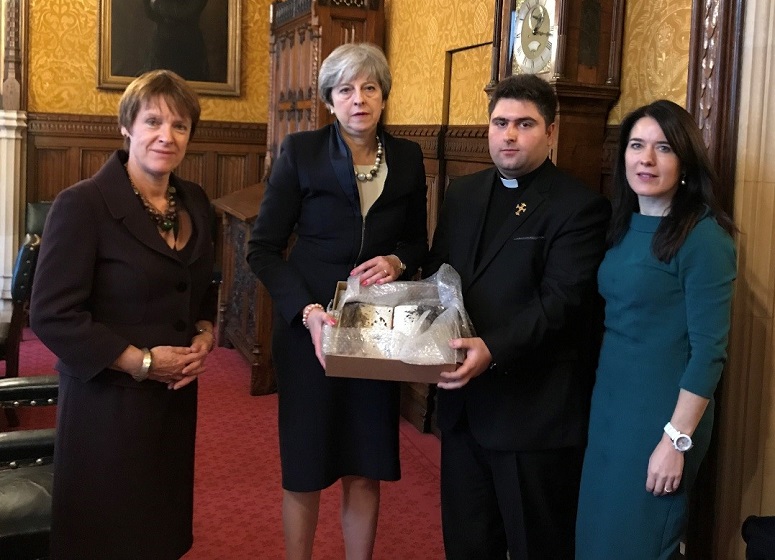
Father Daniel, from Erbil, Iraq, met Prime Minister Theresa May on Wednesday 13th December and gave the Prime Minister the gift of an Aramaic Bible, retrieved from a church in Karamles, Iraq, that had been burned by IS. Dame Caroline Spelman MP and Lisa Pearce, CEO of APPG stakeholder Open Doors UK & Ireland were also at the meeting.


On 13 December APPG stakeholder Open Doors launched its latest report in Parliament as part of its Hope for the Middle East campaign: What next for Syria and Iraq? The Enduring Relevance of the Church in the Middle East.

The day before an Open Doors delegation – led by 12-year-old Noeh from Karamles, Iraq – had presented the Hope for the Middle East petition to the UN in New York. The petition has been signed by more than 800,000 people in 143 countries, over 186,000 in the UK. It calls for equality, dignity and a role in reconciliation for Christians and other minorities in Iraq and Syria.

”We all hope to have our full rights in Iraq… This is the most important thing we need to continue staying in Iraq,” said Father Behnam Benoka, a priest from northern Iraq, who was also part of the delegation. “The material things are really important. But to continue staying, to continue existing, we need to gain our full rights as real citizens of Iraq.”

The meeting in the UK Parliament was hosted by Kate Green MP and Dame Caroline Spelman MP, and addressed by government minister Alistair Burt.

Caroline Spelman and Kate Green spoke of their moving encounters with women who had been abused by the self-proclaimed Islamic State in the Middle East, speaking of both the horror of those atrocities and the strength shown by the women they had met.

Father Daniel described the challenges facing Christians in Iraq. He said, “I believe that my people may be gone in the near future… that depends on your actions. We are on the frontline, but we are not afraid. Please help us.”

Alistair Burt MP, Minister of State for the Foreign and Commonwealth Office and the Department for International Development spoke of the need for good governance and tolerance in the Middle East.

The report underlines that the current situation in Iraq and Syria has raised questions about the future of Christian communities in these countries. From the start of the Syrian civil war in 2011 and the rise of ISIS (also known as the Islamic State or Daesh) in Iraq in 2014, Christians have been among the the latest wave of violence that have impacted these communities. In the mix of civil war and regional sectarian power struggles, Christians and other religious and ethnic minorities are particularly vulnerable, including to explicit religious persecution. The incredible pressure on the Christian community has led to questions of what relevance the community will continue to play in the countries of Iraq and Syria.

The combined impact of these threats has led to massive displacement of the Christian community. Iraq has seen an estimated 100,000 Christians leave the country since 2014. Only 200,000-250,000 remain from a community that numbered as many as 1.4-2 million in the 1990s. In Syria, the pre-2011 population of 1.7-2.2 million has decreased to somewhere between 800,000 and 1.4 million. Emigration remains a constant feature of life for the Christian communities of Iraq and Syria.

The report identifies three critical categories of questions for considering the present and future role of Christians in Iraq and Syria.

  • In order to protect what remains of the Christian community, what is their current social and political relevance?
  • If Christians are to continue to survive through protracted conflict or be enabled to return to their homelands and reconstruct the areas of the country that have been decimated by years of conflict, do Christians have access to resources to enable this process?
  • The conflicts in Iraq and Syria have both fallen along sectarian lines that have destabilized the social fabric of these diverse communities. What steps are being taken to rebuild social cohesion and governance that protects the rights of all citizens?

The full report

Recommendations for Parliamentarians

To the office of the Prime Minister of the United Kingdom: Please use every opportunity to highlight to foreign leaders and officials, as well as amongst your cabinet colleagues, the positive role religious leaders in the Middle East can play in providing on the ground information and insight from the region and in rolling out reconciliation and educational programmes in communities throughout the Middle East.

To the office of the Foreign Secretary, we urge you to take a leading role in the international community to encourage the integration of religious leaders into reconciliation efforts, which will greatly contribute to the future stability of Iraq, Syria and Kurdistan. One priority area is the city of Mosul, where strong leadership from the international community is urgently needed now that the city has been liberated so as to ensure that traumatised and divided communities can live alongside each other in peace.

We greatly appreciate the Foreign and Commonwealth Office and the Department for International Development’s interest in coming together with faith leaders to discuss a range of policy issues relevant to the Middle East, and look forward to developing this into a series of meetings organised in tandem with Lambeth Palace in the New Year.

To all Parliamentarians: Freedom of Religion or Belief (FORB) affects a myriad of areas of life in the Middle East and needs strong champions in Parliament. Consequently, we urge all present at today’s meeting to keep this important issue on the agenda in both the UK and abroad, mainstreaming it as a consideration in your own work and by raising the needs of the Christian community, and specifically faith leaders, in questions, debates, meetings with foreign diplomats, trade negotiations, media engagements etc.

We urge all Parliamentarians to write to the Foreign Secretary to outline what you have heard today, and in particular to highlight the calls of the petition. We would ask that you take the opportunity to co-sign a ready prepared letter with your colleagues at today’s meeting which will highlight the strength of feeling that exists amongst you on this important issue.

We urge the church leaders present at today’s meeting to use your influence to encourage your congregations to pray and speak out on behalf of believers in the Middle East. Further to this we ask that you call on your political representatives to act on their behalf by writing to your Member of Parliament on behalf of your churches, outlining your concern and support for these ancient Christian communities.

To representatives of NGOs and other agencies present at today’s meeting: we thank you for the work that you do and ask that, if you are not already doing so, you proactively consider issues related to Article 18, the international right to freedom of religion or belief, within the wider work your organisations.

Parliamentary event: Forced Organ Harvesting in China

Jim Shannon MP and Fiona Bruce MP hosted a meeting in the Palace of Westminster on 13 December designed to raise awareness about claims of forced organ harvesting from the religious group known as the Falun Gong.

Over the past decade, reports have emerged which claim that the Chinese Government is killing religious prisoners of conscience to supply its vast, lucrative organ transplantation industry. The U.S House of Representatives and the European Parliament have since passed resolutions condemning the practice. The meeting presented the available evidence of forced organ harvesting in China and discussed what steps the UK Government could take to help prevent this practice.

The meeting heard from the following expert speakers:
Benedict Rogers – Deputy Chairman of the Conservative Party Human Rights Commission and East Asia Team Leader at Christian Solidarity Worldwide.
Ethan Gutmann – Investigative Writer and Human Rights Defender.
Enver Tohti – Former Surgeon from Xinjiang, China
Becky James – Activist and Co-founder of Bristol Against Forced Organ Harvesting
Andy Moody – Human Rights Campaigner and Award-Winning Documentary Filmmaker
Dr Alex Chen – Medical doctor and UK Rep for Doctors Against Forced Organ Harvesting (DAFOH)
Dr Adnan Sharif – Consultant Nephrologist and UK Rep for DAFOH

  • Organ harvesting affects Falun Gong members, Uyghur Muslims, Tibetans and potentially, House Christians
  • Around 60,000 organs are harvested each year in China from prisoners of conscience (these could have been imprisoned on political, religious or other grounds and include the individuals above). Prisoners of conscience are used as the organ pool for transplants (if they are compatible). 92% of Uyghurs have been blood tested to be added to the pool.
  • 23 British citizens in the past couple of years have traveled to China to receive organ transplants and were not able to be told the source of the organs upon asking.
  • No Falun Gong members have ever been sentenced to death in China (despite being imprisoned). Only 1 Falun Gong person whose organs were (partially) harvested has lived and escaped. Organ harvesting is a means of killing political prisoners.

In June 2016 The Independent reported, under the headline China carrying out over 60,000 illegal organ transplants annually, report finds: 

The Chinese government continues to illegally harvest organs from millions of its innocent prisoners despite saying it had ended the practice two years ago, a decade-long study has alleged.

Experts estimate between 60,000 and 100,000 organs are transplanted annually, and the majority of the hearts, livers and other organs are obtained by executing prisoners of conscience.

In all, approximately 1.5 million transplants have taken place at 712 liver and kidney transplant centres across China since 2000, with over 300,000 of those taking place at unregulated centres.

The report also found many surgeons had simply “lost count” of the quantity of transplants they had been asked to perform on a daily basis, with some having undertaken as many as six liver removals in one day.

The findings were published in an update to the 2009 book ‘Bloody Harvest’ and the 2014 book ‘The Slaughter’.

Falun Gong is a unique form of meditative practice established in 1992 and the Chinese government has fought to eradicate it for decades.

It has long been believed Falun Gong practitioners are being executed ‘on demand’ by the Chinese government, to compensate for the country’s shortage of organ donors.

The report was researched and authored by former Canadian secretary of state David Kilgour, human rights lawyer David Matas and journalist Ethan Gutmann to expose widespread medical wrong-doing in the Asian country.

The Chinese government officially state that 10,000 organ transplants take place in the country each year, but the trio believe this figure is far lower than the real quantity.

In a statement, Matas said: “We can easily surpass the official Chinese figure just by looking at the two or three biggest hospitals.

“That increased discrepancy leads us to conclude that there has been a far larger slaughter of practitioners of Falun Gong for their organs than we had originally estimated.

“The ultimate conclusion is that the Chinese Communist Party has engaged the state in the mass killings of innocents.”

Falun Gong practitioners were forced to undergo medical tests before their results were put on a database of living organ sources so quick organ matches could be made, the authors claim.

In response to the report, Chinese Foreign Ministry spokeswoman Hua Chunying told a press conference: “I want to say that such stories about forced organ harvesting in China are imaginary and baseless — they don’t have any factual foundation.”

In 2014, China announced that it would end the harvesting of organs from executed prisoners and move to a voluntary donation-based system.

Last year Amnesty International confirmed China remains the world’s largest executioner of prisoners in the charity’s annual report.

FCO highlights FoRB on Human Rights Day


Speaking on Human Rights Day, Foreign Secretary Boris Johnson said:

Human Rights Day reminds us that it can be easy to take for granted many of the freedoms we enjoy in the UK.

The freedom to be who you want, love who you want, worship or not worship and to live your life as you please is denied to millions across the globe.

Everywhere I go in the world where we have concerns about human rights I raise these frankly because we believe that engagement is the best way to encourage reform.

Standing up for human rights is not only the right thing; it also helps to create a safer, more prosperous and progressive world. This is what Global Britain stands for. And promoting, championing and defending human rights is integral to the work of the Foreign Office and part of the everyday work of all British diplomats.

In 2017 humanists ‘actively persecuted’ in seven countries

The 2017 Freedom of Thought Report — on discrimination and persecution against humanists, atheists and the non-religious — highlights seven countries that have actively persecuted non-religious people this year.

  • New incidents or trends in seven countries show active persecution of atheists and humanists in 2017
  • 85 countries in total exhibit severe discrimination against non-religious individuals
  • IHEU warns of impunity for murder of atheists, and state-supported persecution of the non-religious

The report published today (5 December) by the International Humanist and Ethical Union (IHEU) emphasizes the murders of humanists and atheists in the past 12 months, including Mashal Khan in Pakistan, Yameen Rasheed in the Maldives, and H Farook in India.

In Malaysia, a backlash against atheists was escalated to government levels, when officials threatened to “hunt down” apostates. An anti-atheist campaign in Pakistan saw several activists ‘disappeared’ or prosecuted for alleged “blasphemy”, with two men facing a possible death sentence.

The “apostasy” cases of Mohamed M’kheitir in Mauritania (who was released after an involuntary psychiatric assessment), Ahmad al Shamri in Saudi Arabia (whose death sentence for apostasy to atheism was upheld) and Mohamed Salih in Sudan (who had asked that he be allowed to specify ‘atheism’ on his identity papers) are highlighted as part of the wider threat to those who speak out as “non-religious” or who challenge religious power structures, in particular in Islamic countries where “apostasy” is often reviled.

The report documents 12 countries where leaving or changing religion by “apostasy” is punishable by death.

Even these incidents are only “the most noticeable moving parts on the extensive machine of anti-non-religious discrimination” globally, according to the 2017 edition’s Editorial Introduction. 85 countries are listed as having one or more elements of “severe discrimination” or worse. Such elements include for example imprisonable “blasphemy” laws, fundamentalist proselytization in state-run schools, the derivation of state law from religious doctrine, and control over family and personal status law by religious courts.

The report warns that the increasing number of anti-atheist murders and other incidents of persecution should not be thought of as disconnected events, but as part of “a pattern of regression on a global scale”. While there is much global attention on rising populism and authoritarianism, the Freedom of Thought Report warns that, “The rhetorical opposition and very real threats to democratic norms extend far beyond ‘fake news’ and Twitter bots… Any remaining notion that secularism and human rights must inevitably establish themselves… must now be cast aside as deeply complacent and apathetic.”

Ahead of the report’s launch at the European Parliament on Tuesday, president of the IHEU Andrew Copson said, “More and more people are coming to us in the humanist movement from Saudi Arabia, or Afghanistan, or Pakistan, and saying: ‘I am humanist’ or ‘I am atheist, and I cannot speak out, I cannot say what I need to, even online’. They are afraid they’re going to be attacked for it, maybe even killed.”

Copson continued, “This report shows that this is not an irrational fear. There have been extrajudicial killings occurring in multiple countries and near impunity for the killers. The international community cannot continue to placate states which criminalize leaving religion as a capital offence. We call on the international community to condemn the persecution of humanists and atheists, and to work with human rights defenders around the world to bring an end to this injustice.”

Humanists UK recently urged the Foreign and Commonwealth Office to prioritise freedom of religion and belief, particularly tackling blasphemy laws, around the globe.

Source: IHEU


APPG Statement on Egyptian Mosque Attack

The Officers of the UK All Party Parliamentary Group for International Freedom of Religion or Belief are deeply saddened by the attack on a mosque in Egypt’s North Sinai province which took place today.

According to local police, men in four off-road vehicles opened fire on worshippers who were attending Friday prayers at the al-Rawda mosque. They then detonated several explosive devices. This attack is a gross violation of the Right to Freedom of Religion or Belief, which is enshrined in Article 18 of the Universal Declaration of Human Rights.

Latest reports indicate that the attack, which is the deadliest militant attack against an Egyptian target, has killed at least 200 people and left at least another 130 wounded. Our thoughts and prayers are with those who have been hurt and with the families and friends of those who have been killed.

Any violence against innocent civilians is unacceptable and it is horrifying to see people killed for simply practising their beliefs in peace. It is unclear who is behind the attack but we urge the UK Government to work with their Egyptian counterparts to bring the assailants to justice. We also ask all Governments to protect those who are discriminated against or attacked because of their religion or belief.

UN Resolutions on Freedom of Religion or Belief

UN General Assembly Third Committee, 72nd Session, 49th meeting

The representative of Egypt, speaking on behalf of the Organization of Islamic Cooperation (OIC), introduced a draft resolution titled “Combating intolerance, negative stereotyping, stigmatization, discrimination, incitement to violence and violence against persons, based on religion or belief” (document A/C.3/72/L.37). The draft was a follow-up to the consensus resolution approved last year. There had been a global resurgence of racism, racial discrimination, xenophobia and related intolerance, he said, and populist leaders built platforms on fomenting incitement to that.

The representative of Syria said his country was not a member of the OIC, and would therefore like to co sponsor the draft resolution in Syria’s national capacity.

The Committee then approved the draft resolution without a vote.

By its terms, the General Assembly would condemn any advocacy of religious hatred that constituted incitement to discrimination, hostility or violence. It would call on all States to foster a domestic environment of religious tolerance, peace and respect by, among other things, creating a mechanism within Governments to identify and address potential areas of tension among different religious communities, and assisting with conflict prevention and mediation.

The representative of Estonia, speaking on behalf of the European Union, said the draft resolution was a call to States to respond to intolerance with full respect for international human rights law. The bloc condemned violence based on religion or belief and any incitement to discrimination, hostility or violence, she said, adding that it was equally attached to freedom of opinion or expression as it was linked to freedom of religion or belief and other freedoms. Indeed, freedom of expression was a tool for combating religious discrimination, and any restrictions on it should meet the requirements set out in Article 19 of the Universal Declaration of Human Rights. As the draft stated that intolerance could generate hatred and violence, he reiterated that religious hatred was a threat to fundamental freedoms, and that it was the primary responsibility of States to counter that intolerance. On that basis, the European Union would join consensus.

The representative of the Russian Federation said she had joined consensus on the draft resolution, adding that combating intolerance on the basis of religion or conviction was important, as was developing intercultural dialogue between religions and confessions.

Next, the representative of Estonia, speaking on behalf of the European Union, introduced a draft resolution titled “Freedom of religion or belief” (document A/C.3/72/L.38). She said the promotion and protection of the freedoms of religion and belief as a universal right were essential priorities of the Union’s policy. Promoting understanding was of utmost importance to creating inclusive environments and she urged States to provide adequate legislative protections to those freedoms. The draft stressed the importance of protecting such rights in the face of religious extremism around the world and not only accounted for the right to believe, but also to change one’s beliefs, and the rights to freedom of association and assembly. The draft also expressed support for the Special Rapporteur on the matter who had noted increasing religious intolerance worldwide.

The Committee then approved the draft without a vote.

By its terms, the Assembly would stress that everyone had the right to freedom of thought, conscience and religion or belief, and strongly condemn violations of that freedom, as well as all forms of intolerance, discrimination and violence based on religion or belief. Restrictions on the freedom to manifest one’s religion or belief were permitted only if limits were prescribed by law; were necessary to protect public safety, order, health or morals or the fundamental rights and freedoms of others; or were non discriminatory and applied in a manner that did not vitiate the right to freedom of thought, conscience and religion or belief. The Assembly would urge States to ensure that their constitutional and legislative systems provided adequate and effective guarantees of freedom of thought, conscience and religion or belief to all without distinction.

CSCE: Religious Freedom Violations in the OSCE Region

The Commission on Security & Cooperation in Europe: U.S. Helsinki Commission briefing Religious Freedom Violations in the OSCE Region

Participants:
Ambassador Michael Kozak, Bureau of Democracy, Human Rights, and Labor, U.S. Department of State;
Dr. Daniel Mark, Chairman, U.S. Commission on International Religious Freedom;
Dr. Kathleen Collins, Associate Professor of Political Science, University of Minnesota;
Philip Brumley, General Counsel, Jehovah’s Witnesses

Date: Wednesday, November 15, 2017

All 57 participating States of the Organization for Security and Cooperation in Europe have committed to recognize and respect religious freedom as a fundamental freedom. However, some OSCE countries are among the worst perpetrators of religious freedom violations in the world.

Tajikistan, Turkmenistan, and Uzbekistan are currently designated by the U.S. State Department as “Countries of Particular Concern,” a designation required by U.S. law for governments that have “engaged in or tolerated particularly severe violations of religious freedom.” The U.S. Commission on International Religious Freedom has recommended that Russia also be designated as a CPC and includes Azerbaijan, Kazakhstan, and Turkey in its list of “Tier 2” countries that “require close monitoring due to the nature and extent of violations of religious freedom engaged in or tolerated by governments.”

This briefing happened just two days after CPC designations were due on November 13 (U.S. law requires the State Department to issue new CPC designations no later than 90 days after releasing its annual International Religious Freedom report). Panelists – including a representative from a frequently targeted religious group – discussed religious freedom victims, violators, and violations in the OSCE region. The conversation included recommendations for what governments and the OSCE institutionally should do to prevent and respond to violations. The intersection between security, a chronic justification for violations, and religious freedom was featured.

Read unofficial transcript

View briefing

The Denial of Religious Freedom in Pakistan

UN Geneva Universal Periodic Review Side-Event Highlights the Ongoing and Systematic Persecution of the Ahmadiyya Muslim Community in Pakistan

Today, the Coordination of Associations and Individuals for Freedom of Conscience, (CAP) held a side event at the Palais des Nations alongside Pakistan’s Universal Periodic Review (UPR) by the United Nations Human Rights Council. The side event reflected on the challenges facing religious communities in Pakistan, particularly the country’s draconian anti-Ahmadi and Blasphemy laws that have been used by the state to persecute religious communities for more than 40 years.

With representatives of international NGOs and various UN Missions in attendance, this timely event highlighted the plight of the Ahmadiyya Muslim Community. Declared non-Muslim by Pakistan’s Constitution in 1974, the sect remains among the most marginalised religious communities in the world. Faith-based hate and discrimination against the community is being propagated at the highest levels of the Pakistani government.

Most recently three members of the Ahmadiyya Muslim Community were sentenced to death in Pakistan under false blasphemy charges.

This escalating and state-sponsored persecution is of particular concern due to Pakistan’s upcoming general elections in 2018. The side event brought much needed attention to the fact that Ahmadis in Pakistan are facing an electoral apartheid unlike any other citizen in the country and are the only disenfranchised community in Pakistan.

The event was headlined by an international panel of experts and also featured messages of support from Dr. Ahmed Shaheed, the UN Special Rapporteur for Freedom of Religion, who stressed the need for urgent action to end the systemic persecution of Ahmadi Muslims in Pakistan which he noted was “legally sanctioned” by the laws. He added that the persecution was impacting on all communities and called on Pakistan to implement in full the recommendations of the UPR.

Jim Shannon MP (Chair of the UK All Party Parliamentary Group for International Freedom of Religion or Belief) and Siobhain McDonagh MP (Chair of the All Party Parliamentary Group for the Ahmadiyya Muslim Community UK) also sent messages of support urging for an end to all religious discrimination in Pakistan.

Speakers included Sir Iftikhar Ayaz, Chairman of the International Human Rights Committee, Dr. Aaron Rhodes, President of the Forum for Religious Freedom Europe, Mahmood Ahmad, General Secretary of the Ahmadiyya Muslim Lawyers Association USA, and Baseer Naveed from the Asian Human Rights Commission.

The event was moderated by Thierry Valle, President CAP Liberté de Conscience who further underscored the significance of the issue saying,

“This side event has laid plain that 70 years on from the creation of Pakistan it is still not living up to Jinnah’s vision of Pakistan as a country with complete freedom of religion for all.

“The Pakistan Government must act to end the Federal laws targeting the Ahmadiyya Muslim Community and the daily persecution faced by Christians, Shias, Ahmadis and other communities.”

View the video message from Dr. Ahmed Shaheed, the UN Special Rapporteur for Freedom of Religion

This press release released by CAP Freedom of Conscience

Indonesian court recognises native religions in landmark ruling

JAKARTA (Reuters) – Indonesia’s Constitutional Court on Tuesday affirmed the rights of devotees of faiths outside the country’s officially recognized religions, in a move activists welcomed as a “new chapter for religious freedom”.

Against a backdrop of rising intolerance toward minorities in the world’s largest Muslim-majority nation, the court said Indonesians would not be required to identify as either Muslim, Catholic, Protestant, Hindu, Buddhist or Confucian on their national identification cards.The ruling reviewed by Reuters followed a legal challenge by followers of some of Indonesia’s indigenous faiths.

Bonar Tigor Naipospos from the Setara Institute, a group that advocates for religious harmony, said Indonesians who refused to embrace one of the regulated religions on their identity cards had limited access to education, restricted employment opportunities and were denied legal marriage.

The Court recommended that a seventh, catch-all category be created – “Believers of the Faith” – for ID cards.“This is a new chapter for religious freedom in Indonesia for both government and followers of indigenous religions,” Naipospos said. “This is a door for the government to recognize their rights.”A spokesman for Indonesia’s president Joko Widodo could not immediately be reached for comment.Indonesia’s founding constitution says the state is based on the belief in the “One and Only God” but guarantees “each and every citizen the freedom of religion and worship”.However, blasphemy laws passed in 1965 stipulated only six religions would be protected. Subsequent regulations and laws effectively enshrined those as the only religions recognized by the state.“The ruling (on Tuesday) means the end of Indonesia recognizing only six religions,” said Andreas Harsono of Human Rights Watch.

In the 2000 census, about 400,000 people identified as holding beliefs outside the six main religions, although Harsono said this probably underestimated the extent of believers in non-recognized faiths.Across Indonesia’s vast chain of islands, more than 200 distinctive native faiths, such as the Sundanese people’s Wiwitan, the Dayak’s Kaharingan and the Torajan’s Aluk To Dolo survived even as Buddhism, Hinduism and Islam dominated during different eras.Its people also blended elements of the major religions over time and infused them with animist and mystical beliefs.

The court ruling should also apply to followers of non-indigenous religions such as Baha‘i and Judaism that are not formally recognized in Indonesia, said Nia Sjarifudin of the Unity in Diversity Alliance.

In recent decades, Indonesia’s reputation for tolerance has been tarnished as its unique syncretic form of Islam has been challenged by more fundamentalist interpretations imported from the Middle East.In the past year, an alliance of Islamist hardliners pushed successfully for the imprisonment of then Governor of Jakarta Basuki Tjahaja Purnama, an ethnic Chinese Christian, for insulting Islam under the 1965 blasphemy laws.Atheism is not legal in Indonesia, and non-believers have also been charged with blasphemy.

Reporting by Tom Allard and Jessica Damiana; Editing by Clarence Fernandez

Religious Freedom: Lord Alton’s question

Q Asked by Lord Alton of Liverpool on: 23 October 2017 – Foreign and Commonwealth Office Religious Freedom HL2309

To ask Her Majesty’s Government whether they plan to mark International Freedom of Religion or Belief day on 27 October; whether they will publish details of those countries responsible for violations of Article 18 of the Universal Declaration of Human Rights; and whether they intend to set out what progress has been made to ensure that upholding freedom of religion or belief is given a higher priority as a foreign affairs and development policy objective.

A Answered by: Lord Ahmad of Wimbledon Answered on: 06 November 2017

I issued a statement and video on social media marking International Religious Freedom Day (IRFD). In addition, instructions were sent asking all Embassies and High Commissions overseas to consider how they might mark the day in locally appropriate ways. To coincide with IRFD I have writen to Ambassadors to underline the importance of Freedom of Religion or Belief (FoRB) and to re-issue our revised FoRB “toolkit” which supports our posts’ work in this area. I was also pleased to speak at the launch on 25 October of a new report ‘Article 18: From Rhetoric to Reality’ by the All Party Parliamentary Group for International Freedom of Religion or Belief.
The FCO does not keep a comprehensive and exhaustive record of those states we consider to be in breach of Article 18 of the Universal Declaration of Human Rights and therefore cannot publish the details requested.

There are many examples to illustrate the fact that the FCO continues to afford a high priority to FoRB. We promote FoRB in many countries, including a number of our Human Rights Priority Countries where FoRB is under pressure. We do this through diplomatic channels, public statements and support for projects which promote tolerance. For example, during my recent visit to Bangladesh, I visited an Ahmadiyya mosque for a multi-faith event at which I spoke publicly of the importance of religious tolerance. I also met faith leaders during recent visits to India and Ghana. The UK Government frequently raises concerns with states where we see people face persecution or discrimination because of religion or belief.

We also support the work of United Nations Special Procedures, such as the Special Rapporteur for FoRB, to hold countries to account.

We are currently working to develop a new FoRB strategy which will include encouraging a sharper focus on FoRB issues by our posts overseas. On 23 October, I hosted a roundtable to discuss with faith leaders and civil society how we might work together to promote FoRB. Our commemoration of International Human Rights Day in December, will focus on the role of faith leaders in promoting and protecting human rights, including FoRB.