11 January 2018, Question for Short Debate, asked by The Lord Bishop of Coventry:
To ask Her Majesty’s Government what is their post-conflict strategy for protecting the rights of religious and ethnic minorities in Iraq.
The Lord Bishop of Coventry
My Lords, imagine what it was like, having been hounded out of one’s home when Daesh took control of Mosul, to be back there on Christmas Eve among 2,000 worshippers for the first celebration of the Mass in three and a half years. But then imagine the scene only hours afterwards— not only the church but also the city again almost entirely bereft of Christians because it is still not safe enough for them to return permanently.
What can be done to give Christians, Yazidis, Turkmen, Sabeans, Yarsanis, Shabaks and other vulnerable religious and ethnic communities in Iraq confidence that they have a future in their own land—and why is it vital for that land and that region that their confidence is regained? I will make three contentions. First, the recent military victory over Daesh is only the first step of its defeat. As General Paul Funk, commander of coalition forces in Iraq, recently said, Daesh’s,
“repressive ideology continues … The conditions remain present for Daesh to return, and only through coalition and international efforts can the defeat become permanent”.
That is exactly the fear of minority communities in Iraq—that unless the causes of the violence are rooted out, it will return and, as before, minorities will be the first victims. They look not only to the chaos that ensued after the 2003 invasion, and the reduction in the Christian population, for example, by some 75% by 2014, but back to earlier cycles of violence which, wave after wave, eroded their security and forced former generations to flee.
Secondly, the UK has both a moral responsibility and a strategic interest to help secure a stable and flourishing Iraq. The UK’s deep involvement with Iraq, right up to its part in the military coalition, places a moral burden on us for a long-term commitment to a coalition of reconstruction. Success in Iraq, so long a land marking the failure of British foreign policy, is of vital strategic importance. Daesh might be like a Hydra, with heads surfacing across the world, but if it could be fatally wounded in the country of its birth, it would be starved of vital sources of energy, morale and inspiration.
Furthermore, Iraq may have become a land where Yazidis, Christians, Turkmen and other minorities have suffered unspeakable brutality, where tensions between Shia and Sunni Muslims have spilt blood that has run deep into the soil of the nation, and where the aspirations of Kurds and Arabs divide the country. But it is also a land with a longer history of religious and ethnic coexistence. If that tradition could be harnessed in a renewed political and civic culture that builds an equitable, just and participative society in which all communities can flourish, the region will see that its religious and ethnic diversity can be a source of its strength, not a cause of its collapse, and the world will become a safer place.
My third contention follows on from these two. The protection of religious and ethnic minorities is critical to the future of a secure and politically stable Iraq. Their presence in Iraqi society is a barometer, both of whether the conditions which give rise to violent extremism have been dealt with and of whether it is the sort of society where the capacities of all its citizens can contribute to the common good and to the flourishing of every community.
A basic need that minority communities share with others is the material reconstruction of cities and villages devastatingly damaged by conflict. Her Majesty’s Government have already dedicated resources for “immediate repairs”. However, this week the US substantially increased its financial contribution to Iraq, and the EU announced its long-term commitment, both financial and strategic. Can the Minister therefore say what are the long-term, post-Brexit intentions of Her Majesty’s Government to lead and to shape an international effort to help the Iraqi authorities to rebuild the infrastructure of their land, on which a settled future depends, and how will this leadership be demonstrated at next month’s Kuwait conference? Given Daesh’s targeting of property owned by minority communities, some 50% of whose houses have been damaged or destroyed, will the Government use their influence to ensure that Christian, Yazidi and other communities receive a fair share of that aid?
Material construction will be of use to Iraq and the region only if it is accompanied by social reconstruction, and that depends on the reconstruction of trust. For the minority communities, trust will be hard to rebuild. In my own visits to Iraq, it is the almost total breakdown of trust that has struck me as the greatest threat to the future of minority communities: trust in the international community, trust in the Iraqi and Kurdish Governments and their ability to deliver on their promises and truly to enact Article 14 of the constitution, with its commitment to equality of all before the law, and trust between neighbours where, for example, Christians found themselves betrayed by Muslims with whom they had lived for years. In meetings with Ministers of the Baghdad Government, including the Prime Minister and the President, I was impressed with the commitments they voiced about the necessity of religious and ethnic minorities to the future of Iraq. But the contrast with the doubt in the communities themselves that the Government would turn their words into action was very marked.
Security, of course, is an urgent need, as well as a fundamental right. With this in mind, I ask the Minister whether Her Majesty’s Government will use every effort to empower the Iraqi and Kurdish Governments to ensure that the forces under their control work together to protect all members of their society, especially the vulnerable communities residing in the liberated areas of the Nineveh Plains and Sinjar, and that they do not rely on Shia militias?
Despite the terrible tears in the fabric of Iraqi society caused by betrayals of trust, there are already remarkable examples of civic society beginning to repair it—a symbol of which was the way that the cross on the church at the Mosul Mass was erected by a group of young Muslims. Yet there are interventions that the Iraqi and KRG Governments could make, though their exercise of the law and shaping of culture, to support and quicken these efforts.
The high proportion of young people in Iraq means that there is great potential to create a new culture of understanding and respect through education. The Iraqi Government can play an important role by reforming and policing how minorities are spoken of in educational curricula and course materials in state and in non-governmental religious schools, and also through all forms of media, including media used by religious bodies. How will Her Majesty’s Government encourage the Iraqi authorities to take bold steps to create a culture, through education and media, that celebrates the diversity of its people, affirms the historic place of its ancient minority communities in the nation, and addresses the legal and administrative systems that reinforce the sense of vulnerability and discrimination, such as the proposed registration of children as Muslim if either parent converts to Islam?
I conclude with the words of a priest of the Assyrian Church of the East administering in Dohuk spoken to me just a few days ago. I asked him what he would particularly like to convey to this House today. His reply was hauntingly realistic but inspiringly idealistic. “We may not be able to restore the Christian demography that we had in the past”, he said, “but we can preserve for the future a presence and role for the Christian community in our society so that through our schools, our skills and our hospitals we can serve all the people of this land”. My hope for this debate is that it will play some part in fulfilling the prayer of that priest and of others from the array of Iraq’s ancient, small, suffering communities who long for a future in their own homeland.
Baroness Anelay of St Johns (Con)
My Lords, I am grateful to the right reverend Prelate for securing this debate in such a timely way, just a month after the announcement by the Prime Minister of Iraq that the war against armed groups there was over, as he said. So today we can focus on what it means to “win the peace” while being aware of the problems that crucially still face Iraq.
Daesh no longer holds significant territory there but, although it is failing, it is not yet wholly defeated and still poses a threat to Iraq. Yet the successes of the Iraqi Government, including those of the Kurdistan Regional Government, are immensely important. They signal a new chapter leading towards a more peaceful and prosperous country—or, at least, they can if we and the international community work together with the Iraqi Government to seize opportunities that ensure that we do win the peace.
I was therefore encouraged to see that when our Prime Minister visited Iraq last month, she gave our support to that objective and made it clear that it meant addressing the issues which led to Daesh’s rise. We must recognise that the challenges facing minorities did not begin with Daesh and will not end with its defeat alone. They go much deeper in Iraqi society, and solutions must therefore be far reaching and confront long-standing issues of discrimination, exclusion and marginalisation.
As the UN special rapporteur made clear in her report to the United Nations Human Rights Council, the primary responsibility for the protection of civilians lies with the Government of Iraq, but it is vital that the donor community continues and enhances its generous support to match the massive need for humanitarian stabilisation and development assistance. Over the new year, our inimitable Foreign Secretary said, referring to UK aid:
“The old jam jars are being smashed. The cash will be more sensibly distributed with a view to supporting British foreign policy”.
What impact does the Minister expect that to have on future UK spending in Iraq?
In the autumn of 2016, I hosted an FCO two-day conference on how freedom of religion or belief can contribute to preventing violent extremism. The conclusions reached were that all communities need to be accorded the same rights as the remainder of the population; that education is a vital tool to ensure that children understand the need to respect everyone equally, regardless of their religion; and that legal systems should not discriminate against individuals on the basis of their religion. Will more UK funds therefore now be directed, for example, at supporting respect for freedom of religion or belief and ethnic diversity? Can the Minister update the House on the impact of projects currently funded by the FCO, DfID and the Conflict, Security and Stability Fund—after all, more than 3 million people are now internally displaced and over 10 million people are in need of humanitarian assistance?
While I was in Baghdad, I met Christian families who had fled from Qaraqosh and were given shelter by the remarkable Father Pios. In Erbil, I visited the Harsham IDP camp to hear directly from displaced families. In both cities, the concerns were the same: they are far from home and want nothing more than to return, to rebuild their lives and their country. But first they want to be sure that they can return in safety and have the chance to earn their own living again. What work is being done to ensure that IDPs from ethnic and religious communities are treated in conformity with international standards, including the guiding principles on internal displacement? Has progress been made on ensuring that the UN agencies and NGOs are better able to co-ordinate their response, including ensuring that aid reaches minority groups?
As the right reverend Prelate said, a successful peace depends on political stability. That requires public trust in a unified, independent and sovereign Iraqi state. What encouragement have our Government given the KRG to respect the Iraqi Federal Supreme Court ruling on the unconstitutionality of the referendum that was held last September? What is our Government’s assessment of the likelihood of success for resolving the historic differences between the KRG and the GOI, consistent with the Iraqi constitution?
Winning the peace also means finding a way to recognise the suffering of those who have been killed, raped or enslaved by Daesh. I therefore welcome the decision by the United Nations Security Council to gather and preserve evidence of Daesh’s crimes across Iraq.
When in Baghdad, I launched an Arabic translation of the United Kingdom’s protocol on the documentation and investigation of sexual violence in conflict. Later, here in the House of Lords, I and the ambassador of Iraq and the high representative of the Kurdistan Regional Government launched the Kurdish translation. I am grateful to both of them for their support. Can my noble friend give an assurance that the UK’s PSVI work in Iraq will continue alongside that of the United Nations?
There is still a long way to go, but I am impressed by the enormity of Iraq’s potential and the resilience of its peoples—as the right reverend Prelate said, they are Sunnis, Shias, Kurds, Yezidi, Turkmen, Armenians, Shabaks, Christians, Jews, Kakai and more; that is what makes it so special. Iraq is a country of such great diversity, and has had a rich mosaic of ethnic, religious and linguistic communities for centuries. It is the “cradle of civilisation.” I welcome the fact that our Government have, along with the international community, worked hard to complement the efforts of the Iraqi Government. Now is the time to stand shoulder to shoulder with the Iraqis until the dream of a secure and prosperous future becomes a reality.
Lord Glasman (Lab)
My Lords, I am grateful to the right reverend Prelate for introducing this debate and for his sustained interest, ethical and empirical, in what is going on. I declare an interest in that I am the vice-chair of the APPG on Kurdistan and have been to Irbil and to the KRG region several times over the past years.
I would like to share with noble Lords a couple of anecdotes from that time. The first was during a visit to Kirkuk, when it was under Kurdish government, and to the church of the red stone, where the congregation still spoke Aramaic. It was extraordinary that that was still alive in their lives. There used to be a congregation of many thousands, but it is now a few hundred. When I went to visit, each of them carried a photograph of a relative who had been killed in the previous 10 years—assassinated for being Christian. As they sat in the church, I said to them, “What are you doing? What are you waiting for?” They said, “We are waiting to die”. They claim that the church was founded by St Thomas, and so it is a story of the terrible loss of a culture that has existed since that time. It is extraordinary that there is still a continuity of Christian communities that speak the language of Jesus, and it is terrible to see their loss and decimation. In 1914, Baghdad was still a majority Jewish city; there are now no Jews left in the area. We should not be narcissistic: the Iraq war accelerated trends, but it did not create those trends, which are long-standing.
My second anecdote comes from a refugee camp near Kirkuk at the time that ISIS, having captured Sinjar, had just been pushed back from Sinjar and Nineveh by the Peshmerga. I met the noble Baroness in one of those dreadful marble hotels in the green zone in Irbil during that time. I spoke to the Christians and the Yazidis there, and they told me stories of rape and theft. The Bibles that they had carried through generations had been stolen from them, and that was as great a dispossession as the loss of their homes. The Peshmerga had just liberated that territory from ISIS and the governor of the region announced joyously to them that they were all free to return home. Not one moved. They did not move because, as the right reverend Prelate said, their neighbours had attacked them. They were subjected to murder, their homes were taken by their neighbours and they felt no security. It is extremely important to understand this rupture of trust.
As to what the Government should do, it is time to think boldly, initially in regard to the refugee camps. I witnessed in the refugee camps that there was some degree of solidarity for the Sunni Muslims there, sponsored by Turkey and Saudi Arabia; the few Shia who were there had support from Iran; but there was no systematic solidarity for the Christians or the Yazidis. There was no prayer space for Christians and no support. Another dreadful anecdote is that Bibles were sent, but they were in Arabic and not Aramaic and so were of no use to the local people there. The Government may have given up on the big society in our country, but perhaps they could revive it in these refugee camps and introduce leadership training for Christians and Yazidis who have had their communities smashed. There is no leadership there. They felt that no one was speaking for them and that they had no champions at all. They are the weakest and poorest, and it is right that we should show some special solidarity. As I mentioned, although there is the story that the Christian community is somehow colonial or that they are collaborators, this is far from the truth. Christians have been established in the region since before Islam, having been there for 2,000 years. Given what they have been through, it is right that there should be some solidarity with them.
I want also to echo what the noble Baroness said because it is not to be underestimated. We are talking about religious and ethnic freedoms, but the systematic subjugation and rape of women under Daesh was one of the most wicked things we have seen in our lifetime, so it is important that women are part of the leadership and community rebuilding effort. The Government should turn their attention to the very weakest and poorest who have been marginalised. Christians and Yazidis, particularly the women among them, should be given direct support by us, in particular in the refugee camps, where harassment and rape is still going on. That was recounted to me by the people there, and they said that they really had nowhere to turn.
Following on from that, the noble Baroness mentioned the referendum. Kirkuk is now no longer under Kurdish rule, along with the disputed territories, but it is still worth mentioning that the Kurdish Regional Government took in so many refugees that the population was increased by a third. It is absolutely vital that we continue to support the KRG in the solidarity that they are providing for these refugees. That is one way in which we can sustain meaningful relations. I would be very interested to know, because it is difficult to get information—all I have is anecdote—about the situation for minorities, including the Kurds in Kirkuk. I hear that it is not good since the Iraqi army took over, and there has been a suppression of the Kurdish language. That situation is worth keeping an eye on.
Once again, it is with gratitude that I have participated in this debate. We must persevere in showing solidarity with the Christians and the Yazidis in the area, who have experienced the worst possible dispossession.
Baroness Hodgson of Abinger (Con)
My Lords, I too would like to thank the right reverend Prelate for introducing this debate today. Iraq is a country that has suffered for many years: first under the 24 years of brutal dictatorship of President Saddam Hussein; since the invasion by the US and the UK in 2003, there has been a lack of security in much of the country; latterly, as we have heard, it has been Daesh that has been wreaking havoc, as it extended its caliphate, overrunning large areas of northern and western Iraq, including the key city of Mosul.
The attack by Daesh on religious minorities has been utterly horrifying. The UN has recognised its targeting of the Yazidis as a genocide, forcing them to flee from their ancestral lands in northern Iraq, with thousands massacred and many of the women being taken prisoner and forced to become sex slaves in Iraq and Syria. That has created half a million refugees. Who can forget the terrible pictures on the news of the Yazidis having fled to Mount Sinjar?
The targeting of Christians in Iraq predates Daesh. Some left after the first Gulf War, but there was a series of attacks on Christian communities as security broke down following the UK/US invasion. However, Daesh too has severely persecuted Christians, also recognised by the EU, the UK and the US as a genocide, causing many to flee. A decade ago, as we have heard, some 35,000 Christians were living in Mosul, but today very few remain. As Daesh has now mainly been defeated in Iraq and the media spotlight is turning elsewhere, I am so glad that we have the chance to discuss the situation in Iraq and how we can protect people going forward, because the situation there, while improving in some ways, is far from settled.
Without wishing to downplay the terrible suffering that religious minorities have incurred, it is the Kurds whom I would particularly like to speak about today. The Kurds are the largest ethnic minority in Iraq, comprising between 15% and 20% of the population. In September last year, I went with the APPG on Kurdistan to observe their referendum. With the benefit of hindsight, it is perhaps a shame that the Kurds were never given their own land after the First World War, as they are not really happy in any of the countries—Turkey, Iran, Iraq and Syria—that they are living in today. It is worth remembering that the Kurds have had a particularly terrible time in Iraq. They were oppressed by Saddam Hussein, especially after the first Gulf War, and endured what the other place officially recognised in 2013 was a genocide. We were taken to see the torture chambers in Sulaymaniyah—a place that I never want to visit again—where the Red House museum shows the grimly ingenious means used to rape, torture and murder.
We were told that Saddam Hussein had pushed the borders of Kurdistan back when he was forced out of much of Kurdistan in 1991. After his fall, the Kurdistan Regional Government was established, and in recent years there has been inward investment from the West, especially to Irbil. With the arrival of Daesh, the Kurdish Peshmerga force more than played its part when the Iraqi army was put to rout. This seems to have caused some anxieties to some Iraqis, as the Kurds fought Daesh in areas technically outside today’s Kurdistan. Kirkuk would have fallen to Daesh if the Peshmerga had not immediately reinforced their position there, and security was improved under Kurdistani control.
There is also a religious slant, in that the Kurds are mainly Sunni Muslims and the Baghdad Government have a strong Shia leaning. We were told that the agreement between the Iraq Government and the KRG had been broken by the Baghdad Government, who had withheld funding to Kurdistan from 2014. This was causing much difficulty, especially in paying government employees. I also understand that the Baghdad Government were trying to influence other countries not to buy oil from Kurdistan, which was its only source of revenue.
The Kurds had been threatening to have a referendum since 2014 as a result. Although they had been advised by the UK and other international interlocutors not to do so, they told us that they felt that there was never going to be a “right time”. However, everyone we spoke to there said that the results of the referendum would not lead to an immediate declaration of independence, but that they hoped it would lead to negotiation with Baghdad to start state building. Many we met were bewildered by the lack of UK and western support for their referendum. I was told that they always felt that we were talking about democracy and that they were trying to exercise their right to self-determination.
I suspect that the result of the referendum came as no surprise: on a turnout of 3.3 million Kurds—in excess of 70% in the autonomous and disputed regions—93.25% were in favour of independence. The Iraqi Government immediately demanded that the KRG hand over control of their international airports at Irbil and Sulaymaniyah—they had always been controlled by Baghdad—and all international flights were stopped, except for military, diplomatic and humanitarian flights. This has resulted in many foreigners leaving Kurdistan and has, in some cases, affected the work being done by the NGOs. The Iraqi army violently took back Kirkuk and the disputed territories.
The surrounding countries also condemned the referendum, with Iran swiftly closing its borders and then carrying out threatening military exercises along them. Turkey’s immediate response was to threaten military action too. At the end of October, Masoud Barzani resigned as president.
Where does this leave the Kurds now? While I understand that the UK did not support the referendum and wished for a one-country solution, surely we need to recognise that the situation in Iraq has not been satisfactory for the Kurds. The UK has been providing military training in Iraq, with a base in Irbil. Are we providing the same training to the Iraqis and the Kurds? While Daesh has been defeated, in Kurdistan we heard about people suffering from roaming Shia militia, every bit as brutal as Daesh, so the Kurds still have a need to defend themselves.
Without doubt, the referendum has been a disaster for the Kurds, who are now being squeezed economically. They have lost the disputed areas. Whether the Baghdad Government or the KRG controls the disputed territories, they are still disputed territories that require the implementation of the article of the Iraqi constitution to hold censuses and then referendums so the people can decide whether they wish to be part of the Kurdistan region.
Many people I spoke to talked about a pluralistic approach in Kurdistan and we should recognise that the Kurdistan region has provided sanctuary to very many Christians who live there peacefully and practice their faith without hindrance, as I saw for myself when I visited St Joseph’s Cathedral in Irbil.
As I understand it, the Baghdad Government have not shown any signs of wanting to help re-establish a better relationship. However, I am glad that the UK has joined countries such as France, Germany and the USA in encouraging dialogue between Irbil and Baghdad. I am also pleased that the Prime Minister has invited the KRG Prime Minister to London for talks, maybe as early as this month.
I ask my noble friend the Minister: what is the UK’s stance, and are we trying to help find a peaceful and sustainable solution that will ensure that the rights of the Kurds are upheld? Are we encouraging the UN to intervene here to help? Just doing nothing and allowing the present crisis for the Kurds to simmer for years will damage them in the long term and deprive Iraq and the world of a potentially dynamic and reforming country that has done so much to stabilise and improve Iraq, protect religious minorities and resist Daesh.
Baroness Deech (CB)
My Lords, this is a double tragedy being brought to light by the right reverend Prelate: first, the persecution and extermination of religious minorities—Christians, Jews, Yazidis and others—and, secondly, the failure of the international organisations that should protect them or at least focus on the situation. That failure is most aptly attributed to the UN Human Rights Council, which has become a travesty of its name.
Sometimes it is difficult for us here in this tolerant country to understand the role played by religion elsewhere. In the area under debate today, it is not just a question of choice of belief; religion equates with identity. Indeed, one reason why so many countries in the Middle East are in turmoil is that the nation states there, sometimes created by western colonialists 100 years ago, do not coincide with religious boundaries. Those new states have bundled together people who identify with their communities across boundaries rather than in their own neighbourhoods. To be a religious minority is seen by the ruling class as if one was a foreigner at best and a traitor to the community at worst. It has become especially dangerous to be a minority since the rise of Daesh. Nor is this attitude confined to Muslims; we have seen the atrocities committed against the Rohingya Muslims in Burma by the majority. But in determining cash and protection allocation, the UN High Commissioner for Refugees does not include religious persecution as one of the vulnerability categories. It is time for religious persecution to be up front in UN relief work. Will the Government urge the UN bodies to confront this?
Religious tolerance has been on the decline in Iraq since the 1920s, in tandem with the rise of Arab nationalism and the growing Islamisation of Iraq’s society and state. A good example is the expulsion of the Jews in the 1950s. Today, it is the Yazidis, Palestinians and Christians under threat.
The Jews of Iraq had a history going back 2,000 years; now they are non-existent. A century ago, one-third of Baghdad’s population was Jewish. We have heard much about the centenary of the Balfour Declaration in recent months. One aim of that important document was that,
“nothing shall be done which may prejudice the … rights … or the … political status enjoyed by Jews in any other country”.
What followed was the persecution, killing and expulsion of Jews across the Middle East. Jews allegedly came to Iraq after the exile from Jerusalem in 587 BC. Babylon was a focus of Judaism for more than 1,000 years. A millennium later, Islam arrived there and persecution started. In the 1930s, Iraq followed the German lead in barring Jews from education and the professions. In imitation of the Nazis, there came a pogrom, or “Farhud”, in June 1941, during which an Iraqi mob burned Jewish property, looted houses and hundreds of Jews lost their lives. After the creation of Israel, things got even worse for the Iraqi Jews, regardless of their political affiliation.
Jews were dismissed from virtually all jobs, and to be suspected of being a Zionist was punishable by execution. At first, they were forbidden to emigrate; it later became government policy to get rid of them all. Nearly all the Jewish families left in the 1950s, and their property was forfeit. Saddam Hussein hanged nine Jews as supposed traitors in front of a crowd. The United States has guarded the significant archive of Jewish artefacts in Iraq, all that remains of the community, but is likely to return it to Iraq. Will the Government urge the US to continue to protect that archive?
This year, a new law by the Iraqi Government will target Palestinians living there. It will effectively abolish rights given to Palestinian refugees, causing them to be treated as foreigners rather than nationals, even if born in Iraq. The new law deprives Palestinians living in Iraq of their right to free education, healthcare and travel documents, and denies them work in state institutions. Most of that community has gone to other countries, such as Canada, Chile, Brazil and elsewhere in Europe, where they are better treated than they have been in their homelands. Will our Government press the Iraqi Government to reverse this law, number 76 of 2017, and condemn the treatment of Palestinians in Iraq?
One remedy for this grave situation lies with the British embassy. In Iraq and elsewhere in the Middle East, a human rights focus should be incorporated into embassy work and our diplomats should monitor freedom of religion. The Foreign and Commonwealth Office has issued guidance on how to handle discrimination and suggests that countries that deny freedom should be asked to accept a visit from the UN rapporteur on freedom of religion and belief. It is noted that the UK can support, from the aptly named Magna Carta fund, individuals and organisations working to achieve freedom of religion. Our diplomats can visit victims, attend trials and lobby ministries.
I fear that these excellent intentions may not achieve much, because at the apex of all international effort lies the UN Human Rights Council, a body now so perverted that it no longer makes sense to support it. What is the use of the UK lobbying other countries and supporting UN resolutions on religious persecution when the UNHRC is peopled with representatives of the most egregious offenders? Iraq is a member of the UNHRC, along with Saudi Arabia, China and Venezuela, to mention just a few. When Iraq campaigned for membership of the UNHRC it cited in support the happy condition of the Christian minority. In China, 1.3 billion people are denied freedom of speech, assembly and religion. Tibet is occupied and Tibetans tortured. In Russia, dissidents are harassed, arrested and assassinated. Crimea is annexed and Ukraine bombarded. In Saudi Arabia beheadings are at an all-time high and they bomb Yemeni civilians. The response of the UNHRC is largely silence and the welcoming as members of those atrocious states. Only one country is permanently on the agenda of the UNHRC and that is Israel, targeted by the Arab members in an effort to deflect attention from themselves.
Earlier this year our Government thankfully became a torch-bearer for the truth. The British mission blasted the UN body as biased and overly focused on Israel. The UNHRC has breath-taking double standards and is outrageously biased against the only country in the Middle East whose Christian population has grown, namely Israel. It is time to call out the hypocrisy of the UNHRC, as a preliminary to safeguarding the religious minorities of Iraq and the wider Middle East. Will the Minister ensure that the UK’s place on the UNHRC is, as it was in the past and I hope will be in the future, to tell the truth and defend the persecuted?
Baroness Berridge (Con)
My Lords, I too am grateful to the right reverend Prelate the Bishop of Coventry for securing this debate. I declare an interest as co-chair of the All-Party Parliamentary Group for International Freedom of Religion or Belief. Other noble Lords have eloquently described the plight of different religious minorities in Iraq and the UK aid and military support that has been devoted to restoring the territorial integrity of the Iraqi nation, so I will instead focus on three major areas—leadership, aid delivery and refugee policy—which, if addressed, can help to significantly improve conditions for Iraq’s religious minorities.
I am concerned that there is still an absence of leadership or proper planning for the protection of Iraq’s religious minorities. Neither the UK, Iraq nor the international community has a comprehensive plan that addresses their significant and complex needs for security, reconstruction and support to return home. While every country is sensitive to such outside interference, Article 2.2 of the Iraqi constitution states:
“This Constitution guarantees the Islamic identity of the majority of the Iraqi people and guarantees the full religious rights to freedom of religious belief and practice of all individuals such as Christians, Yazidis, and Mandean Sabeans”.
Any such plan is merely bringing reality to this lofty constitutional provision, so I hope that my noble friend will agree to prioritise the development of such a practical plan of action, especially around the rehabilitation of liberated areas in Nineveh, Sinjar and Mosul. Her Majesty’s Government can also provide leadership by requesting that the Kurdish regional Government and the Iraqi Government develop similar plans of action.
A second major concern is the ongoing, persistent reports that religious minorities in Iraq are being bypassed by international humanitarian aid. Recently—in 2017—four members of the US Congress wrote to USAID, expressing the concerns of many NGOs that US aid money was not reaching religious minorities. The letter stated that there are credible reports of significant corruption in the UN bidding and contracting process for stabilisation projects in Iraq. NGOs, including Aid to the Church in Need, that work with religious minority groups in Iraq have also consistently stated that aid money channelled through the UN has not been delivered quickly enough to support reconstruction. US Vice-President Mike Pence stated on October 26 last year that US aid in Iraq would now bypass the United Nations, and that its aid intended to help Christians and Yazidis will now go directly to Christian charities and other NGOs on the ground. While domestic US politics is clearly affecting such policies, these persistent reports need thorough investigation.
In principle, an individual’s faith is not in itself a criterion for vulnerability. If, however, a faith community will not be worked with by others and is discriminated against, is there not a point at which the consequences of that group’s identity—an identity defined by faith—leads to vulnerability in practice? I join with the comments of the noble Baroness, Lady Deech, who said that there is a naivety in the UN about the impact of faith identity on the practical delivery of help to people in such religious minority communities.
I recognise that it has been very difficult for NGOs to provide the kind of evidence to Her Majesty’s Government to resolve these ongoing claims. So will the Government conduct an independent review of, or request that the UN reviews, DfID’s aid delivery mechanisms in Iraq to evaluate these claims that aid that is paid for by the UK taxpayer but delivered through the UN is not reaching religious minorities? Such claims are undermining the legitimacy of the UN in the eyes of many, not only the Americans.
On refugee policy, late last year the Home Office released statistics relating to the religious make-up of the population who have been resettled in the UK. The UNHCR, on which the UK Government rely, has not referred vulnerable religious minorities from Iraq for resettlement in the UK, despite the Syrian vulnerable persons resettlement scheme being expanded to include people of other nationalities.
Investigation is also needed to determine whether this is due to insufficient outreach by UNHCR to such individuals, unconscious or conscious bias in locally hired UNHCR asylum interviewers, or that scheme’s vulnerability criteria still not being defined widely enough. Those criteria do not include religion or religious persecution. Organisations such as Open Doors International and others have carried out extensive research highlighting that religious minorities are often scared to go to camps, due to the fear of harassment and violence as well as mistrust of UN staff who are of a different faith from their own. Will my noble friend the Minister undertake also to investigate why Iraq’s religious minorities are not being referred by UNHCR and resettled here in the UK under the expanded scheme?
As a donor, DfID could require its partners to include protecting religious minorities in their programming. DfID could also play a role in ensuring greater accountability of aid funds in respect of religious minorities by asking for its partners, such as the UNHCR, to provide regular reporting with quantitative data on issues relating to religious minorities. For example, they could report on how many religious minorities are in the refugee camps and how many cases of violence against minorities have been registered while there.
Finally, in April last year, the UK dedicated a substantial aid package for Syrian refugees in Turkey, Jordan and Lebanon. This funding is aimed at providing more education, skills and jobs for refugees. Unfortunately, that package of support does not apply to refugees from other countries, including Iraq. Extending these benefits to other groups could greatly improve the situation for Iraqi refugees in those countries and ensure that there is no discrimination on the basis of nationality for those who have been persecuted by Daesh. DfID offices in those countries could also develop practical plans to help religious minorities and ensure that they benefit from such support, as many refugees from religious minorities continue to state that they are not being provided for by international aid systems.
By providing practical leadership to ensure that UK aid reaches those most in need of it and that refugees from religious minorities are not discriminated against, the UK Government can significantly help religious minorities in Iraq. I began by thanking the right reverend Prelate for this debate, but I am aware of the complexity and detail of various issues and I hope other noble Lords would value a meeting with the Minister to discuss in detail the issues raised.
Lord McInnes of Kilwinning (Con)
My Lords, I, too, begin by thanking the right reverend Prelate for bringing this issue before the House. It is important not just because of the desperate needs of the minorities in Iraq, but because Britain has a significant strategic interest in a stable and reconstructed Iraq that can in many ways be a beacon to the rest of the Middle East for how to move forward in that troubled region.
Iraq is the ultimate salad bowl. If we look at Iraq on the basis of religion and ethnicity, it is made up entirely of minorities. That is why, as the noble Baroness, Lady Deech, said, it is important for the state that was created by the Sykes-Picot agreement to avoid any religious or ethnic group being overdominant. Otherwise, we will see a repeat of the unfortunate history of much of the 20th century. It is important to begin by thanking the Iraqi and Kurdish peoples for ensuring that Daesh was defeated in their territories. Three or four years ago, we would have thought that the coalition would face a very tough challenge to achieve that, and it is a testament to all the minorities of Iraq and the KRG that that has happened.
In the important mix of diversity that has existed in Iraq for the last two millennia, the pressures we are discussing this evening are not new. The oppression of Christians, Yazidis and other minority groups has continued for century after century. The most recent campaign against the Yazidis was the 74th in the past 500 years—an incredible figure. As the noble Baroness, Lady Deech, and the noble Lord, Lord Glasman, said, what changed over the past 70 years was that the persecution became far more focused on ending diversity and producing demographic change to favour whichever group was dominant at the time. In many ways, it began 70 years ago with Iraqi Jews, and now Christians, Yazidis and other minorities face the same challenge. Those challenges are compounded by the fact that so many of the minorities of Iraq are in the northern part, on the front line of conflict, in areas the Iraqi state and the KRG have found difficult to police and for which to provide sustainable government and a state apparatus that can command public trust, as the right reverend Prelate said. Constant power vacuums and militias are not conducive to a safe environment for any minority.
The oppressions of the past, the political instability and the ongoing demographic changes have created a situation where emigration is the only option for many people. As we have heard, over the past 20 years the number of Iraqi Christians has declined from around 1.4 million to around 300,000. We should be realistic: many among the non-Muslim minorities now in Iraq intend to emigrate and are still there only because of President Trump’s erratic immigration policy and the deficiencies of our own refugee policy in terms of supporting minorities.
I very much feel that it is the responsibility of the Iraqi Government, supported by Her Majesty’s Government, to focus now on ensuring that all Iraqis have the opportunity to stay and thrive in the current Republic of Iraq. The defeat of Daesh gives us an opportunity to restart that process, and there are a number of measures which I hope Her Majesty’s Government will feel able to support.
The first is reconciliation. Although it is obviously important that we invest aid in infrastructure and bringing back communities to a sustainable way of life, it is also important that we invest significantly in reconciliation, especially when so many millions of people are internally displaced. It is welcome that her Majesty’s Government have already committed £38 million to that, but we need to do more. Too often, the aftermath of being caught in a war zone—along with the looting, the physical destruction and the doubt over changes of ownership of property for returnees—leads to a barrier to people returning. We need to build trust, as the right reverend Prelate said, and that will only be done by investing in new buildings, in tribal religious and ethnic links, and in integration.
We also have to ensure that minorities are able to come together in a critical mass which allows them to continue to exist. Otherwise, we end up in a self-fulfilling cycle of ever-diminishing communities which are no longer self-sufficient. I hope Her Majesty’s Government will make representations. I was very concerned to read at the weekend that some internally displaced people in Iraq are being forced back early to their communities to ensure that the election can take place later this year. It is very important that people return only once they are confident enough to do so, and with their consent.
It is of course vital that there is proper, guaranteed minority representation in government. In both Iraq and the KRG, minorities must feel that they have a direct link with government and are not just subsumed by the majority. These people have often suffered because of the rule of militia and other dominant forces that are seen to be in charge of policing and security. It is vital that they have confidence in the transparency of the police and security forces in the areas they live in, but we also need to be very mindful that security forces cannot follow a policy, as they have sometimes in the past, of divide and rule.
We have witnessed the most awful persecution of Iraqi minorities over the last 70 years. It is in all of our interests that the sustainability of a diverse Iraqi state is supported. We need to do all we can to support the Iraqi Government and the KRG in achieving that.
Lord Griffiths of Burry Port (Lab)
My Lords, I am grateful for this opportunity to speak in the gap and I will not detain your Lordships long. I am delighted that it is the right reverend Prelate the Bishop of Coventry who brings this Question to our attention. The city, diocese and cathedral of Coventry have very long, historic and rich relationships with Iraq, and have even provided a vicar of Baghdad in the past, which is quite an achievement if you think about it. I hope that when Coventry is the City of Culture, and we are all flocking to see its riches, some way will perhaps be found to increase the awareness of the visitors coming through of this dimension of Coventry’s corporate life and its international relations. I am grateful for the opportunity to speak in a debate that is led from that city.
I do not have much to say except to endorse what has been said. The terrible things that have happened historically to Iraq, such as Saddam and his Baathist, pan-Arab attempt to coerce, in the Middle East in general, support for a movement that would have brought its own destruction on many.
Then there was the Iran/Iraq war, with all its folly and loss of life; the use of chemical weapons, which brought its own victims; the virtual elimination of the habitat and many of the Marsh Arabs. I would add to the list the United Nations sanctions, which were not hugely successful—500,000 children were said to have died because of how Saddam Hussein administered those sanctions. Then there were the events of 2003 and Daesh immediately afterwards.
What a litany of disaster and destruction that represents. What terrible pictures we see on our television screens of inexorable suffering and the destruction of habitats and cities, with buildings hollowed out. How on earth will it be rebuilt? I am glad to hear of some of the efforts that will be made in that direction.
This debate is about honouring the presence of Christians and asking that, as a minority—an indigenous minority who have lived in that part of the world for so long— their plight should be recognised and that we should do our best to find the right way to support them as the future unfolds.
That is not an easy task. We are told that 3% of the people of Iraq are from non-Muslim faith groups. Is that already too small a base to suppose that it can be regenerated and find self-sustainment in the way that the noble Lord, Lord McInnes, described? Then we have the other difficulty of perception. Any attempts we make must be so nuanced. Perhaps the people of Coventry know more about this than anyone. Christians, for all that they have been there for 2,000 years, are still perceived as, or at least called, instruments of Western imperialism because of the way that the industrial-military takeover of Christianity has allowed people in countries such as Iraq to typify Christianity as belonging to the devil.
We must just hope that ways can be found for the wisdom of Solomon, and thank everybody, especially the right reverend Prelate, for bringing these matters to our attention today.
Lord Taverne (LD)
My Lords, I have little to add to what has already been said very eloquently about protecting the rights of religious and ethnic minorities in Iraq. I just want to say how much I sympathise with the views expressed by the noble Baroness, Lady Hodgson, about the Kurds.
I add my voice as a member of Humanists UK. We work closely with the Foreign and Commonwealth Office and the Department for International Development on human rights, and we were also founder members of the All-Party Group for International Freedom of Religion or Belief. What has not been mentioned in this debate is the severe discrimination and violent practices directed against non-religious individuals: the prosecutions for blasphemy, for holding or propagating atheist or humanist views, or the killing of those accused of apostasy.
In Iraq, religious authorities have supreme power over the state. Islam is explicitly the fundamental source of legislation, and the non-religious are barred from registering as such on ID cards, and have to list instead as one of a small number of religions. Possibly the worst feature of the attitude to the non-religious is the violence to which they can be subjected. An example is the account of a 15 year-old boy, Ahmad Sherwan, who had a debate with his father on 13 October 2013 during which he revealed that he no longer believed in God and thought that religion was just a myth. His father was furious, left home and reported him to the police. He was arrested at home at 11 pm. Three policemen hit him with belts, kicked him with their boots and tortured him with electric shocks at the police station. He said:
“I was left unconscious and whenever I tried to open my eyes, they insulted me, spat on me and beat me until I was unconscious again … I attended a trial, but the judge insulted me. I talked about the right to free speech, he replied by shouting that there is no place on earth for disgraceful infidels like me”.
After 13 days, he was released.
We should not ignore the fact that a key element in the abuses in Iraq has been religious extremism, and we should be concerned to protect the rights of those who have no religious beliefs.
Lord Collins of Highbury (Lab)
My Lords, I, too, thank the right reverend Prelate for introducing this debate—a timely date, as the noble Baroness, Lady Anelay, said. I declare an interest as a member of the All-Party Parliamentary Group for International Freedom of Religion or Belief, of which I am very proud. I am also a member because, as a gay man with no faith, I know the importance of building respect in all societies. Failure to do so can oppress us all. That is why I welcome the debate.
At the end of last year—noble Lords, including the noble Baroness, Lady Anelay, referred to this—Iraq’s Prime Minister Haider al-Abadi declared the country’s war against Daesh officially over. Daesh no longer holds significant territory in Iraq or Syria and, as Theresa May acknowledged at the time, while it is failing, it is not yet defeated. Daesh still poses a threat to Iraq, including from over the Syrian border. The key to the future, as we heard in this debate and on which the Prime Minister also remarked, is to help the Iraqi Government in winning the peace, addressing those issues that led to Daesh’s rise and building a stronger, more inclusive and unified Iraqi state.
I therefore welcome the UK Government’s investment of £30 million in stabilisation support, £20 million in humanitarian assistance and £10 million to support counterterrorist capacity-building in Iraq. Or course, that is on top of the UK Government’s £200 million since 2014 to support the humanitarian response in Iraq.
However, as noble Lords have said—I am sorry to keep quoting the noble Baroness, Lady Anelay—to secure peace and reconciliation we must first ensure that those responsible for war crimes and genocide are held fully to account. I, too, welcome the Government’s efforts in securing the UN resolution that has resulted in the international community being united in seeking accountability for those who perpetrated such crimes. We now have a United Nations helping to gather and preserve evidence for Daesh’s crimes in Iraq. I very much welcome the £1 million to establish the UN investigative team that will lead these efforts, but I would be grateful if the Minister could tell us whether the United Kingdom has been successful in encouraging other countries to contribute to and support these efforts.
Wherever Daesh has been driven back in Iraq, the process of gathering evidence of its crimes can now proceed under the auspices of the United Nations. Alistair Burt, the Minister of State for the Middle East, has said that the United Kingdom will continue to work alongside the Government of Iraq and international partners to implement the resolution. Can the Minister can tell us exactly what those international efforts are and whether they have been successful?
As we heard in the debate, Iraq and the Middle East more widely remain a highly diverse region. Living peaceably with diversity is crucial if further sectarian violence is to be avoided and stability in the Middle East is to be secured. As we also heard in the debate, in Iraq there are ongoing reports of discrimination and violence based on religious affiliation, belief, non-belief or practice. As the noble Lord, Lord McInnes, said, minorities are underrepresented in elected positions, government appointments and public sector jobs. Women and girls, regardless of their religious affiliation, are still being threatened for refusing to wear the hijab and for dressing in western-style clothing.
A recent survey of Iraqi nationals by the National Democratic Institute, which I read about in one of the briefings, showed that, while corruption was seen as the leading contributory factor to the rise of Daesh by something like 42% of respondents, this was closely followed by various factors that demonstrated a failure to live well with diversity, such as sectarian tensions, at 36%, the treatment of Sunnis, at 31%, and political parties, at 29%. However, as noble Lords have said, we have the example of Kurdistan, which demonstrates high levels of diversity and shows that they are not incompatible with a high degree of security—a case that may have lessons for the rest of Iraq.
Another reason to preserve diversity in Iraq is the principle held by many, including the writers of the 2005 Iraqi constitution, of the right to the freedom of religion or belief. Persecution has contributed to the departure of significant numbers of non-Muslims from the country. My noble friend Lord Glasman pointed out that there was a significant Jewish community in Baghdad until the 1940s, which has now completely disappeared. As the right reverend Prelate said, there are now fewer than 250,000 Christians in Iraq, down from a pre-2003 estimate of 1.4 million.
I agree with the comments made by noble Lords that reconstructing buildings alone will not ensure the return of minorities or the long-term security of Iraq. What is required is a level of social reconstruction that would enable the creation of an environment where minorities feel safe enough to return. As the right reverend Prelate said, that is also about trust, which is at the root of this security, both real and perceived. What steps are the Government taking to prioritise the development of a practical plan of action to ensure the protection of religious minorities in Iraq, including in their return home, and to provide funds to rehabilitate the liberated areas?
The noble Baroness, Lady Berridge, referred to the comments of the US Vice-President on the US withdrawal of aid to the UN in Iraq. I support her call for an independent review of the CSSF/DfID aid delivery mechanisms in Iraq to properly evaluate claims that aid distributed through the UN is not reaching religious minorities. I very much hope that the work that the Government have been doing on building peace and reconciliation in Iraq continues in the long term.
Baroness Goldie (Con)
My Lords, I first thank the right reverend Prelate for tabling this debate and all noble Lords for their thoughtful contributions, because this debate has been illuminating and instructive.
Following Iraqi Prime Minister Abadi’s declaration of victory over Daesh last month, the focus must now turn to winning the peace, so I welcome this timely opportunity to set out the Government’s post-conflict strategy in Iraq. I have listened with interest to the various observations made by Members during the debate and I shall try to deal, if not with specific contributions then certainly with the issues that have emerged.
We have all been appalled by the suffering of Christians, Yazidis and other minorities, as well as of the majority Muslim population, at the hands of Daesh in Iraq. My noble friends Lady Anelay and Lady Hodgson spoke of the appalling suffering of women at the hands of Daesh, and I think that we are all horrified at what has emerged in that respect. As the country begins the enormous task of repairing and rebuilding shattered lives and communities, it is vital that the reconstruction effort takes account of the needs and interests of all Iraqis. That is why we welcome the Iraqi Government’s stated commitment to protect all its citizens. However, we are concerned by reports of continuing religious persecution.
Freedom of religion or belief is a fundamental human right. It is important for its own sake, because many millions of people around the world are guided and sustained by their faith. We also believe that tolerance and respect for all are essential foundations of a stable and successful society. The noble Lord, Lord Griffiths, referred to Christianity in Iraq having a small presence. To me, freedom of religion or belief is just that: it is respect for all faiths, regardless of their size. Indeed, the noble Baroness, Lady Deech, made that observation when she referred to the situation of those of the Jewish faith in Iraq.
By ensuring that everyone can contribute to it, society as a whole is better off. There is clear evidence to suggest that tolerant and inclusive societies are better equipped to resist extremism. My noble friend Lord McInnes spoke perceptively of the miscellany of different groups and faiths in Iraq. My right honourable friend the Prime Minister herself has spoken of the need to,
“stand up for people of all religions to practise their beliefs in peace and safety”.
This is why the British Government are working hard to promote and defend freedom of religion or belief in Iraq.
In recent months, we have seen promising signs of efforts to build community cohesion in Iraq’s liberated provinces. To be successful, these efforts will need careful nurturing. My noble friend Lady Anelay spoke eloquently and with wisdom of the need to address underlying issues which, even with the defeat of Daesh, are still there and which must be recognised and dealt with. The noble Lord, Lord Glasman, also referred to long-standing issues that are part of the enduring situation in Iraq over many years. He also referred to the great suffering and fear and used a phrase which struck me: the rupture of trust. I think it very eloquently describes the difficulties which confront Iraq.
The purpose of this debate, from my perspective, is to explain the UK’s post-conflict strategy. There are three strands to that strategy: humanitarian aid, stabilisation support and political engagement. Either directly or indirectly, all three help to protect the rights of religious and ethnic minorities. Addressing the immediate humanitarian suffering is an urgent priority. The UK has committed nearly £230 million in aid, including £40 million in this financial year alone. We have helped to provide food or safe drinking water to more than 1 million people and to give shelter to over 300,000. We provide assistance on the basis of need, irrespective of race, religion or ethnicity, and in line with international humanitarian principles. This ensures that aid reaches the most vulnerable people—and in Iraq, many of these are indeed from religious and ethnic minorities.
In the post-conflict phase, stabilisation will also be critical. It will help minorities to feel safe about returning to their communities and beginning to rebuild their lives. The right reverend Prelate the Bishop of Coventry made the point that there is a fear among minority communities that Daesh will return. I say to him that the United Kingdom’s activity is aimed at supporting Iraq, and that we hope thereby to reduce the risk of Daesh ever regaining a hold.
My noble friend Lady Anelay asked, in effect, what UK funding is achieving. That is a fair and important question. Since 2015, the UK has contributed over £65 million to stabilisation efforts in Iraq. That money has been spent on clearing IEDs and supporting the United Nations Development Programme’s funding facility for stabilisation, which is rebuilding schools, water treatment plants and hospitals. As your Lordships will be aware, that funding is a pooled fund, but there are instances where we funded two specific FFS projects, one in east Mosul, to help with the repair of a water treatment facility and one in west Mosul, including the repair of 1,000 houses. In the pooled resource, we have contributed to 171 projects currently benefiting Christian and other communities on the Nineveh plains.
It is estimated that around three-quarters of a million Iraqis from minority communities will benefit from stabilisation projects. Stabilisation is about not just restoring physical infrastructure; it is also about the fundamental question raised by the noble Lord, Lord Glasman, of rebuilding trust. This community reconciliation is vital if Iraq is to enjoy a stable and prosperous future. My noble friend Lord McInnes rightly emphasised that. That is why, through our Conflict, Stability and Security Fund, and our diplomatic efforts, we are supporting the development of inclusive and representative reconciliation processes at both national and community levels.
The third element of our post-conflict strategy is political engagement. As I said, we welcome the commitment of our Iraqi allies to protect the rights of all religious and ethnic minorities. We will continue to work with them to hold them to that commitment. That means continuing to stress the importance of religious tolerance, mutual respect and understanding and the benefits that they bring to all, and promoting this message at all levels in government and civil society.
The noble Lord, Lord Glasman, talked of the need for leadership training in the minority communities. That is very important. That is why, in our discussions with the Government of Iraq and the Kurdistan Regional Government, we underline the importance of protecting minorities, and of taking their needs into account when planning for the future. We also engage closely on this issue with religious leaders in Iraq. As a number of your Lordships observed, women have a very important role to play in all of that.
The right reverend Prelate the Bishop of Coventry asked about long-term strategy. I hope that what I am outlining indicates what the United Kingdom’s three-pronged approach is intended to achieve—that humanitarian aid, stabilisation and political engagement are all about a future for Iraq. There will be elections in that country this year and these messages will become even more important.
My noble friends Lady Anelay and Lady Hodgson raised a number of issues about UK support to the Kurds. The Government have recognised the Kurdish contribution to both fighting Daesh and hosting people from across Iraq, including many Christians displaced by conflict. The UK supports humanitarian camps in the Kurdish region and our Armed Forces work closely with the Kurdish Peshmerga, as they do with the federal Iraq security forces.
The issue was raised of relations between the Government of Iraq and the Kurds. On the referendum last September, we made it clear that we would not support any unilateral move towards independence. We are encouraging dialogue between Baghdad and Irbil to ensure they put the relationship on to a sustainable long-term footing, and we are doing everything we can to encourage the resolving of differences.
A number of points were raised by my noble friend Lady Berridge. I hope I have managed to outline what humanitarian and stabilising work we are doing and how that is targeted at minorities. She mentioned in particular discrimination against minorities in camps. DfID and FCO staff regularly discuss the situation of minorities with United Nations humanitarian camp staff and NGOs, including Christian NGOs. We have received no evidence of discrimination against minorities trying to access humanitarian aid. However, we continue to raise this subject and would look to investigate any substantive accusations.
The noble Lord, Lord Collins, raised the important issue of accountability—bringing perpetrators to account. He will be aware of the United Kingdom’s leadership in the United Nations on getting a resolution passed, in which we were successful, which is all about doing just that.
I may not have managed to cover all points raised, but I undertake to look at the Official Report and deal with any matters that I have not managed to address specifically in my concluding remarks. The Government firmly believe that religious freedom is not just an important right in itself but a vital foundation for a stable and prosperous society. That is why we are working so hard to support a truly inclusive and representative process of reconciliation in Iraq. It offers all Iraqis the best chance of long-term peace and prosperity, and we will continue to strive to help them to realise that goal.


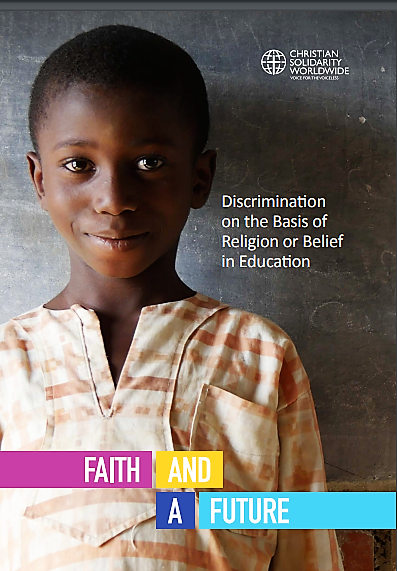 Faith and a Future: Discrimination on the Basis of Religion or Belief in Education, a new report by Christian Solidarity Worldwide (CSW), calls for action to address and end religious discrimination in schools.

