FCO publishes 2017 Human Rights and Democracy report

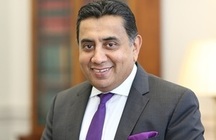
On 16 July Lord Ahmad, the Minister for Human Rights Lord Tariq Ahmad of Wimbledon, published the Foreign and Commonwealth Office’s 2017 Annual Human Rights and Democracy Report.

The official press release stated “The report is a barometer for the global human rights picture with particular emphasis on the FCO’s 30 Human Rights Priority Countries. The report also focuses on how the UK is working to protect and promote human rights across the world. It covers the period from January to December 2017.

The Minister for Human Rights, Lord Ahmad of Wimbledon, said: “70 years ago the UK played a vital role in drafting the seminal text that remains the cornerstone for human rights, the Universal Declaration of Human Rights. However, the ongoing repression of people’s rights reminds us that our work to defend them is as pressing and urgent as ever. This report is vital in documenting the serious concerns we have about the human rights situations in a range of countries. Standing up for human rights is not only the right thing; it helps to create a stable more prosperous world.”

The report also focuses on how the UK is working to protect and promote human rights across the world.

Read the Human Rights and Democracy 2017 report.

Promoting and defending human rights is a fundamental part of the UK’s foreign policy. Every day, all over the world, British ministers, diplomats and officials champion gender equality, LGBT rights, freedom of religion or belief and freedom of expression.

Freedom of Religion or Belief

The report’s section (p10) in full:

In 2017, promoting and defending freedom of religion or belief (FoRB) remained a high priority for the UK. In February, the Prime Minister, Theresa May, reiterated the government’s commitment to “stand up for the freedom of people of all religions to practice their beliefs in peace and safety”. The Minister for Human Rights, Lord Ahmad of Wimbledon, made FoRB a personal priority and began to develop a strategy to galvanise the work of our diplomatic network.

The right to FoRB came under increasing pressure. Discrimination and persecution of minorities was seen in many forms and diverse parts of the world. For example, in Burma, the religious identity of the Rohingya people has long been a factor behind the discrimination they suffer at the hands of the state, and was arguably a motivating factor behind the violence they suffered at the hands of the Burmese military in 2017. Minorities in Pakistan continued to suffer persecution and discrimination, and blasphemy legislation continued to be abused by the justice system. Persecution of the Baha’i in Iran and Yemen was particularly acute, and followers of that faith also faced discrimination elsewhere.

In many countries, through patient, quiet diplomacy or through public statements, the UK worked to reinforce the importance of the universal right to FoRB. For example, in Iraq, we worked to build consensus around the importance of freedom of religion or belief, and of its promotion and protection, in the process of reconstruction of the country following the conflict with Daesh.

Throughout 2017, engagement with faith leaders and NGOs increased. Lord Ahmad launched a series of roundtables to enhance dialogue with faith leaders and civil society experts, in order to draw on their experience. Meetings in 2017 discussed Burma and the role of women in tackling violent extremism.

Promoting FoRB in multilateral fora remained an important element of the UK’s work. Lord Ahmad highlighted the importance of defending the right to FoRB when he addressed the Human Rights Council in September. At the UN General Assembly in December, the UK worked successfully to help maintain consensus on the adoption of the EU-sponsored resolution on ‘Freedom of Religion or Belief’, and the Organisation for Islamic Cooperation-sponsored resolution on ‘Combating Religious Intolerance’.

During 2017, we continued to raise cases of persecution in individual countries, in particular:

  • in China, there were further reports of the demolition of churches and the removal of crosses. 2017 saw the introduction of new restrictions targeting Muslim Uyghurs in Xinjiang. We continued to raise our concerns through the UK-China Human Rights Dialogue, whose latest session was held in Beijing in June;
  • in Nepal, the Embassy hosted a breakfast meeting with faith leaders to mark ‘International Religious Freedom Day’, and to explore different faith groups’ perspectives on how the international community might help promote FoRB. The event reminded the Nepalese government to uphold its international obligations in this area;
  • In July, the Supreme Court in Russia upheld a ruling to label the Jehovah’s Witnesses as an ‘extremist organisation’, effectively criminalising peaceful worship by 175,000 Russian citizens. Lord Ahmad issued a statement on 18 July condemning this decision, and called on the Russian government to uphold its international commitments to religious freedom. Embassy officials and those from the FCO in London continue to hold regular meetings with representatives of the Jehovah’s Witnesses, and Embassy officials coordinated attendance at each hearing with our international partners;
  • the High Commission in Nigeria organised a live panel discussion on religious tolerance on one of Nigeria’s biggest TV networks, for an audience of over 15 million;
  • the ongoing conflict in Syria increased tensions between the different religious groups in the country leading to heightened intolerance, particularly in Daesh-controlled areas, and increased sectarian violence. We continued to support non-governmental efforts to promote dialogue between different ethnic and sectarian groups in Syria, in the search for progress towards a political settlement. We have been clear that any such settlement must include protection for religious rights and freedoms, including for religious minorities; and
  • in Bangladesh, the traditional culture of tolerance has faced challenges from local-level discrimination and violence against minority communities. Against this backdrop, during his visit to Bangladesh, Lord Ahmad visited the Ahmadiyya Mosque in Dhaka and made a call for religious tolerance. The High Commission maintains contact with religious groups and leaders, and is preparing a strategy to address intolerance against religious minorities.

Throughout 2017, we continued to support a number of FoRB projects through the FCO’s Magna Carta Fund. These included a project to support secondary school teachers in Iraq, Lebanon and Morocco to educate their students about tolerance and FoRB. An indication of the impact of this project came when the Kurdish Regional Government asked for it to be shared with every child in the region.

The FCO works closely with DFID to raise concerns on FoRB with partner governments. During 2017, DFID also sharpened its focus on FoRB, by announcing a UK Aid Connect programme to address key development challenges in building FoRB.

Looking forward to 2018, a key focus of our work will be to use our newly developed strategy to mobilise the diplomatic network. This will include building on our existing network of parliamentarians, faith leaders and academia through ongoing collaboration. Our bilateral interventions will also remain an important part of our work as we seek to prioritise a number of countries for our FoRB work.

Finally, we will build on strengthening and amplifying the work of our diplomatic network to further their efforts to promote FoRB across the globe.


The FCO’s 30 Human Rights Priority Countries – those highlighted is where there is specific reference to FoRB:

Afghanistan, Bahrain, Bangladesh, Burma, Burundi, Central African Republic, China, Colombia, Democratic People’s Republic of Korea, Democratic Republic of Congo, Egypt, Eritrea, Iran, Iraq, Israel and the Occupied Palestinian Territories, Libya, Maldives, Pakistan, Russia, Saudi Arabia, Somalia, South Sudan, Sri Lanka, Sudan, Syria, Turkmenistan, Uzbekistan, Venezuela, Yemen and Zimbabwe.

APPG statement on the new UK Special Envoy for FoRB

Lord Ahmad of WimbledonThe APPG for International Freedom of Religion or Belief today issued the following Statement on the Appointment of the New Special Envoy for Freedom of Religion or Belief

The APPG for International Freedom of Religion or Belief warmly welcomes Lord Ahmad in his new role as Prime Minister’s Special Envoy on Freedom of Religion or Belief (FORB).

We are very pleased to see the Prime Minister’s commitment to this fundamental human right for people of all faiths or none, as enshrined in Article 18 of the Universal Declaration of Human Rights and the International Covenant on Civil and Political Rights. We look forward very much to supporting Lord Ahmad in his new role and helping to ensure that he is equipped to work in the UK and around the world to address FORB violations and promote social cohesion along religious or belief lines.

A press release from the Prime Minister’s office headed Lord Ahmad given role as Prime Minister’s Special Envoy on Freedom of Religion or Belief stated:

Lord Ahmad has today been appointed as the Prime Minister’s Special Envoy on Freedom of Religion or Belief.

The role, which supports the Prime Minister’s commitment to religious tolerance in the UK, will allow Lord Ahmad to demonstrate the country’s commitment to religious freedom by promoting inter-faith respect and dialogue internationally.

Lord Ahmad, who is also Minister of State for the Commonwealth and the UN at the Foreign & Commonwealth Office, will promote the UK’s firm stance on religious tolerance abroad, helping to tackle religious discrimination in countries where minority faith groups face persecution.

The appointment underscores the Prime Minister’s commitment to tackling religious prejudice in all its forms and follows the government’s recent announcement of a further £1 million funding for places of worship that have been subjected to hate crime attacks.

Prime Minister Theresa May said:

“Religious discrimination blights the lives of millions of people across the globe and leads to conflict and instability. Both here and abroad, individuals are being denied the basic right of being able to practise their faith free of fear.

“Tolerance for those of different faiths is fundamental to our values, and is an issue I know is already of great importance to Lord Ahmad, who is constantly looking for fresh ways to promote religious liberty in his role as Minister for Human Rights at the Foreign Office.

“I look forward to supporting him in this new role as he works with faith groups and governments across the world to raise understanding of religious persecution and what we can do to eliminate it.”

The PM’s Special Envoy for Freedom of Religion or Belief, Lord Tariq Ahmad of Wimbledon said:

“In too many parts of the world, religious minorities are persecuted, discriminated against and treated as second class citizens. As a man of faith, I feel this very keenly.

“Freedom of Religion or Belief is a human right enshrined in the Universal Declaration of Human Rights. It must be respected. People from all faiths or none should be free to practise as they wish. This respect is key to global stability, and is in all our interests.

“I am delighted to have been appointed as the PM’s Special Envoy. I shall use the UK Government’s global network to reach across religious divides, seek the elimination of discrimination on the basis of religion or belief and bring different communities together.”

House of Lords debates continuing violence in Nigeria

Lord Alton of Liverpool
To ask Her Majesty’s Government what assessment they have made of the continuing violence between communities and armed groups in Nigeria.

Lord Alton of Liverpool (CB)
My Lords, the tragic topicality of today’s debate was underlined last weekend when more than 200 people were reported to have died in co-ordinated attacks on around 50 communities in Plateau state in Barkin Ladi. These attacks began on 22 June and lasted until 24 June. The majority of the victims were women and children. At one location, 120 were killed as they returned from the funeral of an elderly member of the Church of Christ in Nations. A dawn to dusk curfew was established and, as I heard first hand yesterday from the honourable Rimamnde Shawulu Kwewum, a member of the Nigerian Federal House of Representatives, the area remains tense. This most recent episode is shocking, but it is also the latest in an extended pattern of violence that has become all too common across Nigeria, particularly in the Middle Belt and increasingly in some of the more southern states.

Last week Sam Brownback, the United States Ambassador-at-Large for International Religious Freedom, was in Nigeria. On a single day during his visit, there were six suicide bombings by Boko Haram, the largest ​number ever on any single day. As we will hear later from my noble—and courageous—friend Lady Cox, who has visited these areas, these attacks have been systematic and go on unabated.

Human rights groups such as CSW have catalogued every reported attack. While it may not be definitive, the list attempts to provide as comprehensive a record as possible of known attacks and of the death toll in the Middle Belt during the first quarter of this year, underlining the critical need for urgent and effective intervention. I have sent many of these details to Ministers but in the interests of time I will just give the House a snapshot from a few days in April of this year. On 10 April, 10 people were killed in Ukum in Benue state. On 10 April, 51 were killed in Wukari, Taraba state. On 12 April, 41 were killed in Ukum, Benue state. On 12 April, two were killed in Makurdi in Benue state, and another 41 were killed in Ukum in Benue state.

The charity Aid to the Church in Need, on whose board I sit in a pro bono capacity, has also documented appalling acts of violence, which I have sent to the Government. In April, during early morning mass, militants attacked the parish in Makurdi killing two priests and 17 members of the congregation. ACN has also highlighted the 15,000 orphans and 5,000 widows in the north-east—an area that has come under repeated attack from Boko Haram. I would be grateful to hear from the Minister what humanitarian aid we have been able to provide for victims.

CSW reports that in the first quarter of 2018, Fulani herder militia perpetrated at least 106 attacks in central Nigeria. The death toll in these four months, purely from herder militia violence, stands at 1,061. An additional 11 attacks recorded on communities in the south of the country claimed a further 21 lives. One spokesman said: “It is purely a religious jihad in disguise”.

There has certainly been a long history of disputes between nomadic herders and farming communities right across the Sahel, over land, grazing and scarce resources—I have visited places such as Darfur myself and have seen that at first hand. It is true that attacks by herder militia have, on occasion, led to retaliatory violence, as communities conclude that they can no longer rely on the Government for protection or justice. Between 1 January and 1 May this year, there were 60 such attacks. However, compared with the recent escalation in attacks by well-armed Fulani herders upon predominately Christian farming communities, the asymmetry is stark and must be acknowledged by the UK Government in their characterisation and narrative of this violence. Given the escalation, frequency, organisation and asymmetry of Fulani attacks, does the Minister believe that the references to “farmer-herder clashes” still suffice? In the face of the reports of violence collected by impartial human rights groups, there is no place here for, as it were, moral equivalence; nor is it sufficient for the Government merely to urge all sides to seek dialogue and avoid violence. I would urge the noble Baroness to revisit the narrative, conduct her own assessment and either confirm or dispute the data that I have given to the House already—I know other noble Lords will do the same.​

Some local observers have gone so far as to describe the rising attacks as a campaign of ethno-religious cleansing. Armed with sophisticated weaponry, including AK47s and, in at least one case, a rocket launcher and rocket-propelled grenades, the Fulani militia have murdered more men, women and children in 2015, 2016 and 2017 than even Boko Haram, destroying, overrunning and seizing property and land, and displacing tens of thousands of people. This is organised and systematic. We must ask where this group of nomadic herdsmen is getting such sophisticated weaponry from. I wonder whether the Minister has had a chance to look into this; if not, will she give an undertaking to do so?

While recognising the complex, underlying causes of this violence, we must also acknowledge a growing degree of religious motivation behind the violence. The local chapter of the Christian Association of Nigeria recently revealed that herdsmen have destroyed over 500 churches in Benue state alone since 2011. Perhaps the Minister could also respond to reports that during many of these well-planned attacks by Fulani militia, their cattle are nowhere in sight, and they are often reported by survivors to have shouted “Allahu Akbar” during these attacks. Perhaps the Minister can comment on this undoubtedly sectarian aspect of the escalating violence.

Beyond intermittent verbal condemnations, I cannot see much practical action that has been taken to end the violence, which has emboldened perpetrators even further. Moreover, in the light of such an inadequate response thus far, communities will begin—and indeed already are beginning—to feel that they can no longer rely on government for protection or justice, and a few take matters into their own hands. In the words of an Anglican canon in the Middle Belt, “Why do so many security service personnel spend their time guarding our politicians, rather than protecting our people?” I also put on record a recent statement to President Buhari issued by the Catholic Bishops’ Conference of Nigeria. Among other things the statement said:

“Since the President who appointed the Heads of the nation’s Security Agencies has refused to call them to order, even in the face of the chaos and barbarity into which our country has been plunged, we are left with no choice but to conclude that they are acting on a script that he approves of. If the President cannot keep our country safe, then he automatically loses the trust of the citizens. He should no longer continue to preside over the killing fields and mass graveyard that our country has become.”

That is a pretty awesome statement from a bishops’ conference.

Concern about partiality was also raised on 24 March, by the highly respected former army chief of staff and Defence Minister, Lieutenant General Theophilus Y Danjuma, who stated that the armed forces were, “not neutral; they collude” in the,

“ethnic cleansing in … riverine states”,

by Fulani militia. He insisted that villagers must defend themselves because,

“depending on the armed forces”,

will result in them dying,

“one by one. The ethnic cleansing must stop … in all the states of Nigeria; otherwise Somalia will be a child’s play”.​

I would like to hear, therefore, what practical steps the UK Government are taking to work with the Government of Nigeria in developing effective solutions to bring an end to this escalating violence. Can the Minister tell us whether there is a strategic plan and what representations have been made directly? I know that finding solutions is complex, but there is nothing to stop the Minister calling on the Government of Nigeria to recalibrate security arrangements and to resource their forces as a matter of urgency, in order to offer sufficient protection to vulnerable communities.

As I close, I thank the noble Lords who are participating in today’s debate and go back to where I began: to the more than 200 people, mostly women and children, who were killed in sustained attacks on 50 villages by armed Fulani militia just this past weekend. People are dying daily. On 18 June, the Archbishop of Abuja referred in the Telegraph to what he described as “territorial conquest” and “ethnic cleansing” and said:

“The very survival of our nation is … at stake”.

This alone should serve as a wake-up call. Are we to watch one of Africa’s greatest countries go the way of Sudan? Will we be indifferent as radical forces sweep across the Sahel seeking to replace diversity and difference with a monochrome ideology that will be imposed with violence on those who refuse to comply? We must not wait for a genocide to happen, as it did in Rwanda.

Ominously, history could very easily be repeated.

Baroness Berridge (Con)
My Lords, I thank the noble Lord, Lord Alton, for securing this, unfortunately timely, debate and declare an interest as project director of the Commonwealth Initiative for Freedom of Religion and Belief.

While the focus in Nigeria was, for many years, on violence in the Niger Delta area over oil revenues or on the Boko Haram attacks in the north-east, the escalation of attacks between predominantly Christian farmers and predominantly Muslim Fulani herdsmen has gone underreported. As the noble Lord has outlined, in only the past week, as many as 200 Christian farmers were killed in central Plateau state, but the crisis between farmers and traditional herdsmen is not confined to Nigeria. Such violence extends across west Africa and the 2017 Global Terrorism Index estimates that more than 60,000 people have been killed across west Africa in clashes between Fulani herdsmen and settled communities since 2001. The Fulani are an ethnic group of about 20 million people across 20 west and central African countries. The causes of this violence are of course complex but include environmental reasons, religious motivation, terrorism and poor security services.

As the ECOWAS 1998 cross-border transhumance agreement allows herders to move across borders in search of grazing lands, it is not surprising that reports in Nigeria suggest that Fulani are coming from multiple countries. So, in April this year, it was encouraging to note that a further ECOWAS summit was held to discuss the issue, which has led to discussions about changing this agreement to prevent the uncontrolled movement of potentially violent groups across borders. The ECOWAS countries are now co-operating and are particularly looking at greater investment in livestock ​management and a common agricultural policy. But banning cattle-grazing, as has happened in three Nigerian states, has to be incorporated within a wider plan. The foremost livestock producers’ group, the Miyetti-Allah Cattle Breeders Association of Nigeria has endorsed the Government’s 10-year national ranch development plan. Have Her Majesty’s Government been approached by ECOWAS or the Nigerian Government looking for Department for International Development expertise and resource to enact such a ranch plan?

It is surely too simplistic to label these deaths as driven solely by desertification and competition for resources. While there have been attacks by Fulani herdsmen on Muslim farmers in Zamfara state, these are overwhelmingly outnumbered by attacks on Christians. Religious polarisation and extremism have helped to escalate violence in Nigeria to a greater degree than in other countries in the region. An existing conflict such as this and a strong ethno-religious identity has bought Fulani groups into wider jihadi movements, such as the largely Fulani terrorist group, FLM, which has joined with Islamic State. The FLM is apparently now seeking to bring the herdsmen’s grievances from Nigeria within its scope. Do Her Majesty’s Government agree that there has been an escalation in Nigeria of late? What do they believe are the causes and what is the extent of Boko Haram’s role in this? Are Boko Haram militants part of these attacks? It might explain the numerous reports, outlined by the noble Lord, Lord Alton, of attacks with no cattle in sight. Is Boko Haram itself now part of a wider terrorist network?

Parliamentarians and religious leaders have an important role in resolving this conflict and the Commonwealth Initiative for Freedom of Religion and Belief’s conference last month for faith leaders and parliamentarians in Accra highlighted the wealth of resources available across west African Commonwealth countries. Ghana, Sierra Leone and Gambia offer superb examples of how to utilise faith and parliamentary leaders in calming religious tensions and addressing narratives of religious extremism, which will be vital to securing long-term peace in Nigeria.

In the short term, the easy accessibility to an estimated 380 million unregistered small firearms in Nigeria, roughly two guns per person, is a key factor in the scale of the deaths. These arms are looted from the army or black market sources across west Africa. Parliamentarians in Nigeria are currently trying to co-ordinate a meeting of regional parliamentarians connected to their respective security committees to discuss ways of checking the flow of arms around the region. Could the Minister outline whether the Secretary-General of the Commonwealth, the Commonwealth Parliamentary Association or the Inter-Parliamentary Union can be resourced to help this important parliamentary initiative?

The potential for this violence to spread is of concern to us all and I suspect some of the victims are relatives of British Nigerian diaspora, but the 2019 presidential and parliamentary elections in Nigeria provide the best opportunity for Nigerians themselves to demand their Government deal with this crisis. On my one visit to Nigeria, I witnessed that talk radio, civil society and religious groups in the south, especially churches, are ​hugely influential. I had the privilege of addressing an audience of 1 million people physically there. I hope the Nigerians, especially Nigerian Christians, will realise that much more of the solution is in their hands than they perhaps realise.

Lord Chidgey (LD)

My Lords, I too congratulate the noble Lord, Lord Alton, and the noble Baroness, Lady Berridge, on their contributions, and thank the noble Lord, Lord Alton, for bringing this subject to us today. There has been a long history of disputes between nomadic herders and farming communities across the Sahel. In Nigeria, attacks are now occurring with such frequency, organisation and asymmetry, as mentioned by the noble Lord, Lord Alton, that references to “farmer-herder clashes” are wholly inadequate. Armed with relatively sophisticated weaponry, particularly AK47s, the Fulani herder militia is thought to have murdered more men, women and children, between 2015 and 2017, than Boko Haram.

It has overrun and seized property and land, and displaced tens of thousands of people. In 2017, herder militia claimed 808 lives in 53 villages in southern Kaduna alone, burning down over 1,400 houses. As pointed out by the noble Baroness, Lady Berridge, during most of these well-planned attacks, herders’ cattle were nowhere in sight. Over 180,000 people in Benue state are currently living in IDP camps because the herder militia violence has displaced them. More than 500,000 displaced people are living in temporary accommodation, and over 80,000 school-age children are living in IDP camps with no access to education.

Attacks continue unabated, with seemingly little government action. This has entrenched impunity. Apart from verbal condemnations, there has been no action to end the violence. No attacker has been brought to justice. With perpetrators emboldened, attacks by herder militia have now spread to southern Nigeria. No longer able to rely on the Government for protection or justice, communities are seeing a growth in vigilantism and retaliatory justice. The growth in murders of villagers and community leaders in Benue has also led to calls for President Buhari to consider his position, and for the reassessment of security arrangements as a matter of urgency.

As mentioned by the noble Lord, Lord Alton, on 24 March this year the respected former army chief of staff and Defence Minister, Lieutenant-General Theophilus Danjuma, stated that the armed forces were “not neutral” and that “they collude” in the “ethnic cleansing” of riverine states by the Fulani militia.

Earlier this week, I too had the opportunity to meet with the honourable Kwewum Rimande Shawulu, courtesy of the advocacy organisation CSW. The honourable Shawulu is a member of the Nigerian federal House of Representatives in Taraba state. Among his wide-ranging writing and editorial activities, he is currently chair of the National Assembly Army Committee, which gives him unique insight into Nigeria’s current security challenges.

In our discussions, he was able to rebut the claim that the anti-grazing laws are the cause of the spread of violence. The only states with anti-grazing laws are ​in fact Taraba, Benue and Ekiti, yet attacks have been occurring over 10 states. For example, in Plateau state, where there are no anti-grazing laws, there have been many killings, including last weekend, as mentioned by the noble Lord, Lord Alton, when over 200 civilians were reported killed. Interestingly, while there is some evidence that some of the violence has a religious dimension, the honourable Shawulu argued that the only affected area was Adamawa state, which is predominately Christian. Other areas with similar land and other resources have suffered no attacks, be they Christian or Muslim.

The overriding concern is that the growing instability and lawlessness in the region is providing fertile ground for kidnapping, banditry and terrorism with impunity. If this is not addressed, there is a real danger that the activities of Boko Haram, ISIS and similar terrorist groups could penetrate and destabilise the whole region. If not addressed, this could create a conflict and humanitarian crisis on a scale that would engage the international community, the UN Security Council and the UK. The prospect of terrorist cells spreading through Nigeria, Africa’s most populous state, and to territories beyond to threaten Europe cannot lightly be dismissed.

I urge the Government to act now, working alongside their Nigerian counterparts and fellow Commonwealth members, particularly while the UK holds the post-CHOGM Chair-in-Office. I suggest that DfID might examine the aid programme to Nigeria to ensure that provision is made for the communities that have been victims of the Fulani attacks. It should also ensure that minority communities in the north affected by Boko Haram attacks have access to humanitarian aid. There are also issues such as collective Commonwealth support in promoting the non-discriminatory and “even” application of the law to restore and strengthen faith in the law.

The attacks the Nigerian people are suffering can surely be mitigated, if not eroded, with the support of the agencies of the UN, the United Kingdom and the Commonwealth, the faith community and international NGOs. Can the Minister, in her response or in writing, set out how the UK might plan to play a primary role in such a venture?

The Lord Bishop of Coventry

My Lords, I join with others in thanking the noble Lord, Lord Alton, for securing a debate on the serious situation that threatens the very stability of Nigeria. With the noble Lord I deplore the violence and, with other noble Lords and indeed the victims themselves, some of whom have been in contact with many of us this week, I call on Her Majesty’s Government to use their influence on the Nigerian Government to ensure the security of their people and to bring the violence to an end.

The violence here and in other extreme situations is symptomatic of underlying issues in Nigerian society, ranging from security to justice to employment to the exclusion of children from education through poverty, and even including the effects of desertification and the epidemic of drug abuse. They all have their part to play. At a more fundamental level still is the distance ​between the demands of the constitution and the daily lives of many Nigerian people. Intercommunal and interreligious violence of any sort has no root in Nigeria’s constitution. Rather, the constitution is a challenge to political leaders to apply it and to local religious and civic leaders to respect it.

I would like to focus on the importance of unbiased public information across Nigeria, whether through traditional media, social media, formal education, private or state, or informal religious education, in order to build resilience into communities in a way that protects against malign political manipulation of religious identities and nurtures respect and reconciliation between peoples. As shown by another CSW report, Faith and a Future, education impacts on other human rights and,

“can either create a culture of tolerance or fuel stereotyping, animosity and extremism”.

That is surely happening in Nigeria, certainly in the northern and central states, and probably in the south as well. Unfair representations of the other, especially the religious other, are a powerful source of energy for the political purposes of those who seek to gain influence and power. They are not difficult to access and then use to fuel the fires of fear on which hatred thrives and violence depends. Fair, truthful, unbiased education in all its forms has its own greater power to resist the engine of hatred and starve the forces of violence.

Amidst the tragic realities of the suffering of minorities in Nigeria, the appalling suffering of Christians in the northern states to which other noble Lords have drawn graphic attention, the suffering of Muslims caused by reprisals from Christian communities, the prejudice towards Shia Muslims, and even, as we have heard, the wanton murder of Fulani men going about their lawful business en route to cattle markets—amidst the terror of all this suffering, good education in all its forms offers hope for the future. The federal and state Governments have levers they can use—especially in formal education, both private and public—to improve the quality of education as a power for good and not for harm.

Education operates in many forms, but my remaining comments will focus on the content, conduct and character of education within schools, private and state. My interest is in how the religious and ethnic other is portrayed. This includes not only the content of religious education that students receive about their own religion and the religious and ethnic identity of others but the way that content is taught, the way people from minority communities are themselves treated in schools—whether they are afforded their full constitutional rights—together with the character of the educational experience throughout the school: is it cultivating a culture of respect? My understanding is that each state education department has an inspectorate division. This gives a strong lever to monitor the delivery of education according to the principles of the constitution and the guidelines set at federal level.

There are some hopeful signs on the ground. The governor of Kaduna state is pursuing a thorough process of educational reform in which he recently dismissed large numbers of unsuitable teachers and recruited even larger numbers of qualified teachers, ​increasing their allowances to incentivise teachers to work in rural areas. So I conclude by asking the Minister whether Her Majesty’s Government have offered their assistance to state governors who seek to raise the standards of education to a higher level, not only of academic achievement but of more religiously responsible citizenship, and to monitor it rigorously.

Baroness Stroud (Con)

My Lords, I thank the noble Lord, Lord Alton, for tabling this timely debate.

As we have heard, historically attention has been focused in the north of Nigeria, with the much-reported rising number of attacks by Boko Haram. But over this last weekend, as we have also heard, violence between the mostly Muslim Fulani herdsmen and Christian farmers in central Nigeria, the middle belt, killed 200 people and destroyed countless houses. I share the concern of the noble Lord, Lord Alton, about escalating religious violence against Christians and violations of freedom of religion and belief, which are largely unaddressed by the state.

Ethnic and religious relations in Nigeria have always been a delicate balancing act, but these ongoing tensions with this outbreak of violence are as much products of poverty and inequality across the country as they are of deep-seated division. If we want to address issues of safety and security in Nigeria, we also need to address the inequality that modern Nigeria faces. Almost 87 million people in Nigeria live in extreme poverty, on $1.90 a day or less, and this number has increased over time, making Nigeria the country with the highest number of people in extreme poverty in the world. Nigerian government figures show that between 1980 and 2010, the number of people in poverty increased by 153%, with nearly 5 million people facing food insecurity and 49% of the younger generation either unemployed or underemployed. I refer to the register of Members’ interests when I point out that Nigeria sits as the 128th of 149 countries in the Legatum Prosperity Index, with particularly low scores in safety and security, economic quality and health.

However, between 2000 and 2015 the number of millionaires in Nigeria increased by over 300%, and Nigeria has had an average economic growth of 7% annually since 2004. This story is an indictment of successive Nigerian Governments’ failure to manage the country’s wealth, and of a deeply ingrained culture of corruption. The Nigerian National Bureau of Statistics estimates that small-scale bribery, for example to facilitate bureaucratic tasks, amounts to $4.6 billion a year.

Nigeria’s poverty is significantly more profound in the mostly Muslim north of the country, with 2010 figures showing 74% of the population of the north in poverty—20% higher than in the mostly Christian south. This division is exacerbated by an educational and investment divide between the north and south. The challenge to avoid clashes along existing lines of tension as a result of this is a great one.

In addition, the Boko Haram insurgency has had an enormous impact in north-eastern Nigeria in particular, with 20,000 dead since 2009 and at least 2 million people displaced. The Nigerian military, as we have ​heard, has shown itself to be ill equipped to deal with this insurgency, and, despite the Nigerian Government’s claims that Boko Haram is in retreat, these statements have only been followed by an increase in attacks. The group still poses a significant threat to the stability of this region.

Those who have been displaced in north-eastern Nigeria number nearly 2 million, in addition to 200,000 Nigerians in neighbouring countries. This situation is a continuing humanitarian crisis, which the Nigerian Government have also shown themselves ill equipped to tackle, leading to the establishing of major internally displaced people camps. However, the situation in these Nigerian refugee camps is appalling, with outbreaks of cholera, crippling shortages of food and water, and reports of up to 30 armed attacks a month on refugee camps in 2017. Far from being places of refuge, the crowded camps have been made into death traps as Boko Haram seeks soft targets.

With the UK Government now committing to aid funding of £200 million over the next four years, compared to the £100 million we committed to in 2017, will the Minister outline how the Government are intending to use this money effectively to focus on the key priorities that affect the country? This latest spate of violence only shows how urgent the need to address inequality is, and with next year’s presidential elections looming it is essential to ensure that the situation is stabilised so that the election is conducted in a safe environment.

We know what leads to prosperity in a nation. It is stable government that is free of corruption; safety and security; a good business environment; and strong skills development. I ask the Minister in particular to outline the balance of aid between a humanitarian response and support for the long-term nation-building response.

Baroness Cox (CB)

My Lords, I too congratulate my noble friend Lord Alton on securing this debate at this tragically critical time. Over recent decades there have been numerous attacks on Christians in the northern states, where sharia law has been established, as well as in Plateau state in the central belt. Thousands of Christians have been killed, hundreds of churches burned, and homes destroyed. The tragedies escalated with the rise of Boko Haram, which also killed Muslims who did not accept its Islamist ideology.

I have visited many times and seen the tragedies of death and destruction in Bauchi, Kano and Plateau states. But more recently, as other noble Lords have described, there has been a very disturbing change in the behaviour of the Fulani herdsmen. Since time immemorial, they have driven their huge herds of cattle through other people’s lands, causing tensions and some violence, but traditionally, they have moved on. However, in the last two to three years they have adopted a new policy: attacking Christian villages, killing local people, destroying homes, driving villagers off their lands and settling in their place. Now there has been this recent escalation of attacks on Christian villages by the Fulani, with, as other noble Lords have highlighted, over 200 civilians killed in Plateau state ​just last weekend. The Miyetti Allah Cattle Breeders Association of Nigeria has claimed responsibility for the attack.

Last time I was in Nigeria, I visited four villages which had been destroyed by Fulani. I stood in the rubble of the pastor’s home where he had been slaughtered, and I saw the huge numbers of Fulani cattle roaming through the destroyed villages. There are concerns that the Fulani militants are now so well armed that they are possibly fighting a proxy war for Boko Haram, with the shared agenda of driving Christians out of their homelands in northern and central-belt Nigeria.

Time allows only a few examples of quotations from local people, but they are indicative of many more. They provided first-hand evidence of the horror and terror now prevailing in these areas. This is one quote:

“Fulani herdsmen, yesterday 23 June, on a rampage, attacked about 10 villages; ‘in Nghar village alone, about 70 corpses were recovered as the entire village was razed down’”.

This is another:

“The attack last night was vicious … armed Fulani men dressed/masked in black entered Rasak & Gana Ropp villages, shooting randomly … The house of one … family … was surrounded & directly attacked … the Fulani were shooting into the house … as they shouted ‘Allahu Akbar!’”

This is another:

“Other villages in the area … were completely sacked by the armed herders. Survivors from the attacks from these ‘villages are believed to still be hiding in the bushes’”.

Over 60 people are known to have been killed there.

This is another quote:

“The attacks are continuing in other villages and in Gashish. As of 6 pm, at least 30 people were feared dead with several houses and cars razed down”.

This is my last example:

“In a continuing killing spree, Islamic Fulani cattle herdsmen killed eight people in Bassa local council, near Jos. From Sunday 17 June, till today (20th June) we have had no peace in the villages around here … all these villages have been attacked one after the other in three days”.

Archbishop Benjamin Kwashi, who had taken custody of a baby whose mother was killed, said:

“I am in tears because I have taken a child whose mother was shot dead. A family of four killed, another two young men shot dead and so on … Where are those who will protect the poor? Where is the leadership? It is a week and three days now with daily killings of poor unarmed and unprotected citizens of Plateau State”.

Related concerns expressed by local people include the interpretation of the situation as intercommunal attacks, with both sides being equally guilty. One resident said:

“It is annoying when politicians say this is a clash between herdsmen and farmers. I ask, how does a woman farming in her own farm clash with Fulanis carrying AK-47s?”

Other concerns include: failure of security services to protect civilians; impunity, with no one responsible for the killings being called to account; the escalation in the number of internally displaced peoples; and the destruction of crops, which are the livelihood of local people.

I want to make three requests of the Minister. Will Her Majesty’s Government make representations to the Government of Nigeria to take effective action to ​protect all their citizens and to call to account those who have been perpetrating atrocities? Will Her Majesty’s Government work with the high commission to ensure that adequate humanitarian aid is available for those suffering the loss of family members and the destruction of their homes and crops, and forced to become IDPs? Will Her Majesty’s Government urge the Nigerian Government to undertake an investigation into the ethnic and religious persecution of the affected people and the operation of the Nigerian army during these attacks?

There is real fear that these developments are part of a strategy by Islamist fundamentalists to drive Christians out of their traditional homelands in northern and central-belt regions of Nigeria. I urge Her Majesty’s Government to respond appropriately to the very real possibility of religious cleansing.

Lord Suri (Con)

My Lords, the human rights situation in Nigeria has deteriorated significantly in recent years, with a particular surge in attacks by non-state actors—notably armed Fulani herdsmen, also known as the Fulani militia.

Successive Governments have failed to respond effectively, and the violence perpetrated has increased exponentially. Although ongoing in central Nigeria since 2011, attacks spiralled following President Buhari’s inauguration in May 2015, with states experiencing intense violence in a cyclical manner. Such attacks by increasingly well-armed herdsmen on farming communities in the states of Adamawa, Benue, Kaduna, Nasarawa, Plateau and Taraba now occur with frequency, precision and asymmetric violence, rendering references to “farmer-herder clashes” obsolete.

Although far from exhaustive, the following events, documented by Christian Solidarity Worldwide, give a powerful insight into the growing problems. Over 150 villagers were killed in Adamawa state in attacks in the run-up to Christmas 2017. During the festive season, villages in southern Kaduna, Benue and Adamawa were then attacked; churches were destroyed and villagers were killed and mutilated. On 24 December 2017, in southern Kaduna state, four villagers were killed as people gathered in the square of Nindem village, in the Godogodo district of the Jema’a local government area, in the evening to sing carols. A female choir singer was shot in the mouth and maimed horribly.

As the new year dawned, Fulani gunmen invaded the home of a traditional ruler in Arak, in the Sanga local government area in the southern part of Kaduna state, killing him and his pregnant wife. Gambo Makama and his wife are reported to have died at around 12.05 am. Their son was also shot, but survived and was hospitalised. Then, 2018 began with an attack by Fulani herdsmen on the Guma and Logo local government areas of Benue state, in which 73 villagers were massacred. At least 1,061 people are thought to have died in the first quarter of this month. Just this past weekend we saw the most recent terrible episode of violence in Plateau state, with over 200 people—mainly women and children—reported to have been killed.

The situation has been exacerbated by inadequate government action which has enabled attacks to continue unabated. Beyond intermittent words of condemnation, ​the Government have failed to formulate effective strategies to address this violence. This has entrenched impunity and emboldened perpetrators even further, leading to a growth in vigilantism and periodic retaliatory violence, as communities conclude they can no longer rely on government for protection or justice. However, this retaliatory violence is by no means symmetrical—the first quarter of the year saw 106 attacks by the herder militia in central Nigeria, while seven attacks within that timeframe on Fulani herders or communities claimed 61 lives.

The number of attacks and casualties is staggering, and our Government must recognise the considerable escalation in the regularity, scale and intensity of the attacks by Fulani militia on these communities in central Nigeria. We must commit to doing more to encourage and support the federal and state governments to provide protection to those who live in constant threat of attack by a force that constitutes a major threat to national security. As a matter of urgency, we must encourage the formulation of a comprehensive and holistic security strategy that adequately resources the security forces to address this and other sources of violence. Can the Minister provide assurances of action? Will the UK Government do all they can to work with the Government of Nigeria, encouraging them to be more proactive in ending this appalling violence and to protect these vulnerable communities living in constant fear for their lives?

Lord Tunnicliffe (Lab)

My Lords, I too thank the noble Lord, Lord Alton, for introducing the debate. It is impossible to capture every aspect of this complicated situation in such a short debate, but I will briefly touch on the battle against Boko Haram, which is responsible for killing or displacing many thousands of people; multiple accounts, dating back over several years, of sexual attacks by Nigerian forces against women in refugee camps; and violence between herders and farmers, which increasingly resembles ethno-religious cleansing. Addressing multiple forms of violence presents a significant challenge to the Nigerian state, but this cannot and must not become an excuse for inaction.

The situation in Nigeria is equally challenging for countries such as ours. We have a moral duty to help, but we must ensure that such help is effective and is mindful of the various sensitivities involved. Can the Minister inform the House what assessment has been made of the UK’s capacity to provide additional assistance to Nigeria and what forms that may take?

The UK rightly provides training to support the fight against Boko Haram. We should continue to provide that training, but recent events highlight the need for us to also play the role of a critical friend. A fortnight ago, at least 31 people were killed by blasts in Borno State after the chief of the Nigerian army incorrectly told displaced residents that the militants had been defeated and it was safe to return home.

There are long-standing allegations, backed up by NGOs such as Human Rights Watch and Amnesty International, that Nigerian soldiers have sexually ​assaulted vulnerable refugee women. What representations have the Government made to Nigerian counterparts in the light of recent events and allegations involving the country’s military?

Historically, the struggle between Fulani herders and settled farmers has been a result of competition for resources. Christian Solidarity Worldwide note that,

“attacks … are … occurring with such frequency, organisation and asymmetry”,

that references to farmer-herder “clashes” no longer suffices. Despite the herder militia taking more lives during 2015, 2016 and 2017 than Boko Haram, President Buhari, who belongs to the same ethnic group, has been accused of turning a blind eye. Last month, NGOs co-ordinated a minute’s silence to remember 1,917 people killed by herders and armed bandits between January and May of this year. Concerns have been raised about freedom of expression, with some journalists prosecuted for hate speech after reporting the militia’s actions. Can the Minister confirm whether this conflict and its impact on Nigerian civil society were discussed when the Prime Minister met President Buhari in April? With some arguing that the conflict is being exacerbated by droughts, how are the Government tracking and responding to climate-related conflict across the globe?

I urge the Government to provide practical support to Nigeria that promotes peace and security, supports equitable economic growth, and builds the state’s capacity for the future. As we so often see in other parts of the world, it is only by creating the right societal conditions that Nigeria can overcome religious extremism, promote tolerance and limit the scope for the types of violence that have claimed too many lives in recent years.

Baroness Goldie (Con)

My Lords, I thank the noble Lord, Lord Alton, for tabling this debate and for his long-standing interest in community relations. I also thank all noble Lords for their contributions this afternoon. I welcome the opportunity to give the Government’s assessment of the situation in Nigeria and to update noble Lords on United Kingdom action.

It goes without saying that the Government regard the situation in Nigeria as both challenging and deeply disturbing. There are a number of issues at play which are having serious humanitarian consequences. The first are the actions of Boko Haram, of which many noble Lords will sadly be aware. Boko Haram claims to represent Islam, but its interpretation could not be further from the spirit of that peaceful religion. It attacks Nigerians of all faiths who do not subscribe to its extremist views. Its activity—the abduction of schoolgirls and the killings in which it has engaged—is appalling. Its actions have caused immense suffering in Nigeria and neighbouring countries in both Christian and Muslim communities. We assess that the majority of its victims are Muslim. Nearly 2.5 million people have been forced to flee their homes. Boko Haram and its splinter faction, Islamic State West Africa, remain a threat to regional security. Achieving a long-term solution requires non-military measures to improve security and enable economic growth.​
The other worrying issue to which many noble Lords referred and the noble Lord, Lord Alton, particularly covered in his speech, is the violence between farmers and herdsmen in various areas across Nigeria, and in the Middle Belt in particular, where attacks are carried out by herders on farmers, and vice versa. The noble Lord, Lord Alton, raised the question: does the description “farmer-herdsmen” suffice? This was a point also raised by the noble Lord, Lord Chidgey, and the noble Baroness, Lady Cox. The description “farmer-herdsmen” is broadly correct, but it does not fully represent the complexity of the situation. Violence has escalated over the past year—the reasons for this are many—but we are not aware of evidence to support the view that religion is driving this conflict.

The other worrying issue is the extent of recent attacks. In an attack by farmers on herder settlements in Mambilla Plateau in June 2017, over 800 people were killed—the majority of them women and children. We are concerned by the increasing violence in recent months. Just last weekend reprisal attacks by herdsmen on farming settlements resulted in at least 86 fatalities—it may be more than that. My noble friend Lord Suri and the noble Baroness, Lady Cox, very poignantly described the horrific nature of this violence.

As my noble friend Lady Berridge described eloquently, this is complex and it is far reaching. My noble friend Lord Ahmad noted in this House on 26 March that the causes of these clashes are complex. They relate to land, farming rights, grazing routes and access to water. The situation is not helped by a narrative which overplays the ethno-religious dimensions and oversimplifies a complex picture, conflating criminal violence, caused by cattle rustlers and bandits, for example, with community clashes.

The noble Lord, Lord Alton, asked where the weapons are coming from. Regrettably, one suspects there is a widespread availability of weapons; I thought that my noble friend Lady Berridge encapsulated the extent of that problem, as did the noble Lord, Lord Chidgey. In reality, religious extremism or sectarianism is not a key underlying cause of this violence and it would be wrong to conflate these land and water disputes with Boko Haram’s actions.

As Nigeria prepares for elections in 2019 there is a real risk that, without serious effort being made to stem the violence and address the root causes, the conflict between herders and farmers will worsen and become increasingly politicised, threatening peaceful solutions and elections in some states. That is why it is so important that Nigeria not only works to improve the situation in the north-east, but also works to address the causes of the violence between farmers and herders. It is imperative that there is a de-escalation of violence across all affected states. In this context, we welcome President Buhari’s recent commitment to protect the lives and property of all Nigerians and prevent the stoking of religious conflict.

My noble friend Lady Berridge specifically asked about a ranch plan and whether the UK has been engaged with this aspect. We are aware of the Nigerian Government’s proposals for creating cattle ranches for ​Fulani herdsmen and we are encouraging them to respect the rights and interests of all parties in finding solutions to this conflict.

As many, if not all, contributors have identified, all of this is causing a humanitarian crisis. In north-east Nigeria, 7.7 million people are in need of urgent, life-saving assistance and 1.8 million are displaced. This humanitarian crisis is a direct result of the fragile security situation caused by Boko Haram. My noble friend Lady Stroud spoke with authority on the levels of privation and the challenges that poses.

Very specifically, the noble Lords, Lord Alton, Lord Tunnicliffe, Lord Chidgey, and my noble friends Lady Stroud and Lord Suri, all raised the issue of UK action. The United Kingdom is playing a leading role in helping the Nigerian Government to address immediate humanitarian needs. We have increased our aid funding to £300 million over the next five years. We provide assistance on the basis of need, irrespective of race, religion or ethnicity, and in line with the international humanitarian principles. Last year our support reached more than 1 million people, including children, women and the disabled. We are also fully committed to supporting Nigeria’s efforts to tackle Boko Haram. We have provided intelligence analysis and training for the Nigerian military. With regard to farmer-herder violence, we encourage and support mediation by the state, local government and traditional authorities to defuse community tensions.

The right reverend Prelate the Bishop of Coventry referred to education and its importance. I could not agree more. DfID programmes are supporting improvements in the quality of education and increasing access for disadvantaged boys and girls to get education, focusing on three states in the north of the country where human development outcomes are particularly poor.

A number of contributors, not least the noble Lord, Lord Tunnicliffe, and my noble friend Lady Stroud asked what the balance is between humanitarian and development programmes from that spend. As I said earlier, DfID will spend £273 million this year, balanced between shorter-term humanitarian aid and longer-term support to help the Government of Nigeria to improve basic services, and to increase levels of prosperity and standards of good governance. For example, 1.8 million people gained access to clean water and/or sanitation between 2015 and 2017 through DfID programmes and 260,000 additional women and girls are using modern methods of family planning.

The noble Lord, Lord Tunnicliffe, and my noble friend Lady Stroud also asked what assessment has been made of the UK’s capacity to provide additional assistance. I think I have covered that with my response in describing what that £273 million is intended to support.

The noble Lords, Lord Alton, Lord Chidgey and Lord Tunnicliffe, the right reverend Prelate the Bishop of Coventry and the noble Baroness, Lady Cox, all asked what representations the Government have made to Nigerian counterparts in the light of recent events and allegations involving the country’s military. The military training and assistance provided by the UK for the armed forces of Nigeria have consistently ​emphasised the importance of adherence to internationally recognised rules of engagement as well as the importance of international human rights and international humanitarian law. All our military capacity-building support is delivered in line with HM Government Overseas Security and Justice Assistance Guidance to mitigate the risk of human rights violations. We are concerned about Amnesty International’s report alleging sexual abuses by members of the Nigerian security services. We have made clear to the Nigerian authorities the importance of protecting civilians in conflict and detention.

The noble Lord, Lord Tunnicliffe, and the noble Baroness, Lady Cox, also asked whether this conflict and its impact were discussed when the Prime Minister met President Buhari in April. They discussed a number of issues, including security threats faced by the Nigerian people. The focus of these discussions was the conflict with Boko Haram and Islamic State West Africa in north-east Nigeria and the abduction of the Chibok and Dapchi girls.

The noble Lord, Lord Tunnicliffe, also raised climate change and the argument that the conflict is being exacerbated by droughts. Climate change is having a negative effect in Nigeria, particularly in the north, where desertification is increasing. We are currently reviewing the support we are providing to help Nigeria to tackle the effects of climate change.

A final couple of points were raised by my noble friend Lady Berridge and the noble Baroness, Lady Cox, about freedom of religion and belief, and by the right reverend Prelate the Bishop of Coventry and my noble friend Lady Stroud. Foreign and Commonwealth Office officials have also raised this issue and tensions between religious communities specifically with state officials in Borno and Yobe during a visit there in May.

The noble Lord, Lord Chidgey, and my noble friend Lady Berridge referred to the Commonwealth. I understand that there is no involvement with the Commonwealth at the moment. The Nigerian Government have not asked for assistance from the Commonwealth or from other countries.

It is imperative that the Nigerian Government address the violence and instability in both the north-east and the Middle Belt areas of the country. They need urgently to put in place long-term solutions that lay the foundations for a sustainable and peaceful future for all communities. The United Kingdom will continue to provide support to the Government of Nigeria in their efforts to build that future. I thank noble Lords for ensuring that this deeply troubling situation remains the subject of continuing discussion.

Pew Research: global rise in religious restrictions

Restrictions on religion increased around the world in 2016, according to Pew Research Center’s ninth annual study on global restrictions on religion. This is the second year in a row that overall restrictions on religion – whether the result of government actions or by individuals or societal groups – increased in the 198 countries included in the study.

Nationalist parties and organizations played an increasing role in harassment of religious minorities, especially in Europe, the report highlights.

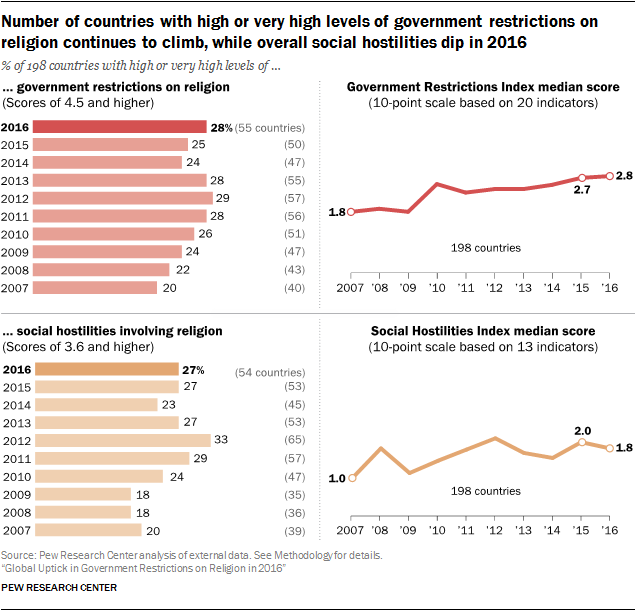
The share of countries with “high” or “very high” levels of government restrictions – that is, laws, policies and actions by officials that restrict religious beliefs and practices – rose from 25% in 2015 to 28% in 2016. This is the largest percentage of countries to have high or very high levels of government restrictions since 2013, and falls just below the 10-year peak of 29% in 2012.

Meanwhile, the share of countries with “high” or “very high” levels of social hostilities involving religion – that is, acts of religious hostility by private individuals, organizations or groups in society – remained stable in 2016 at 27%. Like government restrictions, social hostilities also peaked in 2012, particularly in the Middle East-North Africa region, which was still feeling the effects of the 2011 Arab Spring uprisings. The number of countries with high or very high levels of social hostilities declined in 2013 and has remained at about the same level since, but it is higher than it was during the baseline year of this study (2007).

In total in 2016, 83 countries (42%) had high or very high levels of overall restrictions on religion – whether resulting from government actions or from hostile acts by private individuals, organizations and social groups – up from 80 (40%) in 2015 and 58 (29%) in 2007.

Number of countries with high or very high levels of government restrictions on religion continues to climb, while overall social hostilities dip in 2016


In many countries, restrictions on religion resulted from actions taken by government officials, social groups or individuals espousing nationalist positions. Typically, these nationalist groups or individuals were seeking to curtail immigration of religious and ethnic minorities, or were calling for efforts to suppress or even eliminate a particular religious group, in the name of defending a dominant ethnic or religious group they described as threatened or under attack. In the Netherlands, for instance, Geert Wilders’ Freedom Party announced an election platform in 2016 that called for the “de-Islamization” of the country, including barring asylum seekers from Islamic countries, prohibiting Muslim women from wearing headscarves in public, closing all mosques and banning the Quran. In another case, the Czech group Block Against Islam (which opposes allowing Muslim refugees into the country and calls for restrictions on the Muslim community) organized about 20 anti-Islam rallies around the country during the year.

Government actors – whether political parties or individual public officials – at times used nationalist, and often anti-immigrant or anti-minority, rhetoric to target religious groups in their countries in 2016. About one-in-ten (11%) countries had government actors that used this type of rhetoric. This marks an uptick from 2015, when 6% of cases involved political parties or officials that espoused nationalist views.

Overall, Muslims were the most common target of harassment by nationalist political parties or officials in 2016, typically in the form of derogatory statements or adverse policies. Nationalist parties also singled out Jews, Christians and members of other minority faiths. In Bulgaria, Jehovah’s Witnesses reported an ongoing campaign against their religion by two nationalist parties, the National Front for the Salvation of Bulgaria and the Internal Macedonian Revolutionary Organization, which together form the Patriotic Front political alliance in the country’s legislature. And, in Sweden, representatives of the Sweden Democrats Party made anti-Semitic and anti-Muslim remarks on multiple occasions during the year.

Key Findings

  1. More than a quarter (28%) of countries had “high” or “very high” levels of government restrictions on religion in 2016, an increase from 25% the year before.
  2. The share of countries with “high” or “very high” levels of social hostilities involving religion remained stable at 27%.
  3. A growing share of the incidents of government restrictions or social hostilities in 2016 involved political parties or social groups espousing nationalist positions.
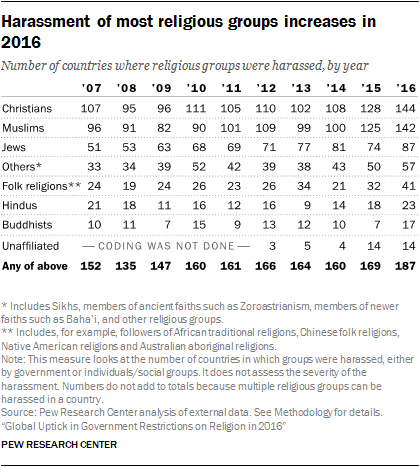
  4. Overall, the number of countries where various religious groups were harassed either by governments or social groups increased in 2016.
  5. Among the 25 most populous countries in the world, Egypt, Russia, India, Indonesia and Turkey had the highest overall levels of religious restrictions.


All information from Pew Research Center

House of Commons debates the persecution of Ahmadis

Siobhain McDonagh (Mitcham and Morden) (Lab)
I beg to move,

That this House notes with concern the rising tide of persecution of Ahmadi Muslims in Pakistan, Algeria and other countries around the world; further notes the effect that hate preachers have on radicalising people internationally and in the UK, through the media, social media and otherwise; notes with concern the past activities of hate preacher, Syed Muzaffar Shah Qadri, who radicalised Tanveer Ahmed, who in turn murdered Mr Asad Shah in Glasgow in March 2016; calls on the Government to make representations to the Governments of Pakistan and Algeria on the persecution of Ahmadis; and further calls on the Government to make more stringent the entry clearance procedures to the UK for hate preachers by ensuring that entry clearance hubs and the Home Office have adequate numbers of Urdu speakers to monitor visa applications and online radicalisation.

Let me begin by wishing all Muslims Ramadan Mubarak. Let me also thank the Backbench Business Committee for granting time for today’s debate, and all the Members who are present to take part in it.

On the border of my constituency is one of the largest mosques in western Europe, which can accommodate 10,000 worshippers. It is little wonder, therefore, that my constituency and the wider south-west London region are home to a thriving Ahmadi community, who help to make up a global community numbering millions. Let me explain to those who are watching or listening to the debate, and who may be unclear about this, that an Ahmadi identifies as a Muslim, but does not believe that Mohammed was the final prophet sent to guide mankind. That causes the Ahmadi Muslim community to be widely denounced as “non-Muslim”, and to be persecuted around the world—and, I am sad to say, often persecuted here in the United Kingdom.

To introduce the debate, I shall take Members on a global tour, from Africa to Asia and from Greater London to Glasgow. I shall then focus particularly on the persecution faced by the Ahmadi community in Pakistan, before turning to the shocking overspill of hate into the UK that the House has a duty and a responsibility to address.

Kate Green (Stretford and Urmston) (Lab)
As my hon. Friend will know, we also have an Ahmadi community in Manchester. Will she allow me to put on the record a tribute to their work in and for the community in general, and in particular to the offer of refuge and hospitality by their mosque after the Manchester Arena attack last year?

Siobhain McDonagh
Their desire to help the wider community and not only themselves marks Ahmadis in a particular way, in all our communities.

Henry Smith (Crawley) (Con)
I congratulate the hon. Lady on securing this important and timely debate. I should be grateful if Crawley could be added to the tour on which we are to be taken. In 2014, the Noor mosque was opened in the Langley Green neighbourhood. As Members will know, “Noor” is Arabic for “light”, and the Ahmadis certainly bring light to the local ​community with their charitable work and community cohesion. I am very grateful for their message of “Love for all, hatred for none”.

Siobhain McDonagh
I completely agree with the hon. Gentleman.

Nic Dakin (Scunthorpe) (Lab)
My hon. Friend has done well in securing the debate. The Ahmadi community in the Scunthorpe area is very small, but its members make a strong contribution to the area, and I want to record my thanks for all the work that they do. The hon. Member for Crawley (Henry Smith) mentioned the message of “Love for all, hatred for none”. They live those words, and it is ironic that they suffer persecution in parts of the world as a result of that creed.

Seema Malhotra (Feltham and Heston) (Lab/Co-op)
Like my hon. Friend the Member for Stretford and Urmston (Kate Green), I pay tribute to the charitable endeavours of the Ahmadi community, particularly through Humanity First. They raised funds for Humanity First to support those affected by the Nepalese earthquake a few years ago, and this weekend the organisation will host a global telethon to raise funds for charity.

Siobhain McDonagh
Just before I continue my global tour, let me say that while all Members present recognise the efforts of the Ahmadi community in their constituencies, former Members also identify with their work. I am delighted that my friend and colleague Tony Colman, the former Member of Parliament for Putney, is present to listen to the debate.

I will begin our global tour in Algeria, where an estimated 2,000 Ahmadis live in fear. Just six months ago, in December 2017, 50 of them were tried on charges related to their religion, and were given sentences ranging from fines to five years in prison. A total of 280 Ahmadi Muslims across Algeria have been arrested on the grounds of their faith in the last two years alone.

We now head east to Egypt, which is home to approximately 50,000 Ahmadis. It was here, earlier this year, that the Interior Minister, Mr Magdy Mohamed Abdel Ghaffar, issued orders for the arrest of 25 innocent Ahmadi men and women. That, however, was just the latest in a long line of persecutions against the Ahmadi community in Egypt, a notable example being the arrest of the community’s publications secretary, Ahmad Alkhateeb, and the confiscation of the publications in his property.

Such horrifying persecution can also be found further south, in Burundi. Earlier this year 13 young Ahmadis were arrested in the city of Bujumbura, where they were attending a religious education class. The secret service raided the mosque and arrested the children on charges of alleged terrorism, for in the eyes of the persecutors Ahmadi material is seen in such an extremist light.

Finally, we head to Asia, and specifically to Indonesia. For it is here that the Ahmadi community has existed since 1925, claiming a community of approximately half ​a million people. It is difficult, however, to know the community’s true scale given that revealing oneself as an Ahmadi here can be nothing less than a magnet for persecution.

Mr Tanmanjeet Singh Dhesi (Slough) (Lab)
My hon. Friend is making a forceful argument. I also concur with other colleagues about the contribution of the Ahmadiyya community and wish to mention in that context mine in Slough.

On Indonesia, just five days ago, on 20 May, The Jakarta Post reported that an unidentified mob attacked and destroyed several homes belonging to Ahmadis and attempted to expel the Ahmadiyya community from Grepek Tanak Eat hamlet in Greneng village. Eye witnesses claim that at least one house was destroyed, in the presence of police officers. Does my hon. Friend agree that while the persecution of the Ahmadiyya community is well documented, more needs to be done to raise awareness of the persecution of the Ahmadis in countries such as Indonesia, as well as Bulgaria and Thailand?

Siobhain McDonagh
I absolutely agree with my hon. Friend.

In Indonesia, Ahmadiyya is not an authorised religion. So when an Ahmadi tries to secure identity documents requiring an authorised religion to be shown, they simply cannot get them. Furthermore, Ahmadi mosques have been burned down, Ahmadis have been denied their voting rights, and they have been driven out of their homes, as my hon. Friend said.

I am afraid to say that in Indonesia the persecution comes from the very top. In 2008 a joint ministerial decree introduced by the Minister of Religious Affairs, the Attorney General and the Minister of Home Affairs prohibited the promulgation of Ahmadiyya teachings. The Minister of Religious Affairs followed this up with calls for an outright ban against the Ahmadis in 2011. But perhaps the persecution is best illustrated by the calls from the governor of West Java, who claimed there would be no violence against the Ahmadiyya community if there were no Ahmadi teachings or practices. The “problem”, he suggests,

“will disappear if the belief disappears.”

It is no wonder therefore that just last weekend 23 Ahmadis sought refuge at East Lombok police station, escaping after an angry mob destroyed their homes in an attempt to expel them from the area.

Away from Indonesia, there are currently 10,000 Ahmadi refugees stuck in limbo in countries including Sri Lanka, Malaysia and Thailand, all having fled persecution in their home countries. Sri Lanka even tried to deport 88 Ahmadis back to Pakistan in 2014 despite claims that they could be at risk in their homeland, and so it is to Pakistan that I now turn.

For it is in Pakistan that the world’s largest Ahmadi community exists, with an estimated 4 million members, and it is there that the persecution Ahmadis face can perhaps be most prominently found. Only this morning, I awoke to terrifying reports of an attack by extremists on an Ahmadi house and mosque in Sialkot last night, with mob leaders calling for this to happen to all Ahmadi mosques. The situation could not be more precarious, for an Ahmadi in Pakistan faces widespread hatred from the moment they are born to the moment ​they die. Perpetrators are given free rein to attack innocent Ahmadis in the knowledge that they will never face prosecution for their actions.

To understand why, we need to revert back 44 years to 1974, when Prime Minister Bhutto amended the Pakistan constitution to declare Ahmadis as non-Muslim for the purposes of law. Ten years later, under General Zia, the Government of Pakistan made it a criminal offence for Ahmadis to call themselves Muslim, refer to their faith as Islam, call their place of worship a “mosque”, make the call for prayers, say the Islamic greeting, or propagate their faith. The constitutional right to freedom of religion that is enshrined in Pakistan’s constitution is therefore completely violated, with an Ahmadi liable to arrest, three years’ imprisonment and an unlimited fine if they are considered to be behaving as a Muslim.

Mr Paul Sweeney (Glasgow North East) (Lab/Co-op)
My hon. Friend is making an excellent and moving speech about the pan-global issues faced by the Ahmadiyya community, yet the hate in Pakistan in particular is something many British citizens have faced. It is often why they became British citizens—none more so than my late fellow Glaswegian, Asad Shah, who was tragically murdered in March 2016. He had left Pakistan 20 years before, but sadly the hatred and prejudice followed him on to the streets of our own country. It is important to acknowledge that this is an issue in the midst of our own communities, and we must address it.

Siobhain McDonagh
I completely agree. Even his holiness the head of the Ahmadiyya faith is now based in London precisely because of the persecution in Pakistan.

Tom Brake (Carshalton and Wallington) (LD)
Does the hon. Lady agree that as far as I am aware it is perfectly in order for me or her to say “Salaam aleikum” as a greeting, whereas in Pakistan it is not in order for an Ahmadiyya Muslim to do that?

Siobhain McDonagh
Yes, and that was brought out in the all-party group investigation meeting just on Monday. It had never occurred to me that it was specifically Ahmadis who could not do such things.

Mr Dhesi
The all-party group looked into the persecution of the Ahmadiyya community and we heard some very harrowing tales, as we did from the Christian community, about how they are being persecuted. We must all stand against discrimination in all its guises.

Siobhain McDonagh
I absolutely agree with my hon. Friend. It is extraordinary that the persecuted Christian community can do some of the things and act in ways that the Ahmadis themselves cannot, so there is a real conflict going on there.

Seema Malhotra
My hon. Friend is making a powerful and important speech and I pay tribute to her leadership of the all-party group. Many Members present in the Chamber are members of the group and support its work. Does she agree that the persecution in other countries serves in one way to reflect the positive relationship in our country between Muslims from different countries and of different backgrounds, including the Pakistani ​community in my constituency, where the relationships between all the different Muslim communities are very strong?

Siobhain McDonagh
I wish all the communities did get on as well as perhaps they do in Hounslow, but there are many incidents of Ahmadis experiencing persecution in the UK from other Muslim groups.

John Spellar (Warley) (Lab)
I join other Members in paying tribute to the contribution the Ahmadiyya community makes in business and commerce and also very much in community affairs and public consciousness. But is it not also a problem that some of that hatred comes here from other countries? We have seen attacks on individuals—we have seen incidents in Glasgow and elsewhere, even if they do not lead to murder—as well as calls for boycotts on businesses owned by Ahmadis? Does my hon. Friend agree that the authorities should be cracking down on this and making it clear that it is totally unacceptable in this country?

Siobhain McDonagh
I completely agree, and local authorities need to look to themselves as well, because Ahmadis are also excluded from most SACREs— standing advisory councils on religious education—in English councils, so some of these things are very close to our respective homes.

The statistics on persecution against Ahmadis in Pakistan show that 260 Ahmadis have been killed and 379 have been assaulted for their faith, while 27 Ahmadi mosques have been demolished and 22 have been set on fire or damaged. Some 39 Ahmadi bodies have been exhumed after burial and 66 Ahmadis have even been denied a burial in a common cemetery—and all in a country with a constitutional right to freedom of religion.

Ahmadis in Pakistan live in constant fear that a baseless accusation will be made against them, with the consequences so often proving life threatening. This persecution is faced from cradle to grave, so I would like to describe the day-to-day reality for an Ahmadi living in Pakistan.

When a young Ahmadi in Pakistan attends school, they face immediate persecution. Take, for example, Farzana, a 15-year-old schoolgirl who gave Christian Solidarity Worldwide an honest and saddening insight. In her own words:

“A few of the children in my school knew that I am Ahmadi and what they did was to go and tell the other students, ‘She is Ahmadi, don’t play with her or eat with her, and stop treating her normally.’”

Her teachers encouraged this—this is what I find so hard to understand—and abused her, both physically and psychologically. Farzana says that they punished her, struck her with sticks and told her not to sit with the other kids because she is an Ahmadi and so is not allowed to do that. Farzana has now moved school as a result of her treatment. She has decided not to tell her new friends that she is an Ahmadi so that she is free from the persecution that she sees as inevitable.

Discrimination in education takes many forms, however, including nationalising all Ahmadi Muslim schools, expelling Ahmadi students based on their faith, and even the editing out of any Ahmadi Muslim’s contribution to Pakistan’s history. Take, for example, Professor Abdus Salam, a groundbreaking scientist famous for his work ​in the field of physics, for which he was awarded the first Nobel prize in Pakistan’s history. His faith has led to him being erased from the textbooks, which I remind the Chamber are rife with biases against religious minorities—and these are textbooks that we help to fund. There simply must be greater accountability by our Government and the Department for International Development to ensure that the vital educational projects that we fund continue, but without supporting intolerance, prejudice and hatred.

To return to Pakistan, an Ahmadi student may not even make it through education. In 2008, all Ahmadi students were expelled from a medical college in Faisalabad on the basis of their faith, while a local newspaper printed the headline, “We shall not allow admission in Rawalpindi Medical College of any student guilty of blasphemy”. For those young Ahmadis, their education and religion cannot co-exist side by side.

On leaving education, discrimination and persecution continues for Ahmadis in Pakistan when it comes to applying for a job. Even the rumour that someone may be an Ahmadi can destroy their opportunity of employment. For example, the civil and military services have placed restrictions on Ahmadis progressing to senior ranks.

Outside of work and education, the persecution for an Ahmadi in Pakistan is allowed to flourish in wider society. When an Ahmadi applies for a passport, they must state their religion by law. Anyone who self-identifies as a Muslim is required to take an oath declaring Ahmadis as non-Muslim. The reality, therefore, is that no Ahmadi can go to Mecca to perform the Hajj—one of the five sacred pillars of Islam. Nowhere else in the world are Muslims required to make such a declaration. How can a state be allowed to impose a religion on its citizens in that way?

For an Ahmadi in Pakistan, their persecution continues when they come to vote, which is particularly pertinent due to the upcoming elections in the country. An Ahmadi is prohibited by law to vote as a Muslim. They must either sign a declaration that they are not an Ahmadi or acquiesce to their status as non-Muslim, with a violation of that requirement punishable with imprisonment. That has effectively denied them the right to vote for nearly 40 years. What is more, the separate electoral list for Ahmadis is published and publicly available, enabling extremists to target, intimidate and harass the community. It is no wonder they face such persecution.

When legislators proposed reforms within the past year that could have changed the situation, outrage was sparked across Pakistan, prompting senior political and judicial figures to speak out, coupled with a mass violent rally. The reality, therefore, is that time is running out for an Ahmadi to be able to vote in Pakistan this summer.

Sir Edward Davey (Kingston and Surbiton) (LD)
Is not the key point that Pakistan uses the state, the constitution and the law to persecute the Ahmadis, which is unique? Of all the horrors we know in Pakistan, the Ahmadi Muslims are singled out by the state and the constitution, which is why we should speak out loudly today.​

Siobhain McDonagh
I absolutely agree with the right hon. Gentleman. Will the Minister take urgent steps to call on the Government of Pakistan to allow Ahmadis to vote in the upcoming elections without denouncing their faith?

After facing a life of hatred, the end of an Ahmadi’s life in Pakistan does not necessarily mean the end of persecution. There are countless examples of Ahmadis being denied the right to burial, with the protesting extremists claiming that they have no right to a burial in a Muslim graveyard. Gravestones have been desecrated and vandalised, and there have also been incidents of exhumation of deceased bodies. To return briefly to the case of Professor Abdus Salam, the Nobel prize-winning scientist, the word “Muslim” has been erased from his gravestone, under a court order.

Electoral disenfranchisement, discrimination in law and expulsion by society have left the Ahmadi community in Pakistan voiceless. So today we must be their voice, for even the constraints of life provide no constraints for the persecution that an Ahmadi in Pakistan may face.

Such persecution, however, is found not just in Pakistan, Algeria, Egypt, Burundi and Indonesia—it can be found right here in the UK, right on our doorstep. Over recent weeks, the all-party parliamentary group on the Ahmadiyya Muslim community, which I proudly chair, has been running a five-part inquiry into the persecution faced by the Ahmadi community. We have heard the testimony of dozens of Ahmadi men and women, describing the scale of hatred that they have faced. It is truly shocking.

The most stark and shocking example in the UK took place just two years ago in Glasgow, where Ahmadi shopkeeper Asad Shah was brutally murdered.

Hugh Gaffney (Coatbridge, Chryston and Bellshill) (Lab)
I pay tribute to my hon. Friend for the important speech she is making. Will she join me in paying tribute to Asad Shah, who was stabbed to death outside his shop in the Shawlands area of Glasgow in 2016? His death shows that we have much to do to raise awareness of and increase support for an important minority group. He was a brilliant man and loved by everyone in his community, recognising that the differences between people are vastly outweighed by our similarities. Asad left us a tremendous gift and we must continue to honour that gift by loving and taking care of each other. We can honour Asad by living in a world of equality as one race—the human race.

Siobhain McDonagh
I completely agree with my hon. Friend the Member for Coatbridge, Chryston and Bellshill (Hugh Gaffney). The 40-year-old was stabbed in his store, sparking an outpouring of grief from locals for a man they described as a true gentleman with a heart of gold.

During the police investigation, officers established that the incident was “religiously prejudiced”. The murder was celebrated by some on social media right here in the UK. The Khatm-e-Nubuwwat organisation even posted a congratulations message on its Facebook page. This violent organisation in Pakistan regularly calls for the elimination of Ahmadis, but it has branches in the UK—and is a registered charity, no less. Furthermore, there are reports that Abrar ul-Haq, an extremely vocal supporter of restrictions on Ahmadis in Pakistan, was allowed into the UK just days ago. Will the Minister establish precisely what measures are being taken to ensure that such hate preachers are not allowed entry to this country, so that Asad Shah remains the one and only Ahmadi to be murdered on our shores?

From anti-Ahmadi sermons preached in mosques, to posters calling for a boycott of Ahmadi business and customers, there is a constant undercurrent of hostility against the Ahmadi community. The action taken by Ofcom against a variety of television channels in the UK provides further examples of hate that, if unchecked, will start spreading to other faith groups as well.

One such example was in Waltham Forest in October, when Muslim members of the Waltham Forest communities forum actively stopped an Ahmadi Muslim from being re-elected, stating that he cannot be a representative of Islam. Meanwhile, a former national president of the Ahmadiyya Muslim Students Association describes how

“some things have just become routine”

on campuses across the country. Posters advertising events are torn down and there are examples of other Muslim societies, in an overt or covert way, trying to undermine their activities.

We return a final time to the case of Nobel prize winner Professor Abdus Salam. Earlier this month, Oxford University hosted the first UK screening of a film about him, but the university’s Pakistan society has been accused of discrimination due to its reluctance to get involved based on Professor Salam’s Ahmadi faith, forcing an apology after an extremely successful event. Such a scourge of extremism is a stain on the freedom of religion that we rightly and proudly celebrate in the UK.

I want to bring my speech to a close by going right back to the beginning and singing the praises of the Ahmadi community in my constituency. Above the front of the Baitul Futuh mosque in Morden hangs a welcome banner that reads, “Love for all, hatred for none.” The Ahmadi community in south-west London has raised thousands upon thousands of pounds for good causes and I am proud that they are a vital part of the fabric of Mitcham and Morden. As their MP, I have a duty to stand up against the persecution they face. As a Chamber, we have a duty to eradicate such persecution from this country. As a country, we have a duty to put pressure on Governments around the world that allow such persecution to flourish.​

Justine Greening (Putney) (Con)
I pay tribute to the hon. Member for Mitcham and Morden (Siobhain McDonagh) for securing this hugely important debate. As she set out, she has a significant local Ahmadiyya community. I praise her speech, which was not only comprehensive but shocking in its detail of the persecution suffered by the Ahmadiyya community around the world.

The Ahmadiyya community plays a key role in my local community. Not only was its first mosque built in 1926 in Southfields—the first mosque built anywhere in London—but the area has been a home to the community ever since. The role that the community plays more broadly within the Putney, Roehampton and Southfields constituency that I have the privilege of representing adds hugely to our wider community. It was the Ahmadiyya community that got everybody together after the 7/7 bombings many years ago and made sure that we would not be divided by the hatred that led to those attacks. It is the Ahmadiyya community that has had a peace symposium every single year for 14 years, giving us an annual chance to come together and talk about all the issues that our communities face.

The Ahmadiyya Muslim Youth Association does amazing work around the country raising money for charity. When we had the floods several years ago, its members ran towards them. They went to visit and help many of the communities affected, not only in nearby places such as Surrey, but further afield up in Cumbria. Of course, we have also heard of some of the transformational work that Humanity First does around the world. The funds that it uses are raised by the community and put to good use to help others who are far less fortunate.

Only last weekend we had the royal wedding, and one of the street parties that I had the chance to go to was in Arnal Crescent in West Hill. It was organised by local Ahmadiyya residents who saw it as a wonderful opportunity not only to celebrate the wedding, but to try to bring together for the first time people who live in that little bit of my constituency and might not have had the chance to meet one another.

The phrase that we have already heard—love for all, hatred for none—percolates through not only every single thing the community stands for, but how people conduct themselves. That is the case not only locally to me, but throughout this country and around the world. We have heard about the persecution that the community faces, and it is shocking that we have seen some of that right here in the UK. We heard about the terrible murder of the Glasgow shopkeeper Asad Shah—and for what? Apparently for simply wishing his local community a happy Easter, which apparently disrespected the Muslim faith. What an awful attitude to have to a pillar of the community who clearly played their role in bringing people together every day.

I draw the attention of the House to some of the invidious persecution that happens closer to home, including some of the literature that we know gets put out in places such as Tooting, and the fact that some shops are encouraged not to deal with the Ahmadi community, whether by selling goods to them or by employing them. That is totally unacceptable on our doorstep. Whenever I have needed to, I have always raised the issues with our local police, but we should certainly should not tolerate persecution right in our backyard.

Mr Dhesi
The persecution of the Ahmadiyya or any community is abhorrent. If we are to be true to the principles of humanity, we must stand shoulder to shoulder with that community and stand up to discrimination in all its guises. Does the right hon. Lady agree that the appointment of a UK global ambassador for religious freedom would assist in highlighting and tackling the issues that we are discussing today, as well as helping to fight discrimination and promote equality?

Justine Greening
It might well help. It is also very helpful that one of our Foreign Office Ministers, Lord Ahmad of Wimbledon, is himself Ahmadi, so he is intimately familiar with some of the persecution faced by the community.

I draw the House’s attention to the excellent report “Ahmadis in Pakistan Face an Existential Threat”. It comprehensively sets out the persecution that happens around the world. I thought that the hon. Member for Mitcham and Morden did an excellent job of setting out just how many countries the persecution happens in. It is absolutely shocking. As she said, only last night a 500-strong mob attacked a mosque that has been there for 100 years in a part of Punjab in Pakistan.

I know that others want to speak, so I will finish my comments by saying that this is a country that has always stood up against persecution and for religious freedom. A debate in this Chamber is hugely important to set out our renewed determination to stand up against such persecution. The fact that this persecution is against a community that is the antithesis of the hatred shown by so many the people who carry it out is the ultimate irony, and the approach of the community sets it apart in many positive ways. I am proud to have these people as part of my local community. They have been an intrinsic part of it for a century now, and they will always be hugely welcome. They add to it in a way that is impossible to convey through this short debate. I will play my role as a local MP in standing up against the persecution they face, both here in the UK and internationally.

Sir Edward Davey (Kingston and Surbiton) (LD)
It is a huge pleasure to follow the right hon. Member for Putney (Justine Greening). I apologise for not always notifying her when I go to the mosque in Southfields to meet his Holiness the spiritual leader of the Ahmadi Muslim community and others to talk to them about their issues, although I am sure that she does not really mind. I also pay tribute to the hon. Member for Mitcham and Morden (Siobhain McDonagh) for her leadership on the all-party parliamentary group, of which I am proud to serve as vice-chair. Our current inquiry is a very important piece of work, and I hope that the House will have a chance later this year to look at it. I pay tribute to her for securing this debate.

I do not want to repeat all the warm and correct words that have been spoken already about the role that the Ahmadi Muslim community plays in our country, except to say that one of the joys in my constituency has been getting to know Ahmadi Muslims, learning about the role they play in Britain and around the world, including of course in Pakistan, and seeing how hard they work. I am always astounded by their discipline and by the amount of time they give to charities, in ​particular, and to raising money. As others have said, the amount of money they raise and the things they do to help British communities in distress, such as during the floods, and through Humanity First, which does amazing work for some of the poorest in our world, is an example of people of faith living that faith through their actions.

The persecution that Ahmadi Muslims face, particularly in Pakistan, is quite abhorrent. The way in which the law in Pakistan—from the constitutional provisions to the penal code—allows state persecution is quite shocking and quite unique. By putting that into its laws, the state of Pakistan gives a green light to the people of Pakistan—many of whom I am sure, in many ways, are extremely religious and good people—to commit awful behaviour, which means that people who persecute, attack and even murder Ahmadi Muslims get away with it. They know that they will not be prosecuted or brought to justice, which means the rule of law does not exist for Ahmadi Muslims in Pakistan, which is atrocious. That is why this country needs to speak loudly and clearly to the Government of Pakistan about how this is absolutely unacceptable.

Bob Stewart (Beckenham) (Con)
I thought the Foreign Office was quite big on this matter and was talking about it quite a lot to the Government of Pakistan. This debate will help, but the Government are already trying their best.

Sir Edward Davey
The hon. Gentleman is right. This debate is not an attack on the Minister, who has done a good job. The right hon. Member for Putney mentioned Lord Ahmad. As an Ahmadi Muslim, he is able to speak with authority and credibility, and I pay tribute to him.

The Minister for Asia and the Pacific (Mark Field)
I never miss a chance to say a quick word.

I thank my hon. Friend the Member for Beckenham (Bob Stewart) for protecting the interests of the Foreign Office. This is a very serious issue, and all hon. Members will appreciate that the correct and most effective way to represent the interests of a persecuted minority is often in private, rather than through megaphone diplomacy. I hope hon. Members will accept that, but I hope to address in my speech some of the valid points that have already been raised in this debate, particularly in relation to the constitution and the penal code, which are tightening the rights of minorities in Pakistan.

Sir Edward Davey
That was a very helpful intervention, because the Minister brings the real issue to bear: our questions on what the Government might do. I understand that such issues need to be dealt with in private, and I am sure that we can take his reassurance that that is happening. I hope that he will focus on the issues of the constitution, and particularly issues of voting and democracy, as the hon. Member for Mitcham and Morden mentioned, because it is outrageous that Ahmadi Muslims are prevented from voting in the normal way.​
Three Ahmadi Muslims were sentenced to death last year: Mr Mubasher Ahmad, Mr Ghulam Ahmed and Mr Ehsan Ahmed. They are on death row. I know that the Government are clear—not only in Pakistan but elsewhere—about our opposition to capital punishment, but this is even worse because, in a sense, those people are on death row because of their faith and beliefs, which is abhorrent. I hope the Minister can indicate that the rights of such people are being considered.

We need to try to understand, both by talking to the Muslim community here in the UK and by talking to the Pakistani Government, how we can reduce this aggressive extremism, one of the outlets of which we are seeing in Pakistan. We see extremism and its impact in Pakistan and elsewhere through, for example, the Pakistani Taliban. We need to work out how we can reduce that extremism. We have already learned from the inquiry that this persecution is permitted by the state, but it is ubiquitous in Pakistani society, which is what I find most frightening.

Siobhain McDonagh
Does the right hon. Gentleman agree that the most frightening thing to come out of our inquiry to date is the fact that younger people in Pakistan are more anti-Ahmadi than older people? In the west, we always expect the younger to be more liberal, but that is not currently the case in the Pakistan, and that is very frightening.

Sir Edward Davey
I absolutely agree, which is why I want to push the Minister a little further. Although I accept that sometimes we have to tread quietly on such issues, I am alarmed that the persecution of the Ahmadis is accelerating. Given the murders, the assaults and, as we saw last night, the attacks on mosques, there is a concern that this is becoming endemic and deep-rooted, particularly due to the textbooks that children are reading.

I do not want to go too far along this road, but what is happening to the Ahmadi Muslims will ring awful bells for those of us who have had the privilege to visit Auschwitz with the Holocaust Educational Trust to learn about the eight steps to genocide. Although we should not throw the word “genocide” around too freely, the UN Office on Genocide Prevention and the Responsibility to Protect needs to do a study. This may not be something that comes and goes; it might be something that has potentially disastrous outcomes.

There is cross-party understanding about this, and we need to think quite deeply. I am not suggesting that the Government should do this, but I urge them to consider making it clear—perhaps quietly—that we have teeth.

Pakistan enjoys, through the UK and the EU, GSP+ trade advantages—it is one of I think 10 countries that do. When I was a Trade Minister, I campaigned against Sri Lanka getting GSP+ status because countries with that status are supposed to uphold UN and International Labour Organisation agreements and conventions. I do not think that Sri Lanka is in any way doing that in a number of areas, and nor is Pakistan.

If we look at the UN international covenant on civil and political rights, the UN international covenant on economic, social and cultural rights, the UN convention on the rights of the child or the ILO convention concerning discrimination in respect of employment and occupation, it is difficult to see that Pakistan is abiding by the ​international conventions it has signed up to with respect to Ahmadi Muslims. These things need to be pointed out because, if we are to have an impact on the behaviour of the Government of Pakistan, we have to show that we are watching and monitoring them, and that we do not accept their behaviour.

There are things that we can do in this country. The hon. Member for Mitcham and Morden mentioned some of the hatred shown to Ahmadi Muslims, and we need the police and local authorities to understand that, and to be strong in preventing and tackling it where it occurs. There are Ahmadi Muslims in refugee camps around the world who have fled from Pakistan, and we are not taking enough of them into this country. That is a Home Office issue, but I ask the Minister to confirm that he will ask the Home Office whether this country can take in more Ahmadi Muslims who are sitting forgotten in refugee camps. Let us not forget them.

If we are to take anything from this debate, let us make some small steps that are under our control and let us revisit our guidance on how Home Office officials are trained to consider asylum applications by Ahmadi Muslims from Pakistan. Let us make sure there is proper guidance so that people understand what Ahmadi Muslims have to put up with in Pakistan.

As we have heard, there is a united approach on both sides of the House. We want to come together and say to the Government of Pakistan that this is unacceptable. We want to say to Ahmadi Muslims here in the UK and around the world, and particularly in Pakistan, that we stand with them, and that we will campaign for their rights, including their right to religious freedom and basic human rights. We will not rest until that happens.

Stephen Hammond (Wimbledon) (Con)
It is a pleasure to follow the right hon. Member for Kingston and Surbiton (Sir Edward Davey), my right hon. Friend the Member for Putney (Justine Greening) and the hon. Member for Mitcham and Morden (Siobhain McDonagh), who is almost an hon. Friend, as we share a border. She referred to the Baitul Futul mosque, which spans our two constituencies. It is where we meet, and as she rightly pointed out, it is the largest mosque in the UK and rumoured to be the second largest in Europe. Like my right hon. Friend and many others in this House, I have been pleased to visit it over many years and to visit the mosque in Putney.

When I was first selected as a candidate, some 18 years ago, the Ahmadiyya community was one of the first to come to see me and to say, “This is what we are doing in the community. How can we work together?” They take part in a number of community events—I wish to stress that at the beginning, before we get on to some of the details. A number of speakers have described this work: the community litter days; and the junior poppy collection day, supporting the people who stood up for freedom in this country and the world when it was required in those dark days some 70 years ago. They recognise the memory of that, and it is symbolic in today’s debate.

The Ahmadiyya community also afforded me the most amusing moment of my first year as a Member of Parliament. Every year, they hold a huge Jalsa Salana for the community all around the world. In those days, it was held in Alton, but it has now moved to a bigger ​farm in north-west Hampshire. As we drove off, my wife said to me, “You are speaking at this event this afternoon. How many people will be there? Have you prepared something?” I said, “Darling, it is a religious ceremony. If we are lucky, there will be a couple of hundred people there.” Members can imagine my surprise when I stood up to address 30,000 people live and a couple of million more watching on the TV—as they reminded me there. That was a salutary lesson: always try to be prepared before standing up to make a speech, wherever you make it.

Let me get on to the serious points about today. I tried to make an initial serious point about how Ahmadis are integral to my community and to those of so many Members across the House. As we have seen, this community encompass and epitomise their slogan—“Love for all, hatred for none”—and they do so in practical ways. All of us in this House stand up for people’s ability to speak freely and to practise freedom of religion and of political expression. We seek to ensure that people are not allowed to prosecute hate in their speech or actions. In the tour around the world undertaken in the speech of the hon. Member for Mitcham and Morden, she not only rightly concentrated on Pakistan, but rightly pointed out, as the right hon. Member for Kingston and Surbiton has just done, that we need to look at a number of issues. If we espouse these values in this House, we should espouse them in the actions taken in our country, too.

One or two people have talked about the worrying development of hate preachers coming to the UK and deliberately infusing hate against the Ahmadiyya community in some of the other mosques. I know from local experience that there was a widespread campaign to boycott Ahmadiyya businesses and shops, which was prosecuted by some of these hate preachers. The hon. Lady was right to mention the TV programme on Waltham Forest, and a Radio 4 documentary “Extremism: Hidden in Plain Sight” revealed recently that certain Urdu newspapers in the UK, which are particularly popular among elements of the Pakistani community, were running deliberate hate campaigns against the Ahmadiyya community. So although I understand this is a debate about persecution in the world, the right hon. Gentleman is right to say that we hope the Minister will say that he will speak to Home Office colleagues to make sure we are doing all we can to ensure that persecution does not happen in this country. If we do that, when we speak to the outside world, we will be able to do so with the surety that we acting to drive out that extremism and hate in this country.

It would be unwise of me to do a tour of the world as the hon. Lady did, but I should say that this persecution is widespread. My right hon. Friend the Member for Putney and others have made the point that it is the Pakistan state that puts this persecution into law. Other states, such as Egypt and Kazakhstan, allow persecution, but the Pakistan state, by putting this into law, has made this official persecution. In Pakistan, the Ahmadis are not allowed to call themselves Muslim, they cannot refer to their faith as Islam, they cannot call their place of worship a mosque and they cannot preach or propagate their faith. There is deliberate inequality of opportunity in education and in terms of practising whatever profession they may wish to do.​

Although I absolutely respect the Minister’s correct position that much can be achieved in private and with methods that are sometimes not public, I believe that it is occasionally important also to use the megaphone, to use his analogy. He will recognise that this persecution is becoming more widespread and more frequent, and several Members have cited examples, but let me put on the record what Christian Solidarity Worldwide has said in the conclusion of its report on the persecution of the Ahmadiyya community. It said:

“The mood of aggression by certain Islamist groups towards the Ahmadiyya community shows no sign of improvement, even the Pakistani government has lacked the political will to make concession to their community.”

It continued:

“The exclusionary politics…has steadily grown since the creation of Pakistan”

and is playing

“an important role”

in other states in the world.

As the right hon. Member for Kingston and Surbiton said, this is an increasing problem, not a decreasing one. The Minister for the Middle East has made the point several times at the Dispatch Box about the number of times we are speaking to the Pakistani Government. Given the increasing nature of this problem and how it is now becoming, as others have said, more or less commonplace and accepted practice in certain countries, I hope that the Minister will say something about what influence the Foreign Office can exert, both publicly and privately.

Seema Malhotra (Feltham and Heston) (Lab/Co-op)
It is an honour to speak in this important debate. I, too, congratulate my hon. Friend the Member for Mitcham and Morden (Siobhain McDonagh) on securing it and on the work she is doing through the all-party group. As she said, this debate is taking place during Ramadan, and I pay tribute to all the Muslim communities in my constituency and across the UK who are observing Ramadan. I pay tribute to their generosity, compassion and charity, as well as their contribution to our society and our economy.

Much has been said in this debate about the kinds of shocking discrimination that the Ahmadiyya community are experiencing across the world—not just in Pakistan but in many other countries. They face discrimination in schooling, in their ability to practise their faith and in their ability to participate in work, in livelihoods and in civic life. It is shocking to hear, read and comprehend this discrimination. The Ahmadiyya community are held in high regard in our country and across the world. As other Members have said, their contribution to British national life is seen in their ongoing commitment to the values of loyalty, freedom and peace. It is devastating to be here debating the hatred that is being experienced by the Ahmadiyya community in so many countries, and in the UK from a minority who have imported that hate. It is essential that it is understood, challenged and stopped in its tracks in our country by the police, local authorities and all our interfaith communities and that the local police and Ahmadiyya community throughout the country keep a close relationship.​

Last year, along with colleagues from this House and the other place, I attended the 51st annual convention, the Jalsa Salana, which an incredible number of people attended. I was also with colleagues and councillors from Hounslow and throughout the country. I pay tribute to the work in my constituency of Zaheer Khan and Councillor Hanif Khan, their father, Mr Abdul Latif Khan, and their late mother, who helped to build and support the growth of the Ahmadiyya community in Hounslow. The legacy of their work set the tone for how the Ahmadiyya community plays its part in mainstream community life, as seen in the more than 100 Ahmadiyya branches in communities throughout Britain.

I have had the privilege of attending Ahmadiyya community events in Parliament and the peace symposium, from which I have learned a great deal. Such events have brought together leaders from all walks of life to engage in a shared mission for peace, common values and prosperity. The motto “Love for all, hatred for none” is one that reaches out and touches the hearts of Muslims and non-Muslims alike. Many of us will have experienced that tone and message of humanity from the Ahmadiyya community. Ahmadis have been quick on the scene and quick to help in moments of need and suffering, such as the attack outside Parliament. Like other Muslim communities and interfaith communities, they brought people together. In the aftermath of that terrorist attack, I stood with them on Westminster bridge, where they brought together young and old, with a message of healing and solidarity.

I am proud of the work of two mosques in my constituency—Baitul Wahid in Hanworth and Baitun Noor in Hounslow West—which unceasingly reach out and bring people together to share in their faith and wisdom. Every year, the community raises hundreds of thousands of pounds for British charities, giving hope to many people who may never know where that support came from.

The Ahmadiyya community continues to suffer persecution around the world. It is important to send the message from the House today that we in Britain are on the side of the Ahmadis and seek their safety in every nation around the world. That requires joined-up action in our country. We have seen the seeds of hatred and discrimination. I do not believe that that is at all representative of the majority in the Muslim community, and it must be dealt with and rooted out. The message must be sent that we will not tolerate that hate being imported from other parts of the world. We must have a joined-up national strategy, involving the police, schools, local authorities, the Home Office and the Foreign Office, because it will take a joined-up strategy to tackle this issue at home as well as abroad.

Will the Minister tell us whether the Foreign Office has raised this issue with the UN? When we see such hatred, which goes against article 18 of the universal declaration of human rights, which requires states to guarantee the freedom of religion and belief, it is important that we have a way to stand together as nations to root out this hatred and to make sure that Ahmadis are free to practise their religion and their faith in every country around the world.

Paul Scully (Sutton and Cheam) (Con)
Salaam aleikum, Mr Deputy Speaker. That means “peace be upon you”. It is seemingly inoffensive and is a very traditional and ​heartfelt greeting in all parts of the Islamic world. I can say it here and the Ahmadiyya community can say it here in the UK. When I go to Bangladesh, I say “Salaam aleikum” as a mark of respect to Bangladeshi friends and people I meet for the first time. I could do that in Pakistan, but unfortunately people in the Ahmadiyya community who live there cannot. As we have heard, they cannot have a call to prayer or self-identify as Muslims.

I have spoken a lot in this place about the Rohingya situation. Before that situation exploded last August and people were persecuted and pushed out into Bangladesh, as part of what people have described as ethnic conflict, the first identifiable thing that people raised about the taking away of the Rohingya people’s citizenship was their inability to vote. In Burma, I met the daughter of a former MP. Not only was he no longer an MP but he could no longer even vote in his own country. When that seemingly fundamental and simple right is taken away, there is a real risk of it leading into something so much worse.

We have already heard about the attack by a violent mob on the 100-year-old mosque in Sialkot in Punjab during the night. The house next door was damaged. Local administrators, police and journalists were all at the scene when it was going on, but they were powerless to do anything other than stand by as spectators while people ran around and continued unabashed with the destruction of the Ahmadiyya property. We have also heard about how the violence and lack of any sense that an Ahmadiyya Muslim could even be human, frankly, has come to this country, with the murder of Asad Shah. Someone actually drove from Bradford to confront a Glaswegian shopkeeper and stab him on the doorstep of his own shop—how can that possibly be humane in any sense?

I often mention my hon. Friend Minister for the Middle East talking about the fact that when people are in effect considered sub-human, there are no depths to which their persecutors will not go to punish, hurt and damage them. I really hope that this is not the thin end of the wedge and that we do not see at some point in future an extension of this persecution—that it does not go so much further, like some of the violence we have seen elsewhere in the world.

The Ahmadi Muslims are fantastic advocates for what is going on around the world. They are a very tight and aware community. The all-party group is doing fantastic work, and I pay testament to the hon. Member for Mitcham and Morden (Siobhain McDonagh): not only for her speech and for securing this debate, but for her work and leadership. I am absolutely delighted to serve alongside her on the all-party group, particularly in respect of the important work we are doing to take that testimony.

The most recent report of any great length of which I am aware was done by the International Human Rights Committee, which specialises in Ahmadiyya affairs. The foreword to the report talked about

“the systemic nature of their persecution”

and

“Pakistan’s draconian blasphemy laws”.

The report goes on to quote Prince Charles, who said:

“The scale of religious persecution around the world is not widely appreciated. Nor is it limited to Christians in the troubled regions of the Middle East. A recent report suggests that attacks are increasing on Yazidis, Jews, Ahmadis, Bahá’ís and many other minority faiths.”​
We must keep having these debates and we must keep these conversations going, because it is so important that we make people aware of what is happening to these people around the world, including in this country.

The key findings of the International Human Rights Committee report include the fact that anti-terror laws are being used—or misused—in Pakistan against the Ahmadis and other religious minorities. We have heard that educational texts provoke intolerance and hatred, particularly the syllabus for religious education, and that nationalised schools and colleges of the Ahmadis have still not been returned to the Ahmadiyya community in accordance with the Pakistan Government’s policies.

Effectively, the constitutional amendment of 1974, designating Ahmadis as non-Muslims, laid the foundation for many, many years of hardship and persecution. Such behaviour is now entrenched in Pakistan, so, as the Minister has said, we must use not megaphone diplomacy, but every lever that we have to ensure that this important community around the world, but particularly in their homeland of Rawabi in Pakistan, can feel free to express themselves and worship in the form that they feel appropriate.

We have heard some of the fantastic and wonderful things that the people of the Ahmadiyya community do. I remember going up to Trafalgar Square, just after the Westminster attack: the first people that I saw were from the young Ahmadiyya community. They were holding a big banner saying, “Love for all, hatred for none.” They were there right at the forefront, showing solidarity with us after what they had seen.

I am looking up at the plaque of Jo Cox. When she was murdered, many of us felt at a very low point—I certainly felt at the lowest point in my three years of being in this place. I felt that we were given great succour by the people in the Ahmadiyya community. They came together to pay tribute—metaphorically to put their arm around us to say that these violent, extreme attacks have no place in this country, or anywhere in the world. That is really the basis of the annual peace symposium at the Baitul Futuh mosque. Those peace symposiums are replicated in smaller Ahmadiyya communities as well. The Sutton Ahmadiyya community holds a smaller symposium in my local area; I am always pleased to go and listen to what they say and to share messages of peace with my neighbours.

People from the Ahmadiyya community were among the first to volunteer at Grenfell. They are so aware of what is going on. Going back to the Rohingya situation, the hon. Member for Mitcham and Morden mentioned their wonderful work raising money for charity. I went to the telethon at the Baitul Futuh mosque where they raised £140,000 in just four hours for the Rohingya community in Burma. They are driven by such situations.

We have heard a lot today about “Love for all, hatred for none”. Anyone just dipping in and out of this debate on television or in the Official Report may think that people are just coming up with a strapline, but it is so much more than that—it really is. That strapline is part of the beating heart of every single member of the Ahmadiyya community. There are no extremists in the Ahmadiyya community; extremism is anathema to their very being. Interestingly, Lord Ahmad, whom we have ​heard about today, was one of the first Ministers looking after the counter-extremism policy. That was a perfect choice at the time.

In conclusion, we must make sure that Pakistan does everything that it can to tackle the religious zealots in its country, because we have seen in other countries such as Saudi Arabia how often the Government, the people and the religious leaders work at different speeds. We must make sure that we help them, effectively, to align. They will, of course, fundamentally disagree with the beliefs of the Ahmadiyya Muslims as they believe that Muhammad is the last prophet and the Ahmadis do not. There is no way in which we can reconcile that, but that does not mean that the Ahmadi Muslims should not be able to celebrate their religion and live in peace.

Tom Brake (Carshalton and Wallington) (LD)
It is a pleasure to follow my neighbour, the hon. Member for Sutton and Cheam (Paul Scully). We do not see eye to eye on many issues, but in relation to this matter we certainly do. We are both advocates of campaigning against the persecution of the Ahmadiyya community, and, indeed, of religious communities more widely. May I thank the hon. Member for Mitcham and Morden (Siobhain McDonagh) for bringing this debate to the House, for the excellent work that she does on the inquiry that she is conducting, and for the support that she gives to the Ahmadiyya Muslim community?

Clearly, unfortunately, religious persecution is a worldwide phenomenon; it does not just affect the Ahmadiyya Muslim community. I am sure that many Members here will have been contacted by the Baha’i community, which faces very serious, systematic persecution in Iran—whether in relation to trying to run a business or trying to get education in that country. The fate of Pakistani Christians is also of concern. They suffer persecution not just in Pakistan, but, to some extent, here, with people trying to disrupt some of their services. We know that the Sunni and Shi’a communities in different parts of the middle east are persecuted by the other sect, and that the Yazidis in Iraq have suffered genocide at the hands of Daesh. The Jehovah’s Witnesses suffer persecution in Russia and, of course, Jews also face persecution in many parts of the world and, indeed, close to home here and in Europe.

Unfortunately, this issue does not just affect the Ahmadiyya Muslim community, but, obviously, I welcome the fact that the debate this afternoon is focused on them. A number of Members have referred to the motto, “Love for all, hatred for none”, which the Ahmadis live by. As the hon. Member for Sutton and Cheam said, it is not just a motto or a strapline, or something that they put on a leaflet or website, but something that they follow and observe in their daily lives. They are fully engaged in all aspects of UK life. A number of Members have referred to the different events that they hold, including the peace symposium. I have also attended the Jalsa Salana on a number of occasions. I was surprised not only at the scale of it in the United Kingdom, but at the reach that it has around parts of the world. We even have live coverage from Ghana. They hold a very successful annual fundraising march. I suspect that a number of Members have suggested to the community some charities that it should support, and it has done so very generously.​
I am very proud that the Ahmadiyya community is able to practise its faith here without any risk or reservation, and we must ensure that that continues. A number of Members have rightly pointed out that, even in the United Kingdom with the murder of Asad Shah, there have been issues. A leaflet has been circulated by the organisation Khatam-e-Nabuwat, which, frankly, should never have been allowed off the printing press.

I hope that, when the Minister responds, he will be able to say a little about what discussions the Government have had with social media companies—there are issues with Facebook in particular to do with not taking down posts quickly enough. Certainly, the Ahmadiyya Muslim community has presented evidence that, on social media, there are significant issues. Have the Government had a dialogue with Facebook and other social media providers about how and how quickly they tackle these issues?

In the briefing that was supplied, there were some examples of where Ofcom has taken action. The most recent one, certainly on the list that we were provided with, goes back to 2013. I would like some assurances from the Minister that Ofcom is indeed properly resourced so that it can look at every single complaint that comes in. Given the number of channels available, I accept that it is difficult for Ofcom to monitor the range of output, but it is clearly something on which it has to keep a close watch. I hope that it is properly resourced to do so.

There is a worrying domestic picture of which the police, Ofcom, the Government and the social media providers should be aware, as should we as individual Members of Parliament. We should not become complacent about our democracy and the ability of people of different faiths to practise their religion here openly and freely.

I turn briefly to the international aspect of the issue, on which many hon. Members have focused, starting with Algeria. We were fortunate in getting a meeting with the Algerian ambassador some months ago. It was a very cordial and frank meeting; my only concern was that there did not seem to be any recognition that there was actually an issue. I am afraid that, to a great extent, that was the also the impression that we got when we met with the deputy high commissioner from Pakistan. The hon. Member for Mitcham and Morden may be able to confirm my impression that there did not seem to be an acceptance that there was, in fact, an issue for the community. After reading out some quite detailed evidence, we were asked to provide more evidence to demonstrate that there was a problem. Many Members have referred to the problem that exists in Pakistan, and there needs to be some recognition on the part of the Pakistan high commission here that there is one.

The third country that I should mention, as others have, is Indonesia. Christian Solidarity Worldwide provided us all with some excellent briefings ahead of today’s debate. It has suggested some recommendations for the UK Government. I am not sure whether the Minister received the CSW briefing, but I will refer to it for him if he did not. The organisation said that the Government should perhaps be a bit more circumspect when describing Indonesia as a role model of tolerance, because the evidence as far as the Ahmadi Muslim community is concerned, unfortunately, shows that that is not necessarily the case.​

Indonesia has the same issue with blasphemy laws as Pakistan. This country should probably recognise that we only abolished our blasphemy laws 10 years ago ourselves—not exactly that long ago. However, we are now in a position whereby we can advocate that other countries should get rid of their blasphemy laws, and Indonesia falls into that category. It passed an anti-Ahmadi Muslim decree in 2008, which I hope that the Government will push to be repealed.

CSW has various concerns, including the need for Indonesia to extend human rights education, including the principle of freedom of religion, and the need to promote inter-faith dialogue and protect and promote the rule of law. It also requests that the Government of Indonesia invite the UN special rapporteur on freedom of religion or belief to visit the country with unhindered access. Those are some specific recommendations for the Minister. If he has not received this briefing, I will give it to him at the end of the debate, so he will be able to refer to it as well as to what I said on the record.

CSW also flagged up a number of specific recommendations regarding Pakistan, including the repeal of blasphemy laws, and the repeal of section 298 of the Pakistan penal code, which is the provision meaning that Ahmadi Muslims cannot say that they are Muslims, either directly or indirectly. CSW calls for evidence that there are prosecutions taking place of those who attack Ahmadi Muslims in Pakistan, and for curriculum reform. In fact, a number of hon. Members have mentioned textbooks that teach things that are a direct threat to the Ahmadi Muslim community.

I accept that the UK Government face a bit of a dilemma about whether to invest in education in Pakistan or not. On balance, I think that it is much better that we do. It is better that the UK Government are making that contribution and providing education, rather than relying on religious institutions, which may promote an agenda that is not favourable towards the Ahmadi Muslim community. CSW recommends restoring the Ahmadi Muslim schools. The Ahmadi Muslim community complied with all the requirements for that as long as 12 years ago, but they are still waiting for that to happen. Safeguards are needed—the kind of safeguards that we advocate around the world for human rights defenders—to ensure that no seminary is spreading hate speech or hate material.

CSW also suggests that we encourage Pakistan to move towards a more democratic and pluralistic society. That is obviously quite a wide request for the UK Government, but the list I have mentioned does include some very specific ones. Given that the UK Government have a positive relationship with Pakistan, are a contributor through international development funds and have a security relationship with the country, we are in a position to exert some leverage.

This is a timely debate, in which all Members have reflected on the very significant contribution that the Ahmadi Muslim community make to the United Kingdom. We are all very proud of that, and both sides of this House should do everything we can to defend the rights of the community to practise their religion here and abroad.

Zac Goldsmith (Richmond Park) (Con)
I apologise for having missed the opening speeches. I indicated to Mr Speaker that that would be necessary, but I am ​nevertheless sorry not to have heard the opening remarks from the hon. Member for Mitcham and Morden (Siobhain McDonagh). I congratulate her on securing this vital debate. It is also an honour and a pleasure to follow the right hon. Member for Carshalton and Wallington (Tom Brake), who represents a wonderful seat. I wholeheartedly endorse all his comments.

I have been hugely fortunate during the time in which I have been an MP to see at first hand—I have to admit, not much before I was elected in 2010—the incredible contribution made to this country by the Ahmadiyya community. We hear all the time, rightly, about the need for better and stronger integration of our diverse communities. That is at the very heart of the values that run right the way through the Ahmadiyya community. It angers me that the community has faced, and continues to face, so much persecution around the world.

The community’s motto, “Love for all, hatred for none”, which colleagues will remember was plastered across buses in 2011—paid for, in fact, by the Ahmadiyya community—shines out from absolutely everything that the Ahmadiyya community does. Colleagues will also remember, following the appalling attacks just across the road from here last year, the scenes of Muslim women from London’s Ahmadiyya community holding hands in solidarity and in condemnation of the violence.

I want briefly to highlight the 10-year partnership between the Royal British Legion and the Ahmadiyya Muslim Youth Association—an extraordinary organisation that has raised more than £200,000 for the poppy appeal. The same organisation runs blood drives, elderly home visits, feeding the homeless, charity events, all kinds of green initiatives, peace conferences, interfaith meetings and so much more. Last year, like other hon. Members, I had the tremendous honour of being invited to the Jalsa Salana—the annual convention of the Ahmadis—which saw around 35,000 people from all over the world coming together to hear the Ahmadiyya message of unity, understanding and mutual respect. I left that event, as I know other hon. Members did, with a bounce in my step. I was inspired by the single-minded commitment of absolutely everyone there to peace, harmony and decency. I feel very lucky that we have such a thriving Ahmadiyya community right here in this great city.

Despite their amazing contribution, wherever they are in the world the Ahmadiyya community is one of the most persecuted groups of people on earth. As hon. Members will be aware, Pakistan—a country with which I have great and deep familial links, and for which I have a great love—is tragically at the heart of much of this persecution. Indeed, we heard only last night that a mob of 500 people is reported to have attacked a 100-year-old mosque in Punjab. We do not yet know the cost of that attack in terms of human suffering.

In that country, there exists deep structural and institutional prejudice against Ahmadis. By defining in law that Ahmadis are not Muslims, Pakistan has justified decades of religious persecution against them, and denied them anything resembling religious freedom. Those who have killed Ahmadis for their faith are often hailed as heroes. Ahmadi figures from Pakistani culture and history are simply deleted from the school curriculum. As the right hon. Member for Carshalton and Wallington ​mentioned, the use of blasphemy laws against Ahmadis can see them imprisoned or even put to death simply for expressing their beliefs. If anyone is in any doubt, I recommend that they read a copy of a 2016-17 report by the Asian Human Rights Commission, titled “Ahmadi Muslims in Pakistan Face an Existential Threat.”

This is not just happening in Pakistan. In Algeria, Ahmadis have been detained and forced to worship in secret. In Indonesia—a country with a proud tradition of religious tolerance—Government Ministers have called for a ban on the Ahmadiyya Muslim faith altogether. Most depressingly, anti-Ahmadi persecution exists in the UK as well. Leaflets have been circulated outside mosques and in universities across the country calling even for the murder of Ahmadis. I saw similar in my own constituency a few years ago. Much of it is anonymous, but not always so.

Extremist clerics have called on fellow Muslims to sever all ties with the Ahmadi community. In 2010, the imam of Tooting Islamic Centre demanded a boycott of Ahmadi-owned businesses. An organisation in Pakistan called Khatm-e-Nubuwwat, which has already been mentioned, calls for the elimination of Ahmadis. It has offices here in the UK. That organisation congratulated all Muslims after the murder in 2016 of Ahmadi shopkeeper Asad Shah, who was killed for being Ahmadi. Appallingly, that organisation has been an affiliate of the otherwise respected Muslim Council of Britain. The MCB has since set up a panel to look at the group, but why on earth do we need a panel when the group has quite openly and brazenly celebrated the murder of people whose version of Islam they do not like? Even calling a panel to examine such a phenomenon is an insult. To add to the insult, two of the members that have been put on to it have strong ties to the very group it is investigating. One of them gave a speech shortly before, saying:

“having any sort of ties with them”—

Ahmadis—

“is far worse than being addicted to drugs and alcohol…I am humbly requesting you, do not meet them or your faith would suffer from an incurable cancer… Leave this place with the promise that not only will you sever all ties with the”

Ahmadis

“but also with anyone who sympathizes with them.”

Well, I guess that includes all of us in the Chamber today.

So this is not just an international problem, and we need to be much, much tougher on those propagating anti-Ahmadi hatred in the UK. When leaflets are distributed advocating violence or boycotts against the Ahmadis, we all need to speak out as one, more strongly, and law enforcement needs to clamp down on it and pursue those making these threats and incitements in a much more robust manner than we have seen in recent years—as well as, of course, condemning the actions of Governments overseas. The UK must use its considerable historical and cultural ties with Pakistan and other nations to call for an end to inhumane laws that criminalise innocent people simply for expressing their beliefs. The Ahmadiyya Muslim community has faced persecution and hate not with violence but with extraordinary dignity and compassion. They deserve every single bit of support that we can provide, here and abroad.​

Jim Shannon (Strangford) (DUP)
It is not often, speaking on a Thursday afternoon, that I realise that I have two hours and 40 minutes to do so. I am only joking, Madam Deputy Speaker—I know that I do not. Everybody else in the Chamber is probably very relieved to hear that as well.

We have a very serious issue before us. I commend the hon. Member for Mitcham and Morden (Siobhain McDonagh) for her efforts to secure this debate and for her commitment to the Ahmadiyya Muslim community. She introduced the debate with compassion, deep interest, and feeling. Every one of us in this House is indebted to her for setting the scene. I thank her very much for that, because we all appreciate it.

In December 2017, I attended an inter-faith event in Omagh in County Tyrone that was organised by the Ahmadiyya community. I was really pleased to be invited, because I had met some of the people there at events over here on the mainland. The organisers of the event invited Muslims, Sikhs, Protestants, Catholics and Jehovah’s Witnesses. People of many other faiths and beliefs were also represented, many of them travelling from the Republic of Ireland to share in the positivity of this truly cross-border, cross-community event. I was very impressed by the commitment of the Ahmadiyya community to worshipping in their own way, but also to bringing together people from all walks of life. It was great to have that in Northern Ireland, with probably 120 or 130 people from across the community. I believe that we can all learn a salutary lesson from their inspiring example.

The right hon. Member for Carshalton and Wallington (Tom Brake) mentioned Jalsa Salana. He and I may have very different opinions on Brexit, but on issues of human rights and persecution we agree on almost everything, to the last line and letter. I commend him for all the hard work that he does in this House, as do others. I have spoken at Jalsa Salana events over the past two years. I am very fond of some of the very spicy food that they have there. It is nice to get away and enjoy those things. We cannot fail to be touched by the love and warmth that there is at those occasions. The hon. Member for Richmond Park (Zac Goldsmith) said that he came away with a warmth and a goodness in his heart, and I think we would all do the same.

This week I was fortunate enough to participate in another excellent event—the Westminster Hall debate on the persecution of Christians. One thing that stands out to me from that debate, and this one, is that in many countries where Christians are persecuted, Ahmadi Muslims, and indeed many other religious and belief groups, are also persecuted. As chair of the all-party parliamentary group on international freedom of religion or belief, and also chair of the APPG on Pakistani minorities, I have come to understand that to protect freedom of religious belief for any one group means to protect it for all. When I speak, as I do, for the Christian community, I also speak for those of other faiths, and indeed for those of no faith. That is what we should all be doing, and I believe that it is what we all do.

When any one group is persecuted for their beliefs, it is a statement that human rights do not apply to everyone. When such a poisonous thought exists in a society, no ​one is safe. Rev. Dr Martin Luther King Jr. famously said—his words are important words that have been recorded in Hansard—

“Injustice anywhere is a threat to justice everywhere.”

He also said:

“No one is free until we are all free.”

We should take those words and think about how important they are. They encapsulate this debate and where we are on these matters. It is vital for people of all faiths and none to follow the example of the Ahmaddiya Muslim community and to come together to stand up for the right to freedom of religion or belief for everyone.

In that spirit, I will speak out about the persecution of the Ahmadiyya Muslim community in Pakistan, and then about practical steps that Her Majesty’s Government can take. I am pleased, as always, to see the Minister for Asia and the Pacific, the right hon. Member for Cities of London and Westminster (Mark Field) in his place. I have no doubt that in his response he will encapsulate the feelings, the passion, the beliefs, the words and the thoughts of us all in this Chamber—as indeed will the shadow Minister.

As we have heard, Pakistan is the only country in the world that officially declares Ahmadis to be non-Muslims in law. The Ahmadiyya community is the most widely institutionally and constitutionally persecuted religious group in Pakistan, with Ahmadis facing persistent, systematic violence and structural discrimination that affects their economic, social and employment status, political life, and educational activities. It affects every facet of their lives. In 2017 alone, at least four Ahmadi Muslims were murdered for their beliefs, and since the mid-1980s, 260 other Ahmadis have met a similarly tragic fate. Whenever people go to Jalsa Salana, they will be taken down to one of the exhibitions there and see images of those who have lost their lives because of their faith. I am always very touched by that. It is poignant occasion that brings home to me, as it would to all of us, just what it means to suffer and to give one’s life for one’s faith.

The Pakistani penal code is used to prevent Ahmadi Muslims from identifying as Muslims, using Islamic terminology and symbols, preaching, disseminating materials on their faith, or referring to their houses of worship as mosques. Any of the above is punishable by three years imprisonment and a fine. If the offence is regarded as blasphemy, then an Ahmadi could be sentenced to death. How tragic and how wrong that would be. Ahmadis are also technically prohibited from voting because in order to do so, the state requires them to register as non-Muslims, which many refuse to do. Blasphemy laws in Pakistan are disproportionately and unfairly used to target Ahmadi Muslims and other religious or belief minorities. Since 1984, over 300 Ahmadis have been charged with blasphemy under the penal code. While the Pakistani Government may be unwilling to repeal the blasphemy laws, there are many legal and procedural changes that can be made to make sure the law is applied more fairly.

The APPG on freedom of religion or belief, alongside the humanist APPG and the APPG on human rights, recently held a roundtable meeting with Foreign Office Minister Lord Ahmad and the UN special rapporteur on freedom of religion or belief in which we discussed some of those changes. For example, the Pakistani ​criminal justice system does not currently carry penalties for false accusations of blasphemy, encouraging allegations based on personal vendettas, enmities, or pure and simple hatred for religious or belief minorities.

Similarly, the current procedure, which we have heard examples of today, of allowing the local police to register blasphemy cases at the behest of any angry individual allows for false or frivolous cases built on the basis of personal animosity. Police stations are easily accessible, and police officers are often happy to register cases without proper investigation. Corruption is unfortunately rampant. If the law was updated to make it an offence to falsely accuse someone of blasphemy and the registration procedure was strengthened to require that any complaint of blasphemy must be submitted to a judicial officer, rather than a local police officer, that could significantly reduce the number of blasphemy charges laid at the feet of Ahmadi Muslims and other minority groups.

It is important to mention that the persecution of Ahmadi Muslims is not limited to Pakistan. Anti-Ahmadi hate has also surfaced in the United Kingdom, as the hon. Member for Mitcham and Morden said. The most extreme example of that was the brutal murder in Glasgow of Ahmadi shopkeeper Asad Shah in 2016, who was killed for his faith. Members have referred to the fact that leaflets calling for members of the Ahmadi Muslim community to be killed have been distributed in universities, mosques and shopping centres in London. A recently broadcast documentary by BBC Radio 4, “Extremism: Hidden in Plain Sight”, revealed that Urdu newspapers in the UK such as Nawaijang and the Daily Ausaf, popular among some of the British Pakistani community, were running hate campaigns against the Ahmadi Muslim community. That speaks to the point I made earlier, that injustice anywhere is a threat to justice everywhere. That is what we need to keep at the forefront of our minds. Persecution of one group naturally spreads like a virus that can travel across the world, without regard for distance or borders, infecting every society it touches. It is therefore vital to tackle this persecution wherever we find it.

I know that I am pushing at an open door when I speak to the Minister—I say that genuinely and sincerely —so I want to suggest some steps that I believe will be helpful in addressing these issues. First, we must develop strategies to advance freedom of religion or belief in countries with severe restrictions on it. I thank the Minister and his Department for their proactive work on that, as I believe that several country desks in the Foreign and Commonwealth Office have already produced such strategies. I ask that he continue to encourage other desks to do the same and that he request that the Department for International Development lends its expertise and input to the strategies, as it can support the FCO in many ways. For example, it can promote freedom of religion or belief through its training programmes and its work on developing education systems that do not discriminate against minority groups.

Secondly, we must develop a database that tracks quantitative data on issues relating to religious or belief minorities. That will help to ensure that the Government are better equipped to recognise and understand patterns of religious discrimination and to respond effectively, in ​order to reduce hostility and conflict between groups. That is also vital to ensuring that UK aid is effectively used to support marginalised communities.

Thirdly, we must increase Government expertise, either internally or via external experts, on violence and persecution with religious characteristics and how religion interacts with society and conflict. DFID has previously expanded its expertise in areas such as gender and preventing sexual violence in conflict, and it is vital that the same is done for religion and religious conflict if the Government aim to promote stability. Stability is a multidimensional phenomenon, but I say sincerely and gently that the case of the Rohingya in Myanmar shows us how unaddressed Government and social hostilities and persecution of religious groups can explode into violence and create humanitarian crises.

Fourthly, we must introduce mandatory training for FCO and DFID employees working in countries with severe levels of discrimination of religious or belief groups. That training should focus on the relevant religions, patterns of discrimination and conflict, and how religion and religious actors interact with the specific societal and conflict context. While FCO staff currently have access to training at the LSE Faith Centre, that training is not mandatory for staff who work in countries with severe freedom of religion or belief violations, and it does not necessarily address all the areas I have highlighted.

To sum up, the Ahmadiyya Muslim community continues to be persecuted for its beliefs. Wherever there is violence and discrimination against Ahmadis for their faith, we can be almost positive that we will find violence and persecution against many other religious or belief groups. What that teaches me and hopefully all of us is that to protect freedom of religion or belief for any one group means to protect freedom of religion or belief for all. It is therefore vital that people of all faiths and none follow the inspiring example of the Ahmadiyya community and come together to stand up for the right to freedom of religion or belief for everyone.

I believe that there are many practical steps that Her Majesty’s Government and we in this House can take to increase our capacity to do that. The Government can develop strategies to advance freedom of religion or belief in countries with severe freedom of religion or belief restrictions; develop a database that tracks quantitative data on issues relating to religious or belief minorities; increase Government expertise on violence and persecution with religious characteristics; and introduce mandatory training for FCO and DFID employees working in countries with severe levels of discrimination of religious or belief groups. By taking those steps, the Government can dramatically improve their capacity to promote freedom of religion or belief and to guarantee the fundamental rights of Ahmadi Muslims and other groups across the world. I sincerely thank the Minister for his hard work in this area; we are deeply indebted to him. I encourage him to give serious consideration to my recommendations, and I look forward to hearing his remarks.

Patrick Grady (Glasgow North) (SNP)
Salaam aleikum, Madam Deputy Speaker. I join others in sending my best wishes to all those around the world observing ​Ramadan. As someone who struggles to observe Lent each year, I think that people’s commitment to observing Ramadan, which involves even stricter discipline, is something we can all learn from.

I congratulate the hon. Member for Mitcham and Morden (Siobhain McDonagh) on securing the debate and thank the Backbench Business Committee for granting such a significant length of time for it. Everyone who has spoken has made heartfelt and personal contributions, and there is a clear consensus across the Chamber on the disgraceful nature of the persecution faced by the Ahmadiyya community. I hope that we will hear positive responses from the Minister.

I pay tribute to the various all-party groups that work on this issue, some of which are represented by Members here today, as well as the organisations that have provided us with background briefings, not least the Ahmadi community and Christian Solidarity Worldwide. I will say more about this later, but I want to say at the start that I join the tributes paid to Asad Shah. It is very fitting that that dreadful outrage is specifically referenced in the motion as it is one of the most terrible examples of persecution that we have seen.

The Scottish National party is, of course, utterly opposed to religious persecution. Religious freedom is a fundamental human right, and it should be respected all around the world. We are deeply disappointed that the Pakistani Government continue to condone, and indeed oversee, some of these religiously motivated attacks, and we call on the Foreign Secretary to press the Pakistani Government to take action against such religious persecution. Reform of blasphemy laws, which has been touched on, is vital, as those laws are incompatible with the international covenant on civil and political rights to which Pakistan has committed. As we have heard, it is alarming that there appears to be increasing persecution of the Ahmadi community here in the United Kingdom, especially given the valuable contributions that the community makes to wider society and our constituencies. I want to reflect on those points in the short time available.

At the end of April, Pakistan’s Ahmadi community released a report detailing the growing hostilities that it faces, including indiscriminate arrests, impediments blocking people from voting in general elections, and the various other forms of discrimination that we have heard about. That is why it is vital that there is reform of blasphemy laws in Pakistan, and in other countries around the world that continue to keep such laws on the statute book.

In Pakistan, blasphemy against any recognised religion is illegal, with penalties ranging from a fine to death. Anyone can file a blasphemy case claiming that their religious feelings are injured for any reason. That is being applied to the Ahmadi community, whose faith is not recognised as a religion. Blasphemy laws are bad for freedom of speech, and blasphemy laws that actively ban another religion by name are really quite exceptional and a matter of serious concern. We have heard throughout the debate the impact of that—killings, attacks, and exclusion from schools and other aspects of civil society. Sadly, that has gone on for decades, dating back to at least the amendments to the constitution.

I was particularly taken aback by the fact that to apply for a passport, Pakistanis are required to sign a declaration that they consider Mirza Ghulam Ahmad ​to be an impostor prophet and his followers to be non-Muslims. That is a quite astonishing thing for any holder of a religious belief to be asked. The theological and religious parallels are not identical, but it seems to be the equivalent of asking me to sign a document saying I do not recognise the authority of the Pope in the Catholic Church, which would just be astonishing.

This is very difficult to comprehend although, as the right hon. Member for Carshalton and Wallington (Tom Brake) said, it is not so long since the blasphemy laws were taken away here. There was a form of religious persecution or discrimination in this country for many years, but we have moved beyond that, and we have to continue to hope that we can encourage other countries to do the same. As Members have said, once we start to allow some form of state-sponsored discrimination against any minority, community or faith group, there a very real risk that this is the thin end of the wedge, and that the experience of persecution begins to be felt by other minority groups or anyone who does not subscribe to the position put forward by the state.

As we have heard from Members on both sides of the House, although some of the worst and most concentrated abuse of Ahmadis is taking place in Pakistan, there is growing persecution around the world. We have heard about particularly stark examples from Indonesia, but we know of others in Bangladesh, Belarus and various other parts of the world. We have seen the same kind of thing: people being targeted for their beliefs, as well as being attacked and murdered. None of that is acceptable, and it must be called out.

I understand that Ahmadis are officially banned from entering Saudi Arabia and performing the Hajj pilgrimage. Again, I encourage Members to consider what the equivalent would be for members of Christian denominations. If they were suddenly told that they could not visit Rome or the holy places in the middle east—Jerusalem, Bethlehem and so on—what kind of a message would that send? We have to think about how that reality is experienced by the people affected.

Sadly, we have seen such persecution on our own doorstep. Several Members from Scotland have spoken about the experience of Asad Shah, as have others who have contributed to the debate. The right hon. Member for Putney (Justine Greening) made the point—it is very true—that the root of the attack appears to have been the fact that Mr Shah was wishing his Christian customers, and his customers generally, a happy Easter. As the hon. Member for Sutton and Cheam (Paul Scully) said, he was living out the phrase, “Love for all, hatred for none”, yet that was one of the motivating factors in his murder.

If anything positive is to be taken from that murder, it is the way in which the community has united in support of the Ahmadis in Glasgow against the kind of extremism displayed in that attack. There was an interfaith campaign, “United against Extremism”, with posters spreading a message of tolerance paid for by the various religious communities, and supported by politicians and civil society across the board. The First Minister was one of several politicians among hundreds of people who attended the vigil that was held.

At that vigil, Ahmed Owusu-Konadu, one of the leaders of the Ahmadi community in Glasgow—I know him very well, and I think every Glasgow MP has got to know him over the past few years since we were elected— ​called on all Muslims to condemn the killing of Shah, saying that spreading a message of intolerance was unacceptable. He and others invited the First Minister to a peace symposium in their mosque, which is in the constituency of my hon. Friend the Member for Glasgow Central (Alison Thewliss). At that meeting in December 2016, the First Minister said:

“The Peace Symposium demonstrates the commitment of the Ahmadiyya Community to promoting the values of peace, tolerance and understanding and is an important opportunity for us to restate our shared values and our shared aims.”

Following the incident, the Scottish Government launched a review of the suite of laws covering hate crime offences in Scotland to ensure that they remain fit for purpose in the 21st century. In launching the review, the Minister for Community Safety and Legal Affairs, Annabelle Ewing, said:

“Racism, intolerance and prejudice of all kinds are a constant threat to society, and while Scotland is an open and inclusive nation, we are not immune from that threat.”

That is absolutely correct; we must have a constant vigil.

We have heard from Members on both sides of the Chamber about other incidents of intolerance and bigotry towards the Ahmadi community throughout the United Kingdom. It was worrying to hear what the hon. Member for Richmond Park (Zac Goldsmith) said about the distribution at universities of leaflets calling for attacks on members of the Ahmadi community. We have also heard about the issues at Oxford University this month, and all that is a matter of great concern.

We are deeply disappointed that the Pakistani Government continue to condone and oversee the conduct of religiously motivated attacks. We call on the Foreign Secretary and Foreign Office Ministers to press the Pakistani Government to take action against religious persecution. It was in 2013 that the Foreign Office first listed Pakistan as a country of concern in relation to its human rights record, particularly due to its record on freedom of religion and belief. An update from the Minister on how the Foreign Office is acting and what representations it is continuing to make through diplomatic channels would be very welcome. What discussions are taking place at a global level through the United Nations and other forums on persecution in the middle east and other Muslim-majority countries?

It is important to hear a response from the Minister to various points made by hon. Members. The hon. Member for Slough (Mr Dhesi), who is no longer in the Chamber, proposed a global ambassador for religious freedom, and I believe an equivalent has been appointed in the United States. The right hon. Member for Kingston and Surbiton (Sir Edward Davey) raised the issue of support for refugees, which is absolutely vital. We must be welcoming, and we must be willing to offer refuge to people who are fleeing persecution and hostility. It would be helpful to hear about some of the recommendations made by Christian Solidarity Worldwide and others, including the action that could be taken in Indonesia and elsewhere that was mentioned by the right hon. Member for Carshalton and Wallington. It would also be useful to know what steps the Government are taking to monitor and tackle the rising violence in the UK and to promote solidarity with the Ahmadi ​community, and what steps they are willing to take to work with the devolved Administrations in promoting such tolerance.

I want to reflect, as other Members have, on the contribution that the community makes to my own constituency. I have had the pleasure of interacting with Glasgow’s Ahmadi community since the 2015 election. We paid tribute to former Members earlier, and it is right to pay tribute to the former Member for Rutherglen and Hamilton West, Margaret Ferrier. Even since the 2017 election, she has continued to be a champion for the Ahmadi community, standing in solidarity with people, supporting their campaigns and attending their events. She contributed greatly to the all-party group on the Ahmadiyya Muslim community when she was in the House and, indeed, to similar debates in the Chamber.

Much as in the other communities that we have heard about, the community in Glasgow has responded incredibly. In spite of and in the face of violence and persecution, people respond, as the hon. Member for Sutton and Cheam said, with peace, love and tolerance. They are actively involved in their community, which shows what a positive contribution can be made. They organise an annual fun run in Glasgow—the money often goes to the children’s hospital in Glasgow—as well as litter picks, and they make space in their mosque available for wider community events. They hold peace symposiums, many of which I have had the privilege of attending. Indeed, as the hon. Member for Strangford (Jim Shannon) said, we are always guaranteed a memorable catering experience when we take part in them.

That experience stands in stark and welcome contrast to the violence and persecution that the community is experiencing, sadly, in the UK and around the world. As other Members have said, the phrase “Love for all, hatred for none” is not simply a slogan; it is a way of being, and a philosophy that permeates every aspect of the community’s life. It also reflects the golden rule in other religions, such as, “Do unto others as you would have them do unto you”. Governments who seek to persecute minorities ought to reflect on that, especially if they themselves are doing so in the name of a religion, because there is not a single global religion that, in its purest form, condones or accepts the violence and persecution we are seeing.

Tolerance is absolutely key, and we must speak out because, as other Members have said, if we allow blasphemy laws, persecution or intolerance towards one set of minorities, the risk is that other minorities and indeed larger groups may be affected as well, with the risk of increasing persecution of others and growing intolerance of all kinds. That is what we must unite against, and that is what has been shown by today’s debate.

Liz McInnes (Heywood and Middleton) (Lab)
It is a pleasure to follow the hon. Member for Glasgow North (Patrick Grady). We have heard some excellent speeches and interventions in this very important debate. I thank my hon. Friend the Member for Mitcham and Morden (Siobhain McDonagh), the chair of the all-party group on the Ahmadiyya Muslim community, for speaking so eloquently on behalf of the community in her constituency and for very skilfully taking us on a global tour and showing us the truly dreadful extent of the persecution suffered by Ahmadi Muslims worldwide.​

My hon. Friend the Member for Stretford and Urmston (Kate Green) highlighted in an intervention the hospitality offered by the Ahmadi Muslim community in Manchester following last year’s attack. The hon. Member for Crawley (Henry Smith), my hon. Friend the Member for Scunthorpe (Nic Dakin) and the hon. Member for Richmond Park (Zac Goldsmith), among many others, recorded the contribution the Ahmadi Muslims make to our national life and their constituencies. Like many who spoke, they quoted “Love for all, hatred for none”. That is something we will all take away with us this afternoon.

My hon. Friend the Member for Feltham and Heston (Seema Malhotra) talked about the charitable endeavours of the charity Humanity First and again the contribution the Ahmadis make to our national life. My hon. Friend the Member for Slough (Mr Dhesi) talked about the situation in Indonesia and quoted an incident of a mob attacking several homes and attempting to expel Ahmadis actually in the presence of police officers. The murder of the newsagent in Glasgow, Asad Shah, was highlighted by my hon. Friends the Members for Glasgow North East (Mr Sweeney) and for Coatbridge, Chryston and Bellshill (Hugh Gaffney), who both paid tribute to Mr Asad Shah and said we needed to do much to deal with the prejudice here in this country.

The right hon. Member for Carshalton and Wallington (Tom Brake) and the hon. Member for Sutton and Cheam (Paul Scully) highlighted the restrictions on Ahmadis even on using traditional greetings. The right hon. Gentleman also highlighted the problems of online hatred being spread on sites such as Facebook. My right hon. Friend the Member for Warley (John Spellar) talked about the contribution of Ahmadis in business, commerce and community affairs and asked that the authorities crack down on the discrimination in this country. The right hon. Member for Kingston and Surbiton (Sir Edward Davey) made the important point that Pakistan uses the state and the law to persecute Ahmadis and highlighted the case of the three Ahmadi Muslims still on death row. The Minister knows that I have written to him about this case.

The right hon. Member for Putney (Justine Greening) and the hon. Member for Wimbledon (Stephen Hammond) talked about the Ahmadi peace symposium held every year and the great work done by the Ahmadi people in bringing communities together. The hon. Member for Strangford (Jim Shannon), the chair of the all-party group on religion or belief, highlighted the important point that freedom of religious belief and thought must apply to those of all faiths and none.

The motion notes the rising tide of persecution of Ahmadi Muslims in Pakistan, Algeria and other countries. It also notes the effect that hate preachers have on radicalising people internationally and in the UK and highlights the past activities of hate preacher Syed Muzaffar Shah Qadri, the Pakistani Muslim cleric who has been banned from preaching in Pakistan because his sermons are considered too incendiary. He is held responsible for radicalising Tanveer Ahmed, the murderer of Mr Asad Shah. As several Members have mentioned, Mr Shah was apparently targeted after messages he put out on social media, including an Easter greeting to Christians. That was highlighted by the right hon. Member for Putney and the hon. Member for Glasgow North. The right hon. Lady also brought attention to the excellent report from the International Human Rights ​Committee and the Asian Human Rights Committee entitled, “Ahmadis in Pakistan Face an Existential Threat”. I would recommend that excellent report to anybody here who has not read it.

The motion also calls on the Government to make representations to the Governments of Pakistan and Algeria on the persecution of Ahmadis and to make more stringent the entry clearance procedures to the UK for hate preachers by ensuring that entry clearance hubs and the Home Office have adequate numbers of Urdu speakers to monitor visa applications and online radicalisation.

As we have heard, Ahmadis believe they are Muslims, yet in 1974 the National Assembly of Pakistan declared them to be non-Muslims. This was done by passing the second amendment to the constitution of Pakistan, which declares Ahmadis to be non- Muslim despite their own belief and thought. Pakistan’s blasphemy laws remain a key area of concern. These legal provisions, which criminalise insults against Islam, are often misused to settle personal scores, and Ahmadis continue to face blasphemy allegations.

Ahmadis cannot defend themselves against charges of blasphemy without committing blasphemy and placing themselves in acute legal, physical and social jeopardy. Ahmadis who voice opposition to legislation making their religion a crime are considered traitors. The International Court of Justice has found systemic and widespread fair trial violations related particularly to Ahmadis accused of blasphemy.

Under Pakistan’s election law, Ahmadis are effectively denied the right to vote and are disenfranchised unless they declare themselves as non-Muslims, which effectively would mean giving up their faith. The Electoral Commission of Pakistan has decided that Ahmadis can be permitted to vote only under a separate register and by self-identifying as a non-Muslim minority. This requirement to deny their faith to vote has caused their disenfranchisement from politics for more than 30 years, and worse still the separate Ahmadi electoral register is publicly available, making it much easier for extremists to target them.

The US Commission on International Religious Freedom identifies Pakistan as a country of particular concern. Its 2017 annual report states:

“Ahmadis are subject to severe legal restrictions and suffer from officially sanctioned discrimination. The second amendment declares Ahmadis to be non-Muslims. Penal Code Section 298 makes it criminal for Ahmadis to refer to themselves as Muslims, preach, propagate or disseminate materials on their faith, or refer to their houses of worship as mosques. They are also prohibited from voting. Ahmadis frequently face societal discrimination, harassment and physical attacks, sometimes resulting in murder.”

I want to mention here the discrimination faced by Ahmadi women, who live in a patriarchal society. As well as facing similar harassment to Ahmadi men, they can become socially isolated and face overt discrimination during routine activities, such as shopping or going to the market. Some shops display signs and banners that say they do not deal with “Qadianis”, the pejorative term used to refer to Ahmadi Muslims. The term originates from Qadian, a small town in northern India, which was the birthplace of Mirza Ghulam Ahmad, the founder of the Ahmadiyya movement.

Many Ahmadis leave Pakistan to seek refuge elsewhere and a safe haven where they can freely practise their religion and live a normal and peaceful life. As we have ​heard, many have fled to countries such as Sri Lanka, Malaysia and Thailand where they may end up in refugee camps or prisons and be denied access to health, education and work. Discrimination against Ahmadis is not confined to Pakistan, and my hon. Friend the Member for Mitcham and Morden took us on a comprehensive global tour.

Human Rights Watch reports that in Algeria, where the Ahmadi minority amounts to around 2,000 people, about 280 people faced criminal trials in 2016 for denigrating tenets of the Islamic faith or taking part in “unauthorised association”. Algeria’s religious affairs Minister, Mohamed Aïssa, has made disparaging remarks about Ahmadis, stating that they are not Muslims and suggesting that the community is part of a wider Israeli conspiracy to destabilise the country.

In Indonesia, Ahmadis were declared “deviant” by that country’s top Islamic body in 2008. Ahmadi leaders have complained of intimidation since 2005 and say that their prayers and activities have been banned in many districts. In February 2011, 20 Ahmadis were attacked on the Java peninsula by about 1,500 radicals. Three members died and five were severely injured.

In Egypt, the Interior Minister has issued orders for the arrest of 25 innocent Ahmadi Muslim men and women. In Burundi, the secret service raided the Ahmadi mosque in Bujumbura, and arrested 13 children and youths who were attending a religious education class. Those children were arrested on alleged charges of terrorism.

Article 18 of the universal declaration of human rights enshrines the right to freedom of thought and religion. In their persecution of Ahmadi Muslims, countries such as Pakistan, Indonesia, Algeria, Egypt, Burundi and others are denying their citizens that universal right. Pakistan’s founder, Ali Jinnah, expressed a clear commitment to defending religious freedom when he said:

“You are free; you are free to go to your temples. You are free to go to your mosques or to any other places of worship in this State of Pakistan. You may belong to any religion, caste or creed.”

It is time for Pakistan to return to that vision and for the UK and our international partners to work more effectively and consistently to secure the rights of the Ahmadi community across the world. Although I appreciate that the more sensitive details may not be made public, we can and must clearly condemn the persecution of Ahmadi Muslims.

Will the Minister call on the Government of Pakistan to pay particular attention to the findings of the International Court of Justice and ensure that Pakistan’s judicial processes deliver fair trials for Ahmadis and other persecuted groups? Will he call on the Government of Pakistan to order the immediate release of all Ahmadis on death row and those held in prison? Will he urge the Government of Pakistan to repeal its anti-Ahmadi and blasphemy laws, which are the basis of the persecution of Ahmadi Muslims? Finally, will he call on all member states where Ahmadis are living in diaspora to ensure compliance with UN conventions and that the UNHCR completes its due process?

The Minister for Asia and the Pacific (Mark Field)
I am grateful to the hon. Member for Mitcham and Morden (Siobhain McDonagh) for securing this important debate. I pay a heartfelt tribute to her work as chair of the all-party group for the Ahmadiyya Muslim community, and for all she has done to support the community in the UK and overseas. That gratitude extends to the contributions of other hon. Members, and I shall try to respond to the points raised. I notice that there is a bit of a south-London mafia in the House this afternoon, but I appreciate the good reason why that is the case. I have the misfortune of living just the other side of the river in my constituency, but in a previous life as shadow Minister for London before the 2005 election, I went out and saw the mosque, and was able to meet many leading members of the London Ahmadiyya community.

As the hon. Member for Strangford (Jim Shannon) pointed out, only two days ago I addressed the House in another debate about the persecution of Christians. On that occasion, Members from across the House gave horrifying accounts of the suffering of Christians in the middle east and in north and west Africa. Today, we have heard similarly appalling descriptions of the discrimination suffered by Ahmadi Muslims.

This has been a very heartfelt but calm debate. I hope that the world outside, in particular the countries mentioned today that clearly discriminate against Ahmadi populations, do not think that that calm does not underpin a certain amount of anger and our real sense of mission. The plight of the most peaceable of communities should be in all of our hearts. I hope we continue to work consistently and persistently on it.

Hon. Members have focused their concerns on events in Pakistan and Algeria in particular, but lest there is any complacency we must accept, as has been pointed out, that the UK is not immune from the scourge of religious intolerance. I take this opportunity on behalf of the Government to extend my personal condolences to the family of Asad Shah from Glasgow and to members of the Ahmadi Muslim community. When the Prime Minister was Home Secretary, I know that she wrote to representatives of that community to express the Government’s condolences and solidarity. We took the opportunity to meet representatives of the community to hear at first hand about the issues they face in their day-to-day lives.

I understand what the right hon. Member for Kingston and Surbiton (Sir Edward Davey) says. There is a great worry that in the world at large minorities are becoming increasingly undermined. We need to recognise that and stand up to it. The Government will continue to challenge extremism in our own community. We all know that our country is built on the values of democracy, respect and tolerance, but we were rightly reminded by the right hon. Member for Carshalton and Wallington (Tom Brake) that we had our own blasphemy laws on the statute book. They were perhaps never going to be pursued, but none the less the fact that they were on the statute book until barely a decade ago reflects the significant change in our own society in the decades and centuries gone by.

I know I speak for everyone in the House when I say that we do not believe it is acceptable for any organisation or individual in this country to promote hatred or to ​condone violence, particularly on social media. I will come on to that in a moment or two. Where messages are posted in this country that incite hatred and murder, they should be reported to the police. Such activity is criminal and will not be tolerated.

The right hon. Member for Kingston and Surbiton made a point about legislation. This is under active review. He will know and appreciate, as we all do, that the balance between freedom of speech and ensuring safety is very delicate. We need to recognise that many global internet service providers are precisely that: global organisations. The internet itself, in a very positive way, is a global resource. We therefore need to ensure that we are able to work with other countries to try to secure global protocols. That will be a major challenge in the decades to come.

As I said on Tuesday, all religious persecution, in whatever form it manifests itself, is abhorrent and deplorable. Governments, religious groups and right-minded people must condemn such incidents wherever they occur and do everything they can to bring them to an end. That is why we will continue to work tirelessly to promote and defend the rights of people of all faiths and none all around the world, so they can practise their faith or belief without fear or discrimination. I tried to explain our approach to defending freedom of religion or belief internationally in some detail on Tuesday, so I will not rehearse the same points today.

I would like to address specific issues raised in the motion, which, if I may say, was extremely comprehensive, about the prosecution of Ahmadi Muslims overseas and on UK policy on counter-extremism. I will be travelling to Indonesia in August and I am very happy to ensure that the very specific points raised by the hon. Member for Mitcham and Morden are brought up in the context of that visit. I have visited, and will visit in the future, Sri Lanka, Malaysia and Thailand. Specific concerns raised here will be brought up. The hon. Lady raised an issue about the Department for International Development and textbooks. I do not believe it is correct to say that we fund biased textbooks, but I will look into that and, if she will forgive me, will write to her in due course.

The hon. Lady also talked about entry clearance and the processes that we focus on, and I know that a number of Members had concerns about that. Ministers of religion and religious workers can come to the UK through one of two routes: either tier 2 as a minister of religion, for longer-term postings, or tier 5 as a religious worker, for temporary positions of up to two years. Those routes cover coming to preach, to carry out pastoral duties, to work as a missionary or to be part of a religious order, and other religious duties. Both visa routes sit under the points-based system and require a certificate of sponsorship from a licensed sponsor.

It is important that we look at context in this debate. In October 2013, in a relatively recent change—as recent as four and a half years ago, although we have to keep the situation under constant review, given the matters raised in this debate—the Government introduced a genuineness test to better identify those who may be trying to abuse either of those routes. The test applies to applications under the points-based system and is part of a wider policy of assessing the credibility of visa applicants.​

That is ultimately a Home Office—rather than a Foreign Office—matter, but we will try as far as possible to have as joined-up an approach as we can. However, I am concerned that the system is being played to a certain extent, and that there are people who may be on dark lists in their home countries—as people who would incite religious hatred—but who are able to come to this country through the rules that we have in place and utilise being based in the UK to preach against Ahmadis in particular. We will do all that we can, and the fact that we have had this debate is useful. This is perhaps something that my Home Office colleagues need to work on more closely, but I give my pledge to the hon. Lady, and indeed, to all Members here, that between us and the Home Office, we will try to ensure that these abuses do not continue.

My right hon. Friend the Member for Putney (Justine Greening) spoke about a number of issues that I will come on to in my speech. She mentioned having a special envoy on freedom of religion or belief. I think this matter is almost literally sitting on the desk at No. 10 Downing Street at the moment. This is something on which we have work in progress, and I think we would want to emulate the US model to which the hon. Member for Glasgow North (Patrick Grady) referred.

My hon. Friend the Member for Wimbledon (Stephen Hammond) is a very close and long-standing friend, and I fear that it is in fact 19 years, rather than 18, since his selection as a candidate—I only know that because we are such good friends that we had a celebratory dinner with our wives, within a few days of that event. I will speak to the Home Office about issues related to domestic persecution—he is not here at the moment because he had another pressing meeting to go to, but I am sure that he will read Hansard avidly.

My hon. Friend touched on the issue of hate preachers, a subject that a number of others mentioned. The official line is that the Government take a robust stance against individuals whose presence in this country might not be conducive to the public good, but I recognise that there is now a much more deep-seated concern among the public that that test—rather a vague test as it is—is not necessarily capturing some people who really should not be in this country. I fear that part of the difficulty with such a test is that if there is a big hue and cry in the media, or on social media, we highlight particular individuals, and I suspect it is probably the case that the Ahmadi community, by its nature, is not organised on social media so is not able to start a big campaign to stop individuals coming into this country. We will need to look at cases on an individual basis—particularly those that are brought to our attention—but like many hon. Members, I am not convinced that we have got this absolutely right. We will need to tighten up and to try to have a more robust test to ensure that those who would do harm, who would wish to incite religious and other division, are not allowed into this country. Again, this is ultimately a Home Office-related matter and it would be wrong of me to be overly prescriptive at this stage.

The right hon. Member for Kingston and Surbiton referred to GSP Plus. He will know that the EU issues reports on this matter. The most recent report was produced in January this year, and made a number of recommendations to Pakistan, among other countries. Along with our European Union partners, we will continue to press Pakistan in this regard.​

The right hon. Gentleman made some thoughtful comments. I think he recognised that this was not necessarily the place for immediate action. One of the difficulties of putting countries on to a blacklist, or taking them off a blacklist, is that it becomes difficult to move away from inertia and to have a list of priorities. There can be dangers in going down that route. I think it is important for us to work with international partners, whether in the EU or, in the time to come, in the broader international community. However, the right hon. Gentleman has made a fair point, and I will take this opportunity to revisit precisely where we were with GSP Plus.

When he was a Minister, the right hon. Gentleman rightly spoke up at a time when the Sri Lankan Government were making international commitments, too many of which had not been fully and properly adhered to. He will recognise that there is also a need and desire at all times to bring countries within the international community so that we can try to work together. Trade and commerce constitute one aspect of that. It must not be an overriding aspect, but it has a part to play in bringing countries back into the international community. These are complex issues, and I shall be happy to take them up with the right hon. Gentleman directly. I should be interested to learn more about his own experience in this regard, especially given that—as he is well aware—Sri Lanka is another country for which I have responsibility in the Foreign Office.

We are aware of a number of reports of Ahmadi Muslims being arrested in Algeria. The Government in Algiers have said that the arrests relate to breaches of law applicable to all religions. However, it is also the case that, while the Algerian constitution provides for freedom of religion, it is not always compatible with domestic law. We will continue to raise our concerns with the Government of Algeria, and urge them to rectify the anomaly and to respect the right of freedom of religion or belief. Last October my colleague the human rights Minister, Lord Ahmad—himself an Ahmadi Muslim, and a man of deep faith —discussed the plight of the Ahmadiyya with the Algerian Minister for Religious Affairs, and our ambassador also raised the issue with him at the beginning of this year.

I should point out that we also have grave concerns about the treatment of the Christian Protestant community in Algeria. We know that, for example, a number of churches have been closed. We have raised that at various levels with the Algerian Government, and our embassy keeps in close contact with the Protestant Church there. Our ambassador met representatives of the Church as recently as last month.

Many Members rightly raised the issue of Pakistan. The debate is particularly timely, in that—as has already been pointed out—it has taken place the day after a brutal mob attack on an historic 100-year-old mosque in the Punjab. We strongly condemn the continuing attacks on a peaceful community. The mob attack serves as an unwelcome reminder of the seriousness of the issue, and I tweeted my condemnation of it earlier today.

Let me say a little about our relationship with Pakistan. We have a tremendous high commissioner there, Tom Drew. He and his team do a great deal of challenging ​work in relation to counter-terrorism and a huge number of consular issues. The Department for International Development has its biggest single programme there, and efforts are being made to work with British Pakistanis to develop trade connections for the future. It all involves a huge amount of work, but that is not in any way to downgrade the work that we do in standing up for the Ahmadi community. I will take the opportunity to ensure that we raise that issue more extensively. I have been to Pakistan once in my present post, and I shall be going again later in the year.

I feel, to an extent, that we are not doing enough, but I hope the House will recognise that we are not ignoring the plight of people who are deprived of freedom of religious belief. There is a huge agenda, not least given the importance of Pakistan as a neighbour of Afghanistan, its relationship with China, and the sense in which the United Kingdom is a trusted partner at a time of uncertainty in that part of the globe. I accept that we may need to do a little more, and that we may do more publicly. That was raised by a number of Members today. I did not wish to suggest that because we tend to deal with these issues privately and quietly—and we do, very persistently, with all of our counterparts—there is no opportunity to go a little more public on them, and I will do my level best to achieve that.

Jim Shannon
Sometimes in Pakistan and across the world we speak to people at high levels of Government responsibility, but the problem is getting that down to the lower levels from where it branches out. How do we do that, because if we get that done, we can address many of the issues?

Mark Field
The hon. Gentleman is right. We do get the highest levels of access to political leaders, and Pakistan is now in a pre-election period which is a time of particular vulnerability for many minorities, and we have touched on that. It is entirely unacceptable that the Ahmadi, for example, are electorally disenfranchised. However we also work at state level, and in my visits going out to Mardan, for instance—I will be heading out to Karachi and Lahore in due course—I try to speak to senior state officials. Pakistan is a large country with over 210 million citizens and many of the states are as populous as parts of the United Kingdom.

We have raised, and will continue to raise, with the Pakistan Ministry of Human Rights the issue of the protection of minority religious communities. I have also done so in writing to the Foreign Minister Khawaja Asif, and my ministerial colleague Lord Ahmad raised this issue as recently as February with the Pakistan Minister of Interior.

The Ahmadi community are prevented by the terms of the Pakistan constitution and penal code not just from practising their religion freely, but from being electorally franchised or indeed, dare I say it, from really being full members of the Pakistani community. That is unacceptable; we state that here and now and will continue to state it in our conversations with our Pakistani counterparts.

Followers of other religions, including Christians and Shi’a Muslims, also suffer persecution, and at the UN last November the UK pressed Pakistan to strengthen the protection of minorities. We also urged it to explain the steps being taken to tackle the abuse of blasphemy ​and anti-terror laws, which leads to attacks against members of religious minorities. Algeria and Pakistan are not the only countries where this persecution takes place. In Bangladesh, regrettably, the authorities have often failed to protect minority religious groups. [Interruption.]

I am being told by the Whips that my time is almost upon me. I have tried to address many of the issues raised in the debate and, if I may, I will say a few brief words about some of the issues raised on our counter-extremism work. Ultimately, that is a Home Office responsibility, but it is also an important aspect that we deal with. The Government remain committed to tackling extremism in all its forms, violent and non-violent, Islamist and extreme far-right and extreme far-left. The threat from extremist influences continues to grow, and we are responding with a joined-up, cross-Government approach.

We have also established a new Commission for Countering Extremism, with Sara Khan as the first lead commissioner. She will provide support and advice to UK civil society, to help it identify and challenge all forms of extremism. While this currently has a domestic focus, it also recognises that extremism needs to be tackled at source, which on many occasions can be traced to what happens overseas. Incidents of religious persecution in Pakistan have a tangible impact on community relations in the UK, and we are working hard to reduce the risk of extremist influences being projected into our own communities.

There is so much more that I would like to say, but I recognise that we need to move on to other business. I have touched on social media and on what needs to happen and on entry clearance, but let me conclude by saying the following. The Foreign Office will continue to promote freedom of religion or belief right across the globe. We also intend to protect our communities here in the UK from the scourge of extremism by working with partners at home and abroad to counter extremist propaganda, by working with global internet service providers and other social media to close down ​the space from which some of this terrible divisive material can be disseminated, and by using every other means at our disposal to exclude from this country those who would do us harm.

I thank you, Madam Deputy Speaker, and all Members of the House for what has been a very worthwhile debate today.

Siobhain McDonagh
I thank the Backbench Business Committee for allowing us the time to debate this issue. I also thank the eight Back-Bench MPs, mainly from south-west London—the best place in the world to live—who made speeches and everyone who made interventions. I appreciate that this is a difficult day as we go into recess, so I am grateful to the shadow Minister my hon. Friend the Member for Heywood and Middleton (Liz McInnes), the Minister, and the Scottish National party spokesperson the hon. Member for Glasgow North (Patrick Grady) for being here.

None of us should underestimate the power and importance to the Ahmadi community of a debate of this sort taking place in the British Parliament, on the Floor of this Chamber. It means that they are recognised and heard—and they desperately need to be heard.

Question put and agreed to.

Resolved,

That this House notes with concern the rising tide of persecution of Ahmadi Muslims in Pakistan, Algeria and other countries around the world; further notes the effect that hate preachers have on radicalising people internationally and in the UK, through the media, social media and otherwise; notes with concern the past activities of hate preacher, Syed Muzaffar Shah Qadri, who radicalised Tanveer Ahmed, who in turn murdered Mr Asad Shah in Glasgow in March 2016; calls on the Government to make representations to the Governments of Pakistan and Algeria on the persecution of Ahmadis; and further calls on the Government to make more stringent the entry clearance procedures to the UK for hate preachers by ensuring that entry clearance hubs and the Home Office have adequate numbers of Urdu speakers to monitor visa applications and online radicalisation.


Forced conversion and forced marriages across the Commonwealth

Baroness Berridge writes for PoliticsHome ahead of her Oral Question today in the House of Lords [Read the full debate] on ensuring the Commonwealth Communiqué’s commitment to eradicate forced marriage is realised and assessing its inter-relationship with forced conversion.


Early and Forced Marriages (EFM) are a major scourge across the Commonwealth. They are a brutal disruption of a child’s natural development and harm the education, and economic and social potential of millions of girls who would otherwise be a major contributor to the Commonwealth’s future. A World Bank study showed that increasing the number of girls in secondary education by 1% increases GDP by 0.3%. EFM denies the right of women to decide their own future and often endangers their lives and health.

Any marriage before the age of 18 is considered a forced marriage as individuals before the age of maturity lack the capacity to give informed consent. Currently 52% of women in the Commonwealth who are now over 18 were married before the age of 18. Approximately 8.8 million Commonwealth women are married as children every year. That is 24,000 girls every day or 17 girls every minute. This is a problem that affects boys as well as girls, with UNICEF estimating that the level of early marriage among boys is one-fifth of the global level amongst girls.

The Commonwealth has recognised the scale of the problem and commitments to end EFM were made in Commonwealth Heads of Government Communiqué’s in 2011, 2013, 2015 and 2018. The Kigali Declaration 2015 mandated and encouraged Commonwealth National Human Rights Institutions to engage with legislators, the judiciary and wider society to change legislation and prevent and eliminate EFM. Despite some successes in changing legislation in Gambia, Malawi and Tanzania the problem of EFM remains widespread.

During their time as chair of the Commonwealth the UK should take the lead on eliminating EFM. The Forced Marriage Unit, formed in 2005, is an excellent model that the UK should encourage and assist other Commonwealth members in replicating. The UK should also change the 1929 Age of Marriage Act, which forms the model for much of the Commonwealth and allows for marriage at 16 with parental consent. This law breaches the recommendations contained in the UN Committee on the Rights of the Child General Comment No.4.

Certain religious and other traditional practices are widely recognised as serving as forces that can perpetuate and EFM. These can manifest in a variety of ways, including the perceived importance of preserving family honour and girl’s virginity, which leads parents to push their daughters into marriage in order to prevent ‘immoral’ behaviour.

What is less widely recognised or analysed is the prevalence of forced conversions as a driver for forced marriages. Being a member of a religious minority often marks you as a target and leaves you with fewer avenues of redress and lower socio-economic power to protect yourself. Certain erroneous religious teaching can also be used to provide religious encouragement for the conversion of girls from a religious minority. All of these drivers are evident in Pakistan where it is currently estimated that 1000 young Christian and Hindu girls and kidnapped, forcibly converted and married off every year.

To draw wider attention to the problem of forced conversions and attendant forced marriages the Commonwealth Initiative for Freedom of Religion and Belief, of which I am Project Director, is launching a report on Forced Conversions and Forced Marriages in Sindh, Pakistan on Wednesday 6 June – the report can be previewed here.

We hope that this report will draw greater focus to the laudable, but sadly so far unsuccessful, efforts of Pakistani legislators who have attempted to tackle the blight of forced conversions. The report will hopefully encourage the UK and Pakistani governments to support legislators in their task and work together to end the suffering of thousands of young girls.

Baroness Berridge is a Conservative member of the House of Lords.

Parliamentary meeting discusses religious persecution in Eritrea

The All-Party Parliamentary Group on Eritrea held a closed session yesterday to examine ongoing religious persecution in Eritrea, in a meeting entitled: Religious persecution in Eritrea: A crime against humanity. The meeting was chaired by Lord Alton of Liverpool, who is a member of the APPGs for Eritrea and International Freedom of Religion or Belief.

This event follows a debate in Westminster Hall on 22 May in which Chris Philp MP noted that, “in June last year, 33 Christian women in Eritrea were imprisoned by the Eritrean Government simply for taking part in prayer activity”.

Freedom of religion, the meeting heard, is poorly defended in Eritrea, and the situation continues to deteriorate. The Jehovah’s Witnesses and Muslim communities, which were amongst the first to experience religious repression, continue to suffer. The Evangelical and Pentecostal faith communities, whose activities were effectively outlawed, along with those of other Protestant denominations, by the enforcement in 2002 of registration requirements, face a campaign of arrest which has been ongoing since 2002. Indefinite detention without charge or trial in life-threatening conditions, debilitation and even deaths in custody are common.

Three religious leaders of different faiths were on the panel to present testimony from members of their community who have faced persecution in Eritrea.

1. Dr Berhane Asmelash, to discuss the persecution of Evangelical Protestants.
2. Sheik Mohamed Juma Aburashed, to discuss the persecution of Muslims.
3. Fr Shenouda Haile, to discuss the persecution of Orthodox Christians

During his presentation, Dr Asmelash explained how dozens of men and women he knew personally had been jailed and tortured for their faith. He told of a woman who had explained how she had been infected with HIV during repeated sexual abuses by her jailers.

Outlining the persecution faced by Eritrea’s Muslim communities, Sheik Aburashed told the meeting that there are now over 300 Muslim leaders in Eritrean jails. He further explained that praying and fasting was not allowed in some places in Eritrea and that this restriction applied to Christians as well as Muslims.

Fr Haile highlighted that Orthodox Christians are also persecuted by the Eritrean government. He mentioned that the church under President Isaias has been infiltrated and monitored, anyone who refuses to accept the government is labelled a “heretic” and monks have been forced to wear uniforms and perform military service.

Following the panel discussion, Lord Alton led an open discussion, including questions from the floor. It was noted that the systematic denial of religious freedom and entrenched human rights abuses in Eritrea cause untold human suffering, which alone should spur us to act. It was argued that European countries have a political interest in resolving the situation, as Eritreans make up one of the continent’s largest refugee populations – many of whom have fled due to religious persecution.

Among the recommendations to come from the meeting was a call for the UK government to champion the renewal of the mandate of the UN Special Rapporteur on the Situation of Human Rights in Eritrea bilaterally, at the European Union, and at the United Nations. The meeting also called for the UK government to put pressure on Eritrea to implement the UN Universal Periodic Review recommendations in a timely manner, and to enact the nation’s constitution, which was ratified in 1997.

In addition to the All-Party Parliamentary Group for Eritrea, support was provided by: The APPG for International Freedom of Religion or Belief; Eritrea Focus; Christian Solidarity Worldwide; Open Doors UK&I; and Aid to the Church in Need.

The persecution of Christians overseas – Westminster Hall debate

Chris Philp (Croydon South) (Con)
I beg to move, that this House has considered the matter of the persecution of Christians overseas.

In April last year, a young Nigerian woman, Dorkas Zakka, was murdered, along with 12 others in Kafanchan, simply for attending an Easter mass. Local priest Father Alexander Yeycock said that Nigerian military units stood by and did nothing while the murders took place.

Last November in Mina, Egypt, a mob surrounded a Coptic church, threatening worshippers inside, many of whom were also physically attacked. Local Coptic leader Anba Macarius says that the Egyptian authorities have done nothing to bring those responsible to justice.

Asia Bibi was sentenced to death by hanging for blasphemy in Pakistan in 2010. Thankfully, that sentence has since been suspended. Two Pakistani politicians who advocated on her behalf and opposed Pakistan’s blasphemy laws were assassinated.

In May last year, two churches in Sudan were destroyed on the orders of the Sudanese Government. In June last year, 33 Christian women in Eritrea were imprisoned by the Eritrean Government simply for taking part in prayer activity.

Just two weeks ago, Pakistani man Suneel Saleem was beaten to death by a group of doctors and security guards—a group of doctors, Mr Hollobone—at the Services Hospital in Lahore, Pakistan, when he protested about the anti-Christian abuse that his heavily pregnant sister had suffered at the hospital. A man was beaten to death by doctors in a hospital simply for being Christian.

In January this year, in Tamil Nadu, in southern India, a mob pursued and beat a priest and three companions outside a police station. Despite their desperate pleas for help, the police stood by and did nothing. We have heard nothing by way of condemnation of these sorts of attacks in India from Prime Minister Modi.

According to a petition presented to Parliament last year by Aid to the Church in Need, such attacks have been taking place in about 50 countries worldwide. In India alone, about 24,000 Christians were physically assaulted last year. In Iraq, the majority of the Christian and Yazidi populations have come close to being wiped out.

Mr Jim Cunningham (Coventry South) (Lab)
I am very interested in what the hon. Gentleman is saying about various countries persecuting Christians. I hope he will come on to North Korea and China, which have ​also been persecuting Christians; in fact, that has been going on for a long time. In Egypt, the Coptic Church has been persecuted for years and years. I hope that the Minister, when he winds up the debate, will tell us, for a change, what the British Government are going to do about it. Perhaps we should look at aid for a start.

Chris Philp
The hon. Gentleman pre-empts my speech in two or three regards, but as he mentions North Korea, I will say now that Aid to the Church in Need ranks North Korea as the worst country for Christians to live in. Accurate information is of course hard to obtain, but ACN estimates that at least 200,000 Christians have gone missing in North Korea since 1953. North Koreans who are found practising as Christians face arrest, torture and imprisonment, and there are worrying examples of Christians being publicly executed in North Korea.

Michael Tomlinson (Mid Dorset and North Poole) (Con)
May I take my hon. Friend back from North Korea to Iraq and the middle east, but may I first make a general point? There are so many hon. Members present who want to speak—I congratulate my hon. Friend on securing this really important debate—that I suggest he sponsor a longer debate in the future so that all of us will have a chance to speak. However, may I also invite him to praise the work of Open Doors, which has been working with the Christian communities in Iraq and Syria?

Chris Philp
I thank my hon. Friend. Perhaps we should all get together and ask for a Backbench Business debate one Thursday, when we could debate this matter more fully. Let us all, as an action, take that away to the Backbench Business Committee. I will note down who is here, so that I can get in touch after this debate.

I would specifically like to praise Open Doors. I did write its name at the top of my notes, but in my haste to get the debate started and not to take up too much time, I overlooked it. In fact, I can see sitting in the Public Gallery Rev. Sue Thomas from St John’s church in Old Coulsdon, in my constituency, who I have been discussing this issue with for some time and who works with Open Doors. I thank Open Doors for its work in this field, and I specifically thank Rev. Sue Thomas.

Mr Tanmanjeet Singh Dhesi (Slough) (Lab)
I congratulate the hon. Gentleman on securing the debate. The Open Doors charity has found that, overall, persecution of Christians has risen for the fifth year in a row. Such persecution—indeed, persecution of any religious group—is abhorrent and unacceptable. Does the hon. Gentleman agree that the UK Government must put the protection of human rights, including freedom of religion or belief, at the heart of their foreign policy and use all diplomatic means available to ensure adherence to international law?

Chris Philp
I agree very strongly with the sentiments that the hon. Gentleman has expressed. I will come on to what I believe the UK Government could do in this area, or could do more of, but whatever efforts are being made at the moment, worldwide they are not enough, because as the hon. Gentleman has just pointed out, the problem of Christians being persecuted is getting worse, not better. The direction of travel is the wrong one, and it is incumbent on those of us in the United Kingdom and other countries who have or can have influence to do a lot more than we are doing at the moment. We need to reverse the trend.

There are many examples of where the trend is getting worse. We all know about the activities of Boko Haram in Nigeria, where 276 Christian schoolgirls were kidnapped several years ago; 112 of them are still missing. In Myanmar, where Rohingya Muslims have been persecuted, Christian converts have been persecuted as well. About 100,000 Christians are living in displacement camps as a result.

Dame Caroline Spelman (Meriden) (Con)
I am very grateful to my hon. Friend for securing this debate. Actually, there was a bid to the Backbench Business Committee for a wider debate, but unfortunately it was rejected—we should try again. He has just mentioned the Chibok girls. May I, through him, remind colleagues of early-day motion 1246 about the plight of one particular girl, who had to spend her 15th birthday still in captivity because she is refusing to renounce her faith? If all colleagues were willing to sign that early-day motion, that would be very helpful.

Chris Philp
My right hon. Friend raises a very important issue and draws attention to a very important early-day motion. So many Christians subjected to this sort of persecution show tremendous faith and tremendous bravery by standing up for their faith in the face of the most appalling threats. The example that my right hon. Friend cites is truly inspiring and tells us how seriously we must take our duty to protect girls such as the one to whom she refers. They deserve all the support and protection that we can possibly give them.

I deliberately chose the examples that I gave earlier because in all of them a Government—a nation state’s Government—failed to take action to protect Christians being persecuted, whether it was those army units in Nigeria standing by and doing nothing, the police in Egypt and India standing by and doing nothing or, in the example from Sudan, the Government themselves imprisoning Christians.

Mr Gregory Campbell (East Londonderry) (DUP)
I, too, congratulate the hon. Gentleman on securing the debate. He is itemising the huge displacement that there has been. Does he agree that, in relation to the middle east alone, we are talking about unprecedented movements of Christians out of their historical homelands, and we really need to address that problem?

Chris Philp
The hon. Gentleman is quite right. I have been raising individual cases, because they tell a painful and powerful story, but behind those individual cases lie hundreds of thousands, if not millions, of Christians being persecuted and displaced, particularly in the middle east. We cannot stand by or walk by on the other side. We must take action.

Mr Barry Sheerman (Huddersfield) (Lab/Co-op)
I congratulate the hon. Gentleman on bringing this important debate. I was reminded that when I was the parliamentary churchwarden for St Margaret’s, we did some good work trying to engage the Commonwealth Parliamentary Association to get an interface with some of these countries where we are not getting through. Could we be optimistic and get something moving back on that kind of track?

Chris Philp
I hope we can. The hon. Gentleman is driving at the point I was just beginning to make. We understand that there are terrorist organisations, such as ISIS, that do terrible things, and we are quite rightly combating them. However, I chose the examples I did very specifically, because in those examples, Governments of nation states—some of them Commonwealth members, and some of them allies of the United Kingdom—have either stood by and done nothing or, in some cases, actively encouraged and facilitated the persecution I have been describing. It is unacceptable that allies of the United Kingdom should stand by and allow this kind of persecution to take place. As a powerful western nation, we have levers at our disposal to influence these countries that are allowing the persecution of Christians to take place under their nose—and knowingly, deliberately and intentionally doing nothing.

The most obvious lever that we have was referred to by the hon. Member for Coventry South (Mr Cunningham), namely the overseas aid budget. It is a good thing that we spend £13 billion a year on overseas aid, which is 0.7% of GDP. That gives us enormous influence. Much of that aid is spent bilaterally. It goes directly to countries rather than via third-party agencies such as the United Nations or the European Union. I believe we should use the power that aid donation confers to achieve the change we want to see.

For example, the largest bilateral recipient of overseas aid is Pakistan, which receives about £350 million a year. Yet, Christians there are persecuted terribly with violent acts. The court system in Pakistan often prosecutes Christians using blasphemy laws, which are wholly contrary to any notion of free speech or religious freedom. I believe we should be looking at imposing some conditionality, particularly on aid we give directly to another Government. We should ask that they do more and not just pay lip service and say fine words, which generally speaking they do, but that they take real action to prevent the persecution of Christians, whether it is in the court system, or through the police and other armed forces standing by and doing nothing.

Jeremy Lefroy (Stafford) (Con)
Does my hon. Friend agree, on a more positive side, that we need to expect the Department for International Development to take far more account of the work that Christian and other faith-based organisations do? It does not take enough account of the strength of the work that those organisations do in development on behalf of the people of that country. My right hon. Friend the Minister has been an exception to that in his role in the Foreign Office, but that needs to spread to DFID, which cannot be a religion-free zone.

Chris Philp
My hon. Friend is quite right. Christian charities and organisations often show enormous courage in going into areas where Governments and the UN fear to tread, and they do work protecting Christians who are not being protected by anybody else. I endorse my hon. Friend’s point, and I hope the Minister will specifically reply to it in his remarks.

I am clear that we should be using the overseas aid budget as a means to influence behaviour by sovereign Governments. In this country we offer full religious freedom, quite rightly, regardless of faith, to everybody. I am proud that we do, but in return we should be demanding that Christians and people of any faith around the world receive precisely the same religious freedom. Where that religious freedom is not extended by unenlightened Governments, we should be doing everything to change that.

We allow some countries, for example in the middle east, to send quite large amounts of money into this country to promote their domestic faith, which is fine, and we are happy to let that happen, but at the same time, those very same Governments that are sending money here are denying religious freedom over there. That is fundamentally unfair, and it should end.

I am conscious that time is pressing on, so I want to conclude. There are two reasons why I believe this issue should be at the top of our foreign policy and overseas aid agenda, and why we need more than warm words from some of these overseas Governments. There is a human rights dimension. Religious freedom is a fundamental human right. There is a human tragedy, in that individual Christians are being persecuted in the most appalling ways, as I described in the examples I gave. I also believe that it serves our national interest to see human rights promoted, because if we help these countries become more tolerant—if we help human rights take root—that will in itself combat extremism. Where there is tolerance and respect, extremism will not flourish. There is an overwhelming human rights case for pushing this agenda hard and properly, and there is a national interest argument as well.

I know that lots of hon. Members want to speak, so I will conclude now. This is an important issue and one we all feel strongly about. I look forward to the Minister’s response.

Preet Kaur Gill (Birmingham, Edgbaston) (Lab/Co-op)
It is a pleasure to serve under your chairmanship, Mr Hollobone. I thank the hon. Member for Croydon South (Chris Philp) for bringing this important debate. He so eloquently put forward the argument about the persecution of Christians. We have clearly seen a considerable increase in attacks by armed Fulani herdsmen on predominantly Christian farming communities in northern Nigeria. To get an understanding of the scale of these attacks in the past three years, I note that the Fulani herdsmen, armed with AK47s and in some cases chemicals, are believed to have killed more men, women and children than Boko Haram.

Egypt is home to the middle east’s largest Christian community—comprising some 10% of the population—the majority of whom are orthodox. The spread of ISIS-affiliated groups in the country has seen a significant rise in their persecution. In February 2017, the group released a propaganda video vowing to wipe out Egypt’s Coptic community and this followed the killing of 28 Christians by a suicide bomber in the Coptic Orthodox cathedral of St Mark in Cairo, in December 2016. Last year, two church bombings killed 49 people and another 29 were killed when extremists attacked people travelling to a monastery in May.

Given the time constraints, I will conclude by reminding the Minister that in 2017, in its report on human rights, the Foreign and Commonwealth Office stated that freedom of religion and belief was now considered

“a key and integral part of the work”

of the UK Government and one of three areas that the Government would be prioritising. I urge the Minister to ensure the Government stand by that commitment.

Fiona Bruce (Congleton) (Con)
It is a pleasure to serve under your chairmanship, Mr Hollobone. I would like to speak with particular reference to China. A recent hearing of the Conservative party human rights commission, which I chair, heard—as the Aid to the Church in Need report, which has already been referred to, says—that persecution in China has notably increased recently.

There are 127 million Chinese Christians, yet we have heard that, partly as a result of the revival of Christianity in China, the Chinese authorities are now cracking down even more strongly than previously, not just on the unregistered churches, where we have heard that thousands have been pulled down, crosses have been pulled down and clergy have been routinely detained, but now on registered churches and even house churches, the small churches where groups have met legitimately. Officials are going into those homes, removing any Christian items and replacing them with a picture of the Premier.

This spring, new laws were implemented to prevent certain groups of people from going to church in China, including people in certain types of employment, and even—quite shockingly—to prevent the taking of a person under 18 to church. Increasingly, apart from the imprisonment of the clergy, the human rights lawyers, who used to be able to defend the clergy from unreasonable accusations, have also been imprisoned. I understand that it is now virtually impossible to find such a lawyer in China—

Jim Shannon (Strangford) (DUP)
Thank you, Mr Hollobone, for the opportunity to speak. I congratulate the hon. Member for Croydon South (Chris Philp) on introducing the debate. I welcome the Minister and look forward to his important response. As chair of the all-party parliamentary group for international freedom of religion or belief, many things come to my attention. In Nepal, the new anti-conversion and blasphemy laws threaten Christians. In Nigeria, Christian farmers and others have been murdered in their thousands by the armed Fulani militias. In Pakistan, at least 1,000 Hindu and Christian girls are kidnapped, forced to convert, forcibly married or sold into prostitution annually.

I would like to leave something for the Minister to do in these 90 seconds—it is a bit like that radio programme “Just a Minute”. He should develop strategies to advance freedom of religion or belief in countries with severe FORB restrictions; develop a database that tracks quantitative data on issues relating to religious or belief minorities; increase Government expertise internally or via external experts; and introduce mandatory training for employees of the Foreign and Commonwealth Office and the Department for International Development who work in countries with severe levels of discrimination against religion or belief.

Those steps will address the persecution of Christians. This year, 100,000 people will die for their faith, 200 million will be persecuted and 2 billion will live in an endangered neighbourhood. When we put those figures into perspective, we know why this debate is so important. That is why I am very happy to support the hon. Member for Croydon South.

Kevin Foster (Torbay) (Con)
It is a pleasure to serve under your chairmanship, Mr Hollobone. I congratulate my hon. Friend the Member for Croydon South (Chris Philp) on securing this debate. In the brief time I have available, I will compliment Open Doors on its work.

The necessity for this debate is shown by an attack on the Emmanuel Christian College, which Open Doors has been supporting, that took place on 14 May in South Sudan, where 10 people, including five children, were killed. Although the details are unclear, witnesses blame the Sudan People’s Liberation Army. That is a sad reminder of the risks people face to do what many of us take for granted in our daily lives, which is to declare our Christian faith, to go to church and to wish to share that faith with others.

This is not just about the state actors—the traditional idea of a Government oppressing their people—but the non-state actors, such as Daesh, which have brought so much terror to the middle east and, in particular, to Christian families there. In the Minister’s response, I am interested to hear what work he plans to do with Governments who we want to change their policies to allow more religious freedom and to support Governments who are genuinely struggling to deal with extremist elements within their nation states that cannot be dealt with by normal law enforcement mechanisms.

The key part is about stopping the persecution not just of Christians, but of people who freely choose which faith they have, or who have no faith. All Christians should stand for that fundamental right.

David Linden (Glasgow East) (SNP)
It is a pleasure to see you in the Chair, Mr Hollobone, and I congratulate the hon. Member for Croydon South (Chris Philp). I will be brief and talk about one person in China: Gao Zhisheng, a prominent Chinese human rights lawyer who is best known for his work defending Christians, Falun Gong adherents and other vulnerable social groups. He is believed to have been forcibly disappeared by the authorities since August as a result of his work on sensitive cases and his open letters to Chinese political leaders.

Gao was detained and tortured numerous times before being convicted of inciting to subvert state power. He was sentenced to three years in prison and was released on 7 August 2014 with serious health problems. He was disappeared again in August and I met his daughter not long after being elected.

My only ask is that the Minister makes direct representations to the Chinese authorities to revise all regulations and legislation pertaining to religion to ensure that they align with international standards on freedom of religion or belief, as set out in article 18 of the international covenant on civil and political rights, in consultation with religious communities and legal experts. That is my ask. The Minister should get on with it.

Steve Double (St Austell and Newquay) (Con)
It is an honour to serve under your chairmanship, Mr Hollobone. I place on record my huge respect for people of all faiths who are persecuted around the world for their faith and, in the context of this debate, particularly for Christians who face horrific circumstances that we in this country can only imagine. We honour their dignity and courage.

Persecution is not always about violence and killing people. It often takes more subtle forms where Christians and people of other faiths are excluded from certain parts of society and from obtaining certain jobs—in some countries they cannot work in the public sector—and are perhaps put under surveillance. We should be conscious of all forms of persecution that Christians face around the world, not just the most extreme.

To echo other hon. Members, our Government should do more to use the influence they have, particularly through the Commonwealth and our overseas aid budget, to ensure that the rights and freedoms of Christians around the world are protected and to challenge countries where that is not the case. Like other hon. Members, I place on record my huge respect for Open Doors and the incredible work that it has done over decades to raise the issue of the persecuted Church around the world and to support persecuted Christians. It is a sad reality that despite the organisation existing for more than 50 years, its work is more needed in our world today than ever before. We should support everything that it and others do to support the persecuted Church.

Chris Evans (Islwyn) (Lab/Co-op)
Given the time constraints, I will focus on the Coptic Orthodox Church. In Islwyn, St Mary’s and St Abu Saifain’s Coptic Orthodox church is the first in Wales, and hundreds of people from across Wales go to worship there every year. I was lucky to be invited when my son, Zachariah, was three weeks old. I went with my wife and we celebrated our first mass with the Copts there. We were so welcomed.

Although Coptic Christians in my constituency and across the UK can freely worship without persecution for their beliefs, the same cannot be said for those in Egypt and elsewhere. Many will remember that a Coptic church just south of Cairo was targeted in a horrific terror attack in December, which took the lives of 10 people, including the perpetrator. That same day, an electronics shop owned by Copts in nearby Helwan was also attacked, leaving another two people dead. The Egyptian Interior Ministry confirmed that those attacks were by Daesh.

Estimates vary as to how many Copts there are worldwide, but it is believed that there are up to 20 million. Of those, at least 15 million reside in Egypt. That makes Copts a minority in Egypt’s population of 95 million, the majority of whom follow Islam, which is recognised as the state religion. There have been many examples of Copts, especially women and girls, being kidnapped, forced to marry and converted. That needs to stop. I agree with hon. Members who have said that where Governments are struggling to keep a lid on extremism and protect Christians, we must do all we can to help them in word and deed.

John Howell (Henley) (Con)
It is a pleasure to serve under your chairmanship, Mr Hollobone. The largest Christian community in Africa is in Nigeria, a country for which I am the Prime Minister’s trade envoy.

The centre and south of Nigeria are tolerant places where faiths live side by side in happiness. The problem comes in the north and north-east of the country, where there is a great deal of radical Islamism. Christians are caught in the crossfire there between ethnic or illegal groups as they pursue their vendettas against other groups.

Nigeria did not stand by, however, after an attack on a Christian church. The President was summoned to Parliament and he condemned the attack in the strongest possible language. The Parliament suspended its sittings for three days. Before it did that, it passed a no-confidence motion in the security chiefs. That is a strong indication of the feeling across the whole of Nigeria—we should not forget that the President is a member of the Islamic faith—that the attack on the church was not to be tolerated.

Martyn Day (Linlithgow and East Falkirk) (SNP)
Thank you, Mr Hollobone, for calling me to speak. I am also grateful to the hon. Member for Croydon South (Chris Philp) for securing this important debate.

Earlier this month, I had the privilege to meet the Reverend Yunusa Nmadu, the chief executive of Christian Solidarity Worldwide Nigeria and general secretary of the Evangelical Church Winning All, who gave me an insight into the awful situation facing Christians in Nigeria, particularly in the north of the country. I was told of the worrying rise in the number of young Christian schoolgirls being abducted and then subjected to forced conversion and forced marriage. I heard about Leah Sharibu, the sole Christian among the Dapchi girls abducted by Boko Haram on 29 February, who remains in captivity.

The rise in attacks by the Fulani militia was also highlighted to me. It is reported that since 2011 such attacks have displaced some 62,000 people and left 6,000 dead and many more injured, in what observers have described as some form of ethnic cleansing. In the same timeframe, the Fulani herdsmen have destroyed some 500 churches in Benue state alone.

I trust that the Minister will be able to use this Government’s influence to encourage the Government of Nigeria to meet their constitutional and international obligations to uphold freedom of religion and belief for all citizens. The examples that I have highlighted just touch on the issues in Nigeria, but there is certainly a great need to press the Nigerian Government to overhaul their existing security arrangements, so as to protect vulnerable communities from the threat posed by the Fulani militia.

I hope that the UK Government are able to raise those concerns, and that the Minister will join me in urging Nigeria to tackle the proliferation of small arms and to address the violence caused by the armed bandits and the Fulani herdsmen, among others.

Julia Lopez (Hornchurch and Upminster) (Con)
Thank you, Mr Hollobone, for chairing this crucial debate, and I thank my hon. Friend the Member for Croydon South (Chris Philp) for securing it.

Sadly, persecution of individuals due to their religious belief is nothing new. However, there is no doubt that communities of Christians that might once have expected to live in peace now face new threats that go hand in hand with rising political violence, attacks on free speech and discriminatory law making in countries such as Bangladesh, Pakistan and Indonesia. The Minister will be aware of the appalling attacks that took place this month on churches in Surabaya.

What can we do? I know that the Minister has been developing a strong relationship with Indonesia, and I would like to know how the UK is sharing our security expertise with nations affected by Islamist terror, what work we are doing to share expertise on deradicalisation, and what engagement we have had on anti-blasphemy laws that are affecting Christian and Ahmadiyya communities.

What can we do to encourage thought leadership in regions such as the middle east? Saudi Arabia clearly wishes to rebrand itself very carefully as a more modern nation, in part to satisfy a growing demand for change from its young and vibrant population but also to diversify its economy. How can we harness that drive and carefully encourage the kingdom towards a more moderate approach, which other nations might be inclined to follow? I would be interested to hear the Minister’s thoughts on that.

It has been mentioned before, but we also have leverage through our aid budget, with some £350 million going to Pakistan alone each year. Understandably, that development package is highly controversial among many of my constituents, but in so far as the Government wish to continue that aid relationship I agree with other Members that it ought to be conditional.

Michelle Donelan (Chippenham) (Con)
This issue is an extremely important one, and I congratulate my hon. Friend the Member for Croydon South (Chris Philp) on securing the debate.

It is shocking that more than 2 million Christians around the world are persecuted simply because of their faith, and like many hon. Members today I commend the work of Open Doors. What stood out for me on its world watch list was the fact that many of the countries on the list are also synonymous with luxury holidays, such as the Maldives and Mexico.

We need to talk more about this issue and not be afraid to talk about it. We are traditionally still a Christian country, and this issue does not necessarily get the airtime that it deserves. We have leverage with our international aid budget, enabling us to push countries to do more and to stop persecuting people simply because of their faith. We should also ring-fence a proportion of our international aid specifically to address this issue, because it is so important. In addition, I want us to ensure that our aid does not have unintended consequences, whereby we try to further causes such as education but actually make the problem worse.

I also note the work of SAT-7 in my constituency of Chippenham. It is a broadcaster across the middle east and Africa that tries to promote Christian values but also tolerance of and respect for all religions, which we all want to see. Also, I echo the comments made earlier about SAT-7 being unable to get donations from the Department for International Development just because of its religious background.

Dame Caroline Spelman (Meriden) (Con)
It is an honour to serve under your chairmanship, Mr Hollobone—thank you for calling me to speak, given that I have already made an intervention.

I return to what is happening in Nigeria. The 2018 world watch list names Nigeria as the country with the largest number of Christians who have been killed, at 3,000. In fact, 6,000 people in Nigeria have been killed by the radicalised Fulani herdsmen since 2011. Can the Minister give us some assurances that the Government will examine the spread of such terrorism into the centre and south of Nigeria, since those parts of Nigeria have ceased to be the focus of the Department for International Development’s responsibility? Nigeria is a vast country that lies on a fault line between Islam and Christianity. There should be very real concern in our country about Nigeria, which, after all, is a Commonwealth country upon which we should be able to bring some pressure to bear.

Will the Minister also come back to the question that I asked in my intervention about what the Government are doing to get the last of the Chibok girls freed? These poor girls have slipped all too easily from the attention of the media around the world, and to think that a girl had to spend her 15th birthday in captivity just because of her unwillingness to give up her most profound belief shocks me to the core. I hope that by having this debate we can do something to ensure that those girls are not forgotten.

Mr Philip Hollobone (in the Chair)
We now come to the Front-Bench speeches. The guideline limits are five minutes for the Scottish National party, five minutes for Her Majesty’s Opposition and 10 minutes for the Minister. Then Mr Philp will have the time remaining at the end to sum up the debate.

Carol Monaghan (Glasgow North West) (SNP)
It is a pleasure to serve under your chairmanship, Mr Hollobone.

I congratulate the hon. Member for Croydon South (Chris Philp) on securing this very important debate. He made a powerful speech, which at times highlighted very disturbing, even harrowing cases from across the world, and he talked about the fundamental human rights that are jeopardised when people are not free to practise their religion.

As Christians in the UK, we can be subject to verbal abuse, but nobody ever prevents us from practising our religion. We have had many contributions this afternoon, and I will mention some of them. The hon. Member for Birmingham, Edgbaston (Preet Kaur Gill) talked about the rise of ISIS and the difficulties that presented for the Christian community. The hon. Members for Congleton (Fiona Bruce) and for Strangford (Jim Shannon) both talked about the Christian community in China and the fact that 127 million Christians in that country are in great danger. The hon. Member for Henley (John Howell), my hon. Friend the Member for Linlithgow and East Falkirk (Martyn Day) and the right hon. Member for Meriden (Dame Caroline Spelman) all talked about the Christian community in Nigeria. In fact, Nigeria is one of the countries where Christians face the greatest degree of persecution.

A number of Members have mentioned the Open Doors world watch list, and I will just highlight some of the countries on it. No. 1 on that list is North Korea, where persecution is led by the state, which sees Christians as hostile elements that have to be eradicated. Neighbours and family members, including children, are highly watchful and suspicious, and will report anything to the authorities. If Christians are discovered, they are either deported to labour camps or killed on the spot, and their families suffer the same fate. Meetings for worship are virtually impossible to arrange and so are conducted in the utmost secrecy. The churches in Pyongyang that are shown to visitors serve mere propaganda purposes.

In Somalia, family members and clan leaders intimidate and even kill converts to Christianity. Al-Shabaab, the radical militant group, relies on a clan-based structure to advance its ideology, forcing sheikhs and imams to teach jihad or face expulsion or death, so it is not only Christians who are targeted in Somalia but Muslims too. Christians from a Muslim background in Somalia are regarded as high-value targets, and at least 23 suspected converts were killed last year.

In Sudan, there is a complex cultural mix, but the Government are implementing a policy of one religion, one culture and one language. Under that authoritarian rule, freedom of expression is curtailed and the persecution of Christians is reminiscent of ethnic cleansing. Some Christians disguise their faith, even from their children and even after death, preferring to be buried in a Muslim cemetery rather than a Christian one.

In Pakistan, Christians suffer from institutionalised discrimination, with occupations that are regarded as low and dirty being officially reserved for Christians. I want to highlight the work of a Glasgow-based organisation called Global Minorities Alliance, which has produced a number of reports. Some of its staff travelled to Thailand to see some of the Pakistani Christians who had travelled to that country. What they found was that Christians fleeing Pakistan can easily gain access to Thailand, because of Thailand’s loose tourist visa regime, but Thailand is no safe haven for them. Once they are in Thailand, they are in a country that refuses to recognise their status as refugees and they find themselves in limbo, unable to go back to Pakistan and unable to start a new life. Daily life has become an economic hardship, coupled with the fear of arrest, detention and deportation.

Finally, I want to mention three countries that target Christians, all of which we have links with—Saudi Arabia, Egypt and Turkey. We sell arms to Saudi Arabia at the same time as it targets Christians. The hon. Member for Chippenham (Michelle Donelan) mentioned tourism links. We have strong tourism links with Egypt and Turkey, yet their persecution continues, so we need to think carefully about our trade deals and our relationships when considering paying into economies through tourism.

Helen Goodman (Bishop Auckland) (Lab)
It is a pleasure to see you in the Chair, Mr Hollobone, and I congratulate the hon. Member for Croydon South (Chris Philp) on his powerful speech on an important subject.

Christianity has been dominant in this country for 1,000 years and, for us, it can be difficult to imagine what it is like to be the persecuted. We tend to think of the persecutions of the first century or of the Tudor TV dramas, but the scale of what hon. Members on both sides of the House have described shows that persecution is a large and growing problem. I want to say something about some particular countries, but we need to ask ourselves why this is happening before we can discuss what we need to do.

Hon. Members have spoken about the middle east. Between 50% and 80% of Christians in Syria and Iraq have been forced to move in recent years, according to Open Doors. I, too, commend that organisation’s excellent work in supporting those communities and in bringing the significant problems to our attention. I also commend the work of Christian Solidarity Worldwide, which came to see me recently.

Many hon. Members, including my hon. Friend the Member for Birmingham, Edgbaston (Preet Kaur Gill), talked about the problems in Nigeria, which are particularly concentrated in the north of the country and which have grown recently. My husband was born in Kaduna and his father, who had been a colonial civil servant, died in 2004. At that time, the persecution was a small cloud on the horizon, not the big problem it is today. We need to do more. It is, of course, not easy, and we cannot just go around threatening people, but we need to pay more attention to the problem, as we do to the oldest Christian community, the Copts, whom my hon. Friend the Member for Islwyn (Chris Evans) talked about, and their particular need for protection.

As hon. Members have said, the persecution takes different forms. In some places it is about a religious divide. In some places it is state-driven oppression, particularly in China. In some places it is about people being excluded, and that is what we see in Mexico where, for example, someone in the wrong denomination might have their water and electricity cut off—shocking things, which I will raise when I am in Mexico next week.

It is hard for us to understand why people feel that they are under threat from other religions, that what other religions do threatens their position, or that they are so entitled, and so confident in their own rightness, that they should impose their views on other people. It is important that we increase and improve religious understanding. The Minister probably knows that there is a very good centre for religious understanding at the London School of Economics and Political Science, led by Rev. James Walters. We also need to consider how we can use our aid money. We need to think more open-mindedly about what misunderstandings we have, as well as about those of other people, without in any way saying that any of the abuses are acceptable.

In Vietnam, there are arrests, imprisonments, torture and extrajudicial killings, yet the Home Office wants to send a constituent of mine, who is a Christian, back there. When I asked the Bishop of Durham for examples he knew of persecution, he raised that of a Jordanian Christian woman who came to this country and was then interned in Yarl’s Wood before she claimed asylum. We need to use the aid programme and we need to speak out, but will Foreign Office Ministers please also talk to the Home Office so that the very people who have been victims are not re-victimised in this country?

The Minister for Asia and the Pacific (Mark Field)
I thank my hon. Friend the Member for Croydon South (Chris Philp) for initiating the debate. I particularly respect his consistent and long-standing commitment—well, long-standing for a colleague of three years, anyway—to the issue during all his time in the House. He and other hon. Members from across the House have given appalling examples of the persecution of Christians overseas. I fear that I will not be able to do justice in the relatively short time available to their heartfelt contributions, but I will, if necessary, write to those whose issues I am unable to address in these few words.

I thank the hon. Member for Bishop Auckland (Helen Goodman). She made a very good point. I am a great believer in joined-up government. Sometimes I fear that, between the Foreign and Commonwealth Office and the Home Office, things are not quite as joined up as they should be on these sorts of matters, and I will do my level best to take up the hon. Lady’s case and address it more avidly, if she will give me the details.

Sir Roger Gale (North Thanet) (Con)
While we are on the subject of joined-up government, will my right hon. Friend use his good offices to seek to ensure that, when Christian clerics are invited to the United Kingdom on religious visits, the Foreign and Commonwealth Office and the Home Office will facilitate visas rather than blocking them?

Mark Field
No doubt I will have the specifics of that matter before too long. Yes, I will endeavour to do that for my hon. Friend.

The Government are, sadly, all too familiar with research conducted in recent years by reputable organisations that shows that the persecution of Christians is on the rise. In the 12 months to October, Open Doors concluded that more than 200 million Christians in 50 countries experienced what it regards as a high level of persecution. Its latest watch list charts a swathe of Christian persecution stretching from northern and western Africa to North Korea.

I should at this point like to touch on the situation in Nigeria— an issue that a number of Members expressed concern about. In addition to the challenges presented by Boko Haram, particularly in the north and on the north-eastern border with Cameroon, Nigeria faces daily violence in its central regions between Christian farmers and predominantly Muslim Fulani cattle herders. That cycle of violent clashes has resulted in countless deaths, particularly in recent years, and even in the destruction of entire villages, which we of course condemn.

I fully understand the concerns that have been raised. I should stress that this is a long-running conflict with complex causes, including land, farming rights, grazing routes and access to water, as well as the religious divisions referred to. Along with my hon. Friend the Member for Henley (John Howell), I warmly welcome President Buhari’s engagement on the issue. It is imperative that the Nigerian Government and the military work together with the affected populations to bring perpetrators to justice and develop a solution that meets the needs of all the communities affected, as British officials will continue to encourage them to do.

My right hon. Friend the Member for Meriden (Dame Caroline Spelman) wanted some reassurance. The Foreign Secretary spoke to the Nigerian vice-president following the abductions of the Dapchi, and the Prime Minister herself, during the Commonwealth Heads of Government meeting, raised these issues with President Buhari on 16 April. Our view is that the attacks on schools must stop. My right hon. Friend the Member for Meriden is right, unfortunately, that the terrible events in the north-east of the country and the abductions—still—of over 100 schoolgirls have disappeared from the media, and this is an opportunity to raise the issue, as we will do in Abuja and beyond.

Returning to the broader theme, Christian persecution takes many forms. As we have heard, places of worship in far too many countries are targeted, shut down or even destroyed. Followers are discriminated against, subjected to mob attack and criminalised—in some cases, by the state. Many live in fear for their lives, and many thousands have been forced to flee their homes.

In whatever form it manifests itself, all religious persecution is abhorrent and deplorable. Governments, religious groups and right-minded people must do all they can to bring it to an end. I am glad that point was raised by a number of Members, including my hon. Friends the Members for Torbay (Kevin Foster) and for St Austell and Newquay (Steve Double), among others.

In our work around the globe, the Foreign and Commonwealth Office will stand up for religious freedom—full stop. We do not do that simply for Christians; indeed, one has to recognise that for us to stand up exclusively for Christians would risk protecting a minority perhaps close to many western hearts to the exclusion of others or would, indeed, risk making them more vulnerable.

I assure Members—I saw this in my most recent visit—that we do our best to recognise that the persecution of Christians has become much more profound in particular parts of the world, not least China. I hope to come back to the point made by the hon. Member for Glasgow East (David Linden) later.

Fiona Bruce
The Minister talks about bringing perpetrators to justice. Two years ago in a debate in this House, Parliament voted by 278 Members to nil to call on the Government to take action to hold to account the perpetrators of genocide against Christians, Yazidis and others in Syria and Iraq. Will he say what action has been taken since then, or perhaps write to us? In his response then, the Minister’s colleague said that the UK is taking an international lead on the issue. Will the Minister meet Lord Alton and me to discuss the genocide determination Bills we have introduced in our respective Houses? They would go some way to addressing the issue.

Mark Field
I will meet my hon. Friend. If she will excuse me, I will write to her with some of the details she has asked for.

We believe that religious freedom is a bellwether of broader individual freedoms, democratic health and, ultimately, economic health. For all those reasons, it is a priority for this Government to defend and promote the rights of not only Christians but peoples of all faiths and none so that they can practise their faith or belief without fear or discrimination.

I could say much—time is running tight—about aspects of the bilateral work we do. Earlier this month, I visited Nepal. I expressed concern to Prime Minister Oli in a meeting I had with him that uncertainty around provisions of the new penal code might be used to limit the freedom to adopt, change or practise a religion. Those provisions can especially target Christian minorities. I also raised concerns about freedom of religion or belief and about the protection of minority religious communities in Pakistan with the Ministry of Human Rights during my visit to that country in November.

Needless to say, we will continue to raise concerns with the authorities in China at our annual UK-China human rights dialogue and on other occasions about the increasingly worrying and widespread persecution of Christian minorities—particularly those converting from other religions. Our values form an integral part of our relationship with China; indeed, the Prime Minister raised human rights issues when she met President Xi and Prime Minister Li earlier this year.

Chris Philp
Will the Minister give way?

Mark Field
If my hon. Friend will forgive me, I only have a small amount of time left.

So far this year my ministerial colleagues have raised issues about freedom of religion or belief with counterparts in such places as Iraq, Egypt and Burma. My hon. Friend the Member for Hornchurch and Upminster (Julia Lopez) mentioned Indonesia. We have made representations to the Indonesian Government to ensure that the proposed blasphemy laws are not applied on their current rather discriminatory basis. I will be going to that country for four days in August and will raise those issues then. My hon. Friend will appreciate the strong intelligence and security relationship we have with Indonesia. That is not in any way to forgive any of these issues, but we have important intelligence relationships, not least because of the global threat, particularly in Mindanao, which is just the other side of the Philippine border.

It is not just about Government-to-Government work. I could say much about NGO and project work, but I think it would be worth while to focus the end of my comments on issues around aid conditionality that have been brought up by a number of Members—particularly my hon. Friend the Member for Stafford (Jeremy Lefroy). It is important to state that the Department for International Development has its own faith-based principles that provide a framework for engaging faith partners in development. It also wants to actively support faith-based NGOs to apply to the UK Aid Connect fund, which is a funding pot for smaller NGOs.

In addition to our discussions with Governments, it has been suggested that UK overseas aid should be entirely conditional on recipient Governments taking concrete action to end religious persecution. I reassure the House that we challenge our development partners precisely and specifically on these issues, in whichever country they arise. There may be countries where we disapprove of what they are doing.

This is a non-religious issue, but in Cambodia we have had opposition leaders being locked up. However, equally, we have long-standing relationships in aid and development terms, particularly in mine clearance in parts of that country. The interests of some of the most vulnerable are at stake. If we do not clear those mines, arable land will not be able to be used. While it is right that these things are conditional and that guidelines are set down, we equally have to recognise that we are sometimes acting for the most vulnerable with a range of aid programmes. Simply to cut off that money mid-flow would not be the right way forward.

Generally, DFID will assess a country’s commitment to each of the four partnership principles. One of those is a commitment to human rights, which includes freedom of religion or belief. Evidence of a lack of commitment to the principles influences decisions on how much aid is given and in what manner it is passed out. For example, it might mean that aid is provided through civil society organisations, rather than Government bodies. Our aim is to support projects that can stimulate positive change in the countries concerned, such as our project to help secondary school teachers promote religious freedom in classrooms across parts of north Africa.

The hon. Member for Croydon South specifically mentioned Pakistan. As I have said, Ministers have raised concerns with the Government in Islamabad this year. We are doing a great deal of work through our projects to try to benefit religious minorities in Pakistan. Last year, for example, we had an £800,000 FCO project to counter hate speech and a £200,000 project to celebrate Pakistan’s religious diversity.

We should all be proud of the life-saving impact of our overseas aid on persecuted religious groups. While we do not allocate humanitarian support to them specifically—because we believe it could be counterproductive—our policy of prioritising those most in need means such groups are often the beneficiaries.

I share many of the concerns that have been raised by other Members. The situation is desperate in Iraq and Syria. Some 1.5 million Christians lived in Iraq as recently as 2003. It is understood that fewer than a quarter of a million now remain. Likewise, in Syria, huge numbers of Christians are now in refugee camps in Lebanon or have fled the country. Very few, I suspect, will feel it is safe to return any time soon.

In conclusion, I thank Members for all their contributions. I fear that a 90-second speaking limit does not do anything like justice to the passion they all feel. Less is more sometimes, but not always in every parliamentary debate I have been part of. As a Government, we will continue to defend the fundamental right of religious freedom, not least because of our commitment to the universal declaration on human rights. I very much hope that other Members will have a chance to speak at much greater length. I will endeavour to look through this debate in Hansard and reply individually to each Member whose points I was not able to pick up in this contribution.

Chris Philp
I thank all hon. and right hon. Members who have spoken in this afternoon’s debate. It was a great shame that time was so constrained. I have noted down everyone who was present, and I will follow up and try to organise a proper full-day Backbench Business debate on this important topic at the earliest opportunity.

This debate shows there is cross-party support for pursuing the issue. I think every major party was represented in today’s contributions, and there is agreement around the Chamber about the need to do more, because things are getting worse, not better.

I once again thank Open Doors for its work raising this important issue. My hon. Friend the Member for Witney (Robert Courts) has been a Parliamentary Private Secretary in this debate, and he has done a lot of work with Open Doors, which is based in his constituency. I know he is a great friend and supporter of the Open Doors movement.

I welcome the Minister’s remarks on overseas aid conditionality. I am glad he made the comments he did, but I would go a little further: no Government who are failing to take action on this issue should receive any overseas aid from this country on a Government-to-Government basis. Where there are mine clearance programmes or we are dispersing aid through charities, that work is valuable and should not be threatened, but no Government who stand by and allow this persecution to happen should receive a single penny of aid from the UK taxpayer.

Religious freedom, whether it is for Christians or any other group, is of fundamental importance. It is a fundamental human right and a mark of our civilisation as a country and as a world. We must do everything we can, and more than we are currently doing, to ensure that religious freedom is protected around the world.

Question put and agreed to.

Resolved,

That this House has considered the matter of the persecution of Christians overseas.

This debate is sourced from the uncorrected (rolling) version of Hansard and is subject to correction.

UK should demand Governments ensure religious freedom

Chris Philp MP has introduced his Westminster Hall debate today – watch it in full – by writing in PoliticsHome under the headline The systematic persecution of Christians is an international tragedy

In April last year, a young Nigerian woman, Dorkas Zakka, was murdered along with 12 others in Kafanchan state simply for attending an Easter mass. Local priest Father Alexander Yeycock said that Nigerian military units stood by and did nothing while these murders took place.

Last November in Mina, Egypt, a mob surrounded a Coptic Church threatening worshippers inside, many of whom have also been physically attacked. Local Coptic leader Anba Macarius said that the Egyptian authorities have done nothing to bring those responsible to justice.

Asia Bibi was sentenced to death by hanging for blasphemy in Pakistan in 2010, although the Pakistani supreme court suspended that sentence in 2015. Two Pakistani politicians who advocated on her behalf and opposed Pakistan’s anti-free-speech blasphemy laws were assassinated.

In May last year, two churches in Sudan were destroyed on the orders of the Government.

In June last year, 33 Christian women in Eritrea were imprisoned by the Eritrean Government simply for taking part in prayer activity.

Just two weeks ago, Pakistani man Suneel Saleem was beaten to death by a group of doctors and security guards at the Services Hospital in Lahore when he protested the anti-Christian abuse his heavily pregnant sister had suffered at the hospital.

The systematic persecution of Christians is an international tragedy. It is often either ignored or even encouraged by national Governments.

According to a petition presented to Parliament last year, attacks on Christians have been taking place in around 50 countries since 2014.

In India, 24,000 Christians (many of them converts) were physically assaulted last year. Meanwhile, in the areas of Iraq that have suffered most at the hands of Daesh, both the Christian and Yazidi populations have come close to being wiped out.

Christians are often a target for religious extremists. In 2014, Boko Haram targeted a predominantly Christian village in Nigeria, kidnapping 276 school girls. One hundred and twelve of these girls are still missing and 13 are presumed dead.

In Syria, only around 11 per cent of the population is now Christian – but around 30 per cent of Syrian refugees are Christians.

In Myanmar, the oppression of the Rohingya Muslim population has been accompanied by the targeting of Christian converts. As a result, there are now more than 100,000 Christians living in displacement camps.

North Korea is ranked as the worst country for Christians to live in. Accurate information is difficult to obtain. However, ACN estimates that at least 200,000 Christians have gone missing since 1953. North Koreans who are “caught” practising as Christians face arrest and torture. There are examples of Christians being publicly executed.

We have the levers to influence some of these national Governments. Our objective should be very clear: we demand that Governments where Christians are being persecuted ensure religious freedom and end persecution. We offer full religious freedom in the UK. We should expect the same around the world, especially from our allies and from countries we support financially.

We send £350m per year to Pakistan in overseas aid – yet Blasphemy laws there are routinely used to harass and imprison Christians. UK overseas aid, particularly where it is spent via the national Government in question, should be conditional on concrete and clear steps being taken to deal with this issue. The FCO should make it a foreign policy priority to put diplomatic pressure on these countries to end religious persecution. There will be a substantial halo benefit in combatting extremism. A world where there is religious tolerance will not only be a more just world, but a safer one too.

Chris Philp is Conservative MP for Croydon South.

Parliamentarians discuss the global abuse of blasphemy laws

Asif Mohiuddin, Andrew Copson, Lord Alton, Barbora Bukovská and Ahmed Shaheed.

Ending blasphemy laws around the globe is ‘a priority for Government’, Foreign Office Minister of State for Human Rights Lord Ahmad of Wimbledon told a joint meeting of the All Party Parliamentary Humanist Group (APPHG),  the All Party Parliamentary Group for International Freedom of Religion or Belief and the All Party Parliamentary Human Rights Group. He underlined his commitment to tackling the issue and set out ways in which the Government is seeking to address the problem.

The meeting, hosted by Stephen Timms MP, also heard from Ahmed Shaheed, UN Special Rapporteur on Freedom of Religion or Belief; Andrew Copson, Chief Executive of Humanists UK and President of the International Humanist and Ethical Union; Asif Mohiuddin, a Bangladeshi humanist blogger who was repeatedly stabbed by Islamists and then imprisoned by the Government for blasphemy; and Barbora Bukovská, Senior Director for Law and Policy at Article 19.

Andrew Copson laid out the facts that around 55 countries have blasphemy or apostasy laws, while 13 punish such ‘crimes’ with death. Things in some parts of the world are going backwards, with Mauritania having passed a harsher blasphemy law just last month – upping the death penalty to ‘mandatory’. In other countries there are ostensibly ‘dead letter’ laws but these are also problematic, not only because they can be reactivated, but also because they legitimise more severe laws elsewhere.

Ahmed Shaheed expressed a desire for EU states to do more on tackling blasphemy laws globally, and said that he feared the fact that some EU states still have such laws may be holding back action. The need for more coordination between a core group of states is imperative, and this means working to implement the Rabat Plan of Action. In the short term, perhaps the focus with some countries should be to manage the effects of their blasphemy laws, whereas in the longer term the focus should of course be elimination.

Asif Mohiuddin explained how in 2013 he was arrested three times by Bangladeshi authorities for ‘blasphemous’ blog posts and was in prison for a total of three months. He faced up to ten years in jail for his crimes and his case is still pending, although he fled to Germany in 2014. In between his arrests he was attacked by Islamists who stabbed him nine times and barely escaped with his life. He later found himself in the same jail cell as his attacker, and asked him why he did it. He found that his attacker had studied in a Saudi-founded madrasah, and his family had sent him there because they were poor and the madrasah provided him food and shelter. He underlined the need for education to better tackle extremism.

Barbora Bukovská explained how Article 19 was founded after the campaigns against Humanists UK patron Salman Rushdie’s The Satanic Verses, and its supposedly blasphemous content. She discussed the need for Western states to lead by example and not shy away due to the need to also tackle religious intolerance at home. She underlined the need to work through international channels such as the Istanbul Process and the Rabat Plan of Action, as well as to work with national law enforcement agencies to shape their focus away from blasphemy and onto incitement to hatred and violence only (in line with General Comment No 34).

Responding to the four speakers, Lord Ahmad of Wimbledon explained that ‘this is a priority for the Government’. He outlined the interplay between freedom of expression and freedom of religion or belief, and how denial of one often means denial of the other. He explained that it is an issue the UK is working on internationally alongside others, including through the UN and the Commonwealth. He talked about how education must be a priority and the UK Government is looking at what international education projects it is funding to ensure the UK is doing the best it can in this area. And he agreed with Andrew that even supposedly ‘dead’ blasphemy laws need tackling.

Comments from the floor highlighted the need to ensure that only more senior officials in certain jurisdictions can bring charges and hear them, for it to be lawful to repeat the supposed offences as part of evidence without a fresh offence thus being committed, and for champions to be identified within the OIC.

Reporting – Humanists UK