Freedom of Religion or Belief 1 March 2018
Jim Shannon (Strangford) (DUP)
I beg to move, That this House has considered freedom of religion or belief.
This debate is specifically about how the UK Government can work to advance the right of freedom of religion or belief at the 37th session of the United Nations Human Rights Council. It is a pleasure to speak on these issues. I thank all the hon. and right hon. Members who have taken the time to come on a Thursday afternoon. There are lots of reasons to say, “No, I cannot be here.” I was speaking at the Christian Solidarity Worldwide event on Wednesday, and I reminded people that there would be snow on Thursday. I said, “Maybe the snow will keep you here.” I said that graciously—I do not want to keep Members for anything but the right reason—but there were Members who had to go home early and Members who were unable to get home and so have come. We are pleased that everyone has made the time to be here. I thank you, Ms Buck, for chairing this debate, and we look forward to significant and helpful contributions from all Members.
I declare an interest as the chair of the all-party parliamentary group for international freedom of religion or belief, which speaks on behalf of those with Christian belief, those with other beliefs and those with no belief. I am also the chair of the all-party parliamentary group for the Pakistani minorities. I want to put those two things on record before we start the debate.
I thank Members for participating in this important debate and for continuing to speak out. Every Member here has spoken out on behalf of those who are persecuted for their religion or belief. I also put on record my thanks, in anticipation, to the Minister. We know how much commitment he has for these issues. He is a Minister who will respond to our requests to him in the way that every Member believes in their hearts that he would. It is pleasing to see the shadow Minister in his place. We know he has the heart for this issue, and we look forward to his significant contribution. I look forward to hearing the comments of other Members on how the Government will raise the issue in the UN Human Rights Council session, which kicked off on Monday. We are having this debate today because we want to send our comments to that session. Hopefully the participation we have in Westminster Hall today will go to ministerial level, governmental level and then to the UN.
As most Members in the Chamber will know, the UN Human Rights Council is responsible for strengthening the promotion and protection of human rights. At each session of the UNHRC, member states come together to discuss human rights violations, give them international attention and make recommendations. We will use the debate to highlight issues that we hope can then feed into the UN human rights commission, which is also meeting. That is why I am very thankful for the opportunity to have this debate, so that Members can raise freedom of religious or belief issues with the Government, and so that the issues can be brought to the UN and given the international attention they desperately deserve.
As Members will know, I have campaigned for many years to raise freedom of religion or belief issues in my role as chair of the all-party group for international freedom of religion or belief. I hope to discuss some of those issues in the hope that it will help the Minister and his team to advance the right to FORB at the UN Human Rights Council. As the debate unfolds and as people participate and make contributions, we will form a joint opinion of what we want among all the parties here, the shadow Minister and the Minister, and that will go up into the heart of Government.
I want to speak about five issues; other Members will speak about others. They are: the mass violence of armed Fulani Muslim herders in their conflict with Christian farmers in Nigeria; the criminalisation of blasphemy and religious conversion in Nepal; the continued state-sponsored persecution of the Baha’is in Iran; forced conversion in Pakistan; and abuses of freedom of religion by the Eritrean state and the ongoing imprisonment of Patriarch Abune Antonios—given my Ulster Scots accent, I hope that sounded as it should.
Sessions of the UNHRC represent an excellent opportunity to increase international attention on an issue, so it would be remiss of me not to use this debate to shine a light on the growing violence of armed Muslim Fulani herders in their conflict with Christian farmers in Nigeria. Since 2001, climate change, overpopulation and extremist religious interpretations have combined to cause mass violence between those two groups in Nigeria’s middle belt. Despite rarely being discussed in the media, the global terrorism index estimates that up to 60,000 people have been killed in the conflict since it began 17 years ago. Hundreds of thousands have been displaced, and thousands of villages, churches, mosques, livestock and businesses have been destroyed, at great cost to local and state economies.
There is no doubt that violence has been committed by actors on both sides of the conflict, but the Fulani herdsmen militia, armed with sophisticated weaponry including AK-47s, is thought to have murdered more men, women and children in 2015 and 2016 than Boko Haram. We all know how cruel, brutal and violent Boko Haram is. In 2014, it was recognised by the global terrorism index as the fourth deadliest terrorist group in the world. The scale of the violence is unprecedented. At the federal and state level, the Nigerian Government have long failed to respond adequately.
Bob Stewart (Beckenham) (Con)
I thank the hon. Gentleman for giving way. I declare that I, too, am a member of the all-party group for international freedom of religion or belief. I am most concerned about what is happening in Nigeria because I do not think we know how many people in the country have been displaced by the violence. It is largely unsung in the press, but having looked at it, I would estimate that at least 50,000 or 60,000 people are displaced for religious reasons within Nigeria.
Jim Shannon
I thank the hon. Gentleman for his intervention and his membership of the all-party group. He is there, as we all are, for the same purpose: to try to make lives better and to fight—not physically, but verbally and emotionally—for those across the world who are persecuted.
The Nigerian Government have developed neither early-warning systems nor rapid response mechanisms to violence, and the federal police are rarely deployed. That worries me. Actors on the ground who spoke with the US Commission on International Religious Freedom universally reported that when the police are deployed, they stick to main roads and do not venture into more rural areas where the violence occurs. If they do not go where the violence is and try to stop it, it does not work. The hon. Gentleman is absolutely right about the problem. As Nigeria is a member of the UNHRC, I hope that the Minister and his team will urge the Nigerian Government to do more to defend their citizens. I hope the Minister will offer support to help them do just that.
I will now discuss the situation with freedom of religion or belief in Nepal, which is also a member of the UNHRC. As the Minister knows, article 26(3) of the Nepalese constitution prohibits
“any act or conduct that may jeopardise other’s religion”
or
“convert another person from one religion to another”.
On 8 August 2017, the Nepalese Parliament passed a criminal code Bill that strengthens those constitutional restrictions and outlines significant criminal penalties for offenders. In other words, it is another level of persecution, this time legal. The Bill greatly threatens the rights of religious minorities in Nepal, as the broad definition of the criminal code’s provisions means they can be applied to legitimate expressions of religion or belief. For example, the charitable activities of religious groups or speaking about one’s faith could be considered to be attempts to convert another person. The wording of the Bill is also similar to the wording of blasphemy laws in neighbouring countries, which have been widely misused to settle personal scores, to target religious minorities and to further extremist agendas. The introduction of the Bill is concerning for advocates of human rights and freedom of religion or belief.
What is even more concerning is that the Bill was signed into law on the very same day that Nepal was elected to be a member of the UN Human Rights Council. On Nepal’s appointment to the UNHRC, its permanent representative to the United Nations said:
“This election offers post-conflict Nepal an unprecedented opportunity to prove its worth as an international contributor to the cause of human rights in Nepal and around the world”.
I challenge Nepal to prove to the world that what it is saying in words will happen, because the legal position in Nepal at the moment is contrary to the UN Human Rights Council and what it says. I hope, as I am sure everybody in the room does, that Nepal intends to take this opportunity. I hope that we will challenge Nepal, and that it will change its laws on blasphemy and religious conversion. Nepal’s new role means that it is even more important that the country takes protecting the rights of religious minorities seriously.
It is also important to remember that between 2014 and 2020 the Department for International Development will spend approximately £600 million in Nepal. The UK Government thus have significant influence, through which they can encourage the Nepalese Government to promote freedom of religious belief, not in words, but with action. I ask that the UK Government use that influence, and hold bilateral meetings with Nepalese representatives at the United Nations Human Rights Council, to encourage Nepal to live up to its obligations as a member of the UNHRC.
Another area of grave concern for those who take an interest in human rights and religious freedom is the plight of the Baha’i community in Iran. We have some people in the Gallery today who are here to represent the Baha’is, and we are here to represent them as Members of Parliament and from a legal point of view. The Baha’is in Iran continue to face systematic, state-sponsored persecution. This session of the UNHRC happens to fall during the second cycle of the universal periodic review of Iran’s human rights record. As part of the review, many UNHRC countries have made recommendations to Iran on how it could improve its treatment of the Baha’i community. Those recommendations have covered detention, access to education, access to employment and non-discrimination in legislation. I am sad to say, however, that it seems that none of them has been implemented, which is frustrating.
Moreover, since the election of Dr Hassan Rouhani as President in 2013, ostensibly on a reformist agenda, more than 150 Baha’is have been arrested. As of January 2018, 77 Baha’is are currently imprisoned because of their beliefs, and more than 30,000 pieces of anti-Baha’i propaganda have been disseminated in the Iranian media. We are here today to speak for the Baha’is and to reassure them. They are people whom we will probably never meet, but we meet their representatives.
I understand that the UK Government are likely to co-sponsor and support a resolution on human rights in Iran at this session of the UNHRC. Perhaps the Minister will be kind enough to confirm that? I certainly would welcome it, and I look forward to that confirmation. The resolution, if adopted, would renew the mandate of the special rapporteur on the situation of human rights in Iran, a post held by the late Asma Jahangir. I should like to return to the tragic and untimely passing of Mrs Jahangir later.
Given the sad absence of a report from the special rapporteur on Iran at this session, would the Government kindly consider making a statement during the interactive dialogue on Iran, referencing the dire situation of the Baha’is in that country? Of course, many serious violations of human rights require attention, but I suggest that a statement on Iran is needed to emphasise the intensification of abuses against Iran’s unrecognised Baha’i minority. If people cannot access education, either at secondary or higher level, are unable to own a business or a house, cannot access healthcare, and do not have freedom of religious belief, something needs to be done. The treatment of the Baha’is can, in many ways, be seen as a litmus test for Iran’s sincerity on wider questions of human rights progress.
Another vital issue that I would like to raise is forced conversion and marriage in Pakistan. Pakistani non-governmental organisations, such as the Movement for Solidarity and Peace, have estimated that at least 1,000 Hindu and Christian girls are kidnapped, forced to convert to Islam, and forcibly married or sold into prostitution annually in Pakistan. I cannot begin to understand what has happened to those young girls. The horror and brutality that they go through is unbelievable, and most be recognised by the Government at the UNHRC.
As the Minister will no doubt be aware, Pakistan had a universal periodic review of its human rights record in November 2017. As part of that process, Pakistan received and accepted three recommendations about tackling forced conversion and forced marriage. Pakistan accepted that something has to be done, which is a welcome development, but there are concerns that the recommendations will not be pursued. I am aware of situations in the past where recommendations have been made and no progress has followed, which is unfortunate. I do not want just a verbal confirmation that Pakistan will do something; I want to see actions, because actions are better than words.
In November 2016, the Sindh provincial assembly unanimously passed a Bill against forced religious conversions. The Bill was sent to the governor for approval, but in January 2017 he refused, citing concerns raised by religious scholars and political parties that the clauses were against the teachings of Islam. Such pressure has also impeded the establishment of a national council for minorities’ rights. In 2014, the supreme court ordered the Government of Pakistan to set up such a body to monitor cases of violence and persecution against minorities. The court also ordered the establishment of a special police force to protect minorities and their places of worship. As far as I am aware, those two bodies are yet to be established. Again, there has been verbal commitment, but no action. Let us see if we can move things on. Would the Minister be willing to speak to his Pakistani counterpart to find out about the status of the Sindh Bill and those new bodies? I am also aware of the problems of education, of access to books, and of books that tell stories that are slanted against Christians.
David Linden (Glasgow East) (SNP)
The hon. Gentleman is making an excellent speech, and I concur with everything that he is saying. Earlier this week, I met with Cecil, who was here with Christian Solidarity Worldwide. I was moved by some of the stories he told me about his own kids’ experiences at school of censorship in the things that they are taught. The important thing to put on record is that we are not asking for a leg up; we are just asking for equality, particularly for the Christian faith. It is really disappointing that Pakistan is not adhering to that. Does the hon. Gentleman agree that DFID has a role to play here? Some of these books are paid for by international aid money. It is concerning that the authorities are overlooking that.
Jim Shannon
I thank the hon. Gentleman for making that point. I had the opportunity to meet the gentleman to whom he refers, and I agree that his stories were heartrending. No one could fail to be moved by what he told us.
Finally, during this month’s UNHRC session there will be a specific interactive dialogue on the human rights situation in Eritrea. The UK can contribute to that dialogue by raising the Eritrean Government’s continued abuse of FORB. That abuse was highlighted in 2016, when the UN commission of inquiry on human rights released a report, concluding that the Eritrean Government perceive freedom of religion as a threat, and that there are reasonable grounds to believe that they have committed crimes against humanity. If we believe that—and that belief has an evidential basis—we need to do something.
In Eritrea, there are only a handful of recognised religious organisations, and people who practise unregistered religions face fines and imprisonment, often without charge or trial. Estimates of the number of religious prisoners in Eritrea vary, but it is thought that there are between 1,000 and 3,000 prisoners. Reports of the torture and inhuman treatment of those prisoners are, sadly, only too frequent. According to Christian Solidarity Worldwide, prisoners have been held in metal shipping containers, underground cells, and in the open air, in desert areas surrounded by barbed wire or thorns.
Even the recognised religions are tightly controlled by the state in Eritrea. Abune Antonios, the patriarch of the recognised Orthodox Church, was deposed and replaced roughly 10 years ago. He has been under house arrest since that time. Here we are 10 years later, having been unable to persuade the Eritrean authorities to release him. Antonios was reportedly released in 2017, appearing at a mass in July following an alleged reconciliation with the Eritrean Government. It is widely believed that his tightly-managed appearance was aimed at convincing the international community that the human rights situation in Eritrea was improving and, more significantly, at convincing the Eritrean people that the division caused by the patriarch’s removal was over—paving the way for a pro-Government successor. After his reappearance, the patriarch was returned to house arrest. He has not been seen since.
Will the Minister urge the Eritrean Government to release Patriarch Antonios and the prisoners of conscience detained unlawfully simply because of their beliefs? I also suggest that he encourages the Eritrean Government to extend invitations to relevant UN representatives, enabling them to conduct unhindered, thorough, independent and impartial human rights investigations?
To sum up, FORB is a fundamental human right. Tragically, countless people worldwide are suffering because of its denial. In Nigeria, armed violence by Fulani herders has taken the lives of countless innocent people. In Nepal, the Government’s laws threaten the freedom of religious minorities. In Iran, the Baha’i community are oppressed by the state at every point in their lives. In Eritrea, holy men and peaceful believers wind up unlawfully imprisoned. In Pakistan, thousands of young girls are taken from their homes and married off to men against their will. Those are just a few examples of FORB violations across the world.
I believe it is our duty as parliamentarians to speak out for those who have no voice, those who are suffering and neglected and those who want to live their lives in peace—those who just want to worship their God in the way that they want. The 37th session of the United Nations Human Rights Council offers an excellent opportunity to help those vulnerable people, and I ask that the Government raise these issues at this month’s session. During the dialogue with the special rapporteur on freedom of religion or belief, I ask that the Government repeat their stated commitment to FORB. I know the Minister will do that, but will he give us the assurance that it will go to the next stage, to protect the lives of persecuted religious minorities?
Will the Minister also share the steps that he has taken to advance FORB with his counterparts at the UNHRC, and encourage them to take such measures as well? That would be helpful for the debate, and to reassure those in Westminster Hall, in the audience and those watching outside.
Before I finish—this is one of those “finally and penultimately” moments, but I am getting there—I hope hon. Members will not mind if I say a few words about the late Asma Jahangir, the special rapporteur on the situation of human rights in Iran. Her name is familiar to many human rights activists and will be familiar to many in this room. She was a lawyer and campaigner, who co-founded and chaired the Human Rights Commission of Pakistan. She suffered imprisonment and house arrest for her support for democracy and human rights, but her resilience and capabilities saw her become the first woman to serve on Pakistan’s Supreme Court Bar Association. She was a strong defender of human rights in Pakistan and spoke out against violence against women, a position that exposed her to serious threats. At the international level, she was called to serve the United Nations human rights machinery in three roles, first as the UN special rapporteur on extra-judicial executions, then as special rapporteur on freedom of religion or belief and finally as special rapporteur on human rights in Iran, a post she held until her death last month on 11 February, aged only 66. For someone who is close to 66, that is a young age—I am not that close, but I am going that way.
Pakistan has lost one of its most courageous daughters, the United Nations has lost one of its most effective human rights defenders and many people of faith and campaigners for religious freedom and for women’s rights have lost a friend. She will be mourned in prayers by many communities. I hope that in our debate today in this House we are paying some tribute to Asma Jahangir’s work and her contribution to human rights.
In conclusion, I thank the Backbench Business Committee for giving me the opportunity to bring this subject forward for debate and I thank all hon. Members for coming to participate. I look forward very much to the responses from the shadow Minister and the Minister. Today, in this House, we can be the voice for the voiceless across the world.
Stephen Kerr (Stirling) (Con)
I compliment the hon. Member for Strangford (Jim Shannon) on his exceptional speech, which was a tour de force of some of the issues that the Government need to address. He mentioned the situation in Nigeria, Nepal, Iran, Pakistan and Eritrea.
We have to keep making the case for freedom of religion and belief. We must not take it for granted. With the indulgence of colleagues, I would like to make that case, speaking personally from the experience of my faith group. Many colleagues will know that I am a member of the Church of Jesus Christ of Latter-day Saints. Last summer, quite a few hon. and right hon. Members attended performances of the British Mormon pageant, a musical drama depicting the arrival of the first Mormon missionaries in Great Britain in 1837 and the story of the first British converts and their faith. It was performed by a cast of hundreds of volunteer actors and musicians in the grounds of the Mormon temple in Chorley.
The story of the Mormons is a very British one. At one time there were more Mormons in England than in Salt Lake City, and the British influence on the Church is evident to this day. For example, a singing group of early Welsh Mormon converts became the world-famous Mormon Tabernacle Choir.
When the first missionaries arrived in England in 1837, they travelled to Preston from Liverpool, where one of the missionaries had family. When they stepped off the coach from Liverpool, they found themselves in the middle of an election meeting in Preston market square—Preston was unusual at that time because the franchise was wider than the norm. They were greeted with the unfurling of an election banner that read, “Truth will prevail.” That is a very appropriate theme this afternoon.
The early missionaries took that as a good sign for the work that they were about to commence, but the early members of the Church were subjected to persistent and organised violent persecution. Prophet Joseph Smith, the first president of the Church, was assassinated, and the Mormon pioneers were eventually driven out of the United States. Led by Brigham Young, a latter-day Moses, they established their Zion, a city of refuge in the mountain west, which is Salt Lake City today.
The Church has 13 articles of faith, one of which reads:
“We claim the privilege of worshiping Almighty God according to the dictates of our own conscience and allow all men the same privilege. Let them worship how, where and what they may.”
Given the history and the origins of my Church and its earliest adherents, Members will understand that freedom to live in peace according to one’s beliefs and conscience, devoid of offence towards others, is a matter of deeply felt importance to me.
Today, more than at any time past, none of us can ignore the global and regional importance of religion to politics, conflict resolution, economic development, humanitarian relief and more. Some 84% of the world’s population identifies with a religion, yet 77% of the world’s inhabitants live in countries with high or very high restrictions on religious belief.
Article 18 of the United Nations declaration of human rights says:
“Everyone has the right to freedom of thought, conscience and religion; this right includes freedom to change his religion or belief, and freedom, either alone or in community with others and in public or private, to manifest his religion or belief in teaching, practice, worship and observance.”
In its latest annual report, Open Doors attempts to rank the countries that are the worst persecutors of religious minorities. It has been described as a “Who’s Who” of intolerance, brutality and fear. There is a top 10 of countries that are described as practising extreme persecution of religious minorities: North Korea, Afghanistan, Somalia, Sudan, Pakistan, Eritrea, Libya, Iraq, Yemen and Iran.
The report also makes the point that all faiths endure persecution, but Christians are among those who suffer the most. My hon. Friend the Member for Chippenham (Michelle Donelan) made the point as lately as yesterday, in questions to the Department for International Development, that we should dedicate a fixed proportion of international aid to tackling religious persecution. I support that. The United Kingdom should take a lead and set an example. We have at least some influence over countries on that list I read from the Open Doors report.
If we in this Parliament do not commit to defending the rights of all people to tend to their own soul in whatever way they see fit, who exactly do we expect to step forward and fulfil that role and responsibility for us? While it is right that we should approach human rights from a legalistic point of view, we should also be concerned about the spiritual welfare of those who are denied the freedom to exercise their conscience. Our determination to be the defenders of freedom of religion and belief should shape how we interact with other societies and how we bring our global influence to bear.
The plight of the Baha’i community in Iran is appalling. Knowing members of the Baha’i community here in the United Kingdom and recognising their gentle and engaging nature, I find their plight tremendously upsetting. Their situation has not been unnoticed by the international community. The United Nations universal periodic review is a mechanism by which all UN members have their human rights records scrutinised by their peers. The Chilean Government, who conducted a review of Iranian human rights, said that Iran should adopt provisions to prevent all forms of discrimination against women and girls and, in particular, to promote access to higher education for members of the Baha’i community and other religious minorities. The Iranian Government accepted that recommendation, but it has not been followed through and the Baha’i religious minority in Iran continues to have limited access to higher education. It remains official policy in Iran to deny members of the Baha’i faith access to higher education. Iranian policy states:
“They must be expelled from universities, either in the admission process or during the course of their studies, once it becomes known that they are Baha’is.”
In other words, students who have a minority point of view are expelled.
The Iranian Government have failed to live up to their commitment to remove discrimination from education, and continue to expel Baha’i students from Iranian universities. I ask the Minister to consider whether the UK mission to the Human Rights Council in Geneva should at the very least make a clear statement about the plight of the Baha’i community in Iran specifically about the denial of access to higher education. All Governments have a responsibility to deliver on the promise of religious freedom, and to protect the freedom to worship and the basic tenet of the free exercise of conscience.
David Linden
The hon. Gentleman is speaking very powerfully about Iran’s persecution of the Baha’i community, which I have raised with Ministers previously. It is widely known that a secret police service in Iran monitors Christians. I implore the Minister to raise that with Iranian authorities. The hon. Gentleman is making an excellent point, and we should not shirk from holding Iran to account on this very serious issue.
Stephen Kerr
I am very grateful for the hon. Gentleman’s intervention, and I endorse what he said.
All people—those of faith and those of no particular faith—should observe the laws and respect the culture of the country of which they are citizens or residents. Freedom and respect for law and order are two sides of the same coin. There is a strong correlation between how laws are framed and held inviolate so that individuals are permitted the free exercise of conscience, and the peace and prosperity that societies enjoy. Although we largely enjoy freedom of religion and belief in our country, Parliament and parliamentarians should be alert to the constant need to protect that fragile and precious privilege.
Stephen Lloyd (Eastbourne) (LD)
The hon. Gentleman is making some very powerful points. At a briefing in the other place last week, I learned that, in a lot of the refugee camps near Syria and in other parts of the middle east where there is a war situation, Christians, Sunnis or Shi’as—in other words, people who have a different religious perspective from that of the majority—either pretend to be something they are not or stay outside, which is very unsafe, because their fear is so extreme. Although I am proud of what we do to support refugees in that situation, does the hon. Gentleman agree that our Government must say that responsibility comes with the funding that we give?
Stephen Kerr
I am very grateful to the hon. Gentleman for his intervention, and endorse what he said. Conditions should be attached to the support we give. I, too, feel tremendous pride in UK aid and what it does in refugee camps, but minority groups must not be excluded.
The lessons of history teach us that there can be awful consequences if the majority becomes insensitive to, and apathetic about, the rights and privileges of conscience and choice of even the smallest minority. Freedom of religion is the right to choose, change, declare and act upon one’s faith. It includes the freedom to worship, but it is much more than that. It is the right to exercise or practise one’s religion without Government interference.
Religious freedom, including our freedom to act according to our conscience within the law, protects the space we all need to live our lives according to our beliefs and values. An assault on that freedom is an assault on our basic ability to live as we choose and be who we are openly and freely without hindrance. All people—those of faith and those of none—have a stake in protecting religious freedom for that reason. Fairness is never easy. It does not just happen. We must be aware of how we interact with each other, even on a casual basis. That approach runs counter to a troubling tendency, perhaps most evident on social media, for the attributes of people of faith to be reduced to nothing more than a caricature of their beliefs. A “fairness for all” approach goes beyond that. It asks people to try to understand the concerns and needs of others, even if they disagree with them. Most of the time, people with whom we disagree have sincerely held beliefs and a reasonable basis for holding them. We must respect each other.
Religion, especially in an environment of respect, strengthens the social fabric of society. Rabbi Lord Jonathan Sacks said that religion
“remains the most powerful community builder the world has known…Religion is the best antidote to the individualism of the consumer age. The idea that society can do without it flies in the face of history”.
The Prophet Mohammed said:
“None of you truly believes until he wishes for his brother what he wishes for himself.”
We should commit ourselves consistently to apply the principle of selfless love for our fellow human beings. We should seek to improve ourselves as individuals and our society in the exercise of the United Kingdom’s influence as a global power.
Siobhain McDonagh (Mitcham and Morden) (Lab)
On the border of my constituency is the largest mosque in western Europe. Unveiled across its entrance is a welcoming banner that reads “Love for all, hatred for none”. The mosque can accommodate an incredible 10,000 worshippers, so it is no wonder that there is a thriving Ahmadiyya Muslim community in my constituency.
The Ahmadi community identifies as Muslim, but does not believe that Mohammed was the final Prophet sent to guide mankind. Not only does freedom of religion evade the Ahmadi, but they are actively persecuted across the world, including in the UK. I would like to take hon. Members on a global tour, from Africa to Asia, and from Greater London to Glasgow.
Algerian Ahmadis live in fear and are denied fundamental human rights, contrary to the guarantees offered by the Algerian constitution. Between the summers of 2016 and 2017, 280 Ahmadi Muslims across Algeria were arrested due to their faith. In Egypt, the Interior Minister, Mr Magdy Abdel Ghaffar, issued arrest warrants earlier this year for at least 25 Ahmadi Muslims, following which the Ahmadi publications secretary, Ahmed Elkhatib, was arrested following a raid on his home.
In Burundi, 13 young Ahmadis were arrested earlier this year. They were attending a religious education class at a mosque in Bujumbura city when it was raided by the secret service. I am pleased to hear that that situation has now been resolved, although it should never have occurred in the first place. In Indonesia, Ahmadi mosques have been burned down, some Ahmadis have been denied voting rights and the right to marry, and many have been driven out of their homes.
I could go on, but the persecution is happening right here on our doorstep. In Glasgow in 2016, Ahmadi shopkeeper Asad Shah was murdered by an extremist. During the police investigation, officers claimed that the incident was “religiously prejudiced”. In Waltham Forest, Muslim members of the Waltham Forest communities forum actively stopped an Ahmadi Muslim being re-elected in October 2017, stating that he could not be a representative of Islam.
The country I want to focus on today is Pakistan, which is home to an estimated 4 million Ahmadis. Across the country, they are actively targeted by the state on the grounds of their faith. In 1984, under General Zia, the Government of Pakistan made it a criminal offence for Ahmadis to call themselves Muslims, to refer to their faith as Islam, or even to preach or propagate their faith. Since that year 259 Ahmadis have been killed, and 183 assaulted for their faith; 84 mosques have been demolished, sealed, burnt or forcibly occupied, and 52 banned from construction; and 65 Ahmadis have been denied burial in a Muslim cemetery. Yet Pakistan is a country where people have a constitutional right to freedom of religion.
In order to vote in the forthcoming elections, Ahmadis must either sign a declaration that they do not belong to the Ahmadi community, or acquiesce to their status as non-Muslims. What is more, that separate electoral list for Ahmadis is published and publicly available. On Monday, the High Court in Islamabad ordered Pakistan’s national citizenship authority to provide detailed information on an estimated 10,000 Pakistani citizens who are believed to have changed their religion from Islam to Ahmadiyya. No wonder Ahmadis face such widespread persecution.
In October 2017 Captain Muhammad Safdar, the son-in-law of Pakistan’s former Prime Minister Nawaz Sharif, gave a hate-filled speech in the National Assembly, encouraging all public authorities, including the judiciary, to oust the Ahmadiyya Muslim community from all aspects of life in Pakistan. The following day three Ahmadis were sentenced to death on spurious charges. In December I received an extremely concerning report that Captain Safdar was visiting the UK. As chair of the all-party parliamentary group for the Ahmadiyya Muslim community, I wrote immediately to the Home Secretary. Twelve weeks later I received a quite remarkable response from UK Visas and Immigration:
“In order to safeguard an individual’s personal information and comply with the Data Protection Act 1992, we are limited in what information we can provide when the request is made by someone who is not the applicant. We are therefore unable to provide you with information about Captain Safdar without his written consent.”
Let me make that clear. As a Member of Parliament, representing hundreds of Ahmadis in my constituency, owing to data protection I was unable to receive confirmation that a member of the National Assembly of Pakistan who had just made a hate-filled speech against the Ahmadi community was entering the UK. I ask the Minister, in whose interest is it for the data protection of that man to be considered more important than the protection of the Ahmadi community as a whole?
Freedom of religion is one of our most fundamental human rights. It is an indispensable pillar of the freedom of communities and societies worldwide. The case of the Ahmadi community globally proves that it should not be taken for granted because, when it is denied, the consequence to life can be threatening.
Fiona Bruce (Congleton) (Con)
I am grateful for the opportunity to speak on the subject of freedom of religion or belief. I was going to speak about three countries, Nepal, Egypt and our own, but the hon. Member for Strangford (Jim Shannon), who spoke so eloquently at the start of the debate, has already discussed Nepal, so I will limit my speech to just two countries.
I want to highlight the latest position for those of religious minorities and atheists in Egypt. At the end of last year, a 35-year-old man told the news agency Al-Monitor:
“Atheists in Egypt are afraid to publicly come out as such. If you proclaim yourself a nonbeliever, you literally open the gates of hell; you stand to lose many of your friends and will be treated like an outcast. Your own family may accuse you of mental illness and possibly disown you. We are being forced to live as hypocrites for fear of facing discrimination and harassment.”
He also said that the situation was getting worse.
A number of recent cases back up that claim. In December, Egyptian security forces arrested Ibrahim Khalil, a 29-year-old computer science graduate, who prosecutors at the Dokki police station interrogated for five hours on accusations of “defaming religion” and “administering a Facebook page that promotes atheism”. He was ordered to be detained pending further investigation. The Egyptian Parliament has recently been discussing a Bill to criminalise atheism, classifying it as contempt of religion, which is punishable by up to five years in prison under Egyptian law.
I encourage the UK Government to seek to persuade the Egyptian Government to end discriminatory and restrictive policies, including legislation banning atheism and minority faith groups, as well as legislation restricting church construction, and processes that make registration of conversion challenging. I am pleased to see the Minister for Asia and the Pacific, my right hon. Friend the Member for Cities of London and Westminster (Mark Field), in his place today because he has taken a genuine personal interest in this subject over many years. I am confident that he will refer it to his Foreign and Commonwealth Office colleagues, who I know have previously expressed concern about the situation in Egypt.
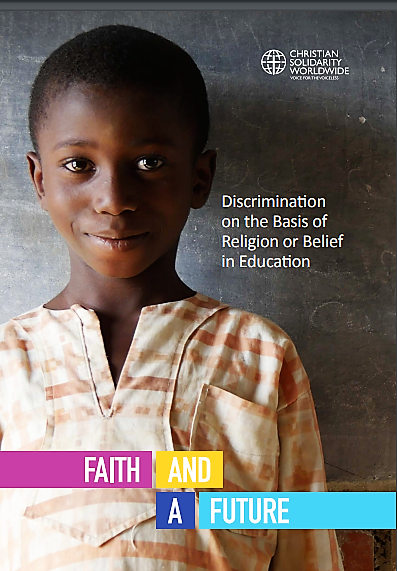
I must also mention, once again, attacks on Coptic Christian churches in Egypt. Most recently, over the past 12 months, more than 100 Christians have been killed, according to Christian Solidarity Worldwide. I commend the work of CSW, in particular its recent publication, “Faith and a Future: Discrimination on the Basis of Religion or Belief in Education”, launched at the CSW meeting earlier this week in this place, which a number of us attended. If the Minister has not received a copy, I hope he will accept mine, because it contains many recommendations.
Turning back to the position of Christians in Egypt, in April last year, attacks on two churches killed 44 and left scores injured. In May, at least 28 people were killed and 23 injured when masked gunmen opened fire on three vehicles transporting members of the Coptic community to the St Samuel the Confessor monastery. In October, an extremist attacked Father Samaan Shahata Rizkallah, a 50-year-old Coptic Orthodox priest, chasing him, stabbing him repeatedly in the head, neck and abdomen with a meat cleaver, and imprinting a cross on his forehead. Father Samaan died from his injuries. In December, in the Helwan neighbourhood south of Cairo, a gunman attacked a Coptic-owned shop, killing two brothers. Later that day, the same gunman attempted to storm Mar Mina church, killing members of the congregation and a police officer at the checkpoint guarding the church. Several others were wounded. The gunman was endeavouring to enter the church to detonate explosives, but fortunately was intercepted and arrested.
These are incidents, the like of which we have heard of time and again in Egypt over recent years. I implore the Minister and the UK Government to call on the Egyptian Government to ensure that all such attacks are thoroughly investigated, with perpetrators brought to justice and proper investigations launched, so that accusations of complicity—including within the security forces—are also investigated. Will the Government encourage the Egyptian Government to ensure that the measures put in place to combat terrorism do not violate human rights, including freedoms of association, expression and religion or belief?
Given that, I want to reflect on how and why the UK should lead on matters of religious freedom. I want to express concern about freedom of religion or belief in our own country. In more than seven years in this place, I have spoken many times, including in this Chamber, about challenges to religious freedom in other countries. I have to confess, however, that while I was preparing for this debate I was in some trepidation about speaking about the subject with reference to our own country—I thought I might be seen as somewhat out of kilter with what we call the “mood of the room”. So it has been with some relief that I have heard other Members speaking about their concerns about challenges to freedom of religion or belief in this country. I am therefore somewhat surprised, but ironically also very pleased, that I appear to be echoing concerns already expressed by colleagues relatively early in the debate. As has been said, we cannot with credibility ask other countries to pursue religious freedom diligently if we do not do so ourselves.
Our former, well-respected colleague, who spoke many times about this subject, David Burrowes, the former MP for Enfield, Southgate, told me today about at a meeting that he and the right hon. Member for Islington North (Jeremy Corbyn) held with an Iranian parliamentary delegation in the last Parliament. David Burrowes challenged that delegation on human rights issues in their country, including the persecution of Christians. They challenged back, picking up on abuses in this country, and in effect said, “Put your own house in order before you criticise us.”
Precious religious freedoms have been hard won in this country over centuries by many, including free church Christians, Catholics and Jewish people. As the recent publication, “Turn the Tide: Reclaiming Religious Freedoms in the UK”, reminds us:
“The very first clause of Magna Carta includes the statement…‘The English Church shall be free, and shall have its rights undiminished, and its liberties unimpaired’”.
That is one of only four of the Magna Carta’s 63 clauses that remain part of the English law. It ends:
“This freedom we shall observe ourselves, and desire to be observed in good faith…in perpetuity.”
From the 16th century, Britain led the world in developing those freedoms, spreading them to other countries round the globe. Many died to achieve those freedoms; others were imprisoned or exiled, or had to leave the country; others were denied an education, not allowed to hold jobs in the public sector or stand for Parliament, simply because of their faith. William Tyndale gave his life so that the Bible could be freely read in England. John Bunyan, author of “The Pilgrim’s Progress”, spent 12 years in Bedford County Gaol for the right to preach and worship freely.
The hard-won freedom of religion is under attack in the UK today, whether unintentionally by those who lack religious literacy, more deliberately from aggressive secularists, through attacks by one faith on another, or simply by those who ridicule people of faith in the 21st century. Those people are ridiculing our Queen and our Prime Minister, both of whom have very publicly declared faith. We hear of British adults who were raised in other religions and converted to Christianity being subjected to extraordinary abuse, including physical violence. One from the north of England wrote to his MP about his family’s troubles. He said:
“We were forced out of our…home after…several years of suffering as converts…in the form of persecution which entailed assault, daily intimidation, criminal damage to property: smashing house windows and also 3 vehicles written off”.
In fact, the empty house next to them was set on fire, in the hope that the fire would spread to their property. Eventually, the family was moved out under armed police protection to a new home elsewhere in the country.
Two street preachers were arrested and prosecuted in 2017 for peaceably preaching from the Bible—we know that they were peaceable because there was a film of the event. A Crown prosecution lawyer suggested at the court hearing that publicly quoting from the Bible should be considered a criminal offence. The street preachers were fined but later acquitted on appeal to the Crown court. Their case is seriously disturbing. The fact that the police and Crown Prosecution Service decided to prosecute the men simply for publicly reading the Bible challenges the long-established freedom in this country to do that. That was one of the very first aspects of freedom of religion to be established, when in 1537 Henry VIII issued a royal decree to that effect. As I have mentioned, that was the freedom that William Tyndale died for in 1536.
Let it be said and heard in this Parliament that reading the Bible in public is not a criminal offence in this country in the 21st century. The case I have mentioned appears to have resulted from a misunderstanding of the law by public officials, but such instances are deeply concerning and have a so-called chilling effect on the freedom that many Christians feel they have to speak about their faith in public in this country. That is deeply troubling, and we in this place, who value freedom of speech so preciously, need to be more keenly aware of it and call it out. I am not saying that every complaint of religious discrimination we hear is justified—sometimes we might not hear the whole story—but there have been enough instances in recent years to cause us concern.
Parliamentary colleagues in this room may remember the assault that took place against the Brethren denomination just a few years ago, when the Charity Commission sought to remove its charitable status. I remember more than 40 MPs crowding into this very room to raise objection after objection. More recently, we have had to combat the suggestion—again in this very room—from the Government, that churches running more than six to eight hours of Sunday school or youth clubs each week should have to register with the authorities and be monitored by Ofsted for the content of their teaching. That suggestion would have turned the clock back two centuries in terms of religious freedom in this country. I sincerely hope that, as there has been no public announcement on that proposal, the Government have quietly dropped it.
Even more recently, there has been a suggestion that those wanting to hold public office should have to swear an oath supporting a currently undefined set of 21st-century British values. That harks back to my earlier reference to people being barred from public office because of their religious beliefs. Great work was done through the 18th and 19th centuries to remove such barriers to people becoming school teachers, Army officers, lawyers, mayors, or students or academics at Oxford or Cambridge Universities. Drawing up a new set of beliefs that people have to sign up to could take us back to the 17th century, and attempts to draw one up have been troubled. Although most things on such a list would be universal values, not necessarily everything would be. If the Government are still considering that suggestion, I urge them to reconsider it and to withdraw it.
The issue of freedom of religion, belief and expression in our country merits much further attention. Government need to ensure that UK laws that target violent extremism do so precisely and do not impinge on the religious freedoms of peaceable citizens, whose faith often motivates them to contribute very positively to society. To that end, Government should consider requiring officials to include religious belief in the equalities impact assessment, along with the current criteria of race, disability and gender, to ensure protection from discrimination. After all, religious belief is also a protected characteristic.
It would be beneficial for Government to look at ways to improve religious literacy across Government Departments and public officials. As suggested in the report, “Improving Religious Literacy”, published in 2017 by the all-party parliamentary group on religious education, which I have the privilege of chairing, that is being done in the Foreign and Commonwealth Office and the Department for International Development. I very much welcome that recent work, but it needs to be done more widely. If we are to be coherent and carry integrity internationally, religious freedom in this country must be nurtured, manifested and supported as well as it is abroad.
Martin Docherty-Hughes (West Dunbartonshire) (SNP)
It is good to see you in the Chair, Ms Buck. I congratulate my hon. Friend—I hope I can call him that—the Member for Strangford (Jim Shannon) on opening this debate in such a manner and highlighting many of the issues that belief and religious faith face across the world. I have to say that I am of dubious faith, but even we of dubious faith recognise the connection between the freedom and love of democracy and religious belief. It is a matter that we should take more seriously.
I want to highlight to the Minister the case of China very briefly and another state, India, in slightly more depth—something I am sure he is not surprised by. In the light of some of the situations faced by Christians in China, specifically Roman Catholics, I hope that the Minister, perhaps via the papal nuncio, will feed back to the Holy See that, in its deliberations with the People’s Republic of China to overcome some of their disagreements over the last 70 years, it might reflect on how the Roman Catholic faith survived the tyranny of western communism and how it should deal with the practice of Roman Catholicism in its connections with eastern Communism. Undermining the underground Roman Catholic Church in any fashion would be a retrograde step, not just for those practising their faith in the Roman Catholic fashion but for all people of faith in the People’s Republic of China.
I turn—I am sure this will not surprise the Minister—to the situation in India. The Republic of India, the world’s largest democracy, has a legal system based on common law, is a signatory to many UN declarations, including on human rights, and is a Commonwealth nation. I hope that the Government, through the Foreign Secretary, will raise a few points with President Modi and his officials at the Commonwealth Heads of Government meeting here in London in April.
According to some reports, appallingly, India has risen from the 28th most dangerous country in which to practise the Christian faith to the 11th. Christianity in India is not some modern belief flown in from the United States mid-west, but finds its roots in the Christianity of St Thomas the apostle between, some would say, the birth of Christianity and the 6th century. Yet well-known people in the state of India continue to call publicly for the country to be free of Christians by 2021. So far, there have been 23,000 incidents of physical and mental abuse against Christians of all denominations, and 635,000 Christians have reportedly been detained without trial or unfairly arrested. That is just the tip of the iceberg in terms of Christianity.
We should not forget the situation of Sikhs in India. Those in the Sikh community make up the largest proportion of the Indian diaspora in Scotland. Let us not confuse the expression of Sikh faith and its persecution in India with the authentic debate about self-determination. There should be no doubt that the Sikh community faces profound discrimination and intolerance in the practice of its faith. The number of Sikhs detained for very long periods by state authorities continues to rise across all the states that make up the Indian nation. That is a matter not only for those who practise the Sikh faith in India, but for every UK citizen—including many constituents of Members here—who wishes to travel to the Punjab to visit holy sites and/or their families.
Since the detention without charge of my constituent, Jagtar Singh Johal of Dumbarton, members of the Sikh community across the UK have become gravely concerned that they, too, may be detained on the simple premise of being a member of the Sikh faith. To travel to a Commonwealth nation in a situation like that is quite profound. I will therefore ask some specific questions of the Minister for the Government to consider.
First, when President Modi attends the Commonwealth Heads of Government meeting in April, what discussions will the UK Government have with the Government of India about the persecution of Christians? Secondly, what discussions will the UK Government have with the Government of India on the persecution of those of the Sikh faith? Thirdly, how will the Minister use the responses to his letters to heads of mission about freedom of religion or belief? How will those responses inform Foreign and Commonwealth Office policy, and how will the FCO encourage heads of mission to ensure that their diplomatic staff are trained to spot and resolve freedom of religion or belief violations? Finally, will the Government ask other Commonwealth nations in April what actions they are taking to build a more tolerant society, where religious belief is not only legislated for but defended?
Sir Edward Leigh (Gainsborough) (Con)
We should congratulate the hon. Member for Strangford (Jim Shannon) on how he introduced the debate and his work over many years to highlight these issues. I have joined him in many debates over the years. As usual, he spoke up in a powerful and noble way. I am grateful to all those who spoke before me, and I adopt all their points. I do not disagree with anything anyone said.
The hon. Member for Mitcham and Morden (Siobhain McDonagh) rightly described the persecution of Ahmadi Muslims. I was astonished by the reaction of the Iranian parliamentary delegation to this country that my hon. Friend the Member for Congleton (Fiona Bruce) mentioned. I agree that there are examples of politically correct magistrates and police officers being over-zealous in dealing with Bible preachers, and everything she said was right, but to equate that with a criminal regime in Iran that hangs and persecutes people and treats minorities with complete contempt is ridiculous. When we speak out, we should attack the really evil regimes around the world. There are forces for good that are trying to resolve difficult cases.
I say to the hon. Member for West Dunbartonshire (Martin Docherty-Hughes) that the Papal Nuncio has visited Parliament. We have been talking to him and to our ambassador to the Holy See in the past week, and the all-party group on the Holy See is going to the Vatican. The situation with the underground Church in China is unbelievably complex, but there is no question of the Catholic Church deserting those brave people. We hope some sort of compromise or consensus can be achieved with the Chinese Government.
The honest truth is that the people who are persecuted in the world are overwhelmingly either Christians or members of minority Muslim communities who are persecuted by majority Muslim communities. There are of course very bad examples of discrimination by Christians, but I hope that the Minister will not use the usual rather easy Foreign Office line that there is persecution everywhere in the world. I agree that there is persecution in too many parts of the world, and all persecution is terrible, but the people whose lives are made a complete and utter misery and who are overtly oppressed are overwhelmingly either Christians or members of minority Muslim groups.
We are going to stand up one by one and attack various Governments for persecuting people, so let me start with a good news story from Israel. Recently, the Israeli Parliament considered a private Member’s Bill that would have granted expansive powers to confiscate church property in Jerusalem. Astonishingly, it would have allowed the municipality to confiscate even properties that had previously been sold by church bodies. Such ex post facto laws are almost unheard of in Israeli jurisprudence. Indeed, traditionally, Christian communities have been protected in Israel.
The Christian community in the holy city united in protest and even closed the Church of the Holy Sepulchre for the first time in decades. Luckily, the Knesset suspended its consideration of the Bill, but the Israeli Prime Minister’s role in having it stopped is noteworthy. He stepped in, as The Jerusalem Post reported:
“Netanyahu became involved after it became clear that the closure of the church had the potential to cause Israel considerable diplomatic damage”.
Our Government should take heed. Diplomacy can work, and Her Majesty’s Government should not be afraid to protest or condemn, even when our close friends are involved.
Let me deal with one aspect of the persecution of Christians. There is a Christian Solidarity Worldwide briefing many pages long from which one could take numerous examples, but I want to deal with the persecution of Christians in the Nineveh plains of northern Iraq, mainly because I know the region and have visited it. All but one of the Christian villages I visited in the Assyrian plain near Mosul were overrun. The Iraqi Christian population numbered more than 1.4 million in the 1980s, before our disastrous invasion of Iraq. By mid-2015 it had declined to 275,000, and it had further declined to 200,000 by last year.
The Syriac Orthodox patriarch, Ignatius Aphrem II, told the recent Budapest international conference on persecuted Christians:
“I am afraid the day will come when our visitors come to see us as dummies in a museum, placed in old churches or monasteries. I fear that, in failure of the necessary steps, we may only become memories of the past in a very short time.”
If one goes to ancient Christian communities in the middle east, one hears the mass said in Aramaic, which is the language of Jesus Christ—the original language. However, we should listen to what the Syriac Orthodox patriarch said about Christians being driven out of the foundation place of Christianity.
The situation is not entirely hopeless. Many refugees who were only internally displaced have tried to move home and rebuild their communities.
I recently received a memorandum on the current status of Christians in northern Iraq from a member of the senior leadership of the Christian Church community in northern Iraq. I have met this gentleman and talked to him at length, but for security reasons I cannot give his name, because he is resident in the region. The fact I cannot do that, as he is scared for his safety if I read out his testimony, says something about the problems we face. Anyway, our friend in Iraq writes:
“The displaced Christians from the historically Christian towns of the Nineveh plain are in the midst of a gradual, often halting, return to their homelands. Of the…100,000 Christians originally displaced from the region, approximately 30,000 to 40,000 have begun efforts to move back. Of these, many have also still retained some form of residence in the greater Irbil region, where they took refuge during their displaced status. As such, there is continual movement back and forth between greater Irbil and the slowly rebuilding towns of Nineveh. ”
However, he goes on to point out that there has been almost no return of Christians to Mosul, because of justified fears for their safety in the city. I went to Mosul and saw the Christian communities there before ISIL—because of the appalling events there, nobody in their right mind would have gone anywhere near that city in recent times. Because of the security concerns there, Mosul’s Christians remain displaced. They cannot return home and rebuild their lives, and they cannot help Iraq return to some sense of normality and stability. Our correspondent notes that they
“are dependent largely upon the resources of the Christian churches and aid groups.”
Again, not all is hopeless; there are signs of progress. I am relieved to hear that the United Nations Development Programme has changed its previous policy and is now starting to work more closely with Church leadership in Nineveh, which provides almost the only real local government in the area. Hungary has been strong in its work in this field: in addition to appointing an ambassador-at-large for persecuted Christians, it has donated €2 million to help reconstruction in the villages of the Nineveh plain.
What can we do? How can the United Kingdom help? I turn to the Minister. Our friend on the ground in northern Iraq has given me concrete suggestions, which I put to the Minister and to which I hope he might respond. First, the UK Government need to put pressure on the leaders of the Kurdistan Regional Government and the central Government in Baghdad to resolve their disputes peacefully and swiftly. That is an easy ask, Minister, but it may be more difficult to achieve. The travel blockade that prohibits international air travel to Irbil is particularly debilitating and has had a disastrous effect on humanitarian relief and reconstruction efforts.
Secondly, we need to encourage the Iraqi Government to remove all paramilitary forces from the Nineveh plain and replace them with regular Iraqi army and security forces. The Hashd al-Shaabi units there are mostly Shi’a from southern Iraq, with Iranian backing, and their continued presence adds to uncertainty and insecurity about the future. Thirdly and finally, our Department for International Development needs to examine closely as a potential model the new co-operative relationship building between the United States Agency for International Development and the UNDP.
Our friend on the ground notes:
“In particular, we need to examine the structural forms of co-operation and co-ordination which are ensuring that practical and efficient working relationships are being established in which the Christian minorities are properly involved in the rehabilitation process. DFID should not be allowed to simply provide boilerplate representations regarding the effectiveness of the prior UNDP programs which the UN itself has admitted need to show greater responsiveness to the reality on the ground, a reality in which the Christian churches continue to provide the de facto local government leadership in their region. ”
My correspondent cites the example of the $55 million donated by USAID being deployed around the Nineveh plain in a co-ordinated approach, with close contact between the office of the UNDP director for Arab States and the Christian leadership in northern Iraq. He notes:
“This new approach has shown great early promise at improving efficient use of aid funding, and has significantly improved the confidence of the Christian minorities in the UNDP efforts.”
Yes, 3,557 houses have been burnt down, 13,088 houses have been severely damaged, 8,297 have been partly damaged, and reconstruction is very slow. We can be guilty of exacerbating these appalling problems because of our previous foreign policy. I do not want to go on about that—oceans of ink have been spilt on whether it was right to invade Iraq and to destabilise Saddam, Assad or Gaddafi—but all I will say, as I have said before, is that, in our perfectly justifiable attempts to improve democracy and undermine authoritarian regimes in these countries, we have unleashed totalitarian forces, and the victims of those forces have been the minority Christian communities. I hope the Minister will forgive me if I dwelt at some length on northern Iraq, but it is one of the most horrible, most pitiable and most terrible parts of the world.
Mrs Louise Ellman (Liverpool, Riverside) (Lab/Co-op)
It is a pleasure to serve under your chairmanship, Ms Buck. I congratulate the hon. Member for Strangford (Jim Shannon) on securing the debate, his wide-ranging speech and indeed his overall commitment to religious freedom. The contributions of all hon. Members have shown how important it is to remain vigilant about attacks on religious freedom, whether in this country or elsewhere.
I am the chair of the all-party parliamentary group on the Baha’i faith. On numerous occasions, together with other hon. Members, I have raised the plight and persecution of the Baha’is in Iran. However, today I draw attention to a disturbing development: the persecution of Baha’is in Yemen, driven by Iran. I speak specifically of the case of Mr Hamed bin Haydara, a Yemeni Baha’i sentenced to death by public execution by a Houthi-controlled court in Sana’a on 2 January. The persecution of the Baha’i community in Yemen is a recent, extremely disturbing development, and Mr bin Haydara’s case is a graphic illustration of a growing problem, which is a matter of great concern.
Mr bin Haydara is a 54-year-old father of three who has been detained since 3 December 2013. He was first arrested by the national security agency in Sana’a. In the early months of his detention, he was subject to torture, beatings and electric shocks, and he was forced to sign documents while blindfolded. He was detained without charge for 13 months until January 2015, when he was charged with collaboration with the State of Israel, apostasy and harming the political status of the Republic of Yemen. The prosecutor sought the death penalty. More than half of the 38 court hearings in his trial were postponed or cancelled, and the death sentence was announced in his absence. That must raise questions of due process, even in the troubled country of Yemen.
The Baha’i community has reported that six other members of its community are detained in Houthi-controlled prisons and that arrest warrants were issued for a further 25 Baha’is, so there are fears of a wider crackdown on the Yemeni Baha’i community. It appears that elements of the national security agency and the prosecution service in Sana’a are determined to persecute them.
The memorandum of the Iranian supreme revolutionary cultural council in 1991 dealt with the Baha’i question. It stated:
“A plan must be devised to confront and destroy their cultural roots outside the country.”
It is believed that that policy is now being enacted in Yemen. Indeed, it is deeply disturbing to hear the analysis of the United Nations special rapporteur on freedom of religion or belief, Dr Ahmed Shaheed, who on 22 May 2017 observed:
“The recent escalation in the persistent pattern of persecution of the Baha’i community in Sana’a mirrors the persecution suffered by the Baha’is living in Iran”.
In view of the gravity of the threat to the life of Hamed bin Haydara and the steadily increasing oppression of the innocent Baha’i community in Yemen, particularly in those areas under the control of the Houthis, will the Minister request that the UK mission speak under agenda item 10 of this 37th session of the UN Human Rights Council on the situation of Yemeni Baha’is? Will the UK mission also inquire specifically about Mr bin Haydara’s case and that of other Yemeni Baha’is during the interactive dialogue with the special rapporteur on freedom of religion or belief, Dr Ahmed Shaheed? Of course, it is he who has already drawn attention to the plight of the Baha’is in Yemen and the concerns he feels about that.
Those are just two steps that could and should be taken to raise the plight of the Baha’is in Yemen. We must not let them down, and I hope the Minister can give me a positive response to both requests.
Bob Stewart (Beckenham) (Con)
It is a real pleasure to be here to support my very good friend, the hon. Member for Strangford (Jim Shannon). I endorse what other people have said about his conviction and his drive to bring this matter to public attention.
I want to make a slight change from the way other people have spoken. I want to talk about what I have seen as a witness to religious-inspired genocide, particularly between Bosnian Croats, who are Catholics, and Bosnian Muslims, sometimes called Bosniaks. Both sides are ethnically exactly the same; they are South Slav peoples. The only difference is religion.
In 1992-93, I was the British United Nations commander in Bosnia. During my time, I found evidence of atrocities before April 1993, but nothing like what I found on 22 April 1993. That day, I was in the hills on the instructions of the European Community Monitoring Mission ambassador, trying to stop the fighting between Bosnian Muslim and Bosnian Croat forces. I was on the frontlines, and a Bosnian Muslim commander said to me, “You know, we’re not stopping fighting, because our people are being killed by them over there, and they’ve been killed in large numbers in a village called Ahmici.” I said, “I don’t believe it.” They said, “They are.” I said, “Look, if I go there and I discover you’re wrong, and I come back and tell you that you’re wrong, will you take my word for it and stop the fighting?” It was a sort of trade-off.
They said yes, so I left there and went off the hills. My men and I were attacked a couple of times by snipers. We bypassed a Croat special forces unit that opened fire on us and we went into the village called Ahmici. As I entered, I saw the mosque at the entrance had had its minaret toppled—not a good sign. I drove all the way up to the top of the linear village, about a mile. As I passed through it, I saw such devastation that I could not believe it. There were some houses still standing; they had crosses on the door, marked in paint. Everything else was destroyed.
At the end of the village I deployed a platoon of men—let us say 36—either side of the road, in straight lines, and we went through. I was looking to see whether I could find anyone. We did not find anyone; we saw dead animals, but we did not find anyone until about one third of the way down the village. We came across a house, and my men came back to me and said, “This is disgusting, sir, absolutely disgusting.”
We went to the house, and in the doorway were the remains of a man and a teenage boy. They were burned, and they were shot—there were shell cases on the floor—but around the back was worse. We went into a cellar at the back of the house, and when we first saw what we saw, we could not believe it. Our eyes did not believe it. The first thing that hit me was the smell; then, in waves, I realised what I was seeing. I was seeing the remains of a family. That family had been massacred—my goodness, I hope they were shot before they were burned. I do not know whether they were burned alive; I damn well hope they were not, but they were shot. There was a mother, back arched, and there were children. My men and I came out retching.
I had no idea what to do. I could not talk about it, I could not do anything, I was there in a neutral capacity, but I had to do something, because this was religious genocide. It was disgusting, and we had to do something about it—not just talk about it, not just report it. We were on the ground, but what could I do? I did not have enough men. What could I do? Who would I attack?
Then I thought, “The best way of dealing with this is to publicise it right across the world.” So I called a press conference beside my tank. I accused the Bosnian Croats directly of causing the massacre, because the houses with the crosses on were Christian Catholic houses, and those that did not have a cross, the Bosnian Muslim houses, were destroyed.
A couple of days later, I buried over 100 people in a mass grave, mainly women and children and old men. As I was coming away, there beside the road I saw a family in line, dead: mother, father, boy of about 10, girl of about six—dead. The girl was holding a puppy. The same bullet that had killed her had killed the puppy. I took the bodies to the local morgue. I took them into the morgue and said, “Please deal with these bodies.” That is not a great job to do; it is horrid.
The next day, I went down the same road to discover that those bodies had been put back where I had found them. Guess why? It was because I had taken them to a Christian morgue, not a Muslim morgue, so they put the bodies back where I had found them. That is appalling.
I have given evidence in five trials as a result of those activities, at the International Criminal Tribunal for the Former Yugoslavia. I knew the commanders on both sides; I had dinner with some of them. On the face of it, they were normal, decent people. I have to ask: what is it that makes normal, decent people turn to such brutal techniques? How can normal people kill a child, a woman or a man? How can they do that? It seems to me extraordinary.
Obviously, we have never been in that situation, but why is it that the Nazis, for example, who were normal German people, could do that? Why could normal people in Cambodia, or elsewhere, do that, mainly because of religion? Why does it happen in the name of religion? I do not think there is a mainstream religion in the world that advocates violence against another religion, is there? There are lunatic offspring that claim to be part of a religion, but not the mainstream religions, so why is it that, despite that, we still have people being killed or persecuted for religious reasons? I do not know the answer.
I believe, in my heart of hearts, that religion is often used as an excuse to persecute—a really damn good excuse to back up other reasons for persecution. I remember talking to a Christian Croat farmer. I challenged him on why he had attacked the next farm along. He had been to school with his neighbour. He had known him since they were children. They apparently liked one another. He said to me, “I want his farm; he doesn’t deserve to keep it, because he is a Muslim”. Do hon. Members see what I mean by saying it is an excuse? I suspect that religion is often used for that reason—to give people an excuse to do what they wanted to do in the first place.
I hope I am wrong, but I now believe that we will never be able to stop religious persecution, not completely. But my God, it is our duty to do everything we can to try.
Mary Glindon (North Tyneside) (Lab)
It is an honour to serve under your chairmanship, Sir David. It is quite difficult to follow the hon. Member for Beckenham (Bob Stewart). He has provoked a lot of questions on why we think religious freedom is important and why we need to move forward with it and for the Government to do more to support oppressed people.
I congratulate the hon. Member for Strangford (Jim Shannon) on persuading the Backbench Business Committee that we needed to have the debate at the time of the 37th session of the UN Human Rights Council. I thank the Backbench Business Committee for having been persuaded by him in his inimitable way.
I first heard about the Baha’i faith when I met Mr Dan Wheatley, who is a member of the community here and is a persuasive and strong advocate for that community. I subsequently joined the all-party parliamentary group on the Baha’i faith, of which my hon. Friend the Member for Liverpool, Riverside (Mrs Ellman) is the chair. The faith has been spoken about today. It is actually the world’s youngest independent religion. It was started in Iran, and it now has 188 communities around the world, all of which I consider follow a noble and caring teaching faith. Its teaching includes the oneness of humanity and, particularly, the equality of men and women.
However, like many other faiths that have been spoken about, the Baha’is have suffered periods of violence and oppression, in Iran and beyond, as has been eloquently described. Since the 1979 Islamic revolution, the Iranian Government have persecuted the Baha’is. In 1991, a Government memorandum, prepared at the request of the supreme leader, urged that the community should be treated in such a way that
“their progress and development shall be blocked.”
That memorandum, which established Iranian state policy towards the Baha’i community, remains in force. Other hon. Members may be aware of the document and the actions it mandates to repress the Baha’i people. I will focus particularly on one area: restrictions on the right to work. We talk a lot about how important employment is for everybody, not only in the economic but the social sense. A direct result of the memorandum is the Iranian Government’s discriminatory policy to prohibit and restrict the Baha’is’ right to employment—a policy that has been expanded over the years—which has had such an effect on the people in the community.
The hon. Member for Strangford rightly paid tribute to the life of Asma Jahangir, who was the UN special rapporteur on human rights in Iran at the time of her tragic death last month. In her last report, dated 14 August 2017, she noted:
“Baha’is continue to be systematically discriminated against and targeted, and efforts are afoot to systematically deprive them of the right to a livelihood.”
It is also notable that Iran’s actions are in contravention of a recommendation that it accepted from Sri Lanka at the start of the UNHCR’s last universal period review. Recommendation 138.88 stated that Iran should:
“Continue its national policy to promote equal opportunities and treatment with respect to employment.”
There are many examples of how Iran has failed to implement that recommendation, and I will highlight but a few. On 20 April 2016, 17 shops belonging to Baha’is were sealed for being temporarily closed on Baha’i holy days. Days later, on 28 April, four additional shops in the same province were sealed for the same reason. Later that year, after Baha’i-owned businesses throughout the province, in cities including Sari, Qaem Shahr and Bandar Abbas, were temporarily closed on 1 and 2 November to observe a Baha’i holy day, Iranian authorities sealed a total of 124 business premises belonging to 132 Baha’is.
Again, in July 2017, 16 Baha’i-owned business premises in Khuzestan province were sealed following the observance of another holy day. It was a small relief that, two months later, after great effort by the business owners, 14 of the sealed business premises were unsealed. In the same month, the business premises of a non-Baha’i in Ahvaz were sealed because for employing a Baha’i. The owner of the business was forced to dismiss the employee and, after being provided with an assurance of non-co-operation with the Baha’is, the authorities issued an order to unseal the business. Further, on 1 May, the business premises of 18 business owners in a city were sealed by Amaken—the public places supervision office—again because they were closed on a religious holiday.
For us, it would seem impossible for that to happen in our country. There would be an outcry. But these Iranian citizens, who are simply trying to make a living while staying true to the faith that they have chosen to follow, are being treated in this way. I admire their courage and perseverance. I do not know whether I or anyone else in the room who has never had to suffer for their faith could endure such persecution. I confess that I would never want to be tested to such a degree. We all need to think about how we would deal with persecution and whether we would we be able to withstand it for our faith. The people who have been mentioned today, wherever they are, deserve our admiration.
In view of Iran’s failure to adhere to accepted international human rights standards, including commitments that their own Government have made within the framework of the universal periodic review, I urge the Government to continue to support, co-sponsor and lobby for the resolution on human rights in Iran at the Human Rights Council.
Finally, I support the request made by the hon. Member for Strangford that the UK raise the situation of the Baha’is in Iran in an agenda item 4 statement at the UN Human Rights Council, given the sad fact that Asma Jahangir is no longer with us. We are all united in this today. The fact that so many people have turned up on a cold afternoon, perhaps not knowing whether they will get home this evening, shows that we ardently feel that religious freedom should be upheld.
Martin Whitfield (East Lothian) (Lab)
It is always a pleasure to serve under your chairmanship, Sir David, and a pleasure to follow my hon. Friend the Member for North Tyneside (Mary Glindon). I extend my thanks to the Backbench Business Committee and also to the hon. Member for Strangford (Jim Shannon) for securing this debate. Please note, Sir David, my interest as a member of the all-party group. I want to take a moment to express my deep thanks to the hon. Member for Beckenham (Bob Stewart) for sharing his experience as to why this debate today is so fundamentally important.
Human rights are bandied around. They are written and printed, and we speak about them a lot, but today we have heard evidence as to why it is so important that they go beyond words, statements and intentions and become part of what being human and civilised should really be about. Freedom of thought and belief in religion are mentioned in many documents: our own Human Rights Act, the European convention and the UN convention. Those are examples of why, as a civilised world, we can do better for our future. We have heard evidence today from across the world, and indeed from within the United Kingdom, about the great tragedy that people still use others’ religion as a reason to persecute, to be violent towards and to treat differently. They use religion and non-religion—atheism or agnosticism—to say, “You are different enough for me to inflict pain and inhumanity on you,” whether through employment for Baha’is, or through property, approach or education. As the world seems increasingly separated, we need Governments, individuals and Parliaments to stand up and say, “Together we are stronger.” Together we recognise our differences. We hold that as important in the friendships that we make.
Much has been said about the Baha’is today, and I ask to be associated with the comments that we have heard, but I want to ask about Yemen, where recent changes show the potential for another truly tragic part of history to roll out. We have an opportunity. The situation is complex and there are never simple answers, but there is a simple basis: differences in religion are never a reason for treating people differently.
I want to ask the Minster about an event that happened on 21 February when the UNHCR representative was here. I had the privilege of listening to him submit evidence about what is happening. A number of points came out that I want to raise today, which I want the Minister to take away and in due course respond to. The first relates to a statement that I have read in various places, which is that people of minority religious faiths choose not to go to refugee camps. It seems there is an obvious explanation, but I am not sure whether that is correct. I heard the UNHCR representative say that it was by choice and that the majority of refugees are not in camps.
It is important that the Government look into whether the statistics and the explanation are correct, particularly in relation to the number of refugees from minority faiths that are settled in the United Kingdom. There seems to be a difference in the percentages. It is horrible to reduce people who have refugee status to a statistic, but there seems to be a much smaller number of religious minority refugees settled in this country than perhaps there are in other parts of Europe and across the world. It might be a choice that those individuals and families make, which is fine, but I find that anomaly somewhat worrying.
The second thing relates to some of the recommendations made, particularly with regard to the Government’s role in relation to the UNHCR and the process of assessing vulnerability and protective needs and providing humanitarian assistance to refugees. The characteristics of vulnerability are gender, sexual orientation, race and ethnicity, and the language of refugees. Will the Minister comment on how much work is being done to establish religion as one of those areas of vulnerability? It seems to get raised. It is certainly within the documentation, but there needs to be an assessment of how strongly religion forms one of the characteristics of vulnerability.
My next point relates to the training that UNHCR staff get on religious persecution and the safeguarding of religious minority refugees. This country and the Government can be justifiably proud of the knowledge that sits within their Departments, and the world can only benefit by its being shared. It would be nice to know that that is being rolled out to support the UNHCR in various other areas.
We have heard some enormously powerful testimony today. The right to practise a religion or to practise no religion is a fundamental part of being a human being. There are complex questions and complex situations, but no simple answers. Using the power of communication, politics and diplomacy, we need to take our place in the world and strive to ensure that in future the powerful testimony that we have heard today can be consigned to history and we can learn to live together.
Martyn Day (Linlithgow and East Falkirk) (SNP)
It is a pleasure to serve under your chairmanship today, Sir David. I am grateful to the hon. Member for Strangford (Jim Shannon) for securing time for this important debate. I pay tribute to his work as the chair of the all-party parliamentary group for international freedom of religion or belief, and the effort that he has put into it over the years.
We have had a consensual debate. I do not think I have disagreed with any point made by any Member. That speaks for the strength of feeling across the House. We live in a world where about 80% of people identify with a religion, so freedom of thought and religious belief is an essential human right. No one should be persecuted for practising their religion. Yet religious persecution is growing across the world. It is therefore more important than ever that we should stand up to protect that freedom of religion and belief. That freedom includes the right to hold no faith. The issue truly affects everyone.
Earlier this week I had the pleasure of meeting Cecil Chaudhry, of the Catholic Commission for Justice and Peace, who I see is with us today. We discussed the work of the commission in Pakistan and the growth in the incidence of blasphemy cases against religious minorities in the past 30 years. An area of concern that Cecil brought to my attention was bias against religious minorities within the curriculum taught in schools in Pakistan. He furnished me with a book, “Education: the Sole Hope for Change”. I briefly read it over last night, and would be more than happy to pass it to the Minister if he has not seen it already. A number of colleagues have pointed out the influence that the UK can have through its aid policy. The hon. Member for Stirling (Stephen Kerr) and my hon. Friend the Member for Glasgow East (David Linden) made similar points, and I echo that view. Hopefully we may get action in this case.
When we last debated freedom of religion and belief, for International Freedom of Religion or Belief Day in October, I listed a huge range of issues that constituents had raised with me. I will not repeat a similar list today, but the House can rest assured that there has been no let-up in the interest in the issue from people in my area. Those issues echo the points hon. Members have made today, and I shall not rehearse the same arguments, but there is an important observation to be made: my constituents do not show simply tribal interest. It is not a case of Christians complaining about Christian persecution and Muslims complaining about Muslim persecution, but instead it is decent citizens complaining about worldwide oppression. I think that there is something we can take from that. They may be influenced by their own belief, as is the case for many of those who have spoken in the debate.
In a similar vein, I am pleased to note the positive steps being taken in Scotland, and particularly the work of local ecumenical groups in my constituency, whose very existence fosters an attitude of openness and discussion. At a time when churchgoing has been in steep and steady decline throughout these islands, it may seem that, at least in the case of Christian belief and practice, its days are numbered here. However, a closer look at the situation on the ground in Scotland reveals that there are still signs of proactive attempts by faith-based communities and organisations to stem the secular tide and exercise the important human right of religious freedom that we are debating today.
As an example of that, large-scale preparations are currently under way by churches in and around central Scotland to host an ambitious three-day series of stadium events this summer at the grounds of Falkirk football club, on the border of my constituency and that of my hon. Friend the Member for Falkirk (John Mc Nally). It is billed as the Central Scotland Celebration of Hope, and there is an inclusive invitation to everyone who wishes to come. The family-friendly concerts are free of charge and are scheduled to take place on 15, 16 and 17 June, and will be fronted by the American preacher, Will Graham. The rallies at Falkirk stadium follow a successful, smaller outreach that he conducted in Peterhead two years ago, and will include live performances by Christian artists from around the world.
Will Graham is the grandson of the late Dr Billy Graham, who, of course, passed away last Wednesday, at the age of 99. When Dr Graham first came to Scotland in March and April 1955 to hold Christian rallies in Glasgow’s Kelvin Hall as part of the “Tell Scotland” movement, people from far and wide came to hear him speak, and many others around the country attended corresponding events in churches, and watched live broadcasts relayed by the BBC. The Rev. Tom Allan, chair of the All Scotland Crusade, which co-ordinated the Billy Graham mission activities in 1955, estimated that over a two-month period
“a total of 1,185,360 people in Scotland attended meetings of one kind or another”.
The Church of Scotland’s peak national membership of 1.2 million in 1962 has been attributed, in substantial part, to the religious revival that followed Billy Graham’s visit. Congregations from across the denominational spectrum also benefited from a boom in church attendance during that period.
Rev. Will Graham’s upcoming Central Scotland Celebration of Hope is expected to draw large crowds to Falkirk stadium from across the nation and beyond. My colleague John Swinney MSP, the Deputy First Minister of Scotland, and I are among the civic representatives looking forward to attending that positive local event. As happened at the numerous, high-profile rallies in Scotland for Will’s well-known grandfather, the last of which were held in the stadiums of Pittodrie, Murrayfield and Celtic Park in 1991, there will be live-streaming of the Falkirk stadium event in churches and at other venues around the country and, of course, on the internet for everyone. Perhaps that is an indicator that, far from this being a twilight era for Christianity, there may be another resurgence of spiritual interest just on the horizon.
Often the language we use is important, and we must be careful about inadvertently creating a religiously intolerant society. In this regard, I particularly welcome the term “Celebration of Hope”, which is far more inclusive language than the old expression “crusade” or even “mission”. Sadly, not everyone is as thoughtful, as is highlighted by another local matter I have been dealing with. This time the culprit is the press, and I want to single out the Mail Online in particular. The excellent local family-based group in my area, Al Massar, aims to tackle Islamophobia through a range of community activities such as its local football team, which gives free training, and Eid in the Park, a massive community event in the Falkirk area. It works well with local schools, the council and the NHS on various projects. The group is all about community cohesion, and unfortunately felt compelled to complain about reporting of an event it held at the Scottish Parliament to mark World Hijab Day. I shall not go into the full details of the article, but it contained factual errors, and the phrase “antiquated, oppressive, religious tool”—very negative language, which could very easily fuel Islamophobic rhetoric. I have of course supported the group’s complaint to the Independent Press Standards Organisation.
I am sure that the Minister and other Members will be aware that only one complaint out of over 8,000 about discrimination made to the IPSO has been upheld in the past year. The problem appears to be that the editors’ code of practice relates to “prejudicial or pejorative reference” to an individual, not a group. Surely that needs to be changed. The UK Government’s commitment to religious freedom, here and abroad, has been stated many times in this place. I am broadly in agreement with it, and I hope that the Minister can perhaps help with that point too.
On a positive note, sometimes those in the press are on side of the angels, and are on the receiving side of abuse and intolerance. I want to flag up the case of the journalist David Clegg, of the Daily Record, who gave a statement to the police the other day about threats received following his reporting of neo-Nazis targeting the Muslim Labour politician Anas Sarwar. I am sure that hon. Members will wish to join me in saluting his championing of the contribution made by Scots of all ethnic and religious backgrounds.
Thankfully, I live in, and am proud to represent, a very open and welcoming constituency. There is a clear message from the communities that I serve, and from Scotland as a whole, that we welcome people from diverse cultures and backgrounds, and that Scotland is a truly welcoming and diverse nation. We must seek to develop a religious literacy—a point made by the hon. Member for Congleton (Fiona Bruce)—that will enable us to engage in constructive intercultural dialogue, and so better understand and live alongside one another. Together we must do all that we can to ensure that the basic human right of freedom of religion and belief is promoted. Today’s consensual debate has been a welcome step in that direction.
Fabian Hamilton (Leeds North East) (Lab)
It is a pleasure to serve under your chairmanship this afternoon, Sir David. I join my colleagues in congratulating the hon. Member for Strangford (Jim Shannon), my good friend—I hope he does not mind my calling him that—over many years, who was able to table the debate, and in acknowledging the Backbench Business Committee for allowing us the time this afternoon.
It is rare to have a debate of this kind. It brought hon. and right hon. Members together from across the House in a range of emotional, moving contributions and speeches, in which they spoke as one against discrimination against and persecution of people with or without religious beliefs. It is a rare thing in the House that we come together to fight that discrimination across the world and, indeed, in our own society, so I congratulate my friend the hon. Member for Strangford.
The hon. Gentleman drew our attention to a number of issues across the world, not least in Nigeria, where armed Muslim bands have been persecuting Christian farmers over 17 years. The violence is on an unprecedented scale, and we do not often see it reported in the media here. He also mentioned the threat to religious minorities in Nepal. That really grieves me as a person who has visited Nepal on several occasions and was an observer at the elections there in 2013. It is tragic that it is prepared to introduce new laws on blasphemy and religious conversion and is joining the United Nations Human Rights Council at the very moment when it is being intolerant of religious minorities.
We heard much this afternoon, and not just from the hon. Gentleman, about persecution of the Baha’is in Iran. I certainly join him in asking the Government to make a statement on their views on the persecution of the Baha’is, which happens in both Iran and Yemen, as we heard. The hon. Gentleman mentioned the forced conversions that we have seen, in the media, in Pakistan. I think that he was the only Member to draw attention to the situation with the Eritrean Government, who see freedom of religion as a threat to them and demand that religions be registered in that country.
The hon. Gentleman, very movingly, drew our attention to and rightly praised the UN rapporteur Asma Jahangir, who died on 11 February. It was a really good eulogy and an appreciation of a woman who has not had the coverage and publicity that she deserved. We will not forget that she was born in Lahore, but her alma mater was the London School of Economics. She was educated, in other words, in this country; we should be very proud of her as well.
We then heard from the hon. Member for Stirling (Stephen Kerr), who said that we must continuously make the case for religious freedom. He made a passionate contribution on the basis of his deeply felt personal faith. He also mentioned Iran’s persecution of the Baha’i minority.
My hon. Friend the Member for Mitcham and Morden (Siobhain McDonagh) has been absolutely brilliant in upholding the rights of the Ahmadi community, not just in her constituency, where they are well established—their philosophy is “Love for all, hatred for none”—but throughout this country where Ahmadis have been persecuted and, more importantly, in Pakistan, where they suffer the most appalling abuse and, of course, arbitrary arrest and worse. My hon. Friend is a champion of the rights of the Ahmadi Muslim community, and long may that continue. She has upheld the rights of Ahmadis throughout the world and drawn their situation to the attention of right hon. and hon. Members and the media. I congratulate her on her excellent contribution.
We then heard from my hon. Friend—I hope that she will not mind my calling her that—the Member for Congleton (Fiona Bruce). She and I served together on the Select Committee on International Development. When Members serve on a Select Committee and travel across the world, they get to know one another right across the parties and they grow to respect one another, which is the way it should be.
My hon. Friend the Member for Congleton has always been a spokesperson not only for her deeply held Christian faith, but for the rights of other religious minorities. She talked about atheists in Egypt and the way they are persecuted. She raised the case of Ibrahim Khalil and said that the Parliament in Cairo is now considering a law to criminalise atheism. That is extraordinary. She raised the repeated attacks on Coptic Christians, and the murder and brutality that they experience. She said that freedom of religion is also under attack in the UK today—perhaps not on the scale seen in other countries, but intolerance is being shown in spite of the right that was declared in Magna Carta all those centuries ago. My hon. Friend’s speech was detailed, well informed and very carefully written.
The hon. Member for West Dunbartonshire (Martin Docherty-Hughes) told us about religious persecution in China and India. It is very important to remember that in those countries, and despite the fact that India is the largest democracy in the world, there is still religious persecution and on a scale unimaginable in parts of Europe. He said that Christianity is more persecuted in India now than it ever has been. Of course, we must also remember the plight of the Sikhs in Punjab. Many of us represent strong Sikh communities. I recently had the privilege to be in Kerala, where I met a Christian preacher, Dr Paul Chellakumar. I do not think that he will mind my mentioning his name in the House in this debate, because he goes around the villages, small towns and communities in Kerala, preaching the message of the gospel. Kerala is home to the largest minority of Christians in India; many are from a Catholic background. Indeed, I met the Indian Minister of State responsible for tourism, the federal Minister for tourism, whose first name is Alphons, which is not a very Indian name.
We then heard from the hon. Member for Gainsborough (Sir Edward Leigh), who made it clear that there should be no comparison between Iran’s persecution of religious minorities and any issues that we may have in the UK. Of course, he is absolutely right, but that does not mean that discrimination in the UK should go unnoted. We should of course draw attention to it, as I am sure he would agree. The hon. Gentleman also talked, with great knowledge and experience, about the persecution of Christians in northern Iraq. He mentioned Mosul. I was in Baghdad just a few days ago with an Inter-Parliamentary Union delegation, and we heard even more detail of the appalling destruction of western Mosul—the final town to be taken by Iraqi forces when Daesh was expelled. We were told by the United Nations and by Iraqi interlocutors that the destruction in western Mosul is now worse than the destruction in Dresden during the second world war, and that there are more than 30,000 IEDs—improvised explosive devices—unexploded, undetonated. Many of them are attached not just to the rubble, but to the corpses within that rubble. The UN estimates that it will take 10 years to clear the rubble away. The hon. Gentleman also mentioned, of course, the Christians of Nineveh. We heard a great deal about them on our visit to Baghdad.
Then we heard from my hon. Friend the Member for Liverpool, Riverside (Mrs Ellman), who does such brilliant work chairing the all-party parliamentary group on the Baha’i faith and has drawn attention over and over again to the persecution of Baha’is not just in Iran but, as she told us, in Yemen. She told us about the case of Hamed bin Haydara. I dare say that that is not a unique case, but it is one that we really need our Government to draw attention to in the Human Rights Council and in all their discussions with Iran and the Yemenis, as well as with the UN. Iran, she said, calls this the Baha’i question. I just say to Members: where have we heard that before? Substitute the word “Jewish” for “Baha’i”, and we know what we are talking about there. I thank my hon. Friend for her excellent contribution.
Then we were all hushed into total silence by, and paid great attention to, the hon. and gallant Member for Beckenham (Bob Stewart). We have heard his contributions on many occasions and we know his background and the bravery and leadership that he showed when he was the British commander of UN forces in Bosnia from 1992 to 1993. That is the thing that most people know about him, but I had never heard, and I am not sure that other hon. Members ever had, the story, the description, of the slaughter in that village, which obviously so profoundly affected him and which he called religious genocide. I thank him for that contribution. It behoves all of us to listen to that history and try to learn the lessons of it. We must do all we can to eliminate the bigotry of religious genocide. It is truly shocking, even all these years later. I thank him very much for reminding us.
My hon. Friend the Member for North Tyneside (Mary Glindon) talked about the Baha’i faith being the world’s newest and founded in Iran, and said that Iran continues to persecute Baha’is and prohibit them from one of the most inalienable rights of all people, which is the right to work, the right to earn a living, the right to have dignity in work.
My hon. Friend the Member for East Lothian (Martin Whitfield) talked about the need for Governments and Parliaments to say, “Together, we are stronger,” and to remember what is happening in Yemen. He said that of course there are no simple answers, but differences in religion should never be an excuse for treating people differently. I am sure that we can all agree with that.
This debate, as has already been said, is timed to coincide with the 37th session of the UN Human Rights Council, which is being held from 26 February to 23 March. The United Kingdom, as we know, is party to the international covenant on civil and political rights, and article 9 of the European convention on human rights, which is part of the Human Rights Act 1998 and protects freedom of religion or belief.
The number of countries that regulate religious symbols, literature or broadcasting has increased dramatically over the last 20 years and religious persecution has increased since 2000, globally and really disturbingly. I think it useful to quote again from article 18 of the universal declaration of human rights:
“Everyone has the right to freedom of thought, conscience and religion; this right includes freedom to change his religion or belief, and freedom, either alone or in community with others and in public or private, to manifest his religion or belief in teaching, practice, worship and observance.”
It does not protect someone’s religion or belief from being subject to adverse comments or insults. Article 9 of the European convention adds:
“Freedom to manifest one’s religion or beliefs shall be subject only to such limitations as are prescribed by law and are necessary in a democratic society in the interests of public safety, for the protection of public order, health or morals, or for the protection of the rights and freedoms of others.”
That could, perhaps, be taken both ways. I hope not. We have seen that violation of freedom of religion and belief is a global issue. Some 80% of the world’s population now live in countries with high or very high levels of restriction and hostility towards certain beliefs. That has to be changed.
I would like to turn to a couple of areas that have not been covered in detail this afternoon. First, the situation in Myanmar—Burma—and the persecution of the Rohingya Muslims. They are the world’s most persecuted minority. They have been denied citizenship in that country since 1982 and are thus effectively stateless. Human Rights Watch has called the violence against the Rohingya “ethnic cleansing”. More than half of the Rohingya population of Myanmar—1.2 million in total—have fled the country, mainly to Bangladesh, during this current wave of violence. I know that the Minister is doing all he can and he has made statements in the House accordingly. I know the Foreign Office is deeply concerned. I hope it will work even harder. It will certainly have the Opposition’s support in anything it can do to try to stop the violence and help the Rohingya.
In China, article 36 of the Chinese constitution states that Chinese citizens
“enjoy freedom of religious belief”.
It bans discrimination based on religion and forbids state organs or individuals to compel citizens to believe in, or not to believe in, any particular faith. However, the state recognises only five religions: Buddhism, Catholicism, Daoism, Islam and Protestantism. Clearly, it does not recognise Judaism, although I do not think there are many Jews in China. Chinese authorities tightly control religious activity, as we know. However, they tightly control it even further for the Uyghur Muslim community in the province of Xinjiang. The state also monitors the Tibetan Buddhists in the Tibetan autonomous region, as they call it, to quell dissent, because they regard Tibetans as a threat to the state. That is a cause I have been involved in over many years. China also calls the Falun Gong, which has not been mentioned this afternoon, a cult, and thousands of Falun Gong practitioners have been sent to jail since 2015. We have heard, of course, about the organ harvesting that they claim is being practised against them.
In Bangladesh, the constitution protects religious freedom and equality for all, yet the Government of Bangladesh have been criticised for not tackling adequately the increasing Muslim extremism that is targeting the Hindu and Christian minority. I hope the Minister will mention that in his summing up.
We have heard a great deal about Iran, but of course the number of the Baha’i community in Iran is now up to 300,000, although nobody knows truly how many Baha’is live in Iran. I am sure that my hon. Friend the Member for Liverpool, Riverside, who chairs the all-party parliamentary group on the Baha’i faith, knows more than I do about that.
We have not heard about Saudi Arabia—one of the most intolerant countries in the world—where apostasy, the act of conversion to another faith, is punishable by death, as is the case in Iran. In Egypt, as has been mentioned, Copts have been targeted, often by Muslim extremists, with the suicide bombings of churches and religious meetings, and the Government continue to restrict the building of churches. I will not even talk about Daesh, because I want to leave the Minister enough time to answer all the points that have been made.
In winding up, I want to draw attention to a couple more areas. One is the general persecution of Christians. We have heard about Christian persecution in many countries, including Egypt and Pakistan. Christians are also persecuted in North Korea and, as we have heard, in Nigeria and Eritrea. We have also talked about Nepal, which has criminalised Christian conversion and evangelism. We have not mentioned Jehovah’s Witnesses, who are banned in Russia, as the Government consider them an extremist organisation. Many of us may have our doubts about Jehovah’s Witnesses, but I would not call them a terrorist or extremist organisation.
In the United Kingdom, according to data released by the Community Security Trust, the number of anti-Semitic incidents has risen by more than one third to record levels in 2016. According to the London Metropolitan police, the number of hate crimes against Muslims has increased from 343 incidents in 2013 to 1,260 in 2016. The Casey review highlighted that in 2015, polling showed that at least 55% of the general public believe there is a fundamental clash between Islam and the values of British society. That is something that we in this House can change together, if we are so minded.
Finally, let me quote the Minister of State, Department for International Development, the hon. Member for West Worcestershire (Harriett Baldwin). She said:
“All our partners carry out comprehensive vulnerability assessments to ensure aid”—
that we give from the United Kingdom—
“is reaching those most in need, including those from religious minorities as it is already recognised that religion may be a factor in causing vulnerability.”
The Foreign and Commonwealth Office’s 2017 report, “Freedom of Religion or Belief Toolkit” states that
“it is in the interests of the UK to help people to enjoy freedom of religion or belief and to end discrimination on the grounds of religion or belief.”
The Minister for Asia and the Pacific (Mark Field)
It is a pleasure to be here, Sir David. I am delighted to represent the Government in this debate. I congratulate the hon. Member for Strangford (Jim Shannon) on bringing this to the attention of the House—once again. [Laughter.] Joking aside, it is an enduringly important issue, not least, as has been mentioned, as we are in the midst of the 37th UN Human Rights Council.
I will touch on a number of points. First, I pay tribute to the hon. Gentleman and all members of the all-party parliamentary group for international freedom of religion or belief. Their tireless work and commitment to religious freedoms is not just important, but assists the Government in making their case. Every time I am abroad, as a Foreign and Commonwealth Office Minister, I can make the point that this is a big priority for Parliament, so this work is of considerable diplomatic importance. I apologise in advance if I fail to deal with one or two specific points. I will try to ensure that I write to colleagues.
The hon. Gentleman knows that his passion ties closely with my own instincts, which for 16 of the last 17 years were also held from the Back Benches. I contributed to many debates like this before I became a Minister. As he kindly pointed out, I have tried to use my ministerial office to make something of a difference to the Foreign and Commonwealth Office’s approach.
I was reproached by my hon. Friend the Member for Gainsborough (Sir Edward Leigh). It was slightly tongue in cheek, but there is a level of seriousness about this. He will appreciate that we need to make the case for religious freedom across religions. I take the view of my hon. Friend the Member for Congleton (Fiona Bruce) that we need to make the case more robustly—I will try to do so in the months and years ahead—that those who choose not to have a religion should not face prejudice.
My hon. Friend the Member for Gainsborough is right, to a large extent, that there are some specific Christian issues. Those he raised about Iraq are absolutely terrible. As he rightly points out, for some 1,600, 1,700 or 1,800 years there were Christian villages in parts of Iraq and Syria where Christianity has now, I fear, been banished for good. The tragedy is that past totalitarian Governments looked after the interests of minorities—not just Christian minorities, but other religions—better than the new, so-called democratic Governments that have come into play have.
I hope my hon. Friend also recognises that we will, and must, make the case for religions other than Christianity. We are not blind to the fact that there are specific Christian and other minorities. I will do my level best for them, at least in the part of the world where I represent the Government.
I thank the hon. Member for Leeds North East (Fabian Hamilton) for doing a fantastic job of summing up the debate. I will not go through that process again—I will try to say new things—but I wish to respond to one or two points.
I say to the hon. Member for Strangford that the UK co-sponsored last year’s resolution on Iran, and will co-sponsor a resolution along those lines again to renew the special rapporteur’s mandate. On Eritrea and the detention of Patriarch Antonios, we have called for his release with the EU and will continue to work at that level. As a Minister, I have found that working with international bodies can make a difference more generally.
I thank the hon. Member for Leeds North East for his kind words about Burma. What is happening to the Rohingya at the moment is dreadful. He will recognise that we have to work internationally, but one of our concerns about the UN is that, even at the Security Council resolution level, we run the risk of vetoes from China and Russia. I have to say—one or two of my colleagues had better close their ears while I do—that, in terms of international organisations, it is within the EU that we can make more of a difference. I was in Brussels on Monday and we worked together as EU nations. Of course, we will do so post-March 2019 as well. We often have to work on a multilateral basis in those areas. As the EU 28, we have started down the road towards sanctions against some of the military’s worst elements.
My hon. Friend the Member for Stirling (Stephen Kerr) rightly brought up the Baha’i community in Iran, about which we have repeatedly expressed concerns. We will continue to do so, I hope quite robustly, at the conference that is taking place.
The hon. Member for Mitcham and Morden (Siobhain McDonagh) talked about the Ahmadiyya in Pakistan. I know the mosque to which she referred. Lots of politicians seem to congregate there at election time, but she is a more regular attendee. I fully recognise her concerns and will come on to the specific work that we have done. I am working closely with my colleague, Lord Ahmad, who is an Ahmadiyya himself and, as the hon. Lady knows, was a councillor in Merton before going to the Lords.
My frequent jousting partner, the hon. Member for West Dunbartonshire (Martin Docherty-Hughes), alluded to a consular case that we continue to work closely on. He made some profound points about Prime Minister Modi and about Christian and Sikh minorities in India. We will do our best to raise some of those in an appropriate manner at the Commonwealth Heads of Government meeting in mid-April, to ensure that Parliament’s voice is properly heard. He will appreciate that diplomacy sometimes needs to be done behind closed doors, rather than with megaphones. He also made important points about China and the Roman Catholic Church. We will find ways to ensure that those points are addressed to the heads of missions and that we bring them up properly.
I apologise that I had to escape for a quick comfort break in the middle of the speech by the hon. Member for Liverpool, Riverside (Mrs Ellman), but I think I heard all her points. On the specific Yemeni case of Mr bin Haydara, we strongly condemn what is happening and are working with international bodies—the EU among others—to raise it directly with the Houthi authorities. My right hon. Friend the Minister for the Middle East met the Baha’i community in London on 18 January. I will pass on the hon. Lady’s specific concerns. She will recognise that Yemen and Iran are not my part of the world, as it were, but those issues need to be properly raised.
As everyone remarked upon, my hon. Friend the Member for Beckenham (Bob Stewart) made a very powerful speech. He rightly reminded us why we should never cease in our efforts to ensure proper freedom of religion and that religion is not used as an excuse for some of the worst aspects of humanity.
The hon. Member for North Tyneside (Mary Glindon) spoke about Iran and the Baha’i community, which we are very concerned about. We will continue to express those concerns. I, too, admire its resilience in the most difficult circumstances. We have referred to Christian communities that have been banished after a millennium and a half of being somewhere, but the Baha’i community developed its religious base more recently. One can only admire its resilience.
I will come back to the hon. Member for East Lothian (Martin Whitfield) about his specific questions—he alluded to the fact that I would need to do that. He made a very thoughtful speech. We would like to get to the bottom of the situation that he rightly raised. We need to look at whether those with avowed religious beliefs are poorly represented among refugees or whether, as is a possibility, many are not expressing religious beliefs because they realise that they are likely to have great difficulty in refugee camps.
I will now turn to my own speech, as I know that other hon. Members want to return home. We in Government will remain committed to promoting and defending the right to freedom of religion or belief around the world, including the freedom to change religion and the right to have no religion at all.
At this point, I will reflect on the incredibly thoughtful speech of the one person I missed out: my hon. Friend the Member for Congleton. She rightly raised issues that are a lot closer to home. If I had one small point of disagreement with her, it would be this: we need to recognise that religious extremism is often the precursor to violence, which comes back to the point made by my hon. Friend the Member for Beckenham. Although the Government need to deal with that sensitively, I agree with her that all too often, our rather mealy mouthed political correctness threatens long-standing freedoms of religion.
On the day the Government jettisoned the Leveson inquiry as being a bit too difficult to implement, we might well reflect on her words about the desirability of insisting that politicians sign up to a pre-election pledge of presumably secular values. Like her, I hope we can think again before heading down a path that might have the unintended consequences to which she referred.
I have said this many times before, not least in this House, but it bears repeating. The Government promote freedom of religion not just because it is the right thing to do, or because religion matters to many around the world—some 80% of the world’s population are guided by their faith, according to the Pew Research Centre—but because where that freedom is absent or restricted, intolerance and mistrust can grow. In certain conditions, that mistrust can easily turn to violence and conflict, as has been alluded to.
Societies where people are free to practise their faith are almost always more prosperous and more stable. Evidence also suggests that tolerant societies are better equipped to deal with extremism. However, as we are all too aware, this fundamental freedom is being denied to countless millions across the world. Worse still, some face the most appalling persecution because of their faith or belief.
Our last debate on the subject was on International Freedom of Religion or Belief Day in October, after which my noble Friend the Minister for human rights, Lord Ahmad of Wimbledon, wrote to British ambassadors and high commissioners around the world about their everyday work promoting freedom of religion or belief. He and I then wrote jointly to British ambassadors and high commissioners across my patch—Asia and the Pacific—for an update on their work on freedom of religion or belief and details of the future work they envisage. Their responses included a number of interesting strategies and activities, many of which are necessarily conducted through discreet, patient diplomacy.
I should like to share briefly with the House some recent examples of what our posts around the world have been doing to promote and defend religious freedom, first through their bilateral relationships with host Governments and secondly through their project work. I pay tribute to hon. Members, because we have been able to make this case as a result of the pressure they have brought to bear. As a Minister, I feel proud to be able to ensure that so many of our overseas posts are on the front foot when it comes to addressing these issues.
In Nepal, our diplomats have raised and continue to raise our profound concerns about the provision in the new penal code that could be abused to curtail freedom of religion. We shall continue to ensure that its implementation is in line with international standards. Like the hon. Member for Strangford, I am especially displeased that Nepal’s legislation on blasphemy and conversions was being finalised at the very moment that the country was admitted to the United Nations Human Rights Council. I take this opportunity to put on record our concern about that.
We are concerned about the use of blasphemy laws in Indonesia and rising intolerance towards the Ahmadiyya, Shi’a and Christian communities. The UK, along with other EU member states, has made representations to encourage the Indonesian Government to ensure that blasphemy laws are not applied in a discriminatory manner. We have already made such representations in London, and I hope to do so again when I visit Indonesia later this year.
In Uzbekistan, our embassy has increased its engagement with religious communities, including by strengthening its connections with the country’s very diverse Christian denominations and Jewish communities and with Jehovah’s Witnesses, who are struggling to receive permission to worship across the country, as has been discussed. The UN special rapporteur on freedom of religion or belief, Dr Ahmed Shaheed, visited Uzbekistan in October—the first visit from a UN special rapporteur in 15 years.
In my work with the UN, I have been struck by the fact that Kazakhstan, a member of the Security Council, is working closely with a number of other central Asian states. They have a long way to go, but I believe that many of these countries are very keen to become more active in the international community. Freedom of religion or belief is an issue on which, patiently and through diplomacy, we can bring some pressure to bear. I hope we will see some improvement.
Freedom of religion or belief remains a priority area for our engagement with China. We continue to raise our concerns on persecution of religious minorities through our UK-China human rights dialogue. It is worth putting on record that China is making significant progress on our priority issues, including climate change, human trafficking and modern slavery, and is taking a role in the international community. Progress has been made, and we need to give credit where it is due. We are making advances in certain areas, which I hope will be a precursor to improvement of religious tolerance along the lines that we have discussed.
As has been pointed out, Bangladesh has policies and laws intended to safeguard the rights of all citizens to practise their faiths freely. None the less, religious tolerance remains under pressure. Our high commission in Dhaka remains in regular contact with religious groups and leaders and is developing a strategy dedicated to addressing intolerance against religious minorities. Lord Ahmad publicly visited an Ahmadiyya mosque in Bangladesh last August, making a robust case for religious tolerance.
In Pakistan, our excellent high commission is working to promote religious tolerance; I saw that work for myself when I visited Pakistan in November. I have raised and will continue to raise the treatment of religious minorities—including discrimination and violence against the Ahmadiyya and Christian communities—with Pakistan’s Ministry of Human Rights.
Siobhain McDonagh
Does the Minister agree that the first step towards solving a problem is accepting that it exists? On a recent visit to the Pakistan high commission, the right hon. Member for Carshalton and Wallington (Tom Brake) and I met the deputy high commissioner, who informed us that there was no discrimination against Ahmadis in Pakistan and that there were no issues relating to blasphemy laws or Ahmadis going through the Pakistan judicial system.
Mark Field
I accept that point, although that was not my experience in the discussions I had. We will continue to make the case for the Ahmadi minority. We will also raise another issue that was brought up today: the persecution and forced conversions that the Hindu minority face.
Let me touch briefly on our project work. The United Kingdom is working to promote freedom of religion or belief and religious tolerance through a range of UK projects. Some are funded by the Foreign and Commonwealth Office through our Magna Carta fund for human rights; others are funded by the Department for International Development. DFID and FCO officials are, I hope, working side by side in that regard as seamlessly as in other areas of government.
The right to freedom of religion or belief is one of a range of human rights that DFID takes into account when providing direct financial support to foreign Governments. I cannot speak for my ministerial colleague and hon. Friend the Member for West Worcestershire (Harriett Baldwin) or for the Secretary of State, but I know that they will be made well aware of concerns raised in our debate. DFID and FCO officials work closely to focus the minds of Governments of countries that receive aid on the fundamental importance of respecting all human rights, including the right to freedom of religion or belief.
Let me give some examples of how UK funds are spent. Our embassy in Rangoon in Burma is supporting projects to address the drivers of prejudice and intercommunal violence. The Rohingya issue has been dreadful, but is by no means the only profound minority issue in Burma today. We have tried to deliver an inter-faith dialogue and workshop for civil servants, parliamentarians and non-governmental organisations. One has to find a way to address the catastrophic issues around the Rohingya.
Similarly, we are supporting a project in Pakistan that shows animations in schools and online to highlight the value to society of diverse religious, social and ethnic groups. Our Magna Carta fund is supporting a project to raise awareness of challenges faced by freedom of religion campaigners in south and central Asia. Our aim is to persuade people of the need for better protection for such campaigners. The project also trains them in advocacy so that they are better equipped to defend themselves. It has facilitated discussions between human rights defenders and the UN special rapporteur on the situation of human rights defenders, Michel Forst, who was delighted to tell us that those interactions have helped him to develop his own analysis of the specific threats facing human rights defenders.
I thank all hon. Members for indulging me in my attempt to put as much of our work on the record as possible. A huge amount is going on. I am very pleased that my team at the Foreign and Commonwealth Office is so energised, not least by the passion felt in Parliament for the work being done. Our diplomatic network will continue to work hard to promote and defend the fundamental right of freedom of religion or belief around the world through direct engagement with host Governments and UK-funded work. We are also ensuring that our staff are trained in religious literacy to improve their ability to carry out this important work.
I always look forward to working closely with the all-party group for international freedom of religion or belief. I thank hon. Members profoundly for their work to ensure that the public profile of this crucial issue remains so high.
Jim Shannon
Thank you for calling me to speak again, Sir David.
First of all, I thank all right hon. and hon. Members who have made the effort to come along today. Many others wanted to be here but, because of the weather conditions, they had to get home. Some are here because of the weather conditions—they could not get away. [Laughter.] No, that is not fair. They are here because they are interested, which is the main thing.
We have had some magnificent contributions to the debate. I will not give a summary of them, Sir David, because I would not have the time and you would not let me. However, I will just say that there were significant contributions from the hon. Members for Stirling (Stephen Kerr), for Mitcham and Morden (Siobhain McDonagh), for Congleton (Fiona Bruce), for West Dunbartonshire (Martin Docherty-Hughes), for Gainsborough (Sir Edward Leigh), for Liverpool, Riverside (Mrs Ellman), for Beckenham (Bob Stewart), for North Tyneside (Mary Glindon), for East Lothian (Martin Whitfield), for Leeds North East (Fabian Hamilton), and for Linlithgow and East Falkirk (Martyn Day).
I thank the shadow Minister—the hon. Member for Leeds North East—for summing up so well. It is very hard to follow that act, but I thank him because he is a gentleman with passion.
I say to the Minister that we are very privileged in the all-party group on freedom of religion or belief. Some staff members are here today and the all-party group does so well because of the workers here in Parliament, and because of what they do for the group and stakeholders. Our communication with the Minister has been substantial and it is immensely appreciated by both us and our stakeholders. We recognise in the Minister a man—can I say this?—who has a passion for and interest in this issue. I am minded of a biblical story. I will not go into too much detail, Sir David, but I will just say to the Minister that we are here to “strengthen your arms” and hold them up, if I can use that analogy. Those who know the story—everyone here will—know that it is a very important one.
I will just say thanks again to everyone for contributing to the debate, and finish with a quick quotation from Scripture. It is from James 3:17-18:
“But the wisdom that comes from heaven is first of all pure;
then peace-loving, considerate, submissive, full of mercy and good fruit,
impartial and sincere.
Peacemakers who sow in peace reap a harvest of righteousness.”
I will just say that everyone here today has made the voice of the voiceless heard in this House, and how well they have all done.
Question put and agreed to.
Resolved,
That this House has considered freedom of religion or belief.
This debate is sourced from the uncorrected (rolling) version of Hansard and is subject to correction.