Campaign: release Hassan Abduraheem and Abdumonem Abdumawla

Rev Hassan Abduraheem and Mr Abdumonem Abdumawla

Two men in Sudan – Rev Hassan Abduraheem, a church leader, and Mr Abdumonem Abdumawla, an activist – have been given lengthy prison sentences, all because of an act of kindness, reports Christian Solidarity Worldwide.

Their only crime was helping to raise money to treat a badly burned young man who had taken part in a student protest. For this they were sentenced to twelve years’ imprisonment. Their families wept openly in court as the verdict was delivered.

CSW is campaigning to SET THEM FREE, urging people to email their MP to ask them to raise the case with Tobias Ellwood MP, Minister for the Middle East and Africa. They also suggest emailing MEPs to build as much international concern about the unjust sentences as possible, and tweeting @ Federica Mogherini, High Representative of the EU for Foreign Affairs. Their final action is to email the Sudanese Embassy.

Human Rights Without Frontiers has also called for the Sudanese government to release Reverend Hassan Abduraheem and Mr. Abdumonem Abdumawla.

They explain that on 29 January 2017 Rev. Abduraheem and Mr. Abdumawla were found guilty of espionage and abatement, inciting hatred between religious groups, and propagation of false news. Both men were arrested in December 2015 for “aiding and abetting” the recently released Petr Jasek in his alleged spying and were held for eight months before charges were filed in August 2016.

Mr Abdumawla was arrested by the NISS in December 2015 after he began collecting money to help his friend, Ali Omer, a young Darfuri student, who had been injured and seriously burned during a demonstration in July 2013. Mr Abdumawla was put in contact with Reverend Abduraheem and Mr Jašek, who then donated money towards Mr Omer’s treatment.

Mr Abdumawla was held by the NISS between December 2015 and May 2016 and was not allowed to meet or communicate with his family during this time. He was moved to the Attorney General’s custody in May 2016 when the prosecutor started his criminal investigation. Mr Abdumawla is currently being held in al-Huda Prison in Omdurman.

Reverend Abduraheem was arrested by the NISS at his home on 19 December 2015. The NISS held him until 9 May 2016, when he was moved to the Attorney General’s custody. Thereafter the prosecutor started building a case against him, which revolves around a mere act of kindness. Reverend Abduraheem donated money towards medical treatment for Ali Omer. Reverend Abduraheem also facilitated a meeting between Mr Jašek and Mr Omer, after which Mr Jašek donated $5,000 to Mr Omer’s treatment.

While detained by the NISS, Reverend Abduraheem was not allowed to see his family, people from his church, or legal representatives. His family was especially concerned for his health as he suffers from stomach ulcers and they couldn’t get his medication to him. He is currently being held in al-Huda Prison in Omdurman.

While Petr Jasek, who was found guilty of charges and sentenced to more than twenty years in prison, was released on 27 February 2017, Reverend Abduraheem and Mr Abdumawla still remain in prison. They have launched appeals against their sentences, which have yet to be ruled on.

HRWF ask people to urge their release, either by writing their own letter, or using this model letter:

Address letters to H.E. Ambassador Mohamed Abdallah Ali Eltom, Embassy of Sudan, 3 Cleveland Row, St. James’s, London SW1A 1DD – admin@sudanembassy.co.uk

Subject: Release of Rev. Hassan ABDURAHEEM and Mr. Abdumonem ABDUMAWLA

Excellency,

Mr. Hassan Abduraheem, Reverend of the Sudan Church of Christ and Mr. Abdumonem Abdumawla, a Darfuri student, were found guilty on 29 January 2017 of charges which included espionage and abatement, incitation of hatred between sects and propagation of false news. They are each sentenced to a total of twelve years imprisonment.

The two men were arrested alongside Petr Jasek in December 2015 for “aiding and abetting” him in his alleged spying, and held for eight months before charges were filed in August 2016.

Petr Jašek was sentenced to 23½ years in prison for various charges but was released from prison on 27 February after being pardoned and freed by President Omar Bashir.

However, Reverend Abduraheem and Mr Abdumawla still remain in prison. They have launched appeals against their sentences, which have yet to be ruled on.

I am hereby urging the authorities of your country to release them.

Respectfully yours.

Name:

Country:

Think-and-Do Approach to Advancing Religious Freedom

With the strapline Business: A powerful force for interfaith understanding & peace, the Religious Freedom & Business Foundation educates the global business community about how religious freedom is good for business, and engages the business community in joining forces with government and non-government organisations in promoting respect for freedom of religion or belief (FoRB).

Their March newsletter highlights their Thinking, Campaigning and Doing approach to FoRB.

THINKING

Religion annually contributes nearly $1.2 trillion of socio-economic value to the U.S. economy, according to a September 2016 study by Brian Grim and Melissa Grim in the Interdisciplinary Journal of Research on Religion.

As part of its ongoing research, RFBF has completed twelve case studies of business leaders who were finalists for the inaugural Global Business & Interfaith Peace Awards. The case studies are made possible through a generous grant by the Templeton Religion Trust.

The first case study on Don Larson and Sunshine Nuts explores how Don Larson, a former Vice President at The Hershey Company and founder and CEO of the Sunshine Nut Company, is working to revive Mozambique’s economy and reverse the trend in broken families. While it used to be a worldwide leader in cashew production, Mozambique is now one of the world’s poorest nations. Banking policies and civil war led to extreme poverty across religious and cultural lines, leaving many widowed mothers and over 1.6 million orphans throughout the country.

Inspired by his faith and the belief that companies can have a profound impact, Don is working with people of all faiths to transform lives by helping provide jobs for over 50,000 people and by donating 90% of his profits to support orphans, empower farmers, and strengthen the local infrastructure, helping to bring interfaith understanding and peace.

CAMPAIGNING

The Corporate Pledge in Support of Freedom of Religion or Belief (FoRB) — which supports religious diversity and freedom in the workplace — sends two clear messages to current and prospective employees: (1) You can work here without changing who you are; and (2) the company respects all employees and will not favour certain employees over others … and that’s good for the business of all.

The FoRB Pledge is one component of a company’s overall strategy to value its employees and increase their loyalty for the benefit of customers and shareholders. The FoRB Pledge is a company’s public commitment to take reasonable steps to ensure that working at the company does not put employees at odds with their deeply held religious convictions.

DOING

Empowerment+ interfaith action groups are communities of people helping each other gain practical life and career skills that focus on more than just finding a job, but on a vocation that is meaningful and fulfilling.

Empowerment+ is not just about receiving love and help but also about the transformative opportunity to become part of a faith-inspired community that loves and helps others, including immigrants and refugees.

The inspiration for Empowerment+ comes from the famous story about loving our neighbours – The Good Samaritan. Although the Good Samaritan was a foreigner with a foreign religion, his care for the man left to die by the side of the road is the example of love we are called to show to others regardless of their faith or background.
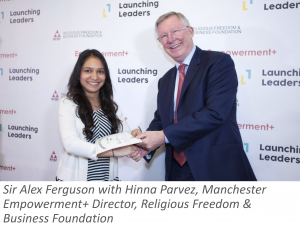
Empowerment+ is being piloted for global rollout at Manchester Universities’ Catholic Chaplaincy (UK) in collaboration with the al-Furqan Islamic Centre, The Church of Jesus Christ of Latter-Day Saints, and other faith partners.

Former Manchester United Manager Sir Alex Ferguson presented awards to the upcoming bright lights of religion and business on January 18, 2017. The worlds of football, religion and enterprise merged in a unique way for the graduation ceremony of the global interfaith pilot of the Launching Leaders course.


UN Special Rapporteur urges separation of religion and state

The UN Special Rapporteur in the field of cultural rights, Karima Bennoune, told the Human Rights Council in Geneva: “We face a global avalanche of hate in the form of rising fundamentalism and extremism around the world. This must be tackled with urgency, using a human rights approach. Culture and cultural rights are critical components of this response”.

The Special Rapporteur is deeply concerned at the normalization of fundamentalist and extremist ideology and rhetoric in many political, cultural and media contexts, in diverse forms and in all regions of the world, and the increasing embrace they find in mainstream political parties and candidates.

In her report to the UN Human Rights Council, the expert highlights how diverse fundamentalist and extremist ideologies have in common a mindset based on intolerance of differences and pluralism, and all attempt to stamp out cultural diversity and dissent.

She gives examples of cultural engineering aimed at redesigning culture based on monolithic world views, focused on “purity” and enmity toward “the other”; these include the policing of “honour” and “modesty”, claims of cultural and moral superiority and the imposition of what is hailed as “true religion” or “authentic culture”.

“These ideologies abuse cultural rights by stifling freedom of artistic expression and curtailing scientific freedom,” she said. “They impose ways of life, including through pressuring educational institutions, personnel and students, targeting minorities, promoting discrimination that infringes on the right to take part in cultural life, erasing symbols of coexistence, and undermining the universality of human rights”, she added.

“Universality is one of the most important tools in the struggle against the harmful effects of fundamentalism and extremism on cultural rights, and must be resolutely defended,” Ms. Bennoune said.

Emphasizing that the threat from fundamentalist and extremist ideologies was far-ranging, she said extremists also aimed to limit the enjoyment of women’s human rights, and restrict the sexual and reproductive rights of all.

Artists and intellectuals are often targeted, she said, both because creativity and expression are seen as a threat by fundamentalists and extremists and also because they often resist and offer alternatives.

The Special Rapporteur stressed that cultural rights are a critical counterweight to fundamentalism and extremism and called for more to be done to guarantee the conditions for all to fully enjoy them. “The arts, education, science and culture are among the best ways to fight fundamentalism and extremism and to prevent or stop the human rights violations to which they give rise. They are not luxuries, but critical for promoting inclusion, making space for peaceful contestation and protecting youth from radicalization,” Ms. Bennoune emphasized.

In her report, Ms. Bennoune called for policies to combat discrimination in the right to take part in cultural life or promote freedom of artistic expression, scientific freedom and education as core aspects of combating fundamentalism and extremism. She also called for policies to promote and protect the separation of religion and State, and ensure that those at risk from fundamentalist and extremist abuse, including as a result of exercising their cultural rights, were not returned to any contexts where they will be at risk of xenophobic attack. “It is a tragic spectacle to witness victims of one form of extremism becoming victims of another when they seek safe haven”.

“In particular,” she said, “we must listen to the local opponents of fundamentalism and extremism – civil society, human rights defenders, including women human rights defenders, educators and people who simply wish to participate in cultural life in their own way -, who have been resisting extremists in some cases for decades. They must be granted the necessary protection against the threat fundamentalist and extremist movements represent and should be included in strategic discussions at all relevant levels”.

In the report, the Special Rapporteur points to cases from all regions where fundamentalist and extremist ideology has motivated abuses of cultural rights by state and non-state actors; she condemns attacks on freedom of artistic expression in Russia, Saudi Arabia, India and Iran, and on intellectuals in Bangladesh. She is also concerned about extremists interfering with the right to take part in cultural life without discrimination such as post-election violence and threats in the United States, sometimes targeting educational and cultural institutions. She highlighted violence against minorities and their cultural sites whether recurring in parts of Europe, or widespread as in Myanmar, and possibly rising even to the level of genocide at the hands of “hyper-extremists” such as Daesh.

Ms. Bennoune said diverse forms of fundamentalism and extremism, though sometimes viewed as opponents, often actually reinforce each other. “One form of fundamentalism or extremism is not a justification for another. Each is a reinforcing reminder of the global humanist crisis that lies before us. We must break out of this vicious circle that will leave youth globally facing a political landscape offering only a bleak choice of competing extremisms”.

The Special Rapporteur called for effective, concerted global action to combat fundamentalism and extremism, and stressed that this must be done in accordance with international standards and not misused as a justification for violations of human rights. She said: “Whereas it is important to clearly condemn and act against violent forms of extremism, we must also tackle fundamentalist and extremist ideologies as these provide the basis for violence and violations. Extremist actors will not be truly disarmed unless their ideology is comprehensively challenged and repudiated,” she emphasized.


Key Parliamentary questions on Freedom of Religion or Belief

On 20 and 21 February Lord Alton of Liverpool asked the following two questions:

The Foreign and Commonwealth Office was asked what progress they have made in fulfilling their 2015 manifesto commitment to “Stand up for the freedom of people of all religions—and non-religious people—to practice their beliefs in peace and safety, for example by supporting persecuted Christians in the Middle East”.

Baroness Anelay replied “It is the Government’s policy to promote freedom of religion or belief in all parts of the world where it is challenged or undermined. We do this in many different ways. Through our bilateral work we continue to lobby host governments, to raise individual cases and highlight practices and laws that discriminate against people on the basis of their religion or belief.
Multilaterally, we work to sustain consensus on the adoption and implementation of two important Resolutions: the European Union’s resolution on ‘Freedom of Religion or Belief’ and the Organisation of Islamic Cooperation (OIC)’s resolution on ‘Combating Religious Intolerance’.

“We also support a number of projects through the Foreign and Commonwealth Office (FCO’s) Magna Carta Fund. For example, we continue to support a network of human rights defenders in South Asia.

“In October 2016, the FCO hosted a groundbreaking international conference to draw attention to the importance of freedom of religion or belief to global efforts to counter violent extremism. In the Middle East, our principal policy designed to prevent the persecution of religious minorities – including Christians – is our support for the international effort to defeat Daesh and return the region to stability and peace.”

The Department for International Development was asked what assessment they have made of the link between the protection of religious minority groups and alleviating global poverty.

On 2 March Lord Bates answered “A commitment to human rights underpins the four strategic objectives of the Government’s UK Aid Strategy, which include tackling extreme poverty and helping the world’s most vulnerable. Freedom of belief is one of a range of human rights that DFID considers through its Partnership Principles Assessments when providing financial support to governments.”

The Persecution of Ethnic and Religious Minorities in Iran

The All-Party Parliamentary Human Rights Group (PHRG) and the All-Party Parliamentary Group on Freedom of Religion or Belief held a panel event on “The Persecution of Ethnic and Religious Minorities in Iran”, on 27 February, with the following speakers:

  • Ahmed Shaheed (AS1), current UN Special Rapporteur on Freedom of Religion or Belief and former UN Special Rapporteur on the situation of human rights in Iran;
  • Mosa Zahed (MZ), Executive Director, Middle East Forum for Development (MEFD), and speaking on behalf of family of imprisoned Iranian spiritual teacher, Mohammad Ali Taheri;
  • Amir Saedi (AS2), Representative, Ahwaz Human Rights Organisation UK (UK branch of international human rights advocacy organisation for the Ahwazi Arabs and other ethnic and religious minorities in Iran);
  • NC (NC), Director of Operations, Middle East Concern (MEC) – which promotes freedom of religion for Christians in the Middle East and North Africa;
  • Paulo Casaca (PC), Executive Director, Alliance to Renew Co-operation among Humankind.

The APPGs would like to thank the MEFD for their assistance in organising this event.

The main points raised were as follows:

  • Iran is a nightmare for minorities because there is no intention to treat everyone fairly; anyone who does not conform to the official state religion can be discriminated against, persecuted and even prosecuted for the national security crime of being “anti-system”. (AS1)
  • As well as discrimination, there is considerable economic marginalisation of minority communities.  The provision of all instruction in Persian also undermines equality, and has resulted in a high drop-out rate of students from ethnic minorities. (AS1)
  • The issue of minorities can be a sensitive one, not only in Iran, and result in accusations of generating social discord and promoting territorial disintegration. (AS1)
  • No matter who is power in Iran following the Presidential election, it is important to continue to engage with Iran; engagement can produce positive results.  An issue that should be highlighted is impunity. (AS1)
  • Taheri, detained since 2011 for establishing an alternative spiritual doctrine and group, remains in prison although his sentence was completed in February 2016.  His family is calling for his immediate and unconditional release and has asked the UK Government to do so also.  It is believed Iranian authorities were trying to charge him with other offences to keep him in prison.  To get Mr. Taheri to end his latest hunger strike, the authorities said his case would be reviewed and a hearing was due to be held today. (MZ)
  • The EU has made representations to the Iranian authorities about the case and stressed the need for necessary medical care to be provided to Mr. Taheri. The MEFD has called on the UK Government to ensure that the deepening of relations with Iran are contingent on an improvement in the human rights situation. (MZ)
  • Iran is the most diverse country in the region, with six major nationalities and no one group having a numerical majority, yet the Persian language is the official language and Jafari Shia the main official religion. (AS2)
  • Arabs in Iran, many of whom reside in Khuzestan province in the southwest of Iran where much of the oil wealth is located, are among the most oppressed minorities and subjected to racism because of historical animosities.  They have no involvement in running their local affairs. The illiteracy rate of Ahwazi Arabs is four times the national average, and unemployment six times the national average.  More generally, the regime changes the local demographics to the detriment of Arabs, by forcefully moving Arabs out and moving non-Arabs into the province. (AS2)
  • Christian churches in Iran are monitored, and Persian speakers not allowed, only Assyrians and Armenians.  Churches have been closed and church property seized.  House church leaders are harassed and can be arrested; Christian converts are persecuted. The right under international law to hold a religious belief should not be subject to restrictions, and the international community should help ensure Iranian authorities respect that. (NC)
  • The anti-drugs policy in Iran is an absolute fraud; it serves to contribute to massive human rights violations and increase the power of the Revolutionary Guards.  Much of the anti-drugs policy is focused on small-scale drug smuggling, which impacts on minority communities as many live near border areas.  All Parliaments should ask for detailed accountability for funds provided by the UN Office on Drugs and Crimes (UNODC) to Iran. (PC)
  • One of those in attendance expressed concerns about reports that relevant Iranian authorities have ordered Sunni prisoners convicted of drug smuggling to be executed as soon as possible so the latter do not benefit from a Parliamentary bill proposing the elimination of the death penalty for prisoners convicted of drug-related offenses.
  • Another person in attendance called on the UK Government to engage more robustly with Iran on human rights issues, particularly given that thousands of lives in Iran had been shattered as a result of the violations committed by the Iranian regime.

The PHRG will continue working with minority groups in Iran, to bring them together to raise greater awareness of their plight, and to raise related matters with relevant interlocutors, such as Iranian authorities and the UK Government.

China: government controls over religion have intensified

The Battle for China’s Spirit: Religious Revival, Repression, and Resistance under Xi Jinping is a new report from Freedom House.

The Chinese government’s controls over religion have intensified under Xi Jinping, seeping into new areas of daily life and triggering growing resistance from believers, according to the report.

“Many spiritual activities practiced freely around the world—from fasting during Ramadan to praying with one’s children or performing Falun Gong meditation exercises—are restricted and can be harshly punished in China,” said Sarah Cook, a senior research analyst at Freedom House and the report’s author. “The scale and severity of controls over religion, and the trajectory of both growing persecution and pushback, are affecting Chinese society and politics far beyond the realm of religious policy alone.”

The Battle for China’s Spirit examines the evolution of the Communist Party’s policies of religious control and citizens’ responses to them since November 2012, in the first comprehensive analysis of its kind. It focuses on seven major religious groups that together account for over 350 million believers: Chinese Buddhism, Taoism, Catholicism, Protestantism, Islam, Tibetan Buddhism, and Falun Gong.

“The party’s rigid constraints render it impossible for state-sanctioned institutions to meet the growing demand for religion in Chinese society,” Cook said. “The result is an enormous black market, forcing many believers—from Taoists and Protestants to Tibetan Buddhists—to operate outside the law and to view the regime as unreasonable, unjust, or illegitimate.”

Religious controls have taken different forms for different localities, ethnicities, and denominations. In many parts of China, ordinary believers do not necessarily feel constrained in their ability to practice their faith. Others face bureaucratic obstacles, mandatory political “reeducation,” or economic exploitation.

But authorities also regularly deploy harsh penalties, long prison terms, and deadly violence against certain communities. At least 100 million people—nearly one-third of estimated believers in China—belong to religious groups facing “high” or “very high” levels of persecution.

Under Xi, many persecutory policies have expanded and evolved. A more restrictive legal environment has been put in place. Repression has expanded to target more state-registered congregations and leaders. And the government has adapted religious controls to a new technological landscape, increasing electronic surveillance at places of worship and imprisoning believers for sharing content on social media platforms or using tools to circumvent internet censorship.

“Despite tightening controls, millions of religious believers defy official restrictions in daily life. Indeed, the survival of groups and beliefs that the party has invested tremendous resources to crush represents a remarkable failure of the government’s repression,” Cook said. “It reflects the party’s difficulty in confronting citizens who are willing to make sacrifices for higher principles. From this perspective, it would appear that in the long-term battle for China’s spirit, an unreformed Communist Party will ultimately lose.”

Key findings by religious community

  • Chinese Buddhism and Taoism: President Xi and other officials portray Chinese Buddhism and Taoism as increasingly important for realizing the party’s political goals at home and abroad, including building regime legitimacy on the basis of traditional Chinese culture. Despite such support and an environment of relatively low persecution, economic exploitation of temples for tourism purposes has emerged as a key point of contention among the state, clergy, and lay believers.
  • Christianity: Since early 2014, local authorities have intensified efforts to stem the spread of Christianity amid official rhetoric about the threat of “Western” values and the need to “Sinicize” religions. Persecution of Protestants—at both unofficial and state-sanctioned churches—has especially increased, while warming relations between Beijing and the Vatican has led some Catholics to be optimistic about the faith’s future trajectory in China.
  • Islam: Chinese government treatment of Muslims differs significantly across ethnic and geographic lines, but both Hui and Uighur Muslims have experienced increased restrictions and Islamophobia since November 2012. Controls on religion have deepened and expanded in the Xinjiang Uighur Autonomous Region in particular, including regarding religious dress, children’s education, and forced selling of alcohol.
  • Tibetan Buddhism: The Chinese authorities impose severe constraints on the religious practice of Tibetan Buddhists, most notably veneration of the exiled Dalai Lama. New measures imposed since November 2012 include punishing assistance to self-immolators, canceling previously permitted festivals, increasing restrictions on private religious practice, and more proactively manipulating Tibetan Buddhist doctrine and selection of religious leaders.
  • Falun Gong: Falun Gong practitioners continue to be subject to widespread and severe human rights violations. Freedom House independently verified 933 cases of Falun Gong adherents sentenced to prison terms of up to 12 years since January 2013. Nevertheless, the purge of key party officials as part of Xi’s anticorruption campaign and Falun Gong outreach to local police have led to reduced repression in some locales.

View the report online herehttps://freedomhouse.org/report/china-religious-freedom 

Freedom House is an independent watchdog organization that supports democratic change, monitors the status of freedom around the world, and advocates for democracy and human rights.

Pakistan: IS claims attack on Sufi shrine

The attack was the country’s deadliest in years: a suicide bomber detonated a bomb among crowds gathered for the busiest day of the week at the shrine to Sufi saint Lal Shahbaz Qalandar in Sehwan, a town in the southern Sindh province.

Amaq, a news agency affiliated to Isis, claimed the jihadi group had carried out Thursday’s attack. It was the latest such attack on devotees of Sufism, a mystical and generally moderate form of Islam despised by radical fundamentalists.

“The explosion took place when a large number of people were inside the shrine boundary,” a local police officer said. “A huge number of people come to the shrine every Thursday to take part in ritual dances and prayers. It is not possible to ensure the security of every person coming and going.”

Sughra Bibi, a 45-year-old woman taken to hospital with shrapnel wounds to her stomach, said she was near the front of the crowd watching the devotional dancing when the explosion occurred. “The terrorists are targeting us just because they hate our shrines,” she said. “They attacked another shrine a couple of months ago. But we will never give up our faith.”

Tanveer Ali, a local man whose wife and son were injured, said those responsible had sinned against Islam by targeting civilians. “The terrorists will have to answer for this on the day of judgment,” he said.

Another witness, Raja Somro, inside the shrine at the time of the attack, told a local television network that hundreds of people were performing their spiritual dance called dhamal when the attacker struck at the shrine. “I saw bodies everywhere. I saw bodies of women and children,” he said. Local television channels aired footage of worshippers crying for help after the blast.

On Friday authorities raised the death toll to 88 after some of the critically wounded died. The Sindh provincial health department said a total of 343 people were wounded in the attack. Most were discharged after treatment but 76 are still in hospital, the department said.

Read The Guardian article in full

Read the New York Times article

INDIA: Report Examines Legal Restrictions Religious Minorities Face

Cover of India ReportA new report, Constitutional and Legal Challenges Faced by Religious Minorities in India, examines India’s constitution and national and state laws that violate the religious freedom of both minority communities and Hindu Dalits.

The U.S. Commission on International Religious Freedom (USCIRF) sponsored this report, which Dr. Iqtidar Karamat Cheema wrote. Dr. Cheema is the Director of the Institute for Leadership and Community Development, based in England.

India is a religiously diverse and democratic society with a constitution that provides legal equality for its citizens irrespective of their religion and prohibits religion-based discrimination,” said USCIRF Chair Thomas J. Reese, S.J. “However, the reality is far different.  In fact, India’s pluralistic tradition faces serious challenges in a number of its states.  During the past few years, religious tolerance has deteriorated and religious freedom violations have increased in some areas of India. To reverse this negative trajectory, the Indian and state governments must align theirs laws with both the country’s constitutional commitments and international human rights standards.

The study highlights opportunities for the Indian government to revise laws so that they would align with the country’s constitution and international human rights standards. The study also makes recommendations to the U.S. government on ways to promote religious freedom in India.

FoRB comment on Trump’s travel ban and refugee priorities

Links to some of the online comments following President Trump’s statements and actions on refugees and immigration:

  • Trump’s statement about giving Christians facing persecution priority as refugees (in TV interview last Friday) More
  • What Arab Church Leaders Think of Trump Prioritizing Persecuted Christian Refugees More
  • Evangelical Christian leaders: travel ban violates religious beliefs on refugees More
  • Iraqi patriarch: Fast track for Christian refugees will fuel tensions More
  • Trump travel ban leaves Iraq’s persecuted Yazidis in limbo More
  • Religious freedom is the greatest global weapon against terrorism More
  • Christian Leaders Denounce Trump’s Plan to Favor Christian Refugees More
  • Trump Halts Program to Bring Jewish, Christian, Baha’i Refugees from Iran More
  • Trump’s pledge to persecuted Christians – welcome news or harmful to those it seeks to protect? More

The order prioritizes Christian refugees

Upon the resumption of USRAP admissions, the Secretary of State, in consultation with the Secretary of Homeland Security, is further directed to make changes, to the extent permitted by law, to prioritize refugee claims made by individuals on the basis of religious-based persecution, provided that the religion of the individual is a minority religion in the individual’s country of nationality.

As a general matter, this will give priority to Christian refugees over Muslim ones. Although framed in a neutral way, this part of the order may raise questions of religion-based discrimination. Trump has said he means to favor Christian refugees.

That violates the First Amendment’s ban on government establishment of religion, according to David Cole, legal director of the American Civil Liberties Union. “One of the critical questions with respect to the validity of executive action challenged under the Establishment Clause is its intent and effect,” he wrote in a blog post. “If intended to disfavor a particular religion, it violates the Establishment Clause.”

[New York Times]

Pakistan acquits 112 in blasphemy rumour case

Reuters reports that a Pakistani court has acquitted 112 suspects in the 2013 torching of hundreds of Christian homes in the eastern city of Lahore over a rumour that one of the residents there had blasphemed.

In March 2013, more than 125 homes in Lahore’s Josep Colony were burned by a mob of more than 3,000 Muslims responding to rumours that a local Christian man, Sawan Masih, had made derogatory remarks about the Prophet Mohammad.

No one was killed in the incident but there was widespread damage to the property of the mostly destitute Christians living in the neighbourhood. Two churches and dozens of Bibles were also desecrated in the attack.

Defence lawyer Ghulam Murtaza Chaudhry said an anti-terrorism court in Lahore had acquitted 112 people accused of torching and ransacking hundreds of houses.

“They were acquitted by the court because of lack of evidences against them,” Murtaza told Reuters. “The state witnesses could not identify the accused and their statements were also contradictory.”

All 112 suspects were already out on bail.

A road sweeper in his late twenties, Sawan Masih told police after his arrest on blasphemy charges that the real reason for the blasphemy allegation was a property dispute between him and a friend who spread the rumour.

In Pakistan, conviction under the blasphemy laws can carry a mandatory death sentence.

Masih was sentenced to death in 2014, a decision he has appealed.

Critics of Pakistan’s blasphemy laws say they have long been used by individuals and religious groups to settle disputes.

This month, the Pakistani Senate’s human rights panel said it would debate how to prevent the country’s blasphemy laws being applied unfairly, the first time in decades that any parliamentary body had considered a formal proposal to stop the abuse of the blasphemy laws.

Many conservatives in Pakistan consider even criticising the laws as blasphemy, and in 2011 a Pakistani governor, Salman Taseer, was assassinated by his bodyguard after calling for reform of the laws.

Hundreds of Pakistanis are on death row for blasphemy convictions.

(Reuters reporting by Mubasher Bukhari; writing by Mehreen Zahra-Malik; Editing by Stephen Powell)